
You Reach for the Bottle. Your Korean Friend Stops You.
Imagine your first dinner in Korea.
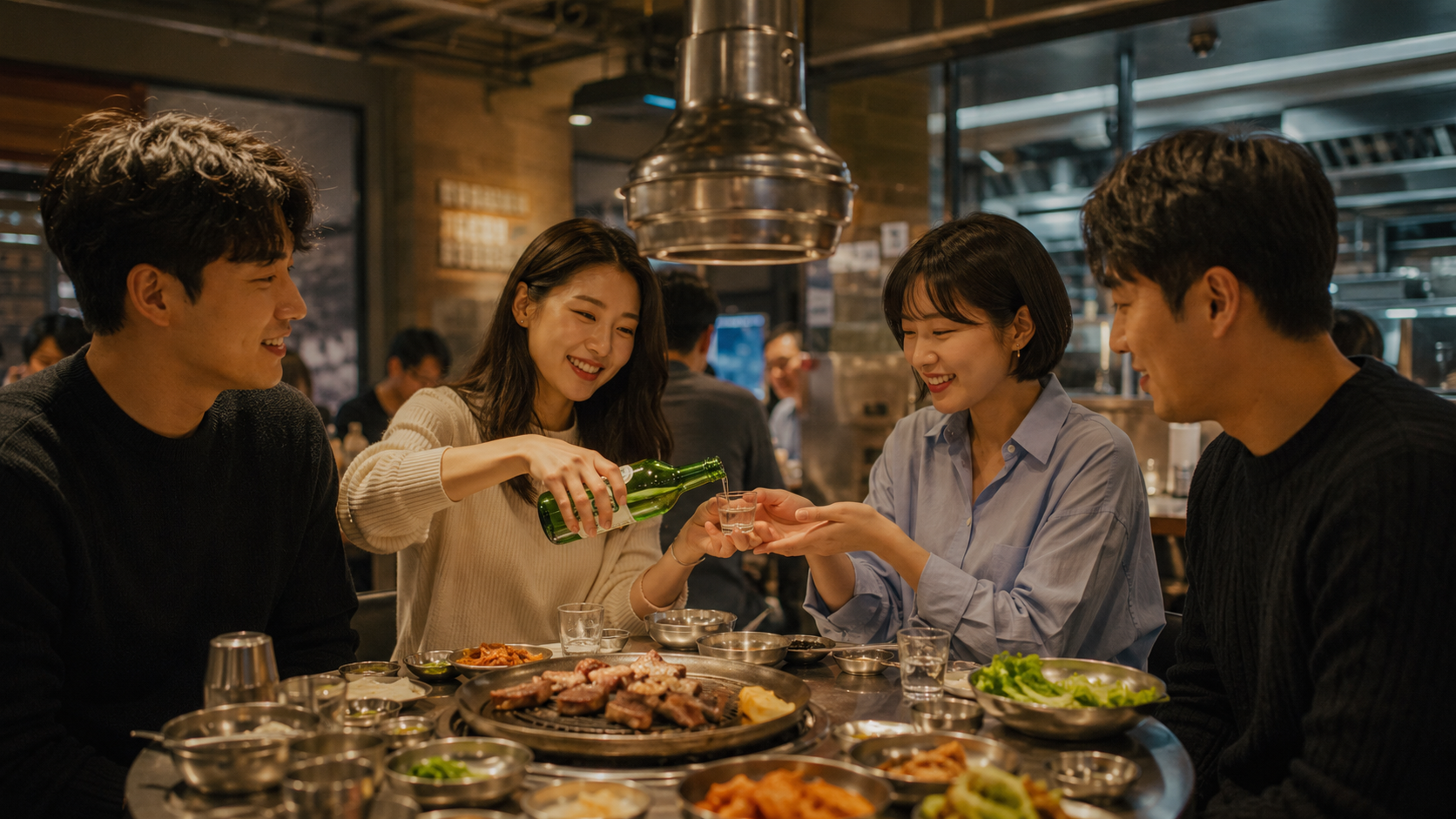
The table is full of grilled meat, kimchi, steaming stew, and small green bottles of soju.
Your glass is empty.
Naturally, you reach for the bottle and begin to refill it yourself.
But the person sitting next to you suddenly says:
“제가 따라 드릴게요.”
Je-ga tta-ra deu-ril-ge-yo.
“Let me pour it for you.”
A few minutes later, their glass becomes empty.
Now you realize what you are supposed to do.
You pick up the bottle.
They hold out their glass.
You pour.
That small exchange reveals something surprisingly important about Korean drinking culture.
The drink is yours.
But pouring it can be about the other person.
In traditional Korean drinking etiquette, people often pour drinks for one another, especially when age, seniority, hospitality, or formality matters. Historical Korean drinking customs also used drinking gatherings as settings for teaching manners and expressing respect toward elders.
So when someone pours you a glass of soju, they may be doing more than simply moving alcohol from a bottle into a cup.
They are acknowledging the person sitting across from them.
First: Do Koreans Never Pour Their Own Drinks?
No.
This is one of the easiest Korean drinking customs to exaggerate.
There is no magical rule that a Korean person can never pour their own drink.
At a casual dinner with close friends, people may behave very informally.
But in more traditional or formal situations, especially when older people, senior colleagues, hosts, or new acquaintances are present, pouring for someone else is an important gesture of courtesy.
The easiest way for an international visitor to think about it is this:
Don’t treat Korean drinking etiquette as a set of absolute laws. Think of it as a language of respect.
The more formal the relationship becomes, the more visible that language can become.
Why Pour for Someone Else?
In many Western drinking situations, the glass can feel primarily individual.
You want more wine?
You pour some.
Your beer is empty?
You order another.
Korean drinking traditions historically placed more emphasis on the exchange.
One person offers.
Another receives.
Later, the gesture is returned.
That turns drinking into a social interaction.
The bottle physically moves around the table.
People notice whose glass is empty.
Someone reaches across and pours.
Another person responds with thanks.
Even before the conversation begins, people are paying attention to each other.
That is why Korean drinking etiquette can sometimes feel almost ceremonial to first-time visitors.
The Most Important Rule: Watch the Hands
If there is one practical detail international visitors should remember, it is:
Two hands show respect.
When pouring a drink for an older person or someone you wish to treat respectfully, a traditional polite gesture is to hold the bottle with your right hand while supporting your wrist or forearm with your left hand.
You can also hold the bottle more clearly with both hands.
When receiving a drink from an elder or senior person, holding the glass with both hands is another familiar sign of respect. Korea.net’s guide to traditional drinking manners specifically describes younger people receiving a drink offered by an elder with two hands and expressing gratitude.
The exact hand position is less important than the message:
“I am giving this moment my attention.”
Why Does the Second Hand Matter?
This gesture appears far beyond drinking.
In Korea, you may see people use two hands when:
giving a gift,
receiving money,
handing over an important document,
exchanging business cards,
or offering something to an elder.
So the drinking custom is part of a much larger Korean etiquette pattern.
One hand performs the action.
The other reinforces respect.
For international visitors, this creates a useful shortcut.
If you are unsure whether a situation is formal:
Use both hands.
It is usually safer to be slightly more respectful than slightly too casual.
Then Comes the Famous Head Turn
Another scene appears constantly in Korean dramas.
A younger person receives a shot of soju.
Instead of drinking while facing the older person directly, they turn slightly to the side.
Sometimes one hand even partially covers the glass.
Why?
Traditionally, turning away while drinking in front of an elder is considered a gesture of respect. Korea.net describes the custom as part of Korean etiquette toward older people.
To someone unfamiliar with the custom, this can look strange.
You might think:
“Why are they hiding?”
They are not.
The gesture communicates:
“I recognize the difference in age or status between us.”
Again, this is most noticeable when hierarchy or formality matters.
You do not need to dramatically turn your entire body every time you drink with a Korean friend.
Age Changes the Table
To understand this etiquette, you need to understand something broader about Korean social relationships.
Relative age has traditionally influenced how Koreans:
speak,
address each other,
choose honorifics,
and behave in certain social settings.
Drinking is one of the places where these differences become physically visible.
An older person pours.
A younger person receives with two hands.
The younger person turns slightly away to drink.
Later, the younger person carefully pours for the senior.
The interaction contains no written rules.
Yet everyone at the table may understand what the gestures mean.
That is why Korean drinking culture can be interesting even for someone who does not drink.
It makes social relationships visible.
Hidden Story: Drinking Was Once Used to Teach Manners
Korean drinking etiquette is not merely something invented by modern office workers.
Historical drinking rituals could serve educational and social purposes.
Korea.net describes hyangeumjurye (향음주례), community drinking ceremonies influenced by Confucian values in which elders and respected members of a community gathered according to prescribed roles. Such gatherings taught drinking manners while reinforcing respect for wisdom, age, and social order.
In other words:
Drinking could be a lesson in how to behave toward other people.
That historical background helps explain why Korean alcohol etiquette sometimes looks more structured than simply:
“Everybody grab a drink.”
The beverage mattered.
But so did the relationship between the people drinking it.
Why Koreans Watch Each Other’s Empty Glasses
At a Korean dinner, you might notice someone glance at your glass.
Not because they are checking how much you drank.
They may be deciding whether they should offer you another pour.
That attention can be a form of hospitality.
The host notices.
The senior notices.
The friend notices.
Someone pours.
You respond.
Then later, you notice their glass.
The exchange continues.
This creates an interesting cultural contrast.
Rather than thinking:
“My glass is empty.”
the table encourages you to notice:
“Their glass is empty.”
That small shift—from yourself toward the other person—is one reason the custom feels socially meaningful.
But You Do Not Have to Keep Drinking
This point is particularly important for international travelers.
Understanding Korean drinking etiquette does not mean you must drink alcohol or continue drinking beyond what you want.
You can participate in the social moment without matching everyone drink for drink.
Modern Korean drinking culture is also changing. South Korea’s Ministry of Culture, Sports and Tourism has noted a broader movement toward more mindful consumption, moderation, quality, and milder drinking experiences, alongside the growth of premium traditional alcohol and creative lower-intensity drinking styles.
So cultural respect should never be confused with pressure to consume more alcohol.
A polite:
“괜찮습니다.”
Gwaen-chan-seum-ni-da.
— “I’m okay, thank you.”
can be enough.
What If You Don’t Drink Alcohol?
You can still participate in the dinner.
Korean social dining is bigger than soju.
Raise your water.
Enjoy a soft drink.
Eat the food.
Join the toast.
Talk with everyone.
The relationship is the important part.
If you want to say that you do not drink alcohol:
술을 안 마셔요.
Su-reul an ma-syeo-yo.
“I don’t drink alcohol.”
Or more politely:
저는 술을 잘 못 마셔요.
Jeo-neun su-reul jal mot ma-syeo-yo.
Literally:
“I’m not very good at drinking.”
This is a commonly useful way to communicate that you do not want much alcohol without turning the moment into a long explanation.
What About “Geonbae”?
Eventually, somebody lifts a glass.
Then comes:
건배! — Geonbae!
It means:
“Cheers!”
Everyone brings their glasses together.
And suddenly an individual drink becomes a group moment.
This is another reason Korean drinking culture fits the larger pattern.
Pouring happens between two people.
A toast connects the entire table.
The meal continues.
Conversation becomes easier.
Another dish arrives.
And the drinking ritual becomes part of the social architecture of the dinner.
Soju Is Only Part of the Story
International visitors often associate Korean drinking entirely with the famous green soju bottle.
Soju is certainly central to Korea’s modern popular drinking image.
But Korea also has a much wider alcohol culture.
There is:
막걸리 — makgeolli
청주 — cheongju
traditional distilled soju,
regional liquors,
beer,
highballs,
and increasingly premium modern interpretations of traditional drinks.
The Korean government has highlighted the global expansion of K-alcohol through premium soju, reinvented makgeolli, highballs, and other products, noting that interest increasingly centers on flavor, craftsmanship, and cultural heritage rather than intoxication alone.
That means the meaning of Korean drinking culture is changing even while some of its old gestures remain recognizable.
From Hoesik to a More Flexible Drinking Culture
One place foreigners often encounter Korean drinking etiquette is:
회식 — Hoesik
A company dinner.
Traditionally, eating and drinking together after work could play an important role in workplace bonding. VISITKOREA still presents company dinners as a recognizable part of Korean office culture, with dishes such as samgyeopsal commonly paired with soju and later rounds extending the evening’s conversation.
But Korean drinking culture should not be frozen in an image from an old drama.
Today’s drinking experiences can range from:
traditional soju dinners,
to craft makgeolli bars,
to highballs,
to quiet meals with a single drink,
to alcohol-free gatherings.
MCST describes the broader direction as increasingly favoring moderation, creativity, and quality.
The etiquette survives.
But the environment around it continues to change.
Business Insight: Korean Alcohol Is Becoming Cultural IP
There is also a fascinating business story here.
For decades, soju was primarily understood internationally as a Korean alcoholic beverage.
Now it increasingly functions as:
a cultural symbol.
International audiences see soju in dramas.
K-pop artists mention Korean drinking games.
Travelers want to try green-bottle soju with Korean barbecue.
Makgeolli appears in modern bars.
Premium traditional liquors become gifts.
The Ministry of Culture, Sports and Tourism has explicitly linked Korean alcohol’s growing global visibility to the broader Korean Wave, while highlighting premiumization, collaborations, creative flavors, and social-media exposure as important parts of that expansion.
This creates an interesting shift.
Korea is no longer exporting only:
the drink.
It is increasingly exporting:
the story around the drink.
And etiquette—pouring, receiving, toasting, eating together—is part of that story.
Did You Know?
Pouring Your Own Drink Is Not “Forbidden”
You may encounter online guides claiming:
“Never pour your own drink in Korea.”
That is too absolute.
Korean drinking etiquette depends heavily on:
age,
relationship,
setting,
and level of formality.
With close friends, the atmosphere can be very casual.
With an elder, senior colleague, business contact, or someone you have just met, traditional gestures may become much more noticeable.
So remember the principle rather than obsessing over rules:
Notice other people.
If someone’s glass is empty, you can offer.
If someone pours for you, receive politely.
If you’re unsure, use two hands.
That will take you surprisingly far.
Naru’s Travel Tips
If you are having drinks with Koreans for the first time, don’t panic about memorizing every rule.
Remember three ideas:
First: When pouring for an elder or someone in a formal relationship, use both hands or support your pouring arm.
Second: When receiving a drink respectfully, hold the glass with both hands.
Third: If everyone around you is behaving casually, you do not need to turn dinner into a Confucian ceremony.
Observe the table.
Follow the tone.
And never feel obligated to drink more alcohol than you want.
The purpose of learning etiquette is to understand people—not to pass an exam.
Learn 5 Korean Words
| English | Korean | Pronunciation | Chinese | Spanish |
|---|---|---|---|---|
| Alcohol | 술 | sul | 酒 | Alcohol |
| Glass / cup | 잔 | jan | 杯子 | Copa |
| Pour | 따르다 | tta-reu-da | 倒 | Servir |
| Cheers | 건배 | geon-bae | 干杯 | Salud |
| Company dinner | 회식 | hoe-sik | 聚餐 | Cena de empresa |
Bonus Word
술자리 — sul-ja-ri
Literally:
“a drinking place/occasion.”
It means a social gathering where people drink together.
But the word is often about much more than alcohol.
A suljari can be where people talk, celebrate, reconnect, or get to know each other.
제가 따라 드릴게요.
Pronunciation: Je-ga tta-ra deu-ril-ge-yo.
English: Let me pour you a drink.
Chinese: 我来给您倒酒吧。
Spanish: Déjeme servirle una bebida.
If someone pours for you, you can simply say:
감사합니다.
Gam-sa-ham-ni-da.
Thank you.
Today’s Question
In your culture, do people usually pour their own drinks or pour for each other?
And does the way you pour or receive a drink change depending on someone’s age or status?
Tell us in the comments.
Naru’s Quote
“At a Korean table, an empty glass can remind you to look at the person beside you before looking at yourself.” — Naru
SEO FAQ
Why do Koreans pour drinks for each other?
Pouring for others has traditionally functioned as a gesture of hospitality, attention, and respect, particularly when age or seniority matters. Historical Korean drinking ceremonies also incorporated formal drinking manners and respect for elders.
Do Koreans pour their own soju?
They can. The idea that Koreans absolutely never pour their own alcohol is an oversimplification. Etiquette becomes more important in formal or hierarchical settings, while close friends may drink much more casually.
Why do Koreans pour soju with two hands?
Using both hands—or supporting the pouring arm with the other hand—is traditionally associated with showing respect. Receiving a drink from an elder with two hands is also a documented Korean drinking custom.
Why do Koreans turn their heads when drinking?
When drinking in front of an elder or senior person, younger Koreans may traditionally turn slightly away as a respectful gesture.
What does “geonbae” mean?
건배 (geonbae) means “Cheers!” and is used when making a toast.
Do I have to drink soju in Korea?
No. Understanding drinking etiquette does not require drinking alcohol. Modern Korean drinking culture is also becoming more diverse, with greater attention to moderation and lighter drinking experiences.
What is a Korean hoesik?
회식 (hoesik) is a company or team meal, traditionally associated with eating, conversation, and sometimes alcohol after work. It remains a recognizable part of Korean workplace culture, although styles of workplace socializing continue to vary and evolve.

Part 3 — The Bottle Is Small, but the Relationship Is Visible
At first, Korean drinking etiquette can look complicated.
Which hand?
Who pours first?
Do I turn my head?
Do I wait?
But focusing only on the rules misses the most interesting part.
The deeper pattern is simple.
People are watching one another.
Your glass becomes empty.
Someone notices.
They pour.
Their glass becomes empty.
You notice.
You return the gesture.
The bottle moves between people.
And a drink that could have been individual becomes relational.
That idea appears in many parts of Korean culture.
Food is shared.
Side dishes sit in the center.
Respect is expressed through speech levels.
Gifts may be offered with two hands.
And even pouring a small glass of soju can communicate:
“I see you.”
Of course, Korea is changing.
People drink differently.
Younger generations may be more casual.
Premium alcohol, highballs, craft drinks, and moderate consumption are reshaping what a Korean night out can look like.
But the older gesture remains easy to recognize.
One person lifts the bottle.
The other lifts the glass with both hands.
For a few seconds, everyone knows exactly what that gesture means.
Sometimes understanding Korea begins with something that small.
한국인은 왜 서로 술을 따라줄까?
한국에서 술자리를 처음 경험한 외국인은 흥미로운 장면을 발견할 수 있습니다.
자신의 잔이 비었는데 직접 술을 따르는 대신 옆 사람이 술병을 들어 잔을 채워주는 모습입니다.
특히 연장자나 직장 선배처럼 예의를 갖춰야 하는 상대에게 술을 따르거나 받을 때는 두 손을 사용하는 모습도 볼 수 있습니다.
이것은 단순히 술을 마시는 방법이 아닙니다.
한국의 전통적인 술자리에서 술을 주고받는 행위는 상대방에 대한 관심과 예의를 표현하는 방식이었습니다. 역사적으로 향음주례 같은 음주 의례에서도 술자리 예절과 어른에 대한 존중이 중요한 요소였습니다.
그래서 한국의 술자리에서는 자신의 잔뿐 아니라 다른 사람의 잔을 살피는 모습을 볼 수 있습니다.
상대방의 잔이 비면 술을 따라주고,
상대방도 나중에 자신의 잔을 채워줍니다.
이 과정에서 술은 개인적인 음료가 아니라 사람과 사람 사이의 작은 교류가 됩니다.
또한 연장자 앞에서 술을 마실 때 고개를 약간 옆으로 돌리는 전통적인 예절도 있습니다.
하지만 모든 한국인이 항상 이런 규칙을 엄격하게 지키는 것은 아닙니다.
친한 친구들 사이에서는 훨씬 편하게 술을 마실 수 있고, 최근 한국의 음주 문화 역시 과음보다 적당한 음주와 맛, 품질을 즐기는 방향으로 변화하고 있습니다.
따라서 외국인이 한국 술자리에서 모든 규칙을 외울 필요는 없습니다.
가장 중요한 것은 상대방과 상황을 살피는 것입니다.
잘 모르겠다면 두 손으로 술을 받고,
상대방의 빈 잔을 보면 술을 따라줄지 물어보고,
마시고 싶지 않을 때는 정중하게 거절하면 됩니다.
한국에서 술을 따라주는 행동은 단순히 빈 잔을 채우는 것이 아닐 수 있습니다.
어쩌면 이렇게 말하는 작은 방식일지도 모릅니다.
“당신을 신경 쓰고 있습니다.”
为什么韩国人喜欢互相倒酒?
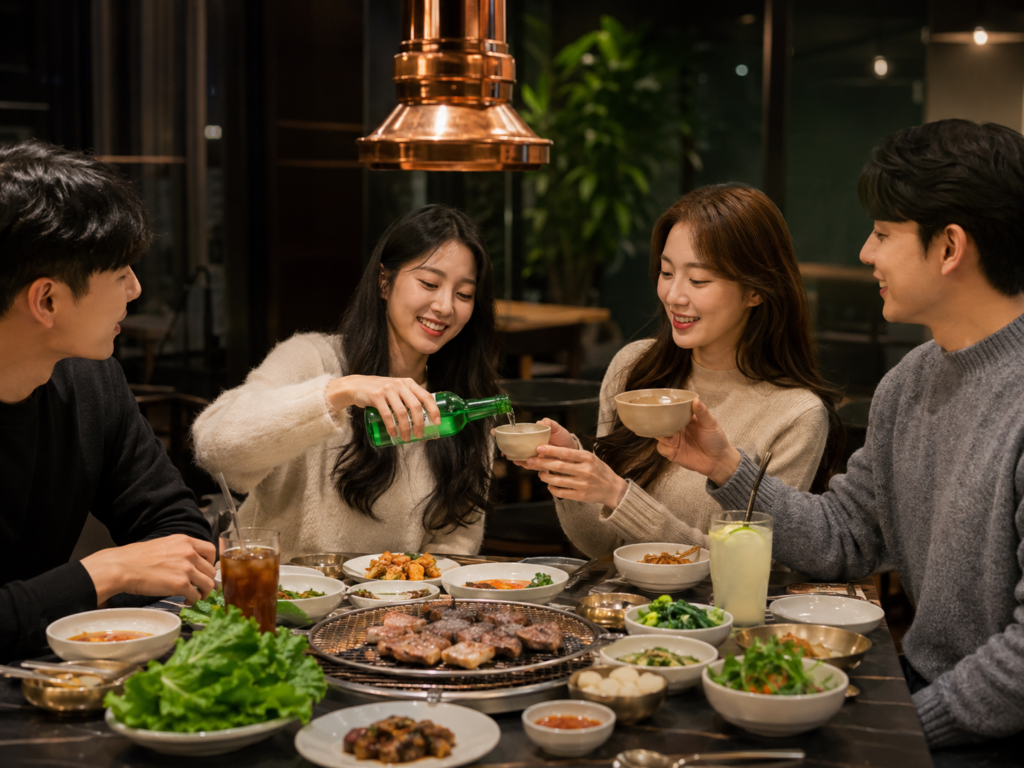
第一次参加韩国聚餐时,你可能会发现一个有趣的现象。
自己的酒杯空了,人们却不一定马上给自己倒酒。
旁边的人可能先拿起酒瓶,为你把酒杯倒满。
而当对方的酒杯空了以后,你也可以为他倒酒。
在比较正式的场合,特别是面对长辈或职位较高的人时,韩国传统礼仪往往强调使用双手倒酒或接酒。韩国官方文化资料也介绍了年轻人从长辈手中接酒时使用双手表达尊重的传统。
有时,年轻人在长辈面前喝酒时还会稍微转过头。
这也是一种传统的尊敬表达方式。
为什么会有这么多动作?
因为韩国传统酒文化中的重点不仅仅是:
“我想喝酒。”
还包括:
“我正在和谁一起喝酒?”
倒酒、接酒、碰杯都可以成为人与人之间表达关系的小动作。
不过,这并不意味着所有韩国人都严格遵守完全相同的规则。
朋友之间的聚会可能非常随意,而且现代韩国的饮酒文化也越来越重视适量、品质和更轻松的饮酒体验。
所以,如果你第一次参加韩国酒局,不需要太紧张。
记住一个简单的方法:
正式场合不确定时,用双手。
观察别人怎么做,然后自然地跟着就可以了。
🇪🇸 Español
¿Por qué los coreanos se sirven bebidas unos a otros?
Durante una cena en Corea puede ocurrir algo curioso.
Tu vaso está vacío.
Intentas tomar la botella para servirte.
Pero la persona que está a tu lado se adelanta y llena tu vaso.
Más tarde, cuando su vaso queda vacío, tú puedes devolverle el gesto.
En la etiqueta tradicional coreana, servir y recibir una bebida puede expresar atención y respeto, especialmente cuando existe una diferencia de edad o jerarquía.
Al recibir una bebida de una persona mayor, utilizar ambas manos es una costumbre tradicional de respeto descrita en fuentes culturales oficiales coreanas.
También existe la costumbre de girar ligeramente la cabeza al beber frente a una persona mayor.
Sin embargo, estas costumbres no deben entenderse como reglas absolutas.
Entre amigos cercanos, el ambiente puede ser mucho más informal.
Además, la cultura contemporánea de bebidas en Corea está evolucionando hacia experiencias que valoran más la moderación, el sabor y la calidad.
Por eso, un visitante no necesita memorizar todas las reglas.
Hay una idea mucho más sencilla:
Presta atención a las otras personas.
Si no estás seguro en una situación formal, utiliza las dos manos.
Si alguien te sirve una bebida, da las gracias.
Y si no quieres beber más, puedes decirlo.
Al final, la costumbre no trata solamente del alcohol.
Trata de las personas alrededor de la mesa.