Korea Has a National Holiday for Its Alphabet
October 9 is Hangeul Day (한글날) in South Korea.
That may sound unusual.
Most national holidays celebrate independence, religion, war, harvests, or famous historical figures.
Korea celebrates something else:
its writing system.
And in 2026, the occasion is especially meaningful.
This year marks both the 580th anniversary of the promulgation of Hunminjeongeum in 1446 and the 100th anniversary of the establishment of Hangeul Day celebrations in 1926. The Korean government is marking the centennial with Hangeul Week events held nationwide from October 6–17 under the theme “Hangeul by My Side.” Korea.net
But why does an alphabet deserve an entire national holiday?
To understand that, we need to go back almost 600 years.
Before Hangeul, Writing Korean Was Difficult
Koreans obviously spoke Korean long before Hangeul existed.
The problem was writing it.
For centuries, educated Koreans primarily used Classical Chinese characters in written communication.
Chinese characters could be adapted to represent Korean, but Korean and Chinese are fundamentally different languages.
For ordinary people, mastering a large number of Chinese characters required years of education.
That meant literacy was heavily concentrated among elites.
King Sejong saw this as a serious problem.
People could speak Korean perfectly well, but many could not easily write down what they wanted to say.
King Sejong Wanted Ordinary People to Read and Write
King Sejong the Great, the fourth king of the Joseon dynasty, introduced a new writing system specifically for the sounds of Korean.
Its original name was:
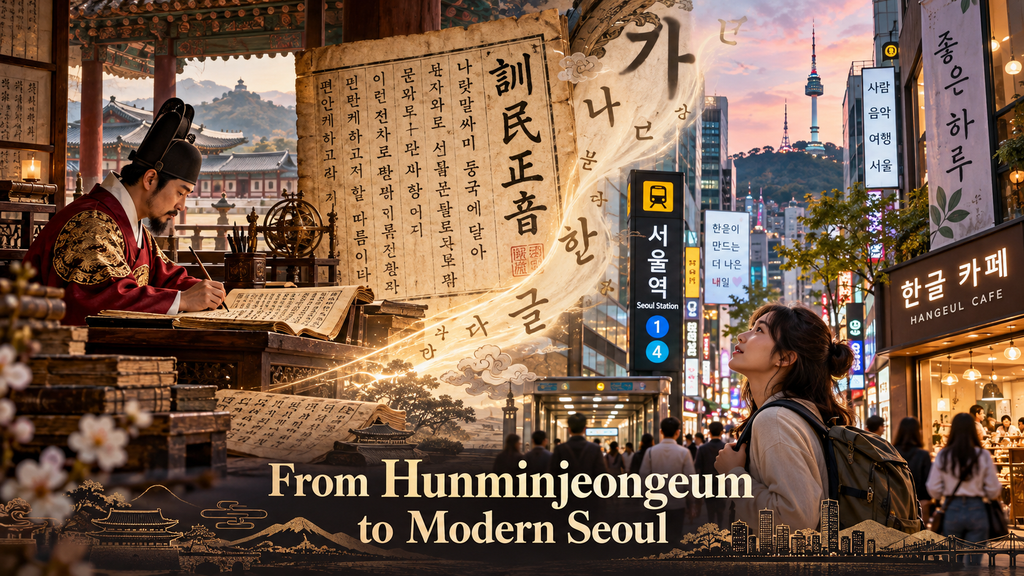
훈민정음 — Hunminjeongeum
It means approximately:
“The Proper Sounds for the Instruction of the People.”
The surviving Hunminjeongeum manuscript explains who created the system, why it was created, and how the letters were intended to work. The script was proclaimed in 1446. VISITKOREA – Imagine Your Korea
That documented design process is part of what makes Hangeul remarkable.
Most writing systems evolved over long periods.
With Hangeul, we know:
who created it,
why it was created,
when it was introduced,
and the principles behind its design.
Hangeul Was Originally Made With 28 Letters
Modern Korean is usually taught with:
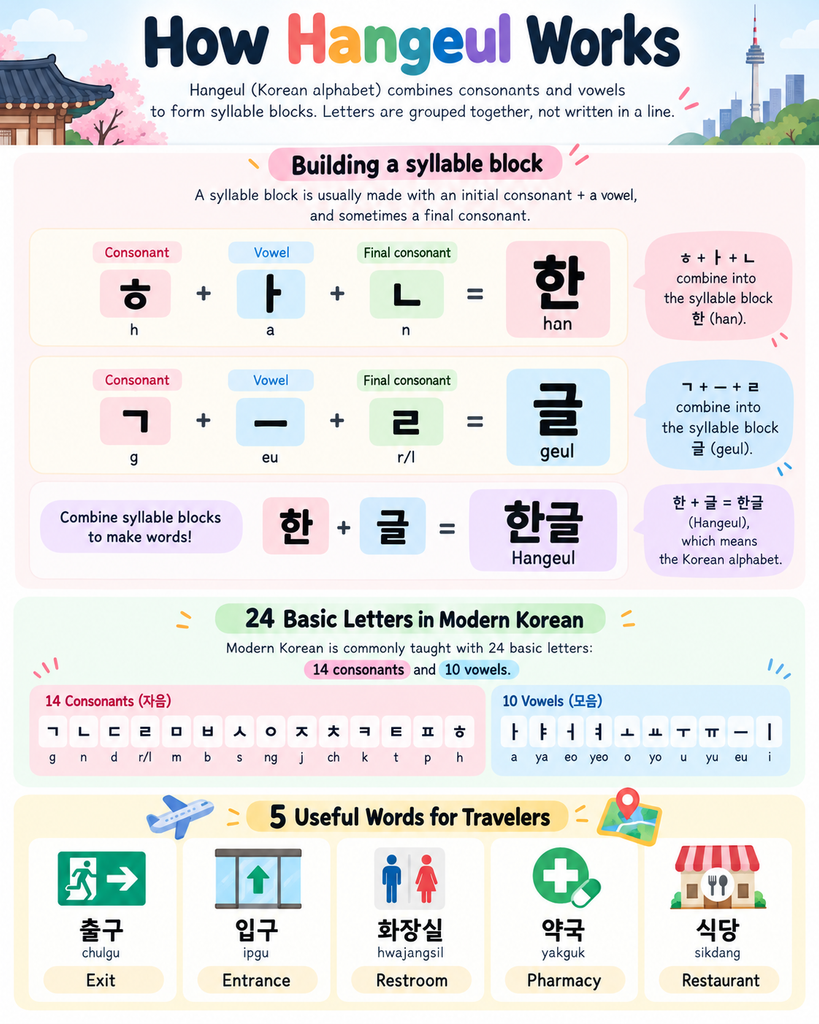
14 basic consonants + 10 basic vowels = 24 basic letters
But Hunminjeongeum originally contained 28 characters: 17 consonants and 11 vowels. Four eventually disappeared from everyday modern Korean. VISITKOREA – Imagine Your Korea
That makes 2026’s 580th anniversary more than just the birthday of today’s alphabet.
It celebrates the original system that eventually developed into the Korean writing used today.
What Makes Hangeul So Different?
Hangeul is not simply a collection of arbitrary shapes.
Many characters were designed systematically.
Consider several basic consonants.
ㄱ
represents a sound similar to g/k.
ㄴ
represents n.
ㅁ
represents m.
ㅅ
represents s.
ㅇ
can represent a final ng sound and is silent at the beginning of some syllables.
The original explanatory text describes consonant shapes in relation to the physical positions of the mouth, tongue, throat, and teeth when making sounds.
This means the visual design of the alphabet contains information about how sounds are produced.
That is extraordinarily unusual.
Korean Letters Don’t Simply Run Across the Page
Another thing surprises first-time learners.
Korean letters are arranged into syllable blocks.
For example:
ㅎ + ㅏ + ㄴ
becomes:
한
Then:
ㄱ + ㅡ + ㄹ
becomes:
글
Together:
한글
Hangeul.
So although Korean writing may initially look complicated, each square is usually built from smaller alphabetic pieces.
Once travelers understand this, Korean signs become much less intimidating.
Can You Really Learn to Read Korean Quickly?
Learning Korean as a language takes years.
Learning enough Hangeul to sound out words, however, can happen much faster.
This distinction is important.
After learning the basic consonants, vowels, and syllable-block structure, an international visitor may begin recognizing words such as:
서울 — Seoul
부산 — Busan
카페 — café
호텔 — hotel
버스 — bus
You may have no idea what a complete Korean sentence means yet.
But suddenly the city no longer looks like a wall of unfamiliar symbols.
For a traveler, that is a very practical achievement.
So Why Is Hangeul Day on October 9?
The modern holiday commemorates the historical proclamation of Hunminjeongeum.
The commemoration itself began in 1926, when Korean language scholars organized a celebration during the Japanese colonial period.
At first it was called Gagya-nal (가갸날), based on an older way of referring to Korean letters. The name later became Hangeul Day.
After historical research clarified the timing of the 1446 promulgation, October 9 eventually became the fixed commemorative date. Global Economic Times
That history makes Hangeul Day important on two levels.
It honors:
the creation of the writing system
and
the later effort to preserve Korean language and cultural identity.
Why Is 2026 Hangeul Day Especially Important?
2026 is not an ordinary Hangeul Day.
It marks:
580 years
since Hunminjeongeum was promulgated in 1446.
100 years
since the first Hangeul Day commemoration in 1926.
This year’s government-organized Hangeul Week runs from October 6 to 17, with performances, exhibitions, academic programs, and interactive activities around Korea. Korea.net
One of the most visually interesting programs is taking place at Gwanghwamun Gate, where a Hangeul-themed media façade is scheduled from October 8–11, 8 PM–11 PM. french.korea.net
For travelers in Seoul this week, that gives Hangeul Day an unusually visible presence in the city.
Where Should Travelers Experience Hangeul in Seoul?
If you want to connect the alphabet with real Korean history, start around Gwanghwamun Square.
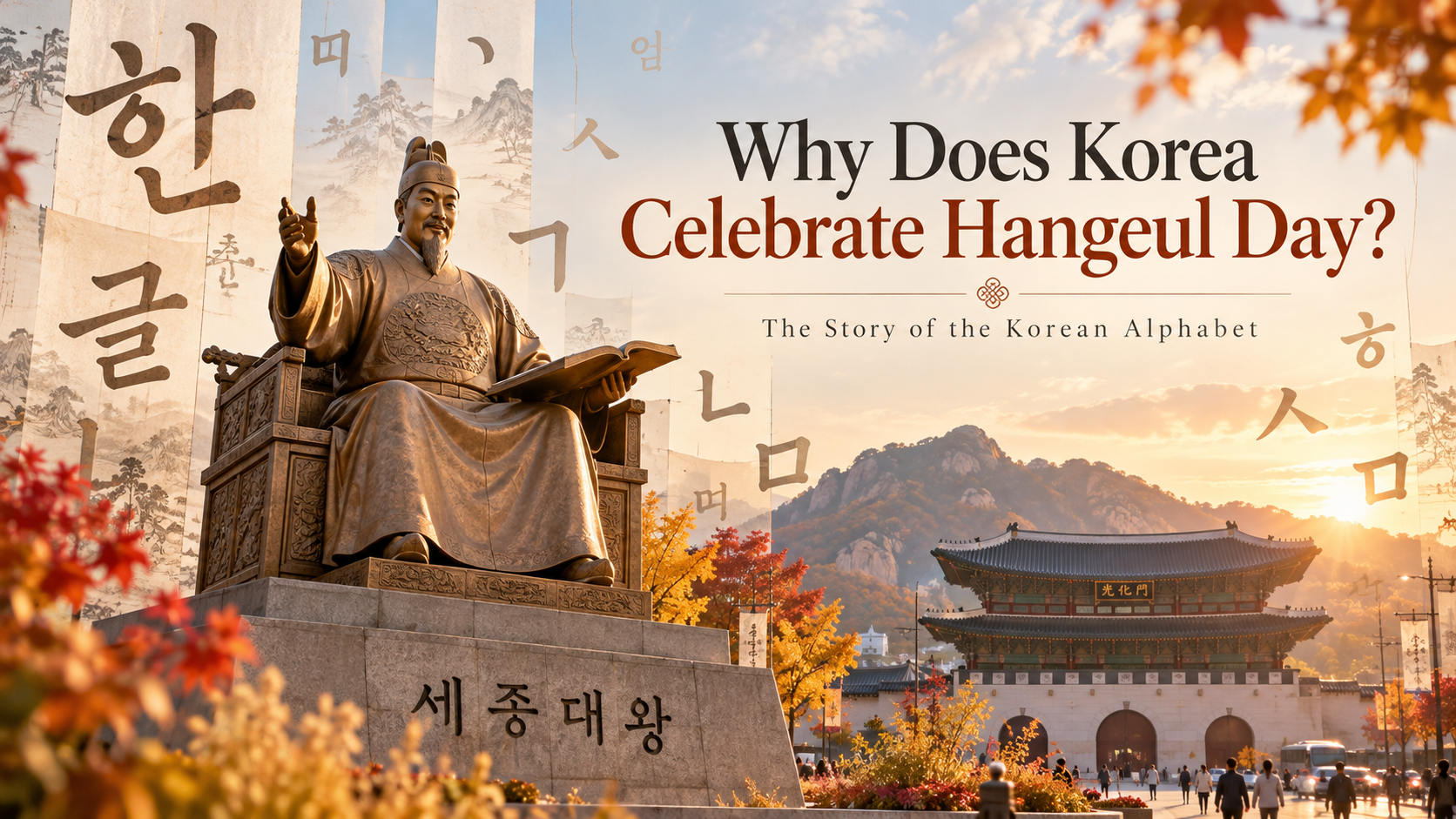
There you will find the large statue of King Sejong the Great.
From this part of Seoul, visitors can also explore:
- Gyeongbokgung Palace
- Korean historical museums
- bookstores
- typography exhibitions
- language-related cultural programs
Even everyday Seoul becomes a kind of Hangeul lesson.
Look at:
subway signs, café menus, street signs, restaurant names, packaging, advertisements.
Once you learn a few characters, you begin seeing patterns everywhere.
Five Korean Signs Every Traveler Can Learn
출구 — chulgu
Exit
Useful in subway stations.
입구 — ipgu
Entrance
화장실 — hwajangsil
Restroom
약국 — yakguk
Pharmacy
식당 — sikdang
Restaurant
You do not need to speak Korean fluently to benefit from reading Hangeul.
Recognizing just these words can make travel easier.
💡 Did You Know?
Hunminjeongeum was not merely a list of letters.
The surviving manuscript also explains how the writing system works.
Its sections include explanations of consonants, vowels, final sounds, letter combinations, and examples of usage. VISITKOREA – Imagine Your Korea
In other words, Korea did not simply preserve its alphabet.
It preserved something close to the original design manual.
🔎 Hidden Story: Hangeul Was About Access
The most interesting story is not simply that King Sejong invented new letters.
It is why he did it.
Writing was power.
People who could read government documents, contracts, laws, and literature had an enormous advantage over those who could not.
A writing system designed to be easier for ordinary people to learn therefore had implications far beyond spelling.
It expanded access to written information.
That is one reason Hangeul still carries such strong symbolic meaning in Korea.
It represents not only language—
but also the idea that written knowledge should be accessible.
A Small Business Lesson Hidden in Hangeul
Hangeul also offers an interesting modern lesson.
Good systems reduce friction.
A complicated system forces users to memorize more.
A well-designed system helps users understand its internal logic.
That is true of:
- alphabets,
- mobile applications,
- restaurant ordering systems,
- transportation maps,
- websites,
- and brands.
Almost six centuries later, people still admire Hangeul partly because its structure is understandable.
For businesses, that is a useful principle:
Good design doesn’t simply look beautiful. It helps people understand what to do next.
🇰🇷 5 Korean Words to Learn Today
| English | Korean | Pronunciation | 中文 | Español |
|---|---|---|---|---|
| Korean alphabet | 한글 | hangeul | 韩文字母 | alfabeto coreano |
| Letter | 글자 | geulja | 字母 | letra |
| Language | 언어 | eoneo | 语言 | idioma |
| King | 왕 | wang | 国王 | rey |
| History | 역사 | yeoksa | 历史 | historia |
🇰🇷 Korean Phrase of the Day
한글을 배우고 싶어요.
Hangeureul baeugo sipeoyo.
English: I want to learn Hangeul.
中文: 我想学习韩文字母。
Español: Quiero aprender el alfabeto coreano.
Another useful phrase:
이 글자는 어떻게 읽어요?
I geuljaneun eotteoke ilgeoyo?
How do you read this letter/word?
Naru’s Tips
Learn Hangeul before your Korea trip.
You don’t need to learn Korean grammar first. Start with reading.
Practice with subway station names.
You already know destinations such as Seoul, Hongdae, Gangnam, and Busan, making them excellent reading practice.
Look for borrowed English words.
Words such as 카페 (kape, café), 호텔 (hotel), and 버스 (beoseu, bus) give beginners quick wins.
Visit Gwanghwamun around Hangeul Day.
It connects King Sejong, Korean history, and modern Seoul in one location.
Don’t worry about reading quickly.
The first goal is recognition, not speed.
❓ Today’s Question
If you could learn to read one new writing system before your next international trip, which language would you choose?
And if you’ve already started learning Korean:
What was the first Korean word you learned to read?
✍️ Naru Quote
“A language lets you speak to people. A writing system lets you begin seeing their world.” — Naru
SEO FAQ
What is Hangeul Day?
Hangeul Day is a South Korean national holiday celebrating the creation and promulgation of Hangeul, the Korean writing system.
When is Hangeul Day?
Hangeul Day is observed every year on October 9 in South Korea. Official Website of the
Who created Hangeul?
Hangeul was created under King Sejong the Great, the fourth king of the Joseon dynasty.
When was Hangeul created?
The writing system was developed during King Sejong’s reign and formally promulgated through Hunminjeongeum in 1446. Heritage Korea
How many letters does Hangeul have?
Modern Korean is commonly taught with 24 basic letters: 14 consonants and 10 vowels. The original Hunminjeongeum system had 28 characters. VISITKOREA – Imagine Your Korea
Why is Hangeul considered unusual?
Unlike many writing systems that evolved gradually, Hangeul has a documented creator, historical purpose, and surviving explanation of its design principles.
한국은 왜 한글날을 기념할까? 한글에 숨겨진 이야기
10월 9일은 한글날입니다.
세계의 많은 국경일은 독립, 전쟁, 종교, 국가의 탄생을 기념합니다.
그런데 한국에는 조금 특별한 국경일이 있습니다.
문자를 기념하는 날입니다.
특히 2026년은 의미가 큽니다.
1446년 훈민정음 반포 580주년, 그리고 1926년 처음 한글날 기념 행사가 열린 이후 100주년을 맞는 해입니다. 정부는 이를 기념해 10월 6일부터 17일까지 전국에서 ‘한글주간’을 운영하고 있습니다. Korea.net
한글이 만들어지기 전에는?
한국 사람들은 당연히 한국어를 사용하고 있었습니다.
문제는 글이었습니다.
당시에는 주로 한자를 사용했지만 한국어와 중국어는 구조가 매우 다른 언어입니다.
많은 글자를 오랫동안 공부해야 했기 때문에 일반 백성에게 글을 읽고 쓰는 것은 매우 어려웠습니다.
세종대왕은 이 문제를 중요하게 생각했습니다.
그래서 한국어의 소리를 보다 쉽게 표현할 수 있는 새로운 문자 체계를 만들었습니다.
그 이름이:
훈민정음
입니다.
뜻은 대략 **“백성을 가르치는 바른 소리”**입니다.
한글의 가장 특별한 점
한글은 단순히 모양을 외우는 문자가 아닙니다.
기본 자음에는 사람이 소리를 낼 때 사용하는 혀, 입, 목구멍 등의 원리가 반영되어 있습니다.
또한 글자를 일렬로만 적지 않고 음절 단위의 네모난 모양으로 조합합니다.
예를 들어:
ㅎ + ㅏ + ㄴ = 한
ㄱ + ㅡ + ㄹ = 글
그래서:
한글
이 됩니다.
이 원리를 이해하면 처음 한국을 방문하는 외국인도 생각보다 빠르게 간판과 지하철역 이름을 읽기 시작할 수 있습니다.
원래 한글은 28자였다
현재 한글의 기본 문자는 자음 14개와 모음 10개, 총 24개로 배우는 경우가 많습니다.
하지만 1446년 훈민정음에는 자음 17개와 모음 11개, 총 28자가 사용되었습니다. 이후 일부 글자는 사용되지 않게 되었습니다. VISITKOREA – Imagine Your Korea
왜 10월 9일일까?
한글을 기념하는 행사는 1926년 처음 시작됐습니다.
당시에는 가갸날이라고 불렸고, 이후 한글날이라는 이름이 정착했습니다.
훈민정음 해례본 등의 역사적 기록을 연구하면서 1446년 반포 시기를 기준으로 오늘날의 10월 9일이 기념일로 자리 잡았습니다. Global Economic Times
따라서 한글날에는 두 가지 의미가 함께 있습니다.
세종대왕이 만든 새로운 문자
그리고
그 문자를 지키고 발전시킨 사람들의 역사
입니다.
2026년이 특별한 이유
올해는 한글날 기념 행사 100주년입니다.
또 훈민정음 반포 580주년이기도 합니다.
10월 6일부터 17일까지 전국에서 한글주간 행사가 열리며, 광화문에서는 공연, 전시, 체험 행사 등이 진행됩니다. Korea.net
특히 10월 8일부터 11일까지 저녁 8시~11시에는 광화문을 활용한 한글 미디어 파사드 프로그램도 예정되어 있습니다. french.korea.net
외국인 여행자가 알아두면 좋은 한글
서울 여행 전에 다음 다섯 단어 정도만 읽을 수 있어도 꽤 유용합니다.
출구 — Exit
입구 — Entrance
화장실 — Restroom
약국 — Pharmacy
식당 — Restaurant
한국어를 할 줄 몰라도 한글을 조금 읽을 수 있다면 한국 여행의 난이도는 확실히 낮아집니다.
Hidden Story
한글이 특별한 이유는 문자가 있다는 것 자체가 아닙니다.
왜 만들었는지 기록되어 있다는 점이 중요합니다.
세종대왕은 평범한 사람들이 자신의 생각을 글로 표현하기 어려운 문제를 해결하고자 새로운 문자를 만들었습니다.
그래서 한글의 핵심 정신은 단순한 언어가 아니라:
정보에 대한 접근성
이라고 볼 수도 있습니다.
Naru’s Tip
한국 여행 전에 한글 문법을 공부할 필요는 없습니다.
먼저 읽는 법만 익혀보세요.
서울, 부산, 강남, 홍대처럼 이미 알고 있는 장소 이름부터 연습하면 훨씬 쉽습니다.
오늘의 질문
여행 전에 새로운 문자 하나를 배울 수 있다면 어떤 나라의 문자를 배우고 싶으세요?
🇨🇳 中文版
韩国为什么庆祝韩文日?韩国文字背后的故事
每年的 10月9日 是韩国的韩文日(한글날)。
很多国家的节日纪念独立、战争、宗教或建国。
韩国却有一个非常特别的节日:
纪念自己的文字。
2026年尤其重要。
这一年是《训民正音》颁布 580周年,也是韩文日纪念活动创立 100周年。
韩国政府从10月6日至17日在全国举办“韩文周”活动。 Korea.net
在韩文出现以前
韩国人当然早就说韩语。
问题是怎样把它写下来。
当时知识阶层主要使用汉字,但韩语和汉语在结构上完全不同。
普通人如果想掌握大量汉字,需要接受长期教育。
因此,读写能力主要集中在社会上层。
世宗大王认为这是一个严重的问题。
于是,他创造了一套更适合韩语发音的新文字系统。
这就是:
训民正音(훈민정음)
意思大致是:
“教导百姓的正确声音。”
韩文为什么特别?
韩文字母并不是随意设计的符号。
一些基本辅音的形状与发音时舌头、嘴巴和喉咙的位置有关。
此外,韩文字母会组合成方形的音节。
比如:
ㅎ + ㅏ + ㄴ = 한
ㄱ + ㅡ + ㄹ = 글
组合起来就是:
한글
一旦理解这个结构,韩文看起来就不会那么复杂。
韩文最初有28个字母
现代韩语通常学习:
14个基本辅音 + 10个基本元音 = 24个基本字母。
但1446年的训民正音最初包含 28个字符。其中4个后来逐渐退出现代日常使用。 VISITKOREA – Imagine Your Korea
为什么是10月9日?
纪念韩文的活动始于 1926年。
最早称为 “Gagya Day(가갸날)”,后来逐渐改称韩文日。
通过对历史资料,尤其是训民正音解例本的研究,最终将 10月9日 固定为纪念训民正音颁布的日期。 Global Economic Times
2026年为什么特别?
2026年是韩文日100周年。
韩国在10月6日至17日举行全国性的韩文周活动。
首尔光化门一带举办展览、演出和体验活动。
10月8日至11日晚间,还安排了以韩文为主题的光化门媒体艺术展示。 french.korea.net
游客最值得先学的5个韩文词
출구 — 出口
입구 — 入口
화장실 — 洗手间
약국 — 药店
식당 — 餐厅
即使不会说韩语,只要能读出一些韩文字,韩国旅行也会方便很多。
Hidden Story
韩文真正特别的地方不仅是它由谁创造。
更重要的是:
我们知道为什么要创造它。
世宗大王希望更多普通人能够表达自己的想法并获取书面知识。
因此,韩文也可以被理解为一个关于:
知识普及和信息可及性
的故事。
今日问题
如果旅行前可以学会一种新的文字系统,你会选择哪一种?
¿Por qué Corea celebra el Día del Hangeul? La historia del alfabeto coreano
El 9 de octubre Corea del Sur celebra el Día del Hangeul.
Muchos días nacionales recuerdan independencias, guerras, religiones o la fundación de un país.
Corea celebra algo diferente:
su sistema de escritura.
Y 2026 es un año especialmente importante.
Se cumplen 580 años de la promulgación del Hunminjeongeum en 1446 y 100 años desde la primera celebración del Día del Hangeul en 1926.
Por este motivo, Corea celebra la Semana del Hangeul del 6 al 17 de octubre. Korea.net
Antes del Hangeul
Los coreanos hablaban coreano mucho antes de que existiera el Hangeul.
El problema era escribirlo.
Durante siglos, la escritura formal dependía en gran medida de los caracteres chinos clásicos.
Pero el coreano y el chino son idiomas estructuralmente diferentes.
Aprender suficientes caracteres requería años de educación, lo que dificultaba el acceso de la mayoría de la población a la lectura y la escritura.
El rey Sejong quiso cambiar esto.
Hunminjeongeum
El nuevo sistema recibió originalmente el nombre:
훈민정음 — Hunminjeongeum
que puede traducirse aproximadamente como:
“Los sonidos correctos para instruir al pueblo.”
Fue promulgado en 1446.
Además, se conserva un documento que explica quién creó el sistema, por qué fue creado y cómo debían utilizarse sus letras. VISITKOREA – Imagine Your Korea
¿Por qué es tan especial?
Los símbolos del Hangeul no son completamente arbitrarios.
Varias consonantes básicas reflejan la posición de los órganos utilizados para producir los sonidos.
Otra característica particular es que las letras se agrupan en bloques silábicos.
Por ejemplo:
ㅎ + ㅏ + ㄴ = 한
ㄱ + ㅡ + ㄹ = 글
Juntas forman:
한글 — Hangeul
Originalmente había 28 caracteres
El coreano moderno suele enseñarse con:
14 consonantes básicas + 10 vocales básicas = 24 letras.
Sin embargo, el sistema original de 1446 tenía 28 caracteres. VISITKOREA – Imagine Your Korea
¿Por qué se celebra el 9 de octubre?
La primera conmemoración organizada tuvo lugar en 1926.
Originalmente se llamó Gagya-nal.
Con el tiempo, el nombre cambió a Hangeul Day y, gracias a investigaciones históricas sobre la fecha de promulgación del Hunminjeongeum, el 9 de octubre se estableció como la fecha conmemorativa. Global Economic Times
Por qué 2026 es especial
Corea celebra este año el centenario del Día del Hangeul.
Entre el 6 y el 17 de octubre se celebran actuaciones, exposiciones y actividades en todo el país.
En Seúl, Gwanghwamun también acoge programas culturales relacionados con el Hangeul, incluyendo una proyección artística nocturna prevista del 8 al 11 de octubre. french.korea.net
Cinco palabras útiles para viajeros
출구 — Salida
입구 — Entrada
화장실 — Baño
약국 — Farmacia
식당 — Restaurante
No necesitas hablar coreano para beneficiarte de saber leer algunas palabras.
Hidden Story
La historia más interesante del Hangeul no es solamente quién creó las letras.
Es por qué se crearon.
El objetivo era facilitar a la población común la posibilidad de expresar sus pensamientos por escrito.
Por eso, el Hangeul representa también una idea sorprendentemente moderna:
hacer el conocimiento más accesible.
Consejo de Naru
Antes de viajar a Corea, no intentes aprender toda la gramática coreana.
Aprende primero a leer Hangeul.
Practica con palabras que ya conoces:
서울 — Seoul
부산 — Busan
호텔 — hotel
카페 — café
Muy pronto, los letreros de Corea empezarán a parecer mucho menos desconocidos.
Pregunta de hoy
Si pudieras aprender un nuevo sistema de escritura antes de tu próximo viaje, ¿cuál elegirías?