In Korea, the Hike Doesn’t Always End at the Bottom of the Mountain
It is Saturday morning in Seoul.
At 8 a.m., the subway is already carrying people dressed in hiking clothes.
They have backpacks.
Hiking poles.
Hats.
Water bottles.
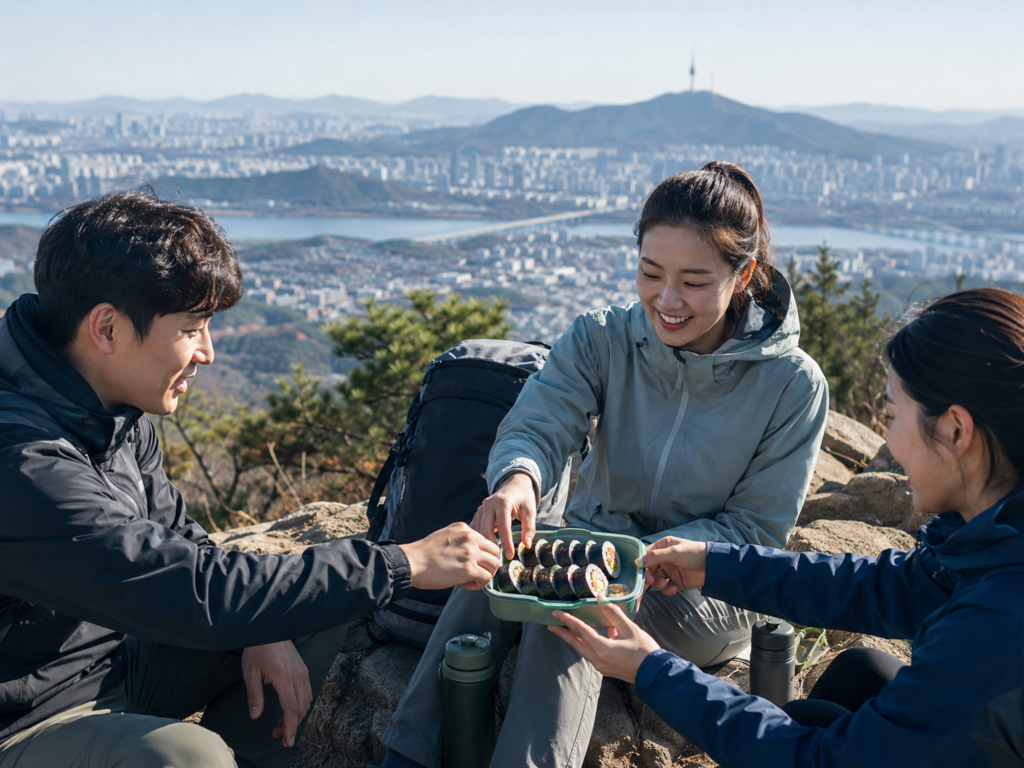
Some are carrying neatly wrapped rolls of gimbap.
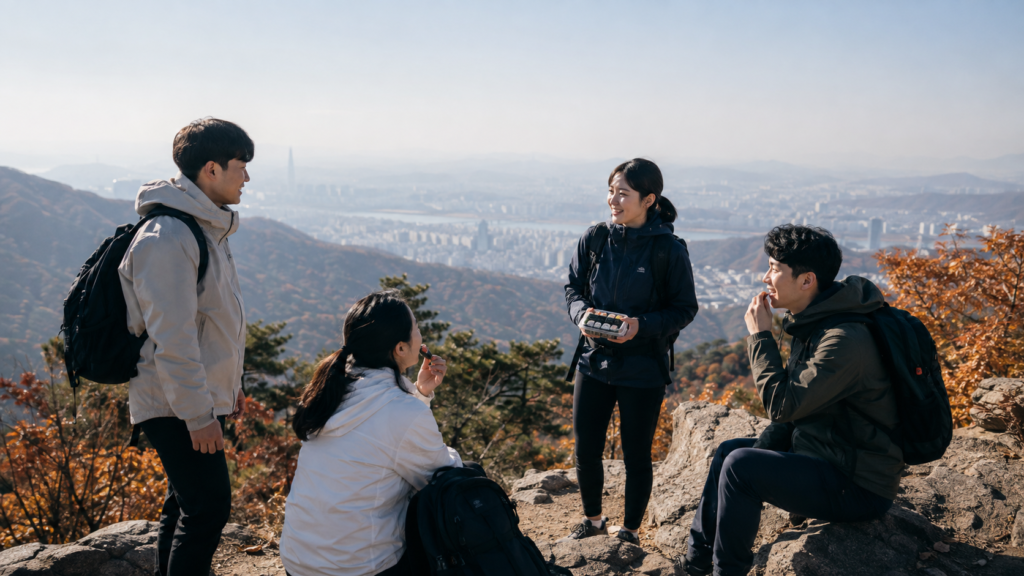
A few hours later, they reach the summit.
There are photographs.
There is water.
Perhaps some gimbap.
Then everyone walks back down.
You might assume the day is finished.
But often, the most delicious part is just beginning.
Near the mountain entrance, someone says:
“뭐 먹을까요?”
Mwo meo-geul-kka-yo?
“What should we eat?”
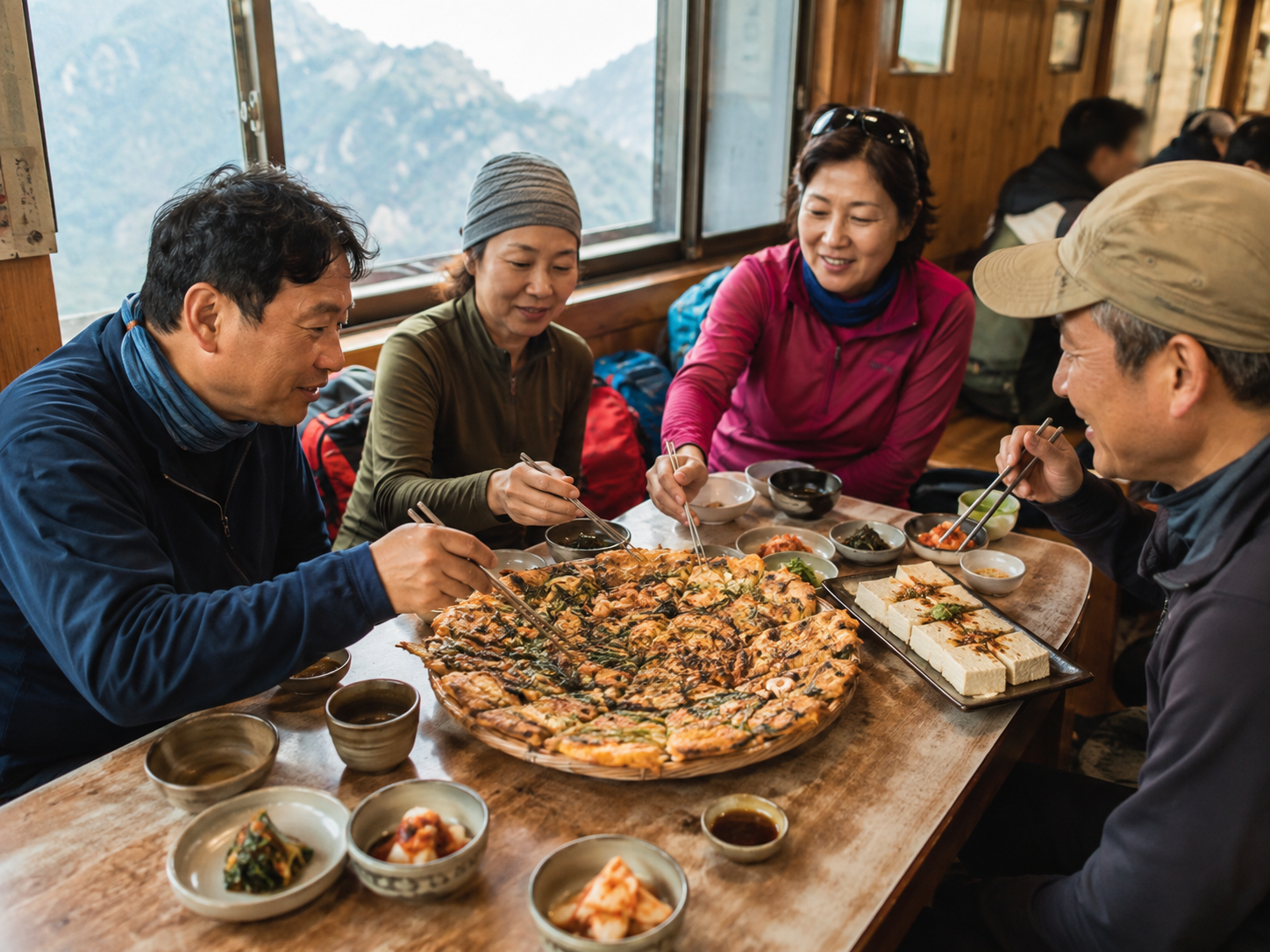
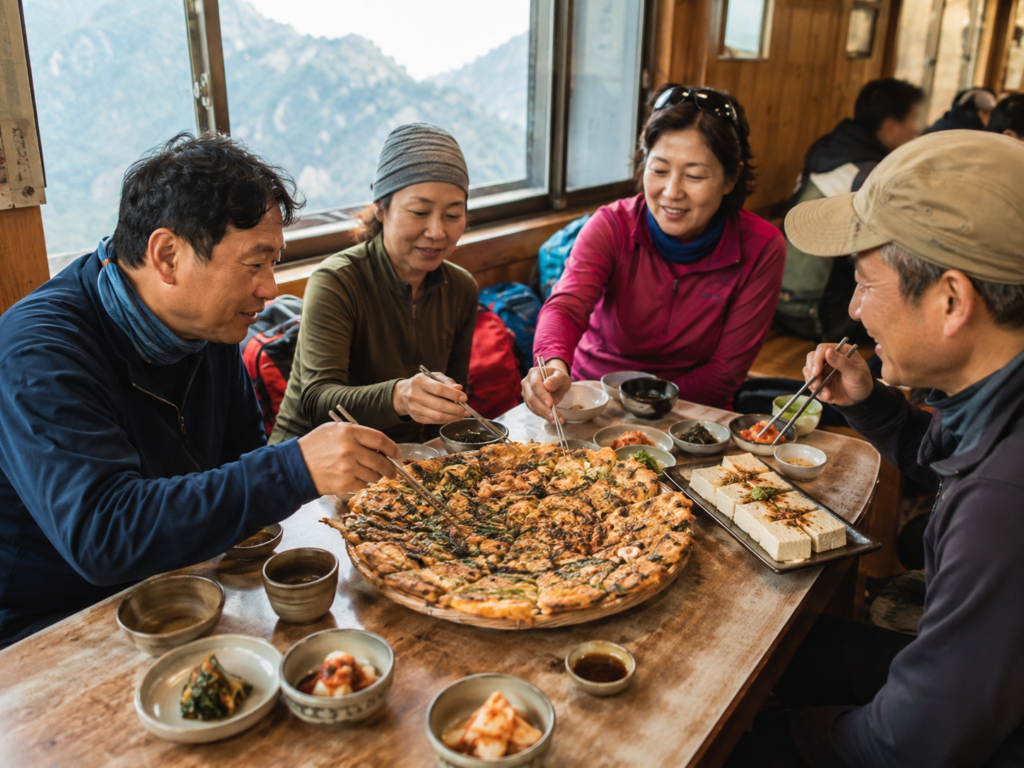
Soon the table might contain a crispy pajeon, a bowl of noodles, tofu, grilled meat, or several dishes meant to be shared.
And this reveals something important about Korean hiking culture:
Sometimes the mountain is only half the experience.
The other half is what happens around the table afterward.
Korea Is a Country That Climbs Mountains
Look at a map of Korea and mountains seem to appear everywhere.
Even Seoul—a city famous for skyscrapers, subways, shopping districts, cafés, and apartment towers—is surrounded and interrupted by mountains.
Bukhansan.
Gwanaksan.
Achasan.
Inwangsan.
Bugaksan.
Namsan.
Some trails can be reached surprisingly quickly from dense urban neighborhoods.
That accessibility helps make hiking less like an occasional expedition and more like something that can fit naturally into everyday life.
And international visitors are starting to notice.
In July 2026, the Seoul Metropolitan Government reported foreign visitor growth of 11.8% at Achasan and 10.0% at Gwanaksan, describing the figures as evidence of growing interest in “K-Hiking.”
Seoul has even established Hiking Tourism Centers around mountains including Bukhansan, Bugaksan, and Gwanaksan, offering services such as equipment rental, luggage storage, changing facilities, trail information, and hiking programs for visitors.
Hiking in Korea is no longer only a local weekend habit.
It is becoming part of the Korea travel experience.
But Why Does Food Always Seem to Appear?
Because Korean hiking culture is not necessarily built around exercise alone.
The mountain creates a sequence.
Meet → climb → rest → eat → talk → go home.
The physical activity gives the group something to do together.
But the meal afterward gives everyone somewhere to stay together.
That is why food can feel almost naturally attached to the hike.
In fact, the Korea Tourism Organization’s official K-Hiking guide specifically introduces two food traditions to foreign visitors: eating gimbap and ramyeon around the summit, and enjoying jeon with makgeolli after finishing the hike. It describes these as ways to experience hiking “the Korean way.”
So if someone invites you to hike in Korea, there is a reasonable chance you may end up discovering Korean food culture at the same time.
First Stop: Gimbap on the Mountain
There may be no food more practical for a Korean hike than:
김밥 — Gimbap
Rice.
Seaweed.
Vegetables.
Egg.
Sometimes meat or other fillings.
Everything is rolled together and cut into small pieces.
No plate is necessary.
No knife is necessary.
You can share it.
You can pack it easily.
And you can eat it while looking across the city from a mountain ridge.
That makes gimbap almost perfect hiking food.
The Korea Tourism Organization even highlights eating gimbap and ramyeon at the top of a mountain as a long-standing Korean hiking experience.
There is also something psychologically satisfying about it.
The same gimbap that might feel ordinary at street level can suddenly taste extraordinary after climbing hundreds of meters.
Maybe the recipe did not change.
You did.
And Then There Is Ramyeon
Imagine reaching a viewpoint after a difficult climb.
The wind is cooler.
Your shirt is damp.
Your legs are tired.
Then you smell:
라면 — Ramyeon.
Hot broth.
Spicy seasoning.
Soft noodles.
A warm bowl after physical exertion creates an almost perfect contrast with the mountain air.
Ramyeon is not practical on every trail and visitors should always respect park rules regarding cooking, fire, waste, and designated facilities.
But culturally, the image is familiar:
mountain + hungry hiker + hot ramyeon.
The Korea Tourism Organization places ramyeon alongside gimbap in its introduction to Korean-style summit eating.
But the Real Feast Often Begins After the Hike
Eventually, everyone comes back down.
Now comes the question:
What should we eat?
Near popular hiking areas, restaurants often become part of the social rhythm of the day.
A group can finally take off backpacks.
Put down hiking poles.
Sit around a table.
And order food that feels satisfying after several hours of walking.
One particularly iconic combination is:
전 + 막걸리
Jeon + Makgeolli
Jeon is a savory Korean pancake.
One familiar version is:
파전 — Pajeon
made with green onions and often other ingredients.
Makgeolli is a cloudy traditional Korean rice drink.
KTO’s hiking guide specifically recommends the combination of jeon and makgeolli after completing a hike as a classic way to celebrate the accomplishment.
For many people, this moment feels very different from eating the same food at an ordinary restaurant.
You have already climbed together.
Sweated together.
Waited for slower friends.
Taken summit photographs.
Complained about your knees.
And now everyone is sitting around the same table.
The food becomes part of the story.
Why Pajeon Feels So Right After Hiking
Pajeon has several characteristics that make it work particularly well for groups.
It arrives as one large dish.
It is easy to divide.
It is warm.
It has a crisp exterior and soft interior.
And everyone can reach toward the center of the table.
That last point matters.
A lot of Korean eating culture is built around shared dishes.
Instead of everyone disappearing into an individual plate, the group continues interacting with the same food.
One person cuts the jeon.
Another passes a piece.
Someone orders another dish.
The conversation continues.
The hike has ended physically.
Socially, it hasn’t.
Hidden Story: The Meal May Be the Social Destination
If you ask someone why they hike, the obvious answers might be:
exercise,
fresh air,
nature,
beautiful views,
or health.
All are reasonable.
But hiking also provides something modern urban life sometimes makes difficult:
uninterrupted time together.
On a mountain, people walk side by side for hours.
There are fewer screens.
The pace is slower.
Then the meal extends that time.
This is why it may be misleading to think of hiking and eating as two separate activities.
In a Korean weekend context, they can form one social experience:
산 → 음식 → 대화
Mountain → Food → Conversation
The mountain gives the group a journey.
The table gives the journey an ending.
“But Didn’t We Just Exercise?”
This is where the experience can look amusing to outsiders.
You may hike for three hours.
Burn plenty of energy.
Feel extremely proud of yourself.
Then sit down and order enough food to fill the table.
Wasn’t the point of hiking to exercise?
Perhaps.
But that is not always the entire point.
For many people, physical activity makes the food afterward feel deserved, satisfying, and social.
The meal becomes a reward.
And that creates a funny Korean hiking paradox:
You climb the mountain to feel healthy.
Then you come down hungry enough to order everything.
Korean Hiking Is Surprisingly Social
Some people hike alone.
But hiking also works extremely well as a group activity.
Friends can hike together.
Coworkers can hike together.
Families can hike together.
Clubs can hike together.
Older adults can maintain social networks through hiking groups.
Even casual acquaintances can talk more naturally while walking than they might across a formal meeting table.
This is one reason the post-hike meal matters.
Once everyone sits down, the physical journey becomes conversation.
“Was that trail harder than last time?”
“Did you see the view?”
“My legs are going to hurt tomorrow.”
“Should we order another pajeon?”
And perhaps, eventually:
“다음에는 어디 갈까요?”
“Where should we go next time?”
One mountain creates the plan for another.
From Local Habit to “K-Hiking”
For decades, hiking has been an ordinary recreational activity for Koreans.
What is changing is that international travelers are increasingly participating in it too.
Seoul has been actively developing hiking as a tourism experience. Its Hiking Tourism Centers provide gear rental and guidance, which lowers one major barrier for travelers: you no longer necessarily need to bring hiking boots and equipment halfway around the world just to try a Korean mountain.
The Seoul government also said in April 2026 that it planned to strengthen lifestyle tourism, explicitly mentioning hiking alongside local cafés and bakeries as ways for visitors to experience the everyday preferences of Seoul residents.
That idea is important.
You are not only looking at Korea.
You are doing something Koreans actually do.
You take the subway.
You climb the mountain.
You eat gimbap.
You come down.
You order pajeon.
Suddenly, hiking becomes cultural tourism.
Why Seoul Is Perfect for This
In many global cities, hiking requires a car and a long journey outside the urban center.
Seoul is different.
Mountains exist remarkably close to neighborhoods and public transportation.
The city’s official Seoul Trail alone is a 156.5-kilometer network of 21 routes connecting mountains, rivers, neighborhoods, and urban streets.
That creates an unusual urban experience.
You can spend the morning surrounded by trees and granite peaks.
Then, later the same day, you can be:
shopping,
eating barbecue,
visiting a café,
or riding the subway through central Seoul.
Nature and megacity are not always separate experiences here.
Sometimes they are only a few subway stops apart.
Did You Know?
Korean Hiking Food Exists Both Before and After the Summit
There are really two different food moments.
During the hike, portable foods such as gimbap make sense because they are easy to carry and share.
After the hike, the menu can become heavier and more social: jeon, noodles, tofu dishes, soups, or other restaurant food.
The official VISITKOREA hiking guide captures this distinction particularly well by recommending gimbap and ramyeon around the summit, followed by jeon and makgeolli after the hike.
So the Korean hiking food journey might look like:
Gimbap → Summit → Descent → Pajeon → Long Conversation
Not bad for a Saturday.
Naru’s Travel Tips
If you want to experience K-Hiking, you do not necessarily need to attempt Korea’s hardest peak.
Choose a trail appropriate for your fitness and experience level, check weather and trail conditions, wear proper footwear, and carry water. Seoul’s Hiking Tourism Centers can also help visitors with equipment rentals and trail information.
For the cultural experience, bring a small snack such as gimbap and leave time after the hike for a meal rather than immediately rushing to the next tourist attraction.
Also, keep the mountain clean. KTO specifically reminds hikers to dispose of trash properly rather than leaving food packaging or waste on the trail.
And if you choose makgeolli after the hike, enjoy it after you are safely off challenging terrain rather than treating alcohol as hiking fuel.
Learn 5 Korean Words
| English | Korean | Pronunciation | Chinese | Spanish |
|---|---|---|---|---|
| Hiking | 등산 | deung-san | 登山 | Senderismo |
| Mountain | 산 | san | 山 | Montaña |
| Summit | 정상 | jeong-sang | 山顶 | Cumbre |
| Gimbap | 김밥 | gim-bap | 紫菜包饭 | Gimbap |
| Green-onion pancake | 파전 | pa-jeon | 葱饼 | Tortita de cebollín |
Bonus Word
하산 — ha-san
This means descending from a mountain or coming down after a climb.
You may hear:
하산하고 뭐 먹을까요?
Ha-san-ha-go mwo meo-geul-kka-yo?
“What should we eat after we come down?”
That might be one of the most important questions of the entire hike.
Korean Phrase of the Day
등산하고 뭐 먹을까요?
Pronunciation: Deung-san-ha-go mwo meo-geul-kka-yo?
English: What should we eat after hiking?
Chinese: 爬完山我们吃什么?
Spanish: ¿Qué comemos después de hacer senderismo?
And if you are still climbing:
정상까지 얼마나 걸려요?
Jeong-sang-kka-ji eol-ma-na geol-lyeo-yo?
How long does it take to reach the summit?
A very useful sentence in Korea.
Today’s Question
What’s your perfect meal after a long hike?
A huge breakfast?
Pizza?
Noodles?
Barbecue?
Or would you try the Korean combination of pajeon after coming down from the mountain?
Tell us in the comments.
Naru’s Quote
“In Korea, reaching the summit gives you the view. Coming back down gives you the meal—and sometimes the best conversation of the day.” — Naru
SEO FAQ
Why is hiking so popular in Korea?
Korea has extensive mountainous terrain, and cities such as Seoul provide unusually convenient access to urban hiking. Seoul now actively promotes “K-Hiking” to international visitors and operates Hiking Tourism Centers providing trail guidance and equipment-related services.
What do Koreans eat while hiking?
Gimbap is particularly convenient because it is portable and easy to share. VISITKOREA also highlights gimbap and ramyeon as foods associated with Korean summit experiences.
What do Koreans eat after hiking?
There is no single required meal, but jeon and makgeolli are a well-known post-hiking combination. KTO specifically recommends the pairing as part of experiencing Korean hiking culture.
What is pajeon?
Pajeon (파전) is a savory Korean pancake featuring green onions, usually cooked on a pan until the exterior becomes crisp. Variations may contain seafood or other ingredients.
What is makgeolli?
Makgeolli (막걸리) is a traditional Korean cloudy alcoholic beverage made from fermented grains, commonly rice. It is frequently paired with Korean savory pancakes such as jeon.
Can tourists hike in Seoul?
Yes. Seoul has numerous accessible mountains and established Hiking Tourism Centers at major hiking areas such as Bukhansan, Bugaksan, and Gwanaksan. Services include trail information, gear rentals, storage, changing areas, and programs aimed at visitors.
Is Korean hiking difficult?
It varies enormously. Seoul offers everything from relatively gentle urban trails to steep mountain routes. Travelers should select routes based on fitness, experience, weather, and current trail conditions.
Part 3 — What Hiking Reveals About Korean Culture
At first, hiking seems universal.
People climb mountains everywhere.
So what makes the Korean experience different?
Perhaps the answer isn’t found at the summit.
It is found in the sequence.
You meet people.
You travel together.
You climb.
You share food.
You take photographs.
You descend.
Then you sit around a table.
The activity moves naturally from:
exercise → nature → food → relationship.
And that combination appears frequently in Korean life.
Eating is rarely only about consuming calories.
Food can mark the beginning of a relationship.
It can extend an activity.
It can turn colleagues into friends.
It can provide an excuse to keep talking.
That is why the restaurant after the mountain can matter almost as much as the mountain itself.
Perhaps you came for the view.
But someone orders pajeon.
Another person suggests noodles.
Nobody seems particularly interested in going home yet.
And suddenly you realize:
The mountain was never the only destination.
The day was about spending time together.
The mountain simply gave everyone a reason to begin.
한국인은 왜 등산 후에 푸짐하게 먹는 것을 좋아할까?
한국의 등산은 단순히 산 정상에 올라가는 운동으로 끝나지 않는 경우가 많습니다.
아침에 친구들과 만나 산에 오르고, 정상에서 김밥을 먹고 사진을 찍은 뒤 내려옵니다.
그리고 누군가 말합니다.
“뭐 먹을까요?”
그때부터 등산의 또 다른 즐거움이 시작됩니다.
파전이나 국수, 두부 요리처럼 여러 사람이 함께 먹을 수 있는 음식을 주문하고 오랫동안 이야기를 나눕니다.
한국관광공사 역시 K-Hiking을 소개하면서 정상에서 김밥과 라면을 먹고, 등산 후에는 전과 막걸리를 즐기는 것을 한국식 등산 경험의 하나로 소개하고 있습니다.
왜 이런 문화가 생겼을까요?
첫 번째 이유는 한국의 산이 생활권과 매우 가깝기 때문입니다.
특히 서울에서는 지하철과 버스를 이용해 여러 산의 등산로에 접근할 수 있습니다. 최근에는 외국인 관광객의 등산도 늘어나면서 서울시가 북한산, 북악산, 관악산 등에 등산관광센터를 운영하고 있습니다.
두 번째는 등산이 사회적 활동이기 때문입니다.
친구, 가족, 동료와 몇 시간 동안 함께 걷고 내려온 뒤 식사를 하면 등산 중 이어진 대화가 자연스럽게 식탁에서도 계속됩니다.
그래서 등산 후 식사는 단순히 배고픔을 해결하는 것이 아닐 수 있습니다.
등산이라는 경험을 함께 마무리하는 시간이 됩니다.
흥미로운 것은 최근 외국인도 이런 문화를 직접 경험하기 시작했다는 점입니다.
2026년 서울시 분석에서도 아차산과 관악산을 방문하는 외국인 관광객이 증가하며 K-Hiking의 인기가 확인됐습니다.
따라서 서울을 여행한다면 한 번쯤 유명 관광지만 방문하는 대신 산에 올라보는 것도 좋습니다.
김밥 하나를 챙기고,
정상에서 서울을 바라보고,
산에서 내려온 뒤 이렇게 말해보세요.
“등산하고 뭐 먹을까요?”
어쩌면 그 식사가 한국의 등산 문화를 가장 잘 이해하게 해주는 순간이 될지도 모릅니다.
🇨🇳 中文
为什么韩国人爬完山后喜欢吃一顿丰盛的饭?
在韩国,登山往往不仅仅是一项运动。
朋友们早上见面,一起爬山,在山顶拍照、休息,有时还会分享紫菜包饭。
然后大家下山。
但这一天往往还没有结束。
有人会问:
“我们吃什么?”
接下来,大家可能一起吃韩式煎饼、面条、豆腐料理或者其他适合分享的食物。
韩国观光公社在介绍“K-Hiking”时,也特别提到在山顶吃紫菜包饭和拉面,以及登山结束后享用煎饼等饮食文化。
为什么食物和登山关系这么密切?
其中一个原因是韩国的山离城市生活非常近。
特别是在首尔,人们可以利用公共交通前往许多登山路线。首尔还在北汉山、北岳山和冠岳山等地区运营登山旅游中心,为游客提供装备租借、路线信息等服务。
但更重要的是,韩国登山往往也是一种社交活动。
一起走几个小时后,再围着同一张桌子吃饭,大家的交流并不会因为登山结束而停止。
因此,韩国式登山可以看成:
山 → 食物 → 对话
山顶带来风景。
而下山后的餐桌,则让人与人之间的关系继续延伸。
🇪🇸 Español
¿Por qué a los coreanos les gusta comer mucho después de hacer senderismo?
En Corea, hacer senderismo no siempre termina cuando llegas al final del camino.
Un grupo de amigos puede reunirse temprano, subir una montaña, descansar en la cima, tomar fotografías y compartir un poco de gimbap.
Después bajan.
Y alguien pregunta:
“¿Qué comemos?”
Entonces puede comenzar otra parte importante de la experiencia.
Pajeon.
Fideos.
Tofu.
Sopas.
Otros platos para compartir.
La Organización de Turismo de Corea incluso presenta comer gimbap y ramyeon durante la caminata y disfrutar jeon después de bajar como parte de la experiencia del senderismo al estilo coreano.
Una de las razones es que las montañas forman parte de la vida urbana coreana.
En Seúl, muchas rutas se encuentran relativamente cerca del transporte público, y la ciudad opera centros de turismo de senderismo donde los visitantes pueden obtener información y alquilar equipamiento.
Pero hay otra razón importante.
Hacer senderismo puede ser una actividad social.
Durante varias horas, amigos, familiares o compañeros caminan juntos.
Y cuando termina la caminata, la comida permite continuar la conversación.
Por eso, el senderismo coreano puede entenderse como una secuencia:
Montaña → Comida → Conversación
Tal vez la vista desde la cima sea espectacular.
Pero en Corea, algunas de las mejores partes del día pueden ocurrir después de bajar.