
When Korean Summer Arrives, So Does Bingsu
Walk into a Korean café in July or August and you may notice something unusual.
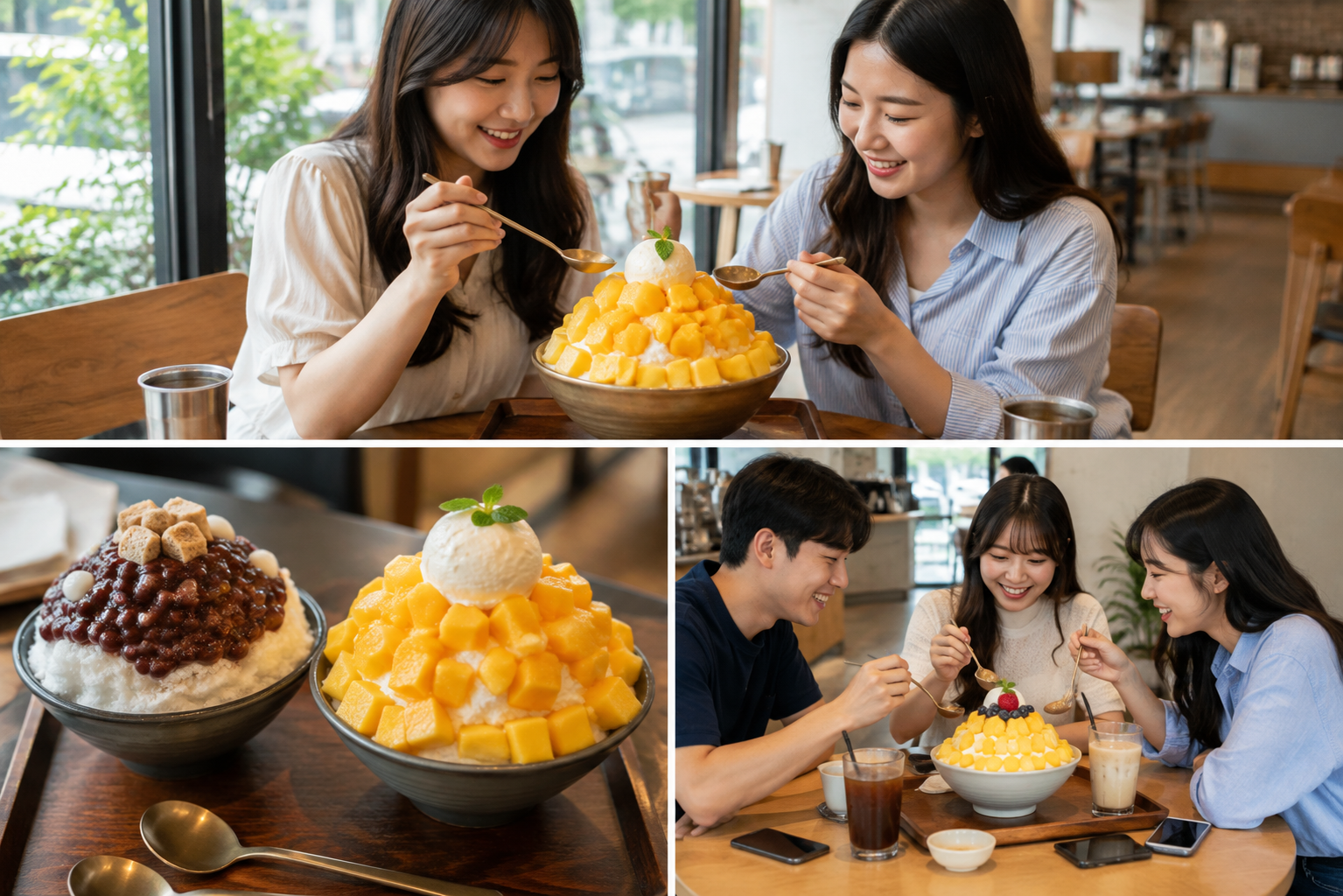
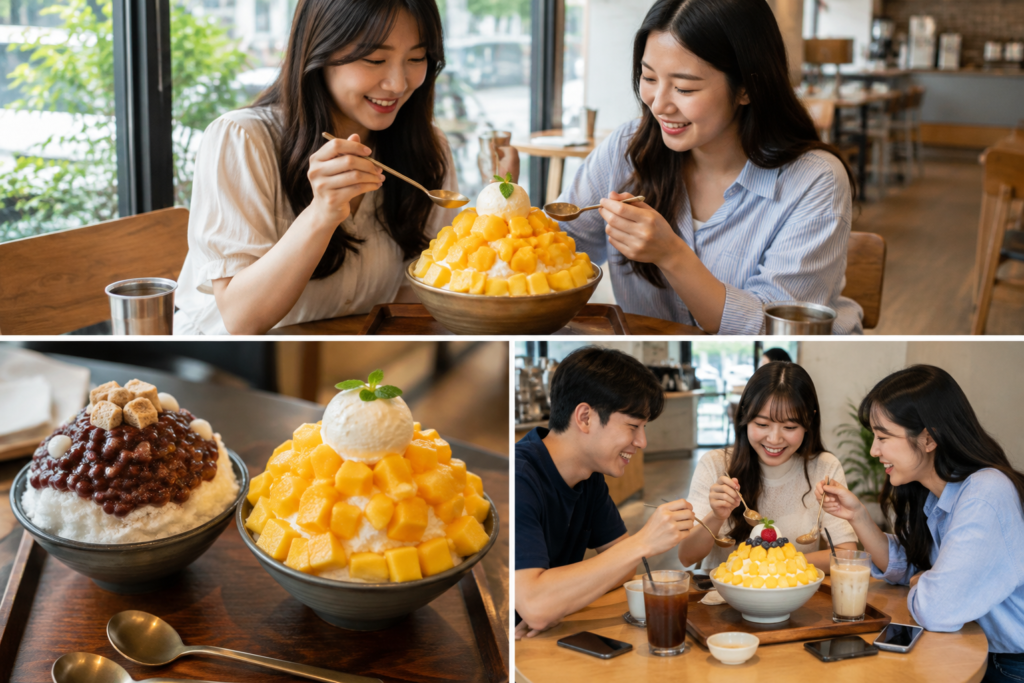
On one table is a giant bowl piled high with snow-like ice.
Another table has bright yellow mango covering what looks like a small frozen mountain.
Across the room, friends are sharing shaved ice topped with red beans and chewy pieces of rice cake.
This is:
빙수 — Bingsu
And for many Koreans, summer simply does not feel complete without it.
Korea Tourism Organization describes bingsu as one of Korea’s representative summer snacks, traditionally made from finely shaved ice with toppings such as sweetened red beans and rice cake.
Today, however, bingsu can look completely different from the traditional version.
You may find:
mango bingsu,
strawberry bingsu,
injeolmi bingsu,
green tea bingsu,
melon bingsu,
chocolate bingsu,
cheesecake bingsu,
black sesame bingsu,
and increasingly extravagant seasonal creations.
Every summer, Korean cafés seem to ask the same question:
How can we reinvent ice one more time?
First, What Exactly Is Bingsu?
The word 빙수 (bingsu) refers broadly to shaved-ice dessert.
The traditional version most foreigners encounter is:
팥빙수 — Patbingsu
팥 (pat) means red bean.
So patbingsu is literally bingsu topped with sweetened red beans.
A classic bowl may contain:
- finely shaved ice
- sweet red beans
- condensed milk
- small pieces of tteok, or rice cake
- sometimes fruit or other toppings
Korea Tourism Organization calls patbingsu a representative Korean summer snack and notes that new recipes using fashionable ingredients continue to appear every year.
That last part is important.
Because bingsu is not really one dessert anymore.
It is almost a dessert platform.
The ice is the base.
Everything else can change.
Why Does Bingsu Feel So Good in a Korean Summer?
Spend August in Seoul and the answer becomes obvious.
You walk outside.
The air feels hot.
Then humid.
Then somehow even more humid.
After twenty minutes of walking, you enter an air-conditioned café.
And there it is.
A mountain of ice.
Bingsu works because it delivers several kinds of refreshment simultaneously.
It is cold.
It melts quickly.
It contains plenty of moisture.
It is sweet without necessarily being heavy.
And because one bowl is often large enough to share, you can slowly eat it while escaping the heat inside a café.
That experience has become so closely associated with summer that Korea Tourism Organization describes Koreans as looking forward to the return of “bingsu season” each year.
In Korea, therefore, bingsu is not simply cold dessert.
It is part of the rhythm of summer.
But Bingsu Wasn’t Always Mango and Cheesecake
Modern bingsu can be spectacular.
But its older identity was much simpler.
Ice + red beans + rice cake.
Red beans already had a long place in Korean food culture, while rice cake was deeply familiar as both everyday and ceremonial food.
Add ice, and the ingredients became something especially refreshing during summer.
Korea.net notes that traditional patbingsu appears in discussions of food dating back to the Joseon period, though accounts of the exact origin of modern bingsu vary.
That distinction is worth remembering.
The history of Koreans enjoying ice is old.
But the modern café dessert we recognize today developed gradually as refrigeration, imported ingredients, cafés, dairy products, condensed milk, commercial ice machines, and changing consumer tastes transformed what could be placed in the bowl.
So today’s mango bingsu is not identical to anything a person in Joseon would have eaten.
It is the modern descendant of a much older Korean fascination with cooling summer foods.
Hidden Story: Ice Was Once a Luxury
Today, ice is almost invisible.
Open the freezer.
Press a refrigerator button.
Buy an iced Americano.
Nobody thinks twice.
But before mechanical refrigeration, summer ice was precious.
During Korea’s premodern period, ice collected during winter could be stored in specially designed facilities so that some of it survived into warmer months.
That means enjoying ice in midsummer was once far more difficult—and potentially much more prestigious—than ordering a bowl of bingsu today.
This makes the history of bingsu particularly fascinating.
Something that once depended on the difficult preservation of winter ice eventually became one of Korea’s most democratic summer pleasures.
Today, you can find bingsu in:
cafés,
dessert shops,
department stores,
traditional teahouses,
restaurant chains,
and luxury hotels.
Ice went from scarcity to experience.
From Patbingsu to “Snowflake” Bingsu
Older-style bingsu usually had a relatively straightforward shaved-ice texture.
Modern Korean bingsu changed dramatically when cafés began making the ice finer, softer, and milkier.
Instead of crunchy ice crystals, some bingsu now resembles:
freshly fallen snow.
The spoon enters almost without resistance.
The ice disappears in your mouth.
Often, the frozen base itself contains milk, giving it sweetness and creaminess even before toppings are added.
That changed bingsu from:
ice with toppings
into something closer to:
a frozen dessert with its own texture and flavor.
This opened the door to endless experimentation.
The Bingsu Flavor Revolution
Traditionalists may still choose:
팥빙수 — Patbingsu
But younger café customers might order:
망고빙수 — Mango Bingsu
Fresh mango piled over milk ice.
Or:
인절미빙수 — Injeolmi Bingsu
Finely shaved ice covered in nutty soybean powder with pieces of chewy injeolmi rice cake. KTO describes injeolmi bingsu as a variation replacing the classic red-bean emphasis with generous soybean powder and injeolmi.
Or perhaps:
딸기빙수 — Strawberry Bingsu
녹차빙수 — Green Tea Bingsu
흑임자빙수 — Black Sesame Bingsu
복숭아빙수 — Peach Bingsu
Korea.net has highlighted how Korean bingsu has become unusually diverse and rapidly transformative compared with many other shaved-ice traditions.
Every summer provides another opportunity for cafés to invent something new.
Why Is Bingsu Usually So Big?
This surprises many first-time visitors.
They order one bingsu.
Then the bowl arrives.
And suddenly they realize:
This was not designed for one person.
Many Korean bingsu portions are naturally suited to sharing.
That fits neatly with a broader characteristic of Korean eating culture.
Food is often experienced together.
Korean barbecue is shared.
Stews are shared.
Side dishes are shared.
And dessert can be shared too.
Two friends can sit around one bowl of bingsu for thirty minutes, eating slowly while talking.
Three people may order one after dinner.
A couple may share one on a date.
This makes bingsu more than dessert.
It becomes a social activity.
The Perfect Café Dessert for Korea
Bingsu also fits Korea’s café culture extremely well.
Think about what makes a successful café product.
It should taste good.
But in modern Korea, it helps if it is also:
beautiful,
seasonal,
shareable,
photogenic,
customizable,
and slightly different from what competitors offer.
Bingsu checks almost every box.
A huge mango bingsu creates visual impact before anyone takes the first bite.
A strawberry bingsu photographs beautifully.
An unusual seasonal flavor gives customers a reason to visit again.
And a limited edition creates urgency.
That is why bingsu is not merely a traditional dessert surviving in modern cafés.
In many ways, it is almost perfectly designed for modern Korean café culture.
Business Insight: Bingsu Became a Seasonal Premium Product
There is another reason bingsu is fascinating.
Its price range can be enormous.
At one end, you can find relatively affordable bingsu designed for casual sharing.
At the other end, Korean luxury hotels have repeatedly introduced premium summer bingsu using high-quality fruit and elaborate presentation. Korea.net has reported on luxury hotels competing through seasonal shaved-ice desserts, demonstrating how a once-simple summer treat evolved into a premium hospitality product.
The business logic is powerful.
The basic idea is simple:
ice + toppings.
But brands can add value through:
premium fruit,
presentation,
location,
service,
limited availability,
brand reputation,
and exclusivity.
A bowl of shaved ice can therefore move from an inexpensive snack to a luxury experience.
Why Mango Bingsu Became So Famous
Among modern bingsu varieties, mango became especially iconic.
Why?
Because mango offers almost everything modern Korean dessert culture likes.
It has a strong color.
It photographs beautifully.
It feels premium.
It works perfectly with soft milk ice.
And large pieces of fresh fruit create an immediate sense of abundance.
The visual formula is almost unbeatable:
white snow-like ice + bright yellow mango + generous presentation.
Before you eat it, you photograph it.
Then you eat it.
That sequence matters in modern café culture.
But Koreans Still Love Red Bean
With all those new flavors, you might assume classic patbingsu disappeared.
It hasn’t.
KTO notes that even as new variations appear, classic combinations featuring milk, boiled red beans, and rice cake remain popular.
That creates an interesting generational bridge.
Modern bingsu can change constantly.
But red bean keeps connecting the dessert to an older Korean taste.
One grandmother may prefer patbingsu.
Her granddaughter may want mango bingsu.
They are still both eating:
빙수.
That ability to change without completely abandoning the original may be one reason bingsu has survived so well.
Did You Know?
“Bingsu” and “Patbingsu” Are Not Exactly the Same Thing
International visitors sometimes use the words interchangeably.
But technically:
빙수 — Bingsu
is the broader category of shaved-ice dessert.
While:
팥빙수 — Patbingsu
specifically refers to bingsu featuring 팥 (pat), red beans.
So:
Mango bingsu = bingsu.
Strawberry bingsu = bingsu.
Injeolmi bingsu = bingsu.
But they are not necessarily patbingsu.
A small vocabulary difference suddenly makes ordering Korean dessert much easier.
Naru’s Travel Tips
If two people are ordering dessert after a meal, consider sharing one bingsu first.
Korean portions can be surprisingly generous.
When your bingsu arrives, don’t wait too long to photograph it.
The beautiful snow-like texture begins melting quickly.
Try a little of the shaved ice and topping together instead of immediately stirring everything into soup.
And if the menu has a seasonal fruit bingsu, it may be worth trying.
Korean cafés often use limited-time fruit menus during the ingredient’s peak season.
Most importantly:
If you think red beans sound strange in dessert, try them before deciding.
The combination of:
cold ice + sweet beans + chewy rice cake
makes much more sense after the first spoonful.
Learn 5 Korean Words
| English | Korean | Pronunciation | Chinese | Spanish |
|---|---|---|---|---|
| Shaved ice / Bingsu | 빙수 | bing-su | 刨冰 | Hielo raspado |
| Red bean | 팥 | pat | 红豆 | Frijol rojo |
| Patbingsu | 팥빙수 | pat-bing-su | 红豆刨冰 | Bingsu de frijol rojo |
| Ice | 얼음 | eo-reum | 冰 | Hielo |
| Summer | 여름 | yeo-reum | 夏天 | Verano |
Bonus Word
인절미 — in-jeol-mi
A traditional Korean rice cake covered with roasted soybean powder.
If you like nutty, slightly savory flavors, 인절미빙수 (injeolmi bingsu) is an excellent choice.
Korean Phrase of the Day
빙수 하나 주세요.
Pronunciation: Bing-su ha-na ju-se-yo.
English: One bingsu, please.
Chinese: 请给我一份刨冰。
Spanish: Un bingsu, por favor.
Want to be more specific?
망고빙수 하나 주세요.
Mang-go-bing-su ha-na ju-se-yo.
One mango bingsu, please.
Today’s Question
If you could invent your own bingsu flavor, what would you put on it?
Mango?
Chocolate?
Coffee?
Cheesecake?
Your country’s favorite fruit?
Or something completely unexpected?
Tell us in the comments.
Maybe the next Korean café trend is hiding in your answer.
Naru’s Quote
“Korean summer isn’t only something you survive. Sometimes, it’s something you eat—one melting spoonful of bingsu at a time.” — Naru
SEO FAQ
What is Korean bingsu?
Bingsu (빙수) is a Korean shaved-ice dessert typically served with sweet toppings. Traditional patbingsu contains sweetened red beans and rice cake, while modern varieties may include mango, strawberries, injeolmi, green tea, chocolate, and many other ingredients.
What is the difference between bingsu and patbingsu?
Bingsu refers to the overall category of Korean shaved-ice desserts.
Patbingsu specifically contains pat (팥), or sweetened red beans.
Why do Koreans eat bingsu in summer?
Bingsu is cold, refreshing, shareable, and strongly associated with Korea’s hot summer season. Korea Tourism Organization describes it as a representative summer snack and notes the annual return of “bingsu season.”
What is bingsu made from?
Depending on the style, the base may be finely shaved ice or a milkier frozen mixture. Toppings can include red beans, rice cakes, condensed milk, fruit, soybean powder, ice cream, chocolate, or many other ingredients.
What is the most traditional bingsu flavor?
Patbingsu, made with sweet red beans, is the classic Korean version. Red beans and rice cake remain strongly associated with traditional bingsu.
Is bingsu meant for one person?
Not necessarily. Many Korean cafés serve bingsu in bowls large enough for two or more people to share, although individual portions also exist.
What is injeolmi bingsu?
Injeolmi bingsu (인절미빙수) combines shaved ice with injeolmi rice cake and roasted soybean powder, often with condensed milk.

Bingsu Explains Something Bigger About Korea
At first glance, bingsu seems simple.
It is ice.
It is sweet.
It cools you down.
But follow its evolution and you can see something much bigger about Korea.
A traditional summer food begins with:
ice + red beans + rice cake.
Then cafés reinterpret it.
Milk makes the ice softer.
Mango turns it tropical.
Injeolmi brings traditional flavors back in a new form.
Luxury hotels make it premium.
Instagram makes presentation increasingly important.
Seasonal menus make it temporary.
Friends make it social.
And suddenly one bowl of shaved ice contains both:
old Korea and new Korea.
That pattern appears everywhere in Korean culture.
Tradition is not always preserved by freezing it exactly as it was.
Sometimes it survives because each generation changes it.
Bingsu demonstrates that beautifully.
The classic 팥빙수 has not disappeared.
It simply gained hundreds of younger cousins.
So when you visit Korea in summer and someone suggests:
“빙수 먹으러 갈래?”
— “Want to go eat bingsu?”
They are not just asking whether you want dessert.
They are inviting you into one of Korea’s favorite ways to experience summer.
🇰🇷 한국어
한국인은 왜 여름에 빙수를 좋아할까?
한국에서 여름이 시작되면 카페 메뉴판에 빠지지 않고 등장하는 것이 있습니다.
바로:
빙수
입니다.
가장 전통적인 형태는 팥빙수입니다.
곱게 간 얼음 위에 달콤하게 삶은 팥과 떡을 올려 먹는 방식으로, 한국의 대표적인 여름 간식 가운데 하나입니다. 한국관광공사 역시 팥빙수를 대표적인 여름 음식으로 소개하고 있습니다.
하지만 오늘날 빙수는 훨씬 다양해졌습니다.
망고빙수,
딸기빙수,
인절미빙수,
녹차빙수,
흑임자빙수,
복숭아빙수 등 매년 새로운 종류의 빙수가 등장합니다.
특히 우유를 이용해 눈처럼 부드러운 얼음을 만드는 방식이 인기를 끌면서 빙수는 단순히 “얼음 위에 토핑을 얹은 음식”에서 하나의 완성된 디저트로 발전했습니다.
빙수가 한국에서 특별한 또 하나의 이유는 함께 먹는 음식이라는 점입니다.
친구와 카페에 가서 빙수 하나를 주문하고 나누어 먹거나, 식사 후 여러 사람이 하나의 빙수를 같이 먹는 모습은 매우 자연스럽습니다.
빙수는 디저트이면서 동시에 여름철의 작은 사회적 경험인 셈입니다.
또한 최근에는 고급 호텔에서도 제철 과일과 프리미엄 재료를 사용한 고가의 빙수를 출시하면서 빙수가 하나의 시즌 상품이자 외식·호텔업계의 경쟁 상품으로 발전했습니다.
흥미로운 점은 이렇게 빙수가 계속 변해도 전통적인 팥빙수가 사라지지 않았다는 것입니다.
한국의 빙수는 전통을 그대로 보존하기보다:
전통을 계속 새롭게 해석하며 살아남는 음식
이라고 볼 수 있습니다.
그래서 한국의 여름을 경험하고 싶다면 한 번쯤 이렇게 말해보세요.
“빙수 먹으러 갈래?”
한국의 여름은 어쩌면 차가운 빙수 한 숟가락에서 가장 쉽게 이해할 수 있을지도 모릅니다.
为什么韩国人夏天这么喜欢吃Bingsu?
每当韩国进入炎热的夏季,咖啡馆里就会出现一种几乎不可缺少的甜品:
빙수 — Bingsu(韩式刨冰)
最经典的版本叫做:
팥빙수 — Patbingsu
“팥 (pat)”就是红豆。
传统的红豆刨冰通常由细腻的刨冰、甜红豆、炼乳和年糕组成。韩国观光公社把它称为韩国代表性的夏季小吃之一。
不过,今天的韩国刨冰已经发生了巨大变化。
你可以找到:
芒果刨冰,
草莓刨冰,
黄豆粉年糕刨冰,
抹茶刨冰,
黑芝麻刨冰,
甚至各种蛋糕和创意口味的刨冰。
现代韩国刨冰的冰也往往非常细腻,有时加入牛奶制作,口感就像雪一样柔软。
而韩国人喜欢刨冰的原因不仅仅是因为它很凉。
刨冰通常很大,适合朋友、情侣或家人一起分享。
因此,一碗刨冰不仅是一份甜点。
它也是一种社交体验。
朋友们坐在咖啡馆里,一边聊天,一边慢慢分享同一碗刨冰。
这也是为什么刨冰非常适合韩国发达的咖啡文化。
它漂亮、季节性强、适合拍照,也可以不断开发新的口味。
今天,甚至韩国的高级酒店也会在夏天推出使用高级水果制作的豪华刨冰。
从传统的红豆刨冰到豪华芒果刨冰,Bingsu的变化其实也反映了韩国文化的一个特点:
传统并不是停止变化。
有时候,传统能够留下来,正是因为每一代人都在重新创造它。
🇪🇸 Español
¿Por qué a los coreanos les encanta el bingsu en verano?
Cuando llega el verano a Corea, hay un postre que aparece prácticamente en todas partes:
빙수 — Bingsu
El bingsu es un postre coreano de hielo finamente raspado que se sirve con diferentes ingredientes dulces.
La versión más tradicional se llama:
팥빙수 — Patbingsu
La palabra 팥 (pat) significa frijol rojo.
El patbingsu clásico combina hielo raspado, frijoles rojos dulces y pequeños trozos de tteok, el pastel de arroz coreano. La Organización de Turismo de Corea lo describe como uno de los aperitivos representativos del verano coreano.
Sin embargo, el bingsu moderno ha evolucionado enormemente.
Hoy puedes encontrar:
bingsu de mango,
fresa,
té verde,
sésamo negro,
injeolmi,
melocotón,
chocolate,
e incluso versiones inspiradas en pasteles.
Además, muchos establecimientos utilizan hielo elaborado con leche y raspado extremadamente fino, creando una textura parecida a la nieve.
Pero el bingsu no es solamente popular porque sea refrescante.
También es un postre que suele compartirse.
Una pareja puede compartir un bingsu durante una cita.
Un grupo de amigos puede pedir uno después de cenar.
Y una familia puede comerlo lentamente mientras conversa en una cafetería.
Por eso el bingsu encaja perfectamente con la cultura de los cafés de Corea.
Es refrescante.
Es visual.
Es estacional.
Se puede compartir.
Y se puede reinventar prácticamente cada verano.
Incluso los hoteles de lujo de Corea compiten con versiones premium elaboradas con frutas de alta calidad y presentaciones sofisticadas.
De alguna manera, el bingsu cuenta una historia muy coreana.
La tradición no desapareció.
Simplemente siguió cambiando.