
Imagine walking through one of the busiest parts of Seoul.
Cars are moving around you.
Office towers rise above the streets.
Tourists are heading toward palaces and shopping districts.
And then you see something unexpected.
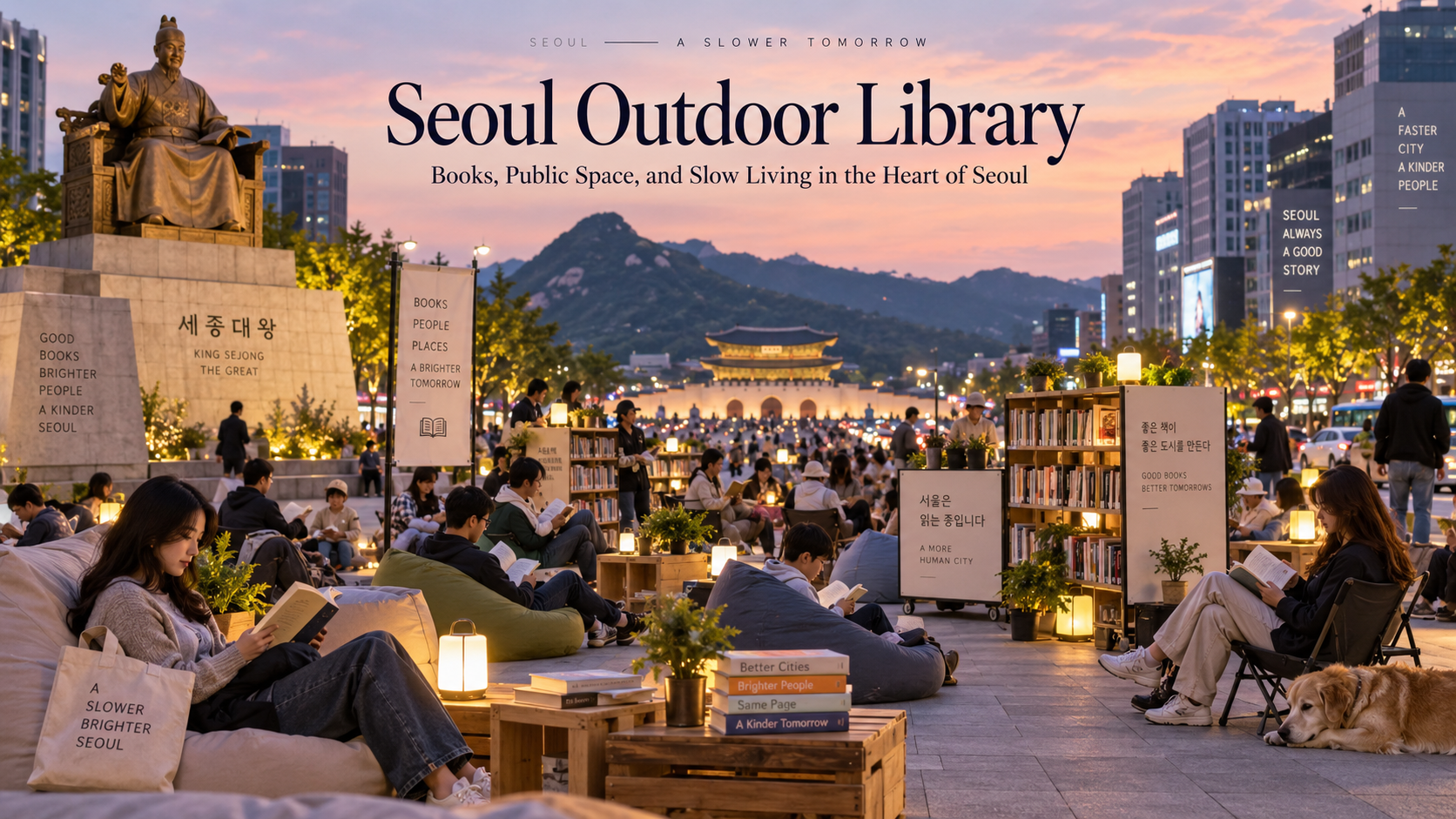
Hundreds of people are sitting on beanbags.
Some are lying on the grass.
Children are flipping through picture books.
An office worker is reading alone.
A couple is sitting beside each other under the evening lights.
This isn’t a park far outside the city.
It is the middle of Seoul.
And yes—
this is a library.
Welcome to the Seoul Outdoor Library.
1. First Question: Where Is the Building?
There isn’t one.
That is part of the idea.
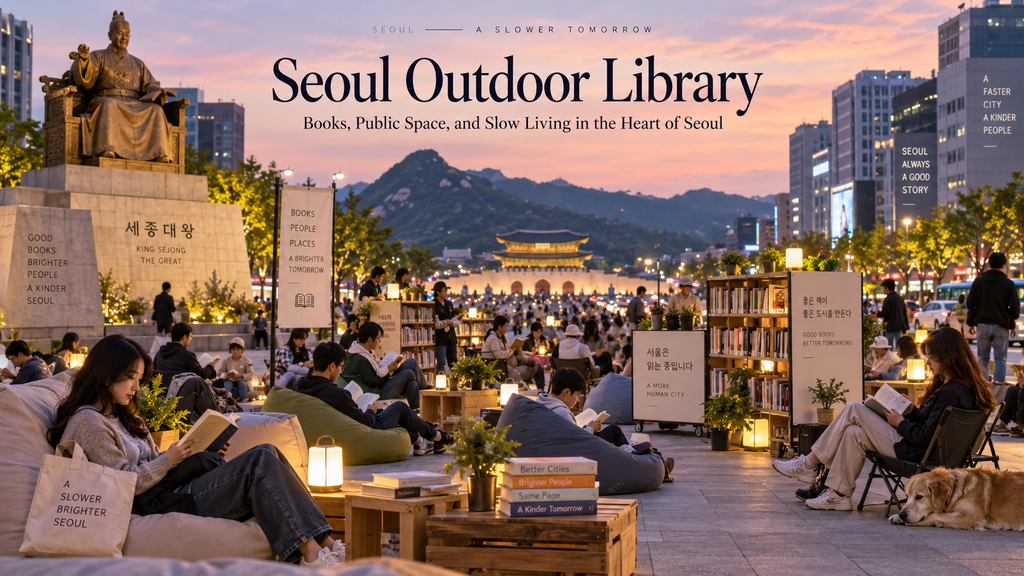
Seoul describes the project as a kind of “Buildingless Library”—a library service that expands beyond walls and brings books directly into public urban spaces.
Instead of asking people to enter a library building, Seoul does the opposite.
It takes the library to where people already are.
A city square.
A stream.
A lawn.
A major tourist district.
That small change completely alters what “going to the library” feels like.
You don’t necessarily plan to study for three hours.
You might simply see a comfortable chair, pick up a book, and stay for twenty minutes.
And perhaps that is exactly the point.
2. Three Outdoor Libraries, Three Different Versions of Seoul
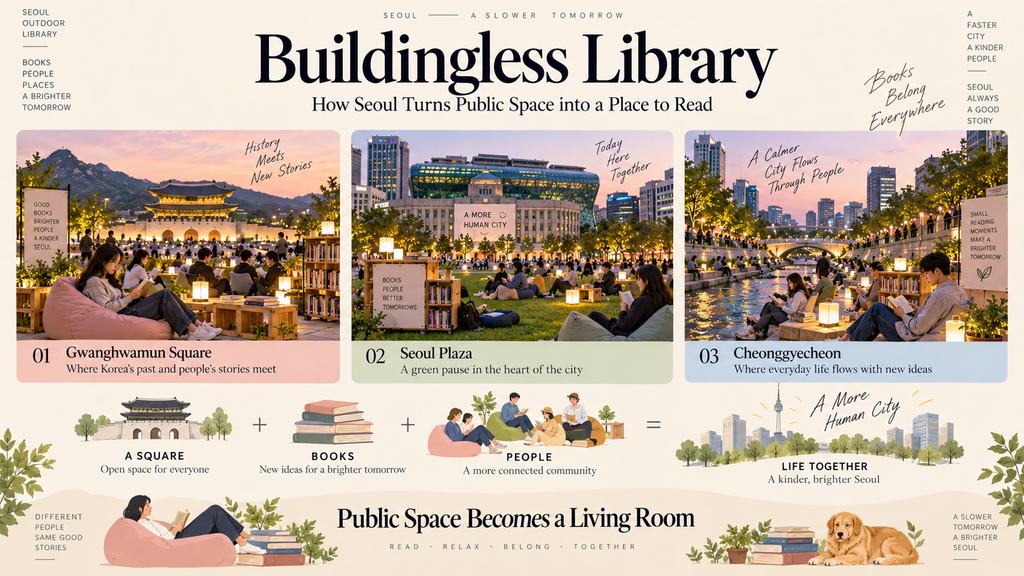
The 2026 Seoul Outdoor Library operates at three major locations in central Seoul.
But they don’t feel identical.
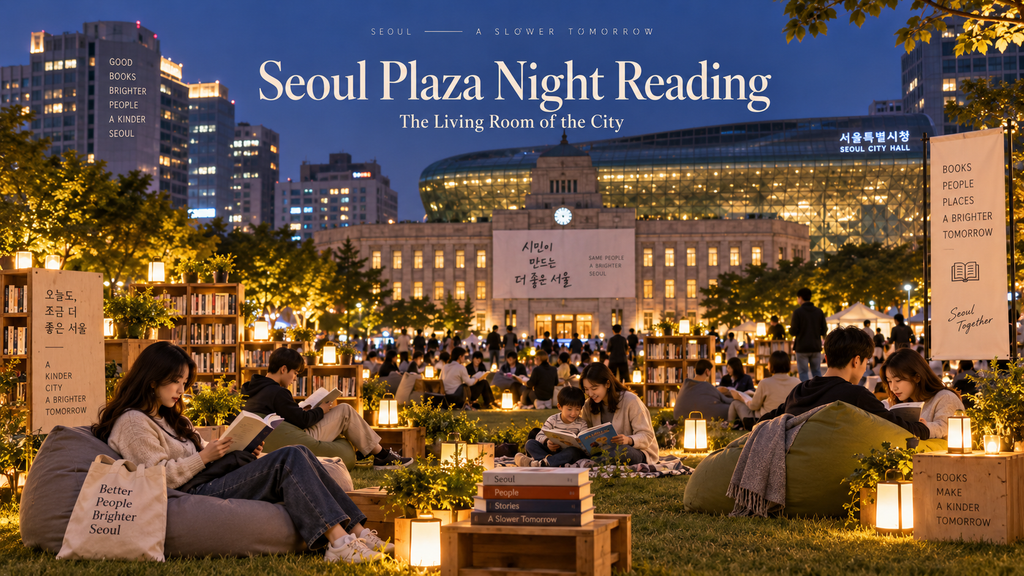
📍 Seoul Plaza — The City’s Living Room
Right in front of Seoul City Hall, a large lawn becomes a reading area.
The city itself describes this space as the “Living Room of the City.”
That description makes sense.
People don’t behave as though they are inside a formal library.
They relax.
They stretch out.
Families sit together.
People take a break between appointments.
Nearby office workers can temporarily escape their desks without actually leaving downtown Seoul.
Best for:
Families
Relaxing on the lawn
Night reading
People-watching
Visitors around Deoksugung and City Hall
📍 Gwanghwamun Square — Reading Between History and the Modern City
Gwanghwamun is very different.
Sit down with a book here and look around.
Behind the square is Gyeongbokgung Palace.
Nearby is the statue of King Sejong, the king associated with the creation of Hangeul.
Government buildings surround you.
Mountains rise behind the old palace.
And now people are sitting in the middle of all of this reading books.
Seoul describes the space as an “Urban Oasis.”
For an international visitor, I think this is perhaps the most interesting location.
You can literally sit between:
Korean history + Hangeul + government + modern Seoul + everyday life.
Best for:
First-time visitors
Photography
Combining with Gyeongbokgung
Visitors interested in Korean history
An evening break after sightseeing
📍 Cheonggyecheon — Reading Beside Running Water
Then there is the most peaceful version.
At Cheonggyecheon, books move down from the enormous city squares to the stream.
The 2026 fall location extends around the section from Mojeongyo to Gwangtonggyo.
Traffic and office buildings are still nearby.
But when you sit beside the water, Seoul suddenly feels slower.
This combination is especially interesting because Cheonggyecheon itself represents a transformation in how Seoul thinks about urban space.
Today it is a pedestrian-friendly stream.
So placing books beside it feels almost natural:
water + walking + books + rest.
Best for:
Couples
Solo travelers
Quiet reading
Evening walks
Visitors who prefer a calmer atmosphere
3. Why Would a City Do This?
At first, it might look like a cute cultural event.
Put some books outside.
Add colorful chairs.
Take photos.
Done.
But there is a larger urban idea behind it.
Big cities have a problem.
They contain enormous amounts of public space—but much of it is designed for movement.
Walk here.
Drive there.
Enter this building.
Exit that station.
Buy something.
Go somewhere else.
The Outdoor Library asks people to do something unusual:
Stay.
And do almost nothing.
Read.
Rest.
Think.
Talk.
Look at the sky.
That is a surprisingly radical idea in a city known for speed.
4. This Is Also a Different Side of Korean Culture
International images of Korea often emphasize speed.
Ppalli-ppalli culture.
Fast delivery.
Fast internet.
Fast-changing trends.
Long working hours.
Constant innovation.
All of those things exist.
But Korea also has another cultural desire that has become increasingly visible:
the desire to slow down.
You can see it in café culture.
Walking trails.
Han River picnics.
Bookstores.
“healing” travel.
And spaces like the Seoul Outdoor Library.
There is even a Korean expression closely related to this feeling:
책멍 — chaek-meong
The city introduced “Chaek-meong” activities in its 2026 Outdoor Library programming.
It combines:
책 — book
with the playful Korean concept of 멍 때리다—letting your mind drift or zoning out.
In other words:
Sometimes you don’t need to “study” a book.
You can simply sit with one.
5. Why Foreign Visitors Should Actually Try It
There are hundreds of Seoul travel lists online.
They tell you to:
visit Gyeongbokgung,
shop in Myeongdong,
eat Korean BBQ,
visit Bukchon,
go up N Seoul Tower.
Those are good experiences.
But something like the Seoul Outdoor Library shows you a completely different Korea.
You stop being a tourist rushing between attractions.
For an hour, you use the city the way residents use it.
That distinction matters.
Sometimes the best way to understand a city isn’t to visit another landmark.
It is to notice what people do when they have nowhere they need to be.
6. You Don’t Have to Read Korean
This is an important question for foreign visitors.
“But what if I can’t read Korean?”
You can still enjoy it.
Seoul specifically expanded its 2026 program for international visitors through initiatives including the Seoul Outdoor Library Tour and a Tourism Library developed with participation from 14 countries.
And even without reading much, the experience itself is worthwhile.
Find a book with photography.
Look through an art book.
Choose children’s books.
Or simply relax.
A library does not have to become homework just because you entered it.
7. Try It at Night
This may be my favorite version.
In September, the fall Seoul Outdoor Library operates during evening hours, generally from 4 PM until 10 PM on Fridays through Sundays.
The experience changes after sunset.
The office buildings light up.
Gwanghwamun becomes calmer.
Reading lamps begin to glow.
The temperature drops.
People stay longer.
At Seoul Plaza, the city has specifically developed outdoor night-reading experiences combining books with performances and cultural programming.
This means you can have a very unusual Seoul evening:
5 PM — palace
↓
6 PM — dinner
↓
7:30 PM — outdoor book
↓
9 PM — walk through central Seoul
No ticket required.
8. The Best First-Timer Route
If I were designing a half-day route for an international visitor, I would do this:
3:00 PM — Gyeongbokgung Palace
See Korea’s royal history first.
↓
5:00 PM — Gwanghwamun Square
Walk through the square and visit the Outdoor Library.
Pick up a book.
Sit for a while.
↓
6:30 PM — Dinner
Eat around Jongno or Gwanghwamun.
↓
8:00 PM — Cheonggyecheon
Walk toward the stream.
Visit the second Outdoor Library atmosphere.
↓
9:00 PM — Seoul Plaza
Finish the evening around City Hall and Deoksugung.
In a single afternoon, you move through:
Joseon history → modern Seoul → books → food → stream → nighttime city.
That is a very K-Global Stage kind of day.
9. A Small Business Insight — Free Doesn’t Mean Economically Meaningless
This is also an interesting city-branding case.
Admission to the Seoul Outdoor Library is free.
So where is the economic value?
Around it.
A successful public experience can increase:
foot traffic,
time spent in the district,
restaurant visits,
café visits,
shopping,
nearby cultural visits,
social-media exposure,
and tourists’ emotional attachment to the city.
In retail, we often talk about creating reasons for people to dwell.
Seoul is doing something similar at city scale.
The library itself does not need to sell you anything.
It creates a reason to stay downtown longer.
That can be economically valuable precisely because it does not feel commercial.
10. It Changes What a Library Can Be
Perhaps the most interesting idea is not really about Seoul.
It is about libraries.
Traditionally:
Library = Building + Books
Seoul asks whether it can instead be:
Books + People + Public Space
Once you remove the building, strange things happen.
Someone who would never intentionally visit a library reads for ten minutes.
A child sees books as part of play.
A tourist experiences Korean culture without buying a ticket.
An exhausted office worker lies down next to a novel.
And a city square designed for ceremonies and movement becomes—
for a few hours—
a place to think.
Did You Know?
The Seoul Outdoor Library began in 2022 and has since expanded into Seoul Plaza, Gwanghwamun, and Cheonggyecheon, evolving beyond reading into a broader cultural platform involving relaxation, exhibitions, performances, and community participation.
That evolution is important.
Seoul isn’t simply placing a bookshelf outdoors.
It is experimenting with what a public cultural space can be.
2026 Visitor Information
📅 Fall Season: September 4 – November 1, 2026
📆 Days: Friday–Sunday
🌙 September: Mainly evening operation, 4 PM–10 PM
☀️ October: Daytime operation, 11 AM–6 PM
📍 Locations:
Seoul Plaza
In front of Seoul City Hall
Gwanghwamun Square — Yukjo Yard
Cheonggyecheon Stream
Mojeongyo–Gwangtonggyo section
🎟️ Admission: FREE
Outdoor schedules may change depending on weather or other events, so check the official schedule before making a special trip.
5 Korean Words to Know
| English | Korean | Pronunciation | 中文 | Español |
|---|---|---|---|---|
| Book | 책 | chaek | 书 | Libro |
| Library | 도서관 | do-seo-gwan | 图书馆 | Biblioteca |
| Reading | 독서 | dok-seo | 阅读 | Lectura |
| Square | 광장 | gwang-jang | 广场 | Plaza |
| Rest | 휴식 | hyu-sik | 休息 | Descanso |
Korean Phrase of the Day
여기 있는 책을 읽어도 돼요?
Yeogi inneun chaegeul ilgeodo dwaeyo?
English: Can I read the books here?
Chinese: 我可以看这里的书吗?
Spanish: ¿Puedo leer los libros que hay aquí?
A useful phrase not only at the Outdoor Library, but at bookstores, cafés and shared reading spaces.
Today’s Question
If your city turned its main square into an outdoor library, would you actually use it?
Would you:
read a novel,
bring your children,
have a date,
take a nap beside a book,
or simply walk through?
Tell me in the comments.
Naru’s Tips
Go after sunset in September.
The lights and cooler weather make the experience much more atmospheric.
Try Gwanghwamun first.
For an international visitor, the combination of Korean history and modern city life makes it the strongest first experience.
Don’t feel pressured to finish a book.
Ten minutes counts.
Combine all three locations.
They are all in central Seoul and work well as part of the same sightseeing route.
Check the weather.
This is still an outdoor event, and schedules can change.
Hidden Story — Seoul’s Public Living Room
Perhaps the most revealing phrase Seoul uses for the project is its description of Seoul Plaza as:
“The Living Room of the City.”
Think about what a living room is.
It isn’t a place you rush through.
It isn’t necessarily somewhere you buy something.
You sit.
Rest.
Talk.
Read.
Spend time together.
Modern cities have plenty of offices, shops, roads and stations.
What they sometimes lack are places where people are allowed to simply be.
By putting books in the middle of a square, Seoul is quietly making an argument:
A good city shouldn’t only help people move faster.
It should also give them somewhere worth stopping.
Final Thoughts
Seoul is often introduced through extremes.
Ancient palaces beside skyscrapers.
Traditional markets beside luxury malls.
Quiet temples beside crowded subway stations.
The Outdoor Library adds another contrast:
one of Asia’s fastest cities asking people to slow down and read.
Maybe that’s why the concept works so well.
The books matter.
But the more interesting story is the space around them.
A plaza becomes a living room.
A stream becomes a reading room.
A tourist becomes, briefly, just another person spending an evening in Seoul.
And sometimes understanding Korea begins with something as simple as sitting down.
Opening a book.
And deciding not to hurry anywhere for the next thirty minutes.
Naru’s Quote
“A city becomes more human not only when it gives people somewhere to go, but when it gives them a reason to stay.” — Naru
서울은 왜 도심 광장을 야외도서관으로 만들까?
서울 한복판을 걷다가 조금 이상한 장면을 만납니다.
광화문광장에 사람들이 책을 읽고 있습니다.
서울광장에서는 빈백에 누워 있고, 청계천에서는 흐르는 물 옆에서 책장을 넘깁니다.
이곳에는 도서관 건물이 없습니다.
그래서 더 흥미롭습니다.
서울야외도서관은 기존의 **“도서관에 사람이 찾아가는 방식”**을 뒤집습니다.
도서관이 사람에게 찾아갑니다.
서울시는 이를 건물의 한계를 넘어서는 Buildingless Library 개념으로 설명하고 있습니다.
세 공간은 서로 다른 서울을 보여준다
서울광장은 서울시가 표현한 그대로 도시의 거실에 가깝습니다. 잔디밭에서 가족, 직장인, 관광객이 함께 쉬고 책을 읽습니다.
광화문광장은 역사와 현대가 함께 보입니다. 경복궁과 세종대왕, 정부청사와 현대 서울 사이에서 책을 읽는 경험 자체가 특별합니다.
청계천은 가장 느리고 조용한 버전입니다. 물소리를 들으며 책을 읽거나 산책할 수 있습니다.
왜 서울은 이런 공간을 만들까?
대도시의 공간 대부분은 사람을 움직이게 합니다.
출근하고,
쇼핑하고,
이동하고,
다음 장소로 갑니다.
서울야외도서관은 반대로 말합니다.
잠깐 머물러도 괜찮습니다.
한국이 흔히 빨리빨리 문화로 설명되는 것을 생각하면 오히려 더 재미있는 장면입니다.
빠른 도시 한복판에서 사람들이 의도적으로 느려지는 것입니다.
외국인에게도 추천하는 이유
서울 여행을 하면 궁궐, 쇼핑, 맛집 같은 관광지를 계속 이동하게 됩니다.
하지만 야외도서관에서는 한 시간 정도 관광객 역할을 멈출 수 있습니다.
서울 시민들처럼 앉아 있습니다.
책을 넘겨봅니다.
사람을 구경합니다.
밤이 오는 모습을 봅니다.
그 순간에는 서울을 구경하는 것이 아니라 서울을 사용하는 것에 가까워집니다.
2026년에는 외국인 방문객을 위한 Outdoor Library Tour와 14개국이 참여한 Tourism Library 콘텐츠도 확대됐습니다.
2026 운영정보
9월 4일–11월 1일
매주 금–일
9월 야간: 16:00–22:00
10월 주간: 11:00–18:00
서울광장 / 광화문광장 / 청계천
무료
날씨나 행사에 따라 변경될 수 있습니다.
Today’s Question
여러분의 도시 한복판 광장이 야외도서관으로 바뀐다면 이용하시겠어요?
Naru’s Quote
“좋은 도시는 사람을 빨리 이동시키는 것만으로 완성되지 않는다. 사람들이 잠시 머물고 싶게 만들어야 한다.” — Naru
为什么首尔把城市广场变成露天图书馆?
在首尔最繁忙的市中心,你可能会看到一个有些意外的场景。
有人躺在草地上的懒人沙发里看书。
孩子们翻阅绘本。
上班族一个人坐着阅读。
情侣们在夜灯下并排休息。
这里不是郊外的公园。
而是首尔市中心。
这就是 Seoul Outdoor Library——首尔户外图书馆。
它最有趣的地方在于:
图书馆没有建筑。
首尔将这个项目称为一种 “Buildingless Library”。
不是让人走进图书馆,而是让书和阅读空间直接来到人们所在的公共空间。
三个地点,三种不同的首尔体验
首尔广场像一个城市客厅。
光化门广场把韩国历史与现代城市生活放在同一个空间里。
清溪川则提供一种更加安静的阅读体验,可以一边听流水声一边看书。
对外国游客来说,我最推荐首先体验光化门。
因为你可以在景福宫、世宗大王以及现代首尔的城市建筑之间坐下来阅读。
为什么首尔要这样做?
大城市通常鼓励人们不断移动。
去工作。
去购物。
坐地铁。
去下一个景点。
户外图书馆却在鼓励另一件事情:
停下来。
阅读。
休息。
看看天空。
甚至什么都不做。
这在以速度闻名的首尔尤其有意思。
外国游客不会韩语怎么办?
完全没有问题。
2026年首尔进一步增加了面向外国游客的项目,包括 Seoul Outdoor Library Tour,以及与14个国家合作的 Tourism Library。
即使你不读韩语,也可以选择摄影、艺术、绘本等内容,或者单纯享受这个空间。
2026年秋季信息
📅 9月4日–11月1日
📆 每周五至周日
🌙 9月:16:00–22:00
☀️ 10月:11:00–18:00
📍 首尔广场 / 光化门广场 / 清溪川
🎟️ 免费
户外活动可能因天气等原因调整。
Today’s Question
如果你的城市把最大的广场变成户外图书馆,你会去吗?
Naru’s Quote
“一座好城市,不只是让人更快到达目的地,也应该给人一个愿意停留下来的理由。” — Naru
🇪🇸 Versión en Español
¿Por qué Seúl convierte sus plazas en bibliotecas al aire libre?
Caminas por una de las zonas más concurridas de Seúl.
Hay oficinas, tráfico, turistas y grandes edificios.
De repente encuentras algo inesperado.
Personas tumbadas sobre cojines leyendo.
Niños mirando libros ilustrados.
Trabajadores descansando con una novela.
Parejas leyendo bajo las luces de la noche.
No estás en un parque a las afueras.
Estás en pleno centro de Seúl.
Bienvenido a la Seoul Outdoor Library.
Y hay algo especialmente curioso:
No hay edificio.
Seúl ha descrito el proyecto como una “Buildingless Library”, una biblioteca que sale de sus paredes y lleva los libros directamente al espacio público.
Tres lugares, tres experiencias
En Seoul Plaza, la sensación es parecida a estar en el salón de una enorme ciudad.
En Gwanghwamun Square, puedes leer rodeado de historia coreana y del paisaje urbano moderno.
En Cheonggyecheon, la experiencia es más tranquila: libros, agua, paseo y descanso.
Para un visitante extranjero, Gwanghwamun es probablemente el lugar más interesante para empezar.
Puedes ver la zona de Gyeongbokgung y el centro histórico de Seúl mientras participas en una actividad cotidiana de la ciudad moderna.
¿Por qué hacer una biblioteca en una plaza?
Las grandes ciudades suelen estar diseñadas para moverse.
Trabajar.
Comprar.
Tomar el metro.
Llegar al siguiente lugar.
La biblioteca propone algo diferente:
quédate un rato.
Lee.
Descansa.
Habla.
Mira el cielo.
Es una idea especialmente interesante en una ciudad que muchas veces se asocia con la velocidad.
¿Y si no sabes coreano?
No importa.
En 2026 Seúl amplió también programas para visitantes internacionales, incluido el Seoul Outdoor Library Tour y una Tourism Library desarrollada con participación de 14 países.
Y no tienes que leer una novela completa para disfrutar del lugar.
Puedes mirar un libro de fotografía.
Sentarte.
Observar a la gente.
O simplemente descansar.
Información para otoño de 2026
📅 4 de septiembre–1 de noviembre
📆 Viernes–domingo
🌙 Septiembre: 16:00–22:00
☀️ Octubre: 11:00–18:00
📍 Seoul Plaza / Gwanghwamun Square / Cheonggyecheon
🎟️ Entrada gratuita
Los horarios pueden cambiar por condiciones meteorológicas u otros eventos.
Today’s Question
Si tu ciudad transformara su plaza principal en una biblioteca al aire libre, ¿la utilizarías?
Naru’s Quote
“Una buena ciudad no solo ayuda a las personas a llegar más rápido. También les da una razón para quedarse.” — Naru