
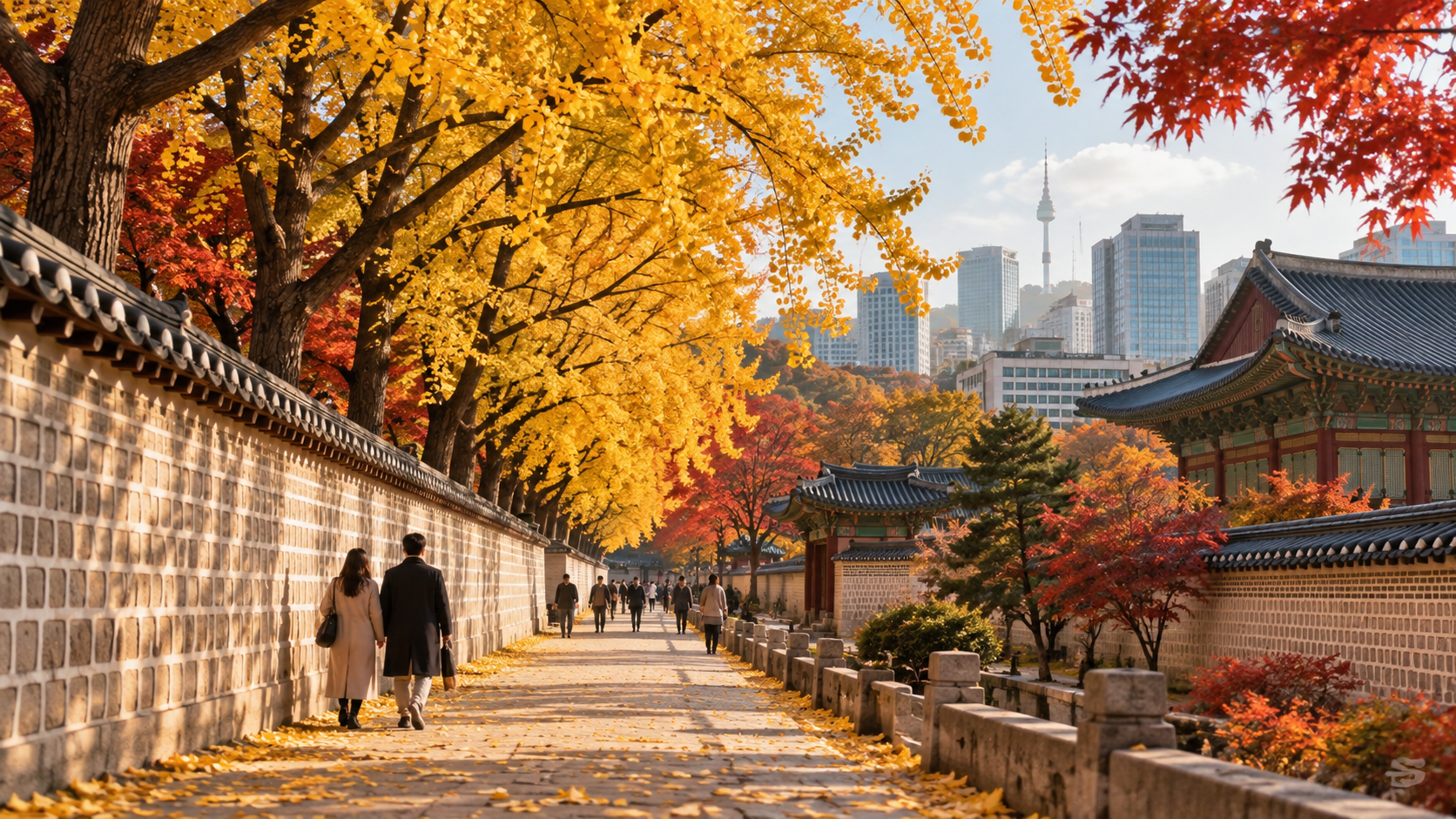
Why Korean Palaces Look Better in Autumn
A Foreigner’s Guide to Seoul’s Most Beautiful Season
If you visit Korea in autumn, you may notice something surprising.
The palaces do not just look beautiful.
They look even better.
Of course, Korean palaces are impressive in every season.
Spring brings blossoms.
Summer adds deep green trees.
Winter covers tiled roofs with snow.
But autumn feels different.
Something about the combination of palace roofs, wooden halls, dancheong colors, golden leaves, crisp air, and softer sunlight makes Korea’s royal architecture feel especially complete.
So why do Korean palaces look so much better in autumn?
The answer is not only about the weather.
It is also about color, space, history, and the way Korean architecture connects with nature.
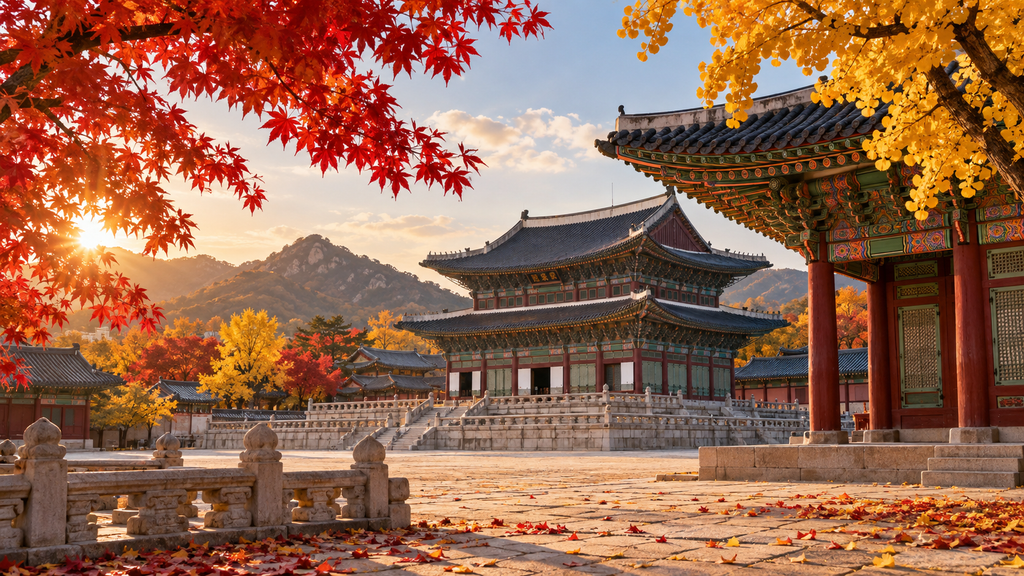
1. Autumn Makes the Colors of the Palace Stand Out
One of the first things visitors notice at a Korean palace is the color.
The painted decorative patterns on traditional buildings are called dancheong (단청).
These patterns often include green, red, blue, white, and yellow.
In summer, those colors compete with strong green trees and intense sunlight.
In winter, the overall scene can feel quieter and more monochrome.
But in autumn, everything comes into balance.
The red columns, green painted eaves, and dark gray roof tiles sit naturally beside yellow ginkgo leaves, red maple leaves, and a softer sky.
This is one reason autumn photographs of palaces often look so striking.
The architecture and the season seem to speak the same visual language.
2. Korean Palaces Were Never Meant to Be Separate From Nature
Many first-time visitors think of a palace as a building.
But Korean palaces are better understood as a landscape.
They are not only halls and gates.
They include courtyards, gardens, stone paths, trees, ponds, walls, and views toward surrounding mountains.
This is especially important in Seoul.
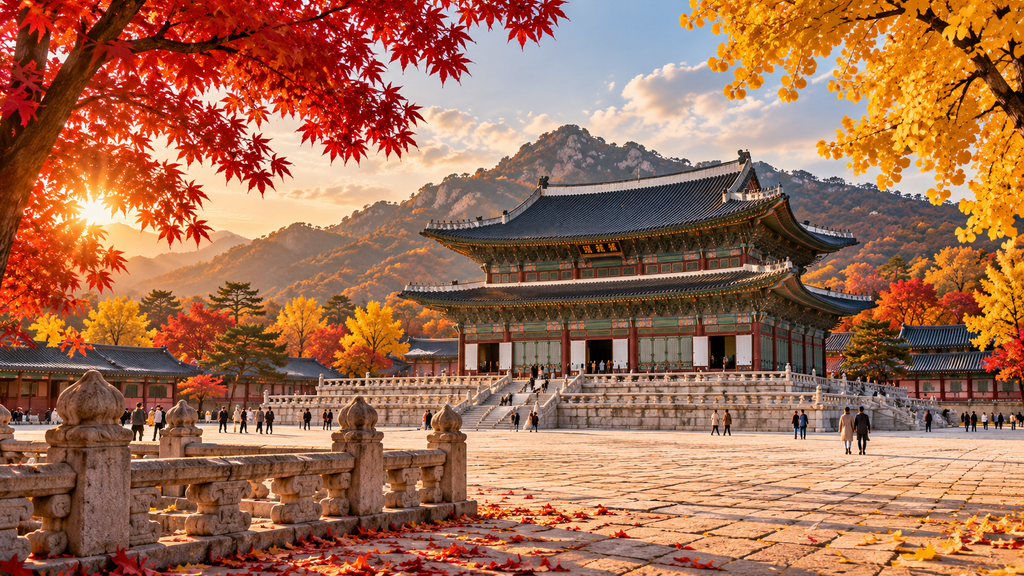
Look at Gyeongbokgung, and you will see mountains behind it.
Visit Changdeokgung, and the famous Secret Garden makes even more sense in autumn.
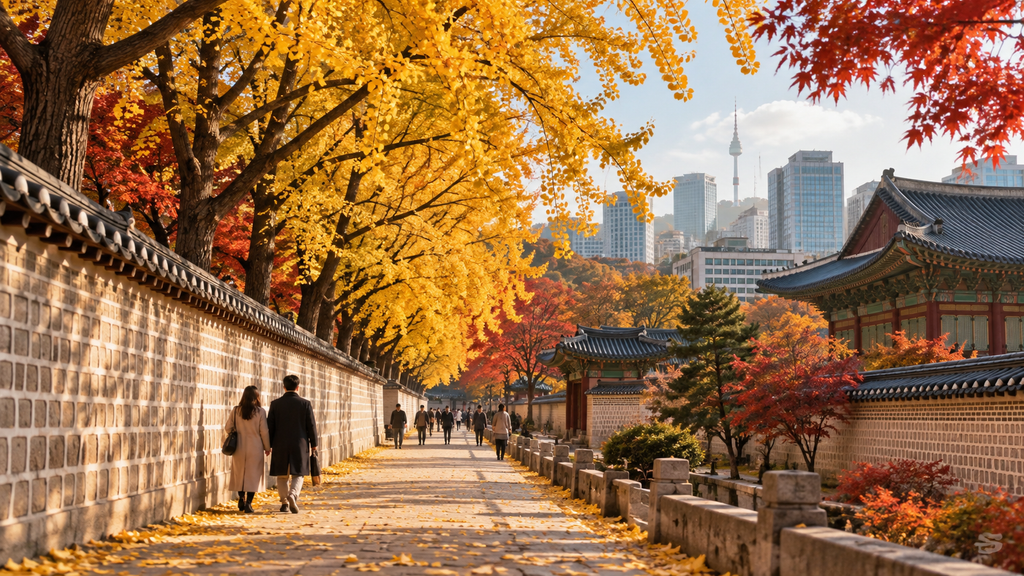
Walk through Deoksugung, and the stone walls under golden trees create one of the most memorable autumn scenes in the city.
Korean royal architecture was designed to exist with nature, not against it.
Autumn simply makes that relationship easier to see.
3. The Light Feels Softer—and Softer Light Is Good for Palaces
Autumn light is one of the secret reasons this season feels so beautiful.
In many places, summer light can be too harsh.
It creates sharp shadows and a strong contrast that sometimes overwhelms architectural details.
Autumn sunlight is gentler.
It often feels lower, warmer, and more golden.
That kind of light works wonderfully with Korean palaces.
It softens wooden surfaces.
It brings out the texture of roof tiles.
It makes courtyards glow in the late afternoon.
And it gives traditional buildings a warmth that matches the historical feeling of the place.
This is also why so many visitors feel that palaces are especially photogenic in autumn—even if they cannot immediately explain why.
4. Fallen Leaves Make the Ground as Beautiful as the Buildings
When people think about autumn beauty, they usually look up.
At palaces, you should also look down.
Stone paths covered with yellow leaves.
Courtyards edged with fallen red maple leaves.
Paths leading through palace gardens with leaves gathered along the walls.
These details matter.
Korean palaces often create beauty not through one dramatic object, but through the balance of many quiet elements.
A tiled roof.
A painted beam.
A tree branch.
A stone wall.
A carpet of leaves.
Together, they create a scene that feels calm rather than overwhelming.
That quiet elegance is one reason autumn suits Korean palaces so well.
5. The Air Feels More Suitable for History
This may sound strange, but weather affects emotion.
In the heat of summer, visitors often hurry.
They search for shade.
They move quickly.
In winter, people may focus more on staying warm than looking carefully.
Autumn is different.
The air is cool enough to walk slowly.
The sky is often clear.
You are more willing to pause in a courtyard or follow a long stone path.
And because you are physically more comfortable, you tend to notice more.
That slower pace changes the palace experience.
You do not just see the palace.
You begin to feel its rhythm.
And Korean palaces reward slow observation.
6. Autumn Matches the Emotional Mood of Traditional Architecture
Korean palaces are not flashy in the way some royal buildings in other countries can be.
They are elegant, balanced, and often restrained.
Their beauty grows through proportion, repetition, open space, and atmosphere.
Autumn has a similar emotional tone.
It is not the explosive energy of spring.
It is not the intense brightness of summer.
It is not the silence of winter.
It feels more reflective.
More mature.
More poetic.
That is why autumn seems to fit palace architecture so naturally.
The season and the buildings share the same emotional mood.
7. Mountains Matter More Than You Think
One of the most distinctive features of Seoul’s palaces is that they often sit with mountains in the background.
This is especially true at Gyeongbokgung.
If you stand in the right place, you can see palace roofs in front and mountain ridges behind.
In autumn, those mountain slopes begin to change color.
That makes the palace feel less like an isolated historical site and more like part of a larger natural setting.
For many international visitors, this becomes one of the most memorable aspects of Korean palace scenery.
It is not just architecture.
It is architecture inside a seasonal landscape.
8. Each Palace Has a Different Autumn Personality
If you want to write this article in a more practical way, this section is especially useful.
Gyeongbokgung
Best for: first-time visitors, grand views, mountain backdrop
Gyeongbokgung feels majestic in autumn.
The wide courtyards and mountain views make the season feel dramatic and iconic.
Changdeokgung
Best for: garden lovers, quieter beauty, walking slowly
Changdeokgung is perhaps the most poetic autumn palace, especially because of its relationship with the Secret Garden.
Deoksugung
Best for: city atmosphere, famous stone-wall road, easy short visit
Deoksugung shows how beautifully autumn and urban Seoul can meet.
Changgyeonggung
Best for: calmer atmosphere, less crowded visits
Changgyeonggung often feels gentler and more spacious, which can be ideal for a slower autumn walk.
This helps foreign readers understand that not all palace visits feel the same.
9. Autumn Makes Palace Visits Feel More “Korean”
There is something very specifically Korean about walking through a palace courtyard in cool autumn air.
The tiled roofs.
The smell of dry leaves.
The mountain view.
The slightly quiet mood.
The balance between human design and natural change.
This combination helps international visitors understand something important:
Korean beauty is often not about one object standing alone.
It is about relationships.
Between building and mountain.
Between painted wood and changing leaves.
Between history and season.
Between emptiness and detail.
Autumn makes those relationships more visible.
That is why palace visits in this season often feel especially meaningful.
10. The Best Palace Experience Is Not to Rush
If you only want a quick photo, any season may be enough.
But if you want to understand why Korean palaces are so loved, autumn gives you a better chance.
Walk slowly.
Sit for a moment.
Look through a gate rather than only at it.
Notice how the colors change from sunlight to shade.
Watch how the leaves collect along the base of a wall.
Look at the mountains behind the roofline.
This is when a palace becomes more than a sightseeing stop.
It becomes a mood.
And autumn is the season that reveals that mood most clearly.
Did You Know?
The colorful decorative painting on traditional Korean buildings is called dancheong (단청).
It was not used only for beauty. It also helped protect wooden structures and expressed symbolic meanings through color and pattern.
5 Korean Words to Know
| English | Korean | Pronunciation | Chinese | Spanish |
|---|---|---|---|---|
| Palace | 궁궐 | gung-gwol | 宫殿 | Palacio |
| Autumn | 가을 | ga-eul | 秋天 | Otoño |
| Autumn leaves | 단풍 | dan-pung | 红叶 | Hojas otoñales |
| Dancheong | 단청 | dan-cheong | 丹青 | Dancheong |
| Garden | 정원 | jeong-won | 庭园 | Jardín |
Korean Phrase of the Day
단풍이 정말 아름다워요.
Danpungi jeongmal areumdawoyo.
English: The autumn leaves are really beautiful.
Chinese: 红叶真的很美。
Spanish: Las hojas de otoño son realmente hermosas.
Today’s Question
If you could visit only one Korean palace in autumn, which would you choose—Gyeongbokgung, Changdeokgung, Deoksugung, or Changgyeonggung?
Tell me which one you would pick, and why.
Naru’s Tips
- Go in the late afternoon for softer light.
- Do not visit only for the main gate—walk deeper inside.
- Combine one big palace and one quieter one on the same day.
- Bring comfortable shoes because the best autumn palace experience is a slow walk.
- Look at the trees as much as the buildings.
Hidden Story
Many people assume autumn makes palaces beautiful simply because leaves turn red and yellow.
But the deeper reason is that Korean palace architecture was never meant to dominate nature.
It was meant to exist with it.
That is why autumn feels so right.
The season does not decorate the palace from the outside.
It completes the palace in the way it was always meant to be seen.
Final Thoughts
Korean palaces are beautiful all year.
But autumn gives them something special.
It sharpens the colors.
Softens the light.
Slows the visitor down.
And makes the relationship between architecture and nature easier to understand.
If spring makes Korean palaces feel lively and winter makes them feel quiet, autumn makes them feel complete.
That may be the simplest reason they look better.
Not because the buildings change—
but because the season reveals what was already there.
Naru’s Quote
“In autumn, Korean palaces do not try to stand out from nature. They finally seem to breathe with it.” — Naru
왜 한국 궁궐은 가을에 더 아름다워 보일까
가을에 한국 궁궐을 방문하면 단순히 “예쁘다”는 느낌을 넘어서
궁궐이 가장 잘 어울리는 계절이 바로 가을이 아닐까 하는 생각이 듭니다.
그 이유는 단풍 때문만은 아닙니다.
궁궐의 단청 색, 기와지붕, 나무 기둥, 돌길, 담장, 그리고 뒤편의 산 풍경이
가을의 부드러운 햇빛과 노란 은행잎, 붉은 단풍과 아주 잘 어울리기 때문입니다.
특히 한국 궁궐은 건물만 보는 공간이 아니라
마당, 정원, 길, 나무, 하늘, 산까지 함께 보는 풍경에 가깝습니다.
그래서 가을에는 궁궐이 자연과 더 잘 연결되어 보입니다.
궁궐별 가을 분위기
- 경복궁: 가장 웅장하고, 산 배경이 아름다움
- 창덕궁: 후원과 함께 가장 시적이고 고즈넉한 느낌
- 덕수궁: 돌담길과 도심 풍경이 함께 어우러짐
- 창경궁: 비교적 한적하고 천천히 걷기 좋음
가을 궁궐의 가장 큰 매력은 서두르지 않을 때 더 잘 보인다는 점입니다.
단풍을 보고, 담장 아래 떨어진 잎을 보고, 햇빛이 바뀌는 것을 느끼며 천천히 걸을 때
궁궐은 단순한 관광지가 아니라 하나의 분위기와 감정으로 다가옵니다.
Today’s Question
가을에 궁궐 한 곳만 갈 수 있다면 어디를 선택하시겠어요?
Naru’s Quote
“가을의 한국 궁궐은 자연과 경쟁하지 않는다. 오히려 자연과 함께 가장 완전해진다.” — Naru
为什么韩国宫殿在秋天看起来更美?
如果你在秋天参观韩国宫殿,你可能会发现一个有趣的现象:
它们不仅很美,
而且似乎在秋天变得更完整了。
原因不只是红叶。
韩国宫殿的美,来自建筑与自然的关系。
丹青的绿色与红色、深灰色瓦顶、木质结构、庭院、石路,再加上金黄的银杏叶和红色枫叶,形成了非常和谐的画面。
韩国宫殿并不是单独存在的建筑物。
它们更像是一种风景。
你看到的不只是殿阁,
还有院子、围墙、树木、花园和远处的山。
因此,秋天会让这种“建筑与自然一起存在”的美感更加明显。
不同宫殿,不同秋天气质
- 景福宫:宏伟,适合第一次来首尔的游客
- 昌德宫:最有诗意,尤其是后苑
- 德寿宫:城市气息与秋景结合得很好
- 昌庆宫:更安静,适合慢慢散步
秋天最适合做的一件事,不是匆匆拍照,而是慢慢走。
看看阳光如何落在屋檐上,
看看落叶如何铺在石路边,
你会更容易理解韩国宫殿的魅力。
Today’s Question
如果秋天只能去一个韩国宫殿,你会选择哪里?
Naru’s Quote
“在秋天,韩国宫殿并不是从自然中跳出来,而是终于和自然一起呼吸。” — Naru
🇪🇸 Versión en Español
Por qué los palacios coreanos se ven mejor en otoño
Si visitas un palacio coreano en otoño, quizá sientas que algo encaja de una manera especial.
No es solo que el lugar sea bonito.
Es que en otoño parece más completo.
La razón no es solamente el color de las hojas.
También tiene que ver con la relación entre la arquitectura y la naturaleza.
Los colores del dancheong, los tejados oscuros, la madera, los caminos de piedra, los muros y las montañas del fondo combinan perfectamente con la luz suave del otoño y con las hojas amarillas y rojas.
Los palacios coreanos no son solo edificios.
Son paisajes.
Por eso el otoño los favorece tanto.
Cada palacio tiene una personalidad otoñal diferente
- Gyeongbokgung: grande, majestuoso, con montañas al fondo
- Changdeokgung: poético y tranquilo, especialmente con su jardín
- Deoksugung: ideal para combinar ciudad y palacio
- Changgyeonggung: más calmado y menos concurrido
En otoño, lo mejor no es correr de un lugar a otro.
Lo mejor es caminar despacio.
Mirar las hojas caídas.
Observar cómo cambia la luz.
Y dejar que el palacio se sienta como algo más que una atracción turística.
Today’s Question
Si solo pudieras visitar un palacio coreano en otoño, cuál elegirías?
Naru’s Quote
“En otoño, los palacios coreanos no intentan destacar contra la naturaleza. Finalmente parecen respirar con ella.” — Naru