
Why Does Baseball Feel Different in Korea?
Imagine going to a baseball game.
You expect the usual sounds:
the crack of the bat,
the umpire’s call,
and occasional cheers from the crowd.
Then the Korean team comes up to bat.
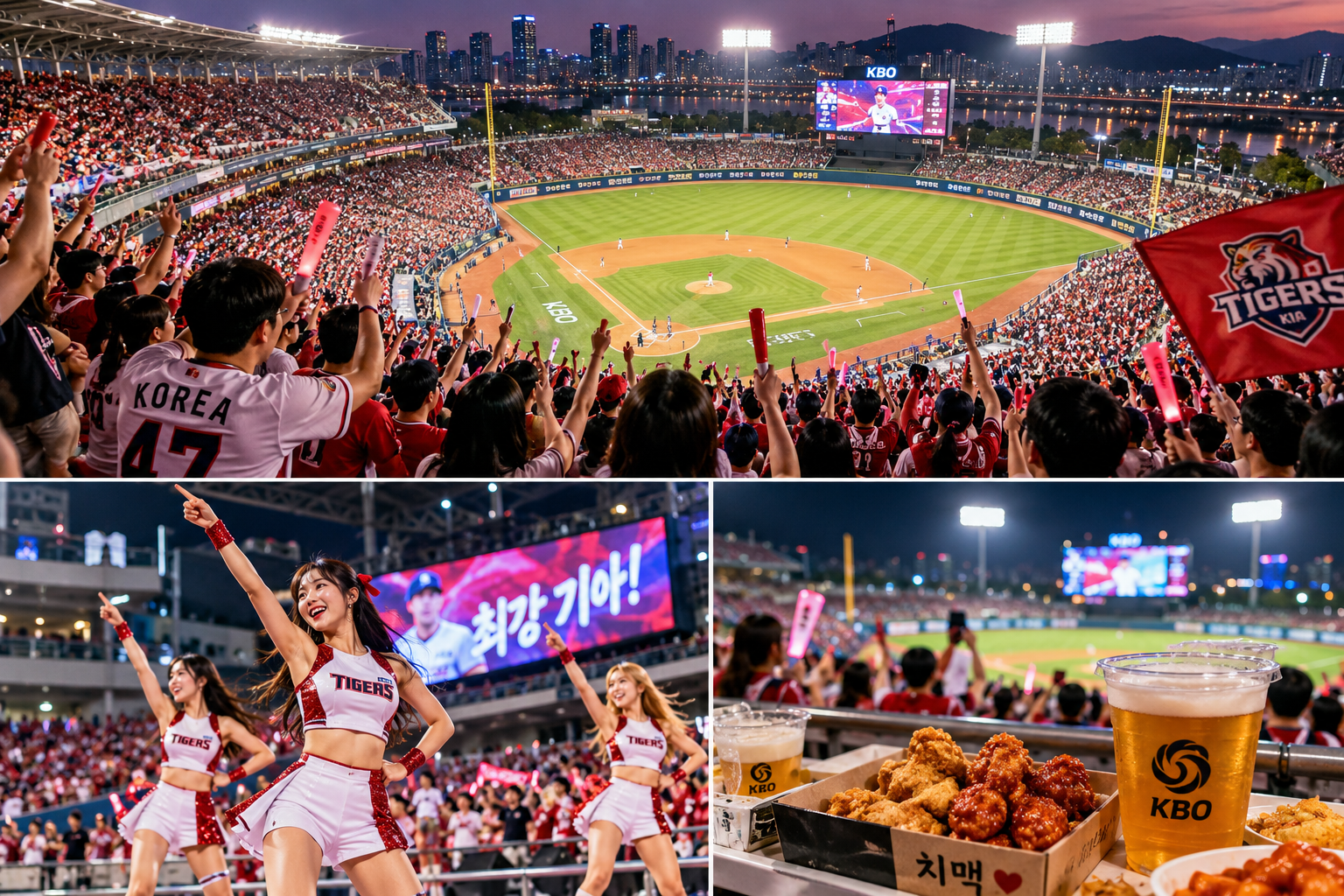
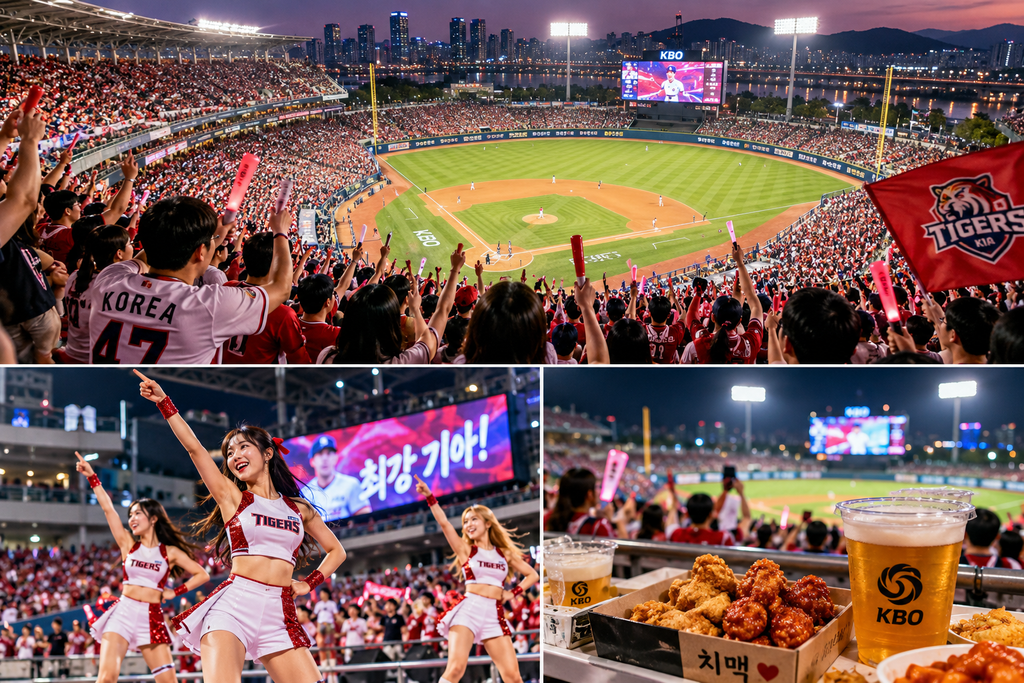
Suddenly, thousands of people stand up.
Music starts.
A cheerleader climbs onto a stage.
Fans begin singing the batter’s name in perfect rhythm.
Someone beside you is waving a cheering stick.
Someone else is eating fried chicken.
And even if you know almost nothing about baseball, ten minutes later you may find yourself singing along too.
Welcome to Korean baseball.
And when autumn arrives, everything becomes even more intense.
Koreans have a special expression for it:
가을야구 — Gaeul Yagu
Literally:
“Autumn Baseball.”
But it does not simply mean baseball played during autumn.
In Korean sports culture, 가을야구 usually refers to the KBO postseason—the games that decide which team ultimately becomes champion.
And for fans, reaching autumn baseball means one thing:
Your team’s season is still alive.
1. First, What Is the KBO?
The KBO League is South Korea’s top professional baseball league.
In 2026, the league consists of 10 teams, and each team plays 144 regular-season games, for 720 scheduled games across the league. The season opened on March 28.
But Korean baseball is currently experiencing an especially strong period of popularity.
By September 12, 2026, the KBO League had already surpassed 11 million spectators, reaching the milestone in just 626 games—17 games faster than the 2025 season. Seven teams had already passed one million home spectators, and the overall seat occupancy rate stood at 85.2%.
That means when autumn arrives, you’re not watching a niche sport suddenly become popular.
You’re watching an already packed league become even more emotionally intense.
2. What Exactly Is “Autumn Baseball”?
During the regular season, every team still has tomorrow.
Lose tonight?
There is another game.
Lose three in a row?
There are still months left.
Autumn baseball changes that feeling.
Only the top teams remain in the postseason.
Now every pitch matters more.
Every defensive mistake feels bigger.
Every home run can change a season.
And eventually, losing means going home.
This is why Korean fans often ask during the second half of the year:
“우리 팀 가을야구 갈 수 있을까?”
Uri tim gaeul-yagu gal su isseulkka?
“Can our team make it to autumn baseball?”
The phrase itself tells you something interesting.
Korean fans don’t always talk about the postseason like a technical tournament stage.
They talk about it like a season they have earned the right to enter.
3. Korean Baseball Cheering Feels More Like a Concert
This is where Korean baseball becomes especially different for many foreign visitors.
In many stadiums around the world, the crowd reacts mainly to what happens on the field.
Korean baseball fans do that too.
But they also create entertainment continuously.
When their team is batting, organized cheering can continue almost nonstop.
Different players often have their own:
entrance music,
cheer song,
chant,
and rhythm.
The Korea Tourism Organization describes Korean baseball stadiums as places where synchronized singing, choreographed cheering and player-specific songs create a concert-like atmosphere. Younger fans, particularly those in their 20s, have also become an increasingly visible part of the crowd.
That means even a routine at-bat can become a performance.
The player steps up.
The song starts.
The fans stand.
And suddenly 20,000 people know exactly what to sing.
4. Every Player Can Have His Own Song
This may be one of the biggest surprises for an international baseball fan.
In Korea, you don’t only cheer for the team.
You can learn songs for individual players.
A batter comes to the plate and his personal cheer song begins.
His name may be worked into the lyrics.
Fans clap in a specific rhythm.
Some perform matching movements.
Then the next hitter arrives—and the song changes.
For newcomers, it can feel like attending a K-pop concert where the performers happen to be playing baseball.
VISITKOREA even describes Korean postseason games as erupting into synchronized K-pop-style songs and choreographed cheers, turning the stadium into what feels like one large festival.
5. Cheerleaders Are Part of the Game Experience
Another distinctive feature is the organized cheering section.
Cheerleaders and cheer masters help guide the crowd.
They signal:
when to clap,
what song to sing,
when to shout,
and sometimes what movement to perform.
This means you do not need to know the cheer in advance.
Just watch the people around you.
Within one or two innings, you’ll probably understand enough to join.
That’s one reason Korean baseball can be remarkably accessible to foreigners.
You don’t need to understand every statistic.
You don’t even need to understand every Korean lyric.
Participation comes first.
Understanding often follows.
6. Korean Baseball and K-Pop Fan Culture Are Starting to Overlap
Modern Korean baseball fandom also looks increasingly familiar to anyone who understands K-pop culture.
Fans customize jerseys.
They collect player photo cards.
They buy character collaborations.
They use sophisticated cheering sticks.
Some fan merchandise is designed less like traditional sports gear and more like idol merchandise.
VISITKOREA notes that player photo cards, customized uniforms and light-stick-style cheering products have become especially visible among younger KBO fans.
One particularly fascinating example is the rise of baseball photo cards.
A small collectible card with a player’s photograph may seem trivial.
But the behavior around it looks very familiar:
collecting,
trading,
waiting in line,
searching for a favorite player,
and posting the collection on social media.
In other words:
K-pop fandom didn’t replace Korean sports fandom.
Parts of the two cultures are beginning to borrow from each other.
7. Sometimes the Cheerleader Becomes Famous Too
Korean baseball’s entertainment culture can occasionally travel far beyond the sport itself.
A perfect example was the “Pikki Pikki” dance associated with the KIA Tigers cheer squad.
The simple dance performed after an opposing batter strikes out went viral internationally, accumulating tens of millions of social-media views and becoming a global challenge. VISITKOREA cited it as an example of Korean baseball cheering crossing over into popular culture.
This is an important difference.
Korean baseball does not exist only inside the stadium.
A chant can become a meme.
A cheerleader can become a social-media personality.
A jersey can become fashion.
A player can develop an idol-like fandom.
Baseball becomes part of broader Korean pop culture.
8. Then There Is the Food
You cannot explain Korean baseball without explaining what people eat while watching it.
The classic combination is:
치맥 — Chimaek
치킨 (chicken) + 맥주 (maekju / beer)
But Korean stadium food goes far beyond chicken and beer.
Depending on the stadium, fans may eat:
tteokbokki,
fried foods,
gimbap,
pizza,
ramyeon,
samgyeopsal,
or regional specialties.
VISITKOREA highlights food as a major part of the KBO experience, including chimaek, tteokbokki and even grilled pork belly in some stadium settings.
At SSG Landers Field in Incheon, for example, visitors can even find picnic and barbecue-style seating areas, showing how stadium design itself can integrate food and socializing into the baseball experience.
This changes what a baseball game means.
For some fans, the evening is not:
“Let’s watch baseball.”
It is:
“Let’s meet friends, eat, drink, sing—and watch baseball too.”
9. Why Does Autumn Make All of This More Intense?
Now imagine everything we have discussed:
the music,
the synchronized chants,
the food,
the rivalries,
the uniforms,
the cheering sections,
and the thousands of fans.
Then add one ingredient:
elimination.
During the regular season, a bad game is disappointing.
During autumn baseball, it can end your season.
That changes the crowd.
A two-out hit becomes louder.
A double play becomes more painful.
A ninth-inning home run can feel unforgettable.
Supporters who have watched 100 or more games suddenly know that only a handful remain.
The emotional value of every moment increases.
That is why Korean autumn baseball feels different even before the first pitch.
10. Autumn Baseball Is Also About Cities
KBO teams are deeply connected with their home cities and regions.
Fans travel.
Restaurants fill.
Merchandise sells.
Subway stations fill with jerseys.
Bars show the games.
And supporters who cannot get tickets still gather together.
VISITKOREA even recommends baseball pocha—sports bars centered around baseball—as an alternative way to experience Korean cheering culture outside the stadium. Fans watch on large screens, sing team songs, drink beer and cheer with strangers who support the same club.
So a postseason game does not only happen inside the stadium.
It spreads into the surrounding city.
11. In 2026, Autumn Baseball Is Even Going to the Cinema
Here is an especially interesting development this year.
On September 28, 2026, KBO and CGV announced that every game of the 2026 KBO postseason will be broadcast live in SCREENX theaters.
SCREENX uses the main cinema screen plus both side walls to create a wider viewing environment.
KBO says the goal is to reproduce more of the ballpark atmosphere while allowing fans to experience postseason games together outside the stadium.
Think about what this means.
Baseball started in the stadium.
Then people watched together in bars.
Now the collective cheering experience is moving into cinemas.
This tells us something bigger about Korean sports entertainment:
The product is no longer just the game.
The product is watching the game together.
12. Korean Baseball Is Becoming an Experience Business
From a business perspective, this is perhaps the most interesting part of Korean baseball.
The competition is no longer simply:
Which team has the best players?
Stadiums and teams are also competing on:
food,
merchandise,
characters,
photo cards,
events,
social-media content,
cheering experiences,
and stadium atmosphere.
This is similar to what has happened in K-pop.
Fans no longer consume only the core product.
They consume an ecosystem.
In K-pop:
music → concert → light stick → photo card → merchandise → fandom community
In modern KBO:
baseball → stadium → cheer song → jersey → photo card → food → social media → fandom community
The similarities are becoming increasingly difficult to ignore.
13. You Don’t Need to Understand Baseball to Enjoy Korean Baseball
This may be the best advice for international visitors.
Don’t wait until you understand every baseball rule.
Go anyway.
Pick a team.
Buy something to eat.
Sit near an active cheering section.
When everybody stands, stand.
When everybody claps, clap.
When they sing the player’s name, try to follow.
By the seventh inning, you may know more Korean than you did when you entered.
And even if the score ends 2–1 and you barely understand why someone was called out…
you will probably understand why Koreans enjoy being there.
14. Useful Advice for Your First KBO Game
Wear the team colors
You do not need a jersey, but it makes joining the crowd more fun.
Don’t choose your seat only by the view
If you want the full Korean experience, being near the organized cheering section can matter more than having the most technically perfect view.
Arrive hungry
Food is part of the experience.
Learn one player song
You don’t need to memorize everything.
Choose one popular player and learn the name and basic chant.
Stay until the end
Postgame events, celebrations or final chants can be part of the experience.
Expect noise
A Korean baseball stadium is not a quiet place for observing strategy.
It is participatory entertainment.
15. Why Is Korean Baseball So Popular Right Now?
There is probably no single reason.
Competitive teams matter.
Star players matter.
But Korean baseball has also made something very important easy:
participation.
You don’t have to be a baseball expert to participate in a chant.
You don’t have to understand advanced statistics to collect a photo card.
You don’t have to know the starting pitcher to enjoy fried chicken with friends.
And you don’t have to follow the entire season to feel the tension of an autumn elimination game.
That lowers the cultural barrier to becoming a fan.
The numbers reflect that momentum.
In 2026, the league reached:
9 million spectators in just 505 games,
10 million in 565 games,
and 11 million by game 626.
For Korean baseball, autumn is arriving during one of the strongest attendance eras in league history.
So Why Does Korean Baseball Become More Intense in Autumn?
Because Korean baseball already feels like a festival.
Autumn simply raises the stakes.
The songs become louder.
The games matter more.
The crowds become more emotional.
A player’s final at-bat might become the last one of the season.
A stadium full of strangers begins singing the same song.
And when the game ends, one group celebrates knowing there will be another game.
The other group realizes there may not be.
That is 가을야구.
Not simply baseball played in autumn.
But baseball played when tomorrow is no longer guaranteed.
⚾ Did You Know?
Koreans commonly refer to the postseason as:
가을야구 — Gaeul Yagu
가을 = autumn
야구 = baseball
The literal translation is simply “autumn baseball.”
But when a Korean fan says:
“우리 팀 올해 가을야구 가겠는데?”
they are not commenting on the weather.
They mean:
“It looks like our team is going to make the postseason.”
🎤 Hidden Story: Korean Baseball Is Borrowing From K-Pop
One of the most interesting recent developments is the crossover between two seemingly different Korean industries:
baseball and K-pop.
Both now use:
individual fandoms,
collectible photo cards,
customized merchandise,
light-stick-like cheering products,
social media,
music,
choreography,
and fan participation.
This makes Korean baseball a fascinating case study in how Korean fandom culture moves between entertainment industries.
Perhaps the future of professional sports isn’t just about creating more spectators.
It is about creating more fans who want to participate.
💼 Naru’s Business Insight
KBO provides a useful lesson for restaurants, retail brands and entertainment businesses.
Traditionally, the core product was the baseball game.
Today, the experience surrounding it may be almost as important:
Game + food + music + merchandise + community + social media.
That increases the number of reasons someone can visit.
A person who is not deeply interested in baseball can still enjoy:
the food,
the atmosphere,
the songs,
the fashion,
or spending time with friends.
This is a powerful business principle:
Expand the experience without diluting the core product.
The game remains baseball.
But the reasons to attend become much broader.
🗣 Korean Phrase of the Day
어느 팀 응원하세요?
Eoneu tim eungwonhaseyo?
English: Which team do you support?
中文: 你支持哪支球队?
Español: ¿A qué equipo apoyas?
This is probably one of the easiest conversation starters at a Korean baseball stadium.
📚 5 Korean Words to Learn Today
| English | Korean | Pronunciation | 中文 | Español |
|---|---|---|---|---|
| Baseball | 야구 | ya-gu | 棒球 | Béisbol |
| Cheer / Support | 응원 | eung-won | 应援 / 加油 | Animar |
| Baseball stadium | 야구장 | ya-gu-jang | 棒球场 | Estadio de béisbol |
| Cheer song | 응원가 | eung-won-ga | 应援歌 | Canción de ánimo |
| Autumn baseball / postseason | 가을야구 | ga-eul-ya-gu | 秋季棒球 / 季后赛 | Béisbol de otoño |
Bonus vocabulary
한국시리즈 (Hanguk Sirijeu) — Korean Series
홈런 (Homreon) — Home run
포스트시즌 (Poseuteusijeun) — Postseason
유니폼 (Yunipom) — Team jersey/uniform
치맥 (Chimaek) — Chicken + beer
❓ Today’s Question
If you went to a Korean baseball game, what would excite you most—the game, the cheering, the food, or the atmosphere?
And if you’ve already been to a KBO game:
Which team’s fans impressed you the most?
Tell me in the comments.
💬 Naru’s Quote
“In Korean baseball, autumn doesn’t just change the weather. It changes the meaning of every pitch.” — Naru
🇰🇷 한국어 버전
왜 한국 야구는 가을이 되면 더 뜨거워질까?
한국에서 야구를 이야기하다 보면 가을야구라는 말을 자주 듣습니다.
말 그대로라면 “가을에 하는 야구”지만, 실제로는 KBO 포스트시즌을 의미합니다.
정규시즌에서는 한 경기에 져도 다음 경기가 있습니다.
하지만 가을야구에서는 한 경기, 한 타석, 한 번의 실수가 시즌 전체를 결정할 수 있습니다.
그래서 야구장의 분위기도 달라집니다.
한국 야구 응원의 가장 큰 특징 중 하나는 선수별 응원가입니다.
타자가 타석에 등장하면 음악이 나오고, 응원단과 팬들이 함께 선수의 이름과 응원가를 부릅니다.
야구를 잘 모르는 사람도 몇 이닝만 지나면 자연스럽게 박수를 치고 노래를 따라하게 됩니다.
최근에는 K-pop 팬덤 문화와 프로야구 팬덤 사이의 공통점도 늘어나고 있습니다.
선수 포토카드를 모으고,
유니폼을 자신만의 방식으로 꾸미고,
응원봉을 사용하고,
선수와 캐릭터 굿즈를 구매합니다.
야구장은 스포츠 경기장이면서 동시에 하나의 엔터테인먼트 공간이 되고 있습니다.
먹거리도 빼놓을 수 없습니다.
치킨과 맥주를 뜻하는 치맥부터 떡볶이, 삼겹살 등 다양한 음식을 야구장에서 즐깁니다. 일부 구장에서는 피크닉이나 BBQ 형태로 야구를 즐길 수도 있습니다.
그리고 2026년 한국 야구의 인기는 특히 강합니다.
KBO 리그는 9월 12일 기준 이미 누적 1,100만 관중을 돌파했고, 이는 2025년보다 빠른 페이스였습니다.
9월 28일에는 KBO와 CGV가 2026 포스트시즌 전 경기를 SCREENX 영화관에서 생중계한다고 발표했습니다.
이제 가을야구는 경기장에서만 즐기는 것이 아닙니다.
야구장,
스포츠펍,
영화관까지
같이 모여 응원하는 경험이 확장되고 있습니다.
결국 한국의 가을야구가 특별한 이유는 단순히 경기의 수준 때문이 아닙니다.
원래부터 축제 같았던 한국 야구에 **“이제 지면 끝날 수도 있다”**는 긴장감이 추가되기 때문입니다.
노래는 더 크게 들리고,
한 번의 홈런은 더 중요해지고,
마지막 아웃카운트는 훨씬 더 무겁게 느껴집니다.
가을야구는 단순히 가을에 하는 야구가 아닙니다.
내일의 경기가 보장되지 않는 순간부터 시작되는 야구입니다.
🇨🇳 简体中文版
为什么韩国棒球到了秋天会更加疯狂?
在韩国,你经常会听到一个特别的词:
가을야구(Gaeul Yagu)
字面意思是“秋天棒球”,但实际上通常指 KBO季后赛。
韩国棒球最大的特色之一,是观众并不会安静地等待比赛高潮。
当自己的球队进攻时,球迷们会一起唱歌、拍手、跳舞。
很多球员甚至拥有自己的专属应援曲。
球员走上打击区后,音乐响起,几万名观众一起唱出他的名字。
韩国观光公社甚至把韩国棒球场的气氛形容成类似演唱会的体验。
近几年,棒球文化还开始与K-pop粉丝文化融合。
球迷购买球员小卡、应援棒、定制球衣和各种周边商品。
在韩国,看棒球已经不只是观看比赛。
它也是:
音乐、食物、社交、时尚和粉丝文化。
2026年韩国职业棒球的人气尤其高。
到9月12日,KBO联赛观众人数已经突破 1100万人次,而且达到这一纪录的速度比2025年更快。
进入季后赛后,气氛会变得更加紧张。
常规赛输掉一场,还有明天。
但在季后赛中,一场失败可能意味着整个赛季结束。
所以每一个安打、
每一次失误、
每一个本垒打
都变得更加重要。
这就是韩国人所说的:
가을야구 — 秋天棒球。
它不仅仅是在秋天进行的棒球比赛。
而是没有人能够保证明天还有比赛的棒球。
🇪🇸 Versión en Español
Por qué el béisbol coreano se vuelve aún más intenso en otoño
En Corea existe una expresión especial:
가을야구 — Gaeul Yagu
Literalmente significa “béisbol de otoño”, pero normalmente se refiere a la postemporada de la KBO.
El ambiente de un partido de béisbol coreano ya es muy diferente al de muchos otros países.
Cuando un bateador entra al campo, puede comenzar su propia canción.
Miles de aficionados cantan su nombre.
Las animadoras y los líderes de las gradas dirigen los movimientos.
La gente aplaude, canta y participa durante gran parte del partido.
La Korea Tourism Organization describe los partidos como experiencias en las que canciones, movimientos sincronizados y cánticos convierten el estadio casi en un concierto.
También existe cada vez más conexión entre el béisbol y la cultura K-pop.
Los aficionados coleccionan tarjetas de jugadores, personalizan camisetas, compran productos especiales y utilizan herramientas de animación similares a los light sticks.
Y, por supuesto, está la comida.
Pollo con cerveza, tteokbokki y muchos otros platos forman parte de la experiencia del estadio.
En 2026, la popularidad del béisbol coreano sigue siendo enorme.
La KBO superó los 11 millones de espectadores el 12 de septiembre, alcanzando esa cifra más rápido que durante la temporada anterior.
Pero cuando comienza la postemporada, todo cambia.
Durante la temporada regular siempre existe otro partido.
En otoño, una derrota puede significar que la temporada ha terminado.
Por eso las canciones parecen más fuertes.
Los jonrones parecen más importantes.
Y cada lanzamiento puede cambiar toda una temporada.
Eso es Gaeul Yagu.
No simplemente béisbol jugado en otoño.
Es béisbol jugado cuando el partido de mañana ya no está garantizado.