
What One Small Gesture Reveals About Respect, Age, and Relationships in Korea
You buy something at a small shop in Korea.
The cashier gives you your card back with two hands.
You meet someone for business.
They hand you their business card with both hands.
At dinner, someone pours a drink while holding the bottle with one hand and supporting their arm with the other.
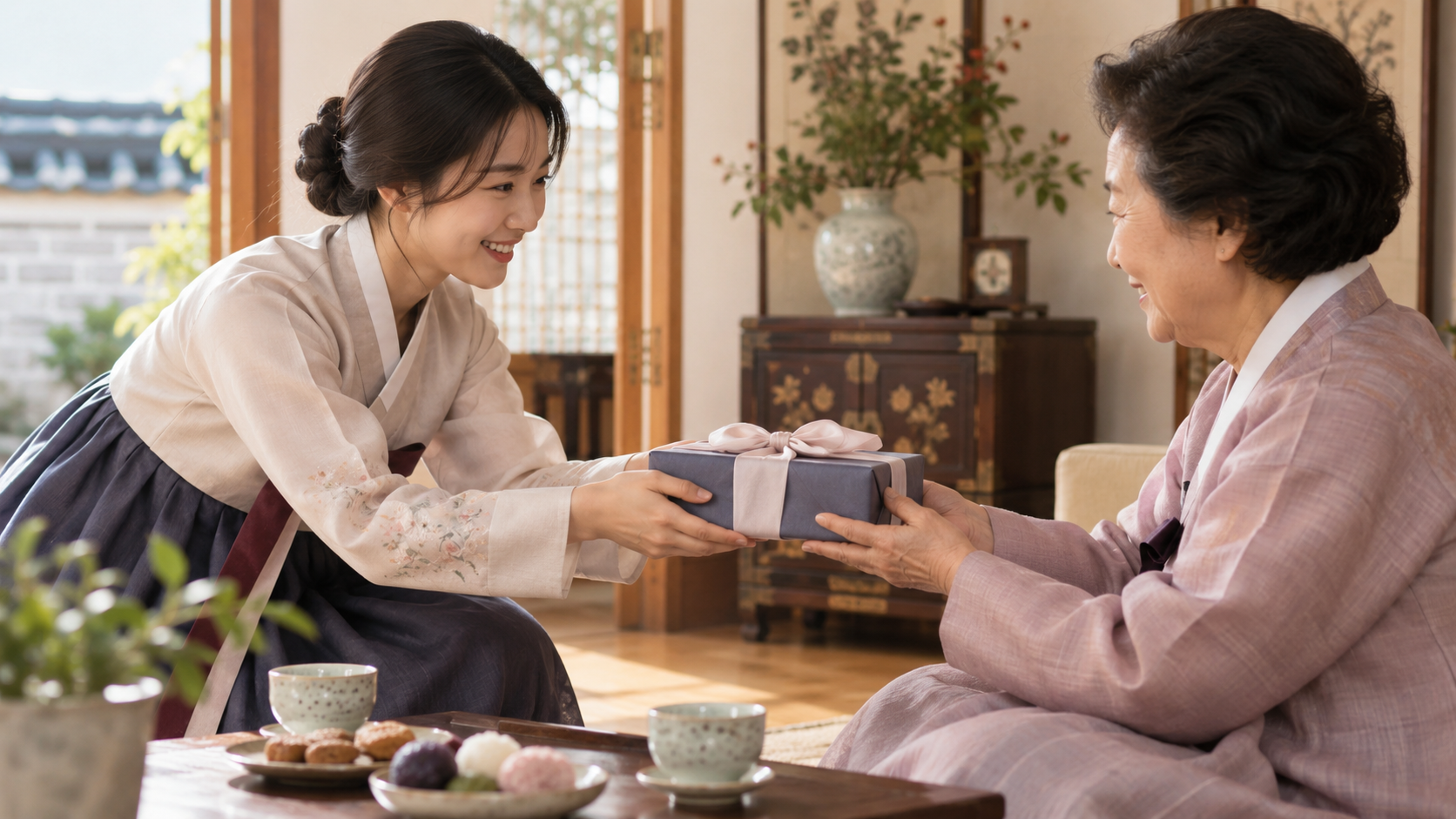
Then you visit a Korean family and notice the same thing again when a gift is exchanged.
At some point, you may start wondering:
Why do Koreans use two hands so often?
It looks like a very small gesture.
But in Korea, it can communicate something much bigger:
“I respect you.”
1. Two Hands Make an Ordinary Exchange More Respectful
Imagine someone casually tossing you a business card.
Now imagine them turning toward you, making eye contact, and offering it carefully with both hands.
The object is exactly the same.
But the feeling is completely different.
That difference is important in Korea.
Using two hands can make an exchange feel more deliberate and respectful.
This is especially common when interacting with:
- someone older
- a senior colleague
- a customer
- someone you have just met
- a person in a more formal situation
It is less about the physical need for two hands and more about what the gesture communicates.
2. It Is Part of Korea’s Larger Language of Respect
To understand the gesture, it helps to understand something about Korean culture.
Respect is not communicated only through words.
It can also appear through:
how you bow,
how you speak,
where you sit,
how you pour a drink,
and how you give or receive something.
Korean also has different speech levels.
You may use 존댓말 (jondaenmal), respectful speech, with someone older or less familiar.
The two-handed gesture works in a similar way.
You could think of it as:
“Honorific body language.”
You are not changing the object.
You are changing the way you deliver it.
3. When Should You Use Two Hands?
Foreign visitors do not need to use two hands every time they give someone a tissue.
But there are situations where doing so is especially appropriate.
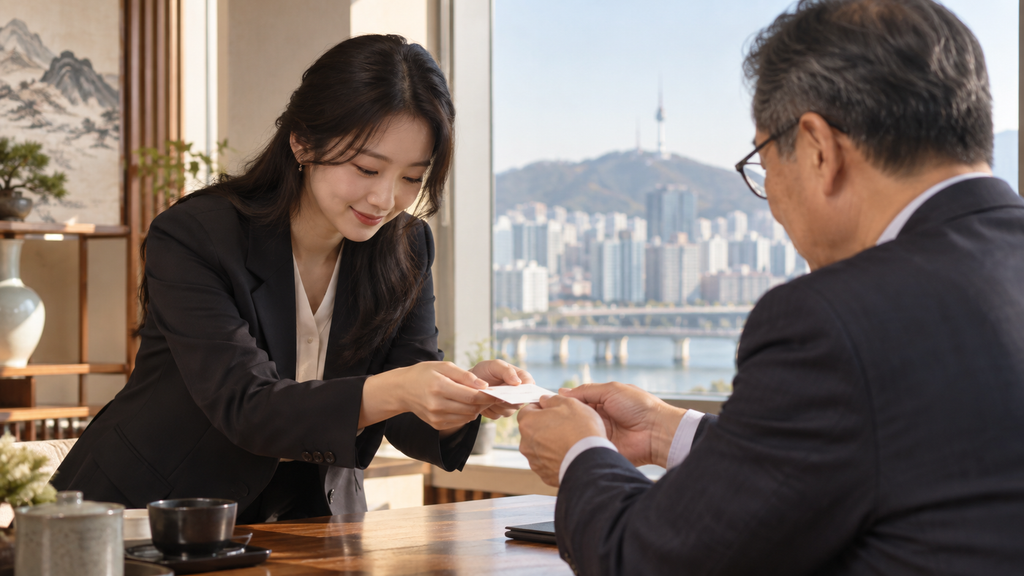
Business cards
This is one of the clearest examples.
When giving or receiving a business card in a professional setting, using both hands is a safe and respectful choice.
Take a moment to look at the card rather than immediately stuffing it into your pocket.
That small pause communicates:
“I acknowledge who you are.”
Gifts
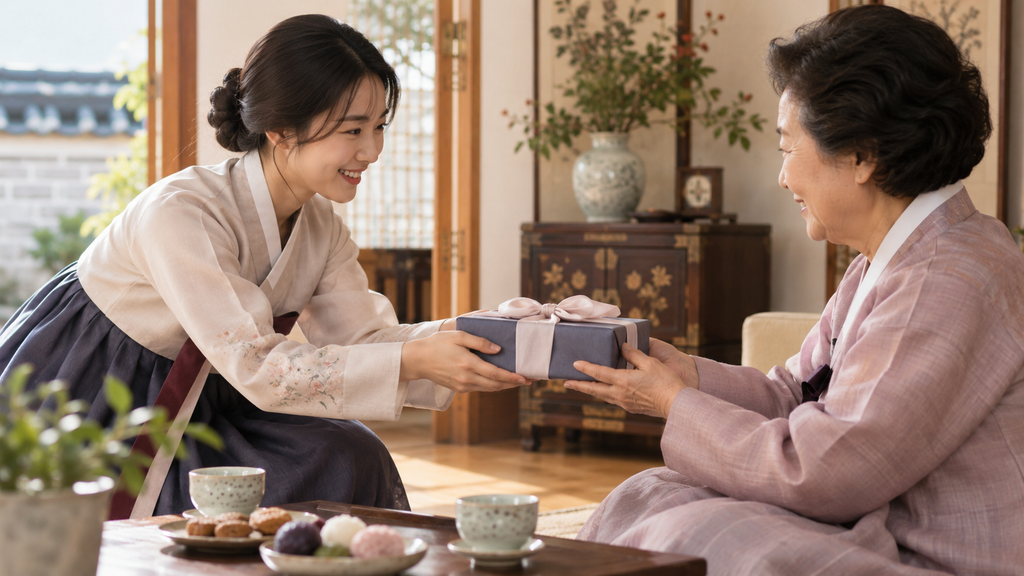
Giving a gift to an older person, host, business partner, or someone you respect?
Use two hands.
The gesture makes the exchange feel intentional rather than casual.
This is especially noticeable around holidays such as Seollal and Chuseok, when gift-giving becomes more common.
Money or cards
In more formal customer-service situations, you may notice employees returning:
cash,
receipts,
or credit cards
with both hands.
Not everyone does this all the time, but it is still widely recognized as polite service behavior.
Drinks
This is perhaps the most famous example.
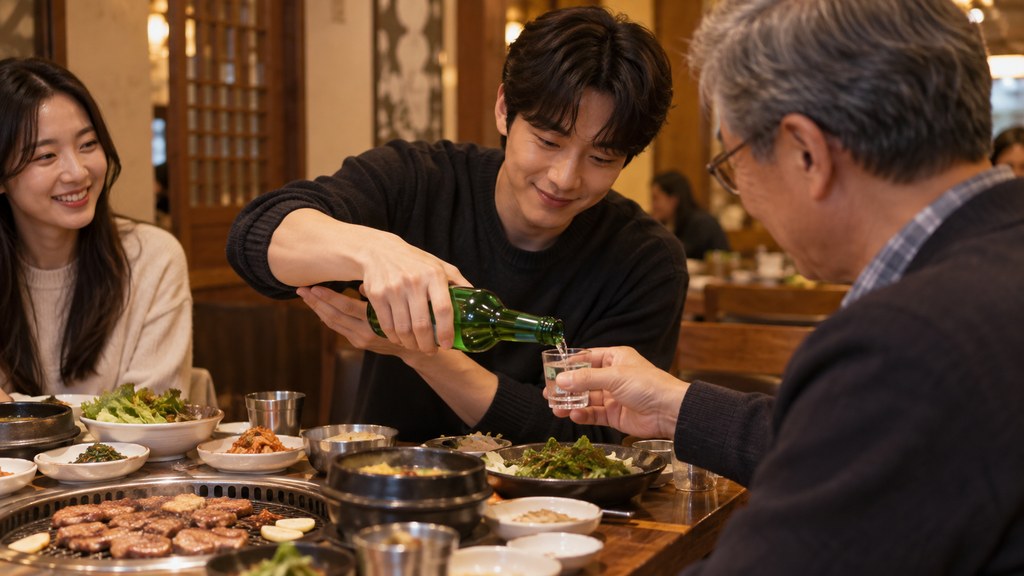
When pouring alcohol for an older person or someone senior, Koreans may pour with one hand while the other hand supports the wrist, forearm, or bottle-holding arm.
When receiving a drink, using two hands can also show respect.
This is especially common in more traditional or formal drinking situations.
4. Why Does One Hand Sometimes Hold the Other Arm?
Here is something foreign visitors often notice.
Sometimes Koreans do not literally use both hands to hold the object.
Instead, one hand holds the glass, bottle, or item while the other hand touches:
the wrist,
forearm,
or elbow area.
Why?
Because the second hand still signals attentiveness and respect.
The exact gesture may vary, but the message remains similar:
This exchange deserves more care than a casual one-handed movement.
Today, you may see many variations depending on age, relationship, and formality.
Hidden Story — There May Be an Old Clothing Connection
There is an interesting explanation often associated with this gesture.
Traditional Korean clothing could have wide sleeves.
Supporting the arm while offering or receiving something may have helped control the sleeve while also creating a more formal posture.
Over time, the gesture became associated with respectful etiquette.
Whether every modern use can be traced directly to clothing is difficult to reduce to one simple origin.
But the gesture fits naturally into Korea’s broader tradition of expressing social respect through posture and controlled movement.
5. The Gesture Makes More Sense When You Understand Korean Age Culture
Why is age relevant?
Because historically, Korean social interaction placed considerable importance on relative age and seniority.
Age could influence:
how people addressed each other,
which speech level they used,
who poured the first drink,
and how formally they behaved.
That is one reason a Korean person may ask your age relatively early after meeting you.
They may be trying to understand:
“What kind of relationship do we have?”
Two-handed etiquette fits into this same social system.
6. But Do Koreans Always Use Two Hands?
No.
This is an important point.
Korean society today is much more flexible than many etiquette guides make it sound.
Close friends are not constantly handing each other phones with ceremonial two-handed movements.
Young people in casual situations may barely think about the rule.
A convenience-store employee may use one hand.
Coworkers of similar age may interact very casually.
Context matters.
The more formal the situation—or the greater the difference in age or seniority—the more likely respectful body language becomes noticeable.
So don’t think:
“Koreans must always use two hands.”
Think:
“Two hands can increase the level of respect in an exchange.”
That is a much better rule.
7. Giving Is Only Half the Story—Receiving Matters Too
Foreign visitors often focus on how to give something.
But receiving is equally important.
If an older person or senior colleague gives you:
a gift,
a business card,
a drink,
or an important document,
receiving it with two hands is a simple way to show appreciation.
You don’t need to perform a dramatic bow.
Just turn toward the person, accept the item carefully, and say:
감사합니다.
Gamsahamnida.
“Thank you.”
That alone will take you very far.
8. Business Etiquette: A Tiny Gesture That Can Make a Good Impression
For international business travelers, this habit is particularly useful.
Imagine meeting a Korean executive for the first time.
When exchanging business cards:
- Face the person.
- Offer your card with both hands.
- Make the text easy for the other person to read.
- Receive their card with both hands.
- Look at it briefly before putting it away.
None of this is complicated.
And most Korean professionals will not expect a foreigner to know every etiquette detail.
But showing awareness can make the interaction feel more respectful.
In cross-cultural business, small signals matter.
9. What Happens With Smartphones?
Here is where traditional etiquette meets modern life.
Suppose someone older asks to see a photo on your phone.
Do you need to present your smartphone with both hands?
Probably not every time.
But in formal situations, you may still notice people using one hand to hold the phone while the other lightly supports the wrist or arm.
The objects changed.
The basic social instinct survived.
That is what makes this habit culturally interesting.
It is not really about business cards.
Or glasses.
Or gifts.
It is about how respect gets translated into physical behavior.
10. What Should Foreigners Actually Do?
The easiest rule is simple.
Use two hands when:
- meeting someone older
- meeting someone senior
- exchanging business cards
- giving a formal gift
- receiving something important
- pouring or receiving alcohol in a formal setting
- you are simply unsure what is appropriate
You are unlikely to offend someone by being slightly more respectful.
And don’t panic if you forget.
Koreans generally understand that visitors come from different cultural backgrounds.
The goal is not perfect choreography.
The goal is showing consideration.
Did You Know?
In Korea, the same idea of respect can appear simultaneously in language and body language.
You might:
use respectful speech,
bow slightly,
and accept an object with two hands
all during the same interaction.
These gestures form a kind of social package.
None of them alone defines Korean culture.
But together, they reveal how much attention Korean etiquette can place on the relationship between two people.
A Small Business Insight — Why Service Gestures Matter
There is also a business lesson here.
In hospitality and retail, customers rarely evaluate service based only on what employees say.
They notice small movements.
How a credit card is returned.
How a receipt is presented.
Whether the employee faces them.
Whether an object is placed down or handed directly to them.
In Korea, a two-handed exchange can turn an ordinary transaction into a subtle signal of care.
That matters especially in:
hotels,
restaurants,
luxury retail,
department stores,
airlines,
and other service businesses.
The product may be identical.
But the gesture changes the perceived experience.
Good hospitality often works exactly like that.
5 Korean Words to Know
| English | Korean | Pronunciation | Chinese | Spanish |
|---|---|---|---|---|
| Two hands | 두 손 | du son | 双手 | Dos manos |
| Respect | 존중 | jon-jung | 尊重 | Respeto |
| Receive | 받다 | bat-da | 接受 | Recibir |
| Give | 주다 | ju-da | 给 | Dar |
| Business card | 명함 | myeong-ham | 名片 | Tarjeta de presentación |
Korean Phrase of the Day
감사히 받겠습니다.
Gamsahi batgetseumnida.
English: Thank you, I’ll gratefully accept it.
Chinese: 谢谢,我会心怀感谢地收下。
Spanish: Gracias, lo recibiré con gratitud.
This is a polite expression you might hear or use when receiving a gift or something meaningful.
For everyday situations, the much simpler:
감사합니다 — Gamsahamnida
is perfectly useful.
Today’s Question
Does your culture have a special way of giving or receiving something to show respect?
Do you:
use both hands,
bow,
avoid eye contact,
make eye contact,
or say something special?
Tell me in the comments.
Cultural differences often become most interesting in the smallest gestures.
Naru’s Tips for Foreign Visitors
When in doubt, use two hands.
It is one of the easiest Korean etiquette habits to adopt.
Pay special attention during business meetings.
Business cards are where this custom is most visible.
Watch what Korean people around you do.
Etiquette becomes much easier when you observe the relationship and context rather than memorizing rigid rules.
Don’t exaggerate it.
You do not need to dramatically bow every time someone gives you a coffee.
Natural respect is better than nervous performance.
Remember that receiving matters too.
Many foreigners remember to give with two hands but forget when taking something back.
Hidden Story — Respect You Can See
Perhaps the most interesting thing about this gesture is how little explanation it requires.
No one needs to say:
“I respect you because you are older than me.”
No one needs to announce:
“This is a formal business relationship.”
The body communicates first.
Two hands.
A small bow.
A careful exchange.
Then the conversation continues.
That is why understanding Korean etiquette can be useful even if you do not speak much Korean.
Some parts of the language are spoken.
Others are performed.
Final Thoughts
Using two hands is one of those Korean habits that seems almost insignificant until you start noticing it everywhere.
A business card.
A gift.
A drink.
A credit card.
A document.
Each time, the gesture is saying something slightly beyond the object itself.
I am paying attention to you.
I recognize our relationship.
I want to treat this exchange with care.
Modern Korea is becoming more casual, and etiquette changes from generation to generation.
But the idea behind this gesture remains easy to understand.
Respect does not always need a long speech.
Sometimes—
it only needs a second hand.
Naru’s Quote
“In Korea, respect is not only something you say. Sometimes, you can see it in the way an object passes from one person to another.” — Naru
한국인은 왜 물건을 주고받을 때 두 손을 사용할까?
한국에서 생활하다 보면 작은 행동 하나가 반복되는 것을 볼 수 있습니다.
명함을 두 손으로 건넵니다.
선물을 두 손으로 줍니다.
윗사람에게 술을 따를 때 한 손으로 병을 잡고 다른 손으로 팔을 받치기도 합니다.
왜 그럴까요?
가장 간단한 답은:
존중을 표현하기 위해서입니다.
한국에서는 존중이 말로만 표현되지 않습니다.
존댓말을 사용하고,
고개를 숙여 인사하고,
물건을 주거나 받을 때 두 손을 사용하는 것처럼
몸의 움직임도 예의의 일부가 될 수 있습니다.
특히 상대가 나보다 나이가 많거나, 직급이 높거나, 처음 만나는 사람이거나, 공식적인 자리일수록 두 손을 사용하는 것이 자연스럽습니다.
언제 두 손을 쓰면 좋을까?
명함을 주고받을 때
업무상 처음 만난 사람에게는 두 손을 사용하는 것이 가장 안전합니다.
선물을 줄 때
어른이나 중요한 사람에게 선물을 건넬 때 두 손을 사용하면 더욱 정중하게 느껴집니다.
술을 따르거나 받을 때
격식 있는 술자리에서는 한 손으로 잔이나 병을 잡고 다른 손으로 손목 또는 팔을 받치는 모습을 볼 수 있습니다.
중요한 물건을 받을 때
선물이나 서류 등을 두 손으로 받으면 감사와 존중을 표현하기 좋습니다.
하지만 한국인이 모든 상황에서 두 손을 사용하는 것은 아닙니다.
친구 사이에서는 매우 편하게 행동하고, 젊은 세대나 캐주얼한 상황에서는 이런 규칙이 많이 느슨해졌습니다.
따라서 핵심은:
**“항상 두 손을 써야 한다”가 아니라 “두 손을 사용하면 존중의 정도를 높일 수 있다”**라고 이해하는 것이 좋습니다.
Today’s Question
여러분의 문화에도 물건을 주고받을 때 존중을 표현하는 특별한 방법이 있나요?
Naru’s Quote
“한국에서 존중은 말로만 표현되지 않는다. 때로는 물건이 한 사람에게서 다른 사람에게 건너가는 모습에서도 보인다.” — Naru
为什么韩国人在递东西时经常使用双手?
来到韩国后,你可能会注意到一个很小的动作。
递名片时,用双手。
送礼物时,用双手。
在正式的酒席上倒酒时,一只手拿酒瓶,另一只手有时会扶住手腕或手臂。
为什么?
最简单的答案是:
表达尊重。
在韩国,尊重不仅通过语言表达。
它也可以体现在鞠躬、敬语、坐姿,以及如何递交或接受东西的动作中。
特别是在面对长辈、上级、客户或第一次见面的人时,使用双手通常会让这个动作显得更加正式和礼貌。
什么时候最好使用双手?
交换名片。
给长辈送礼物。
在比较正式的场合倒酒或接酒。
接受重要文件或礼物。
如果你是一名外国游客,又不知道应该怎么做,一个非常简单的原则就是:
不确定的时候,用双手。
当然,现代韩国社会已经越来越随意。
朋友之间不会每次递手机都郑重地使用双手。
年轻人在休闲场合也可能完全不在意这个习惯。
所以,更准确的理解不是:
“韩国人必须使用双手。”
而是:
“使用双手可以提高一个动作所表达的尊重程度。”
Today’s Question
你的文化中,递东西或收东西时有没有特殊的礼仪?
Naru’s Quote
“在韩国,尊重不只是说出来的。有时候,从一样东西如何从一个人手中传到另一个人手中,也能看见尊重。” — Naru
🇪🇸 Versión en Español
¿Por qué los coreanos utilizan las dos manos al entregar algo?
Si pasas tiempo en Corea, quizá empieces a notar un pequeño gesto.
Una tarjeta de presentación se entrega con ambas manos.
Un regalo se ofrece con ambas manos.
En una cena formal, alguien puede servir una bebida con una mano mientras apoya el brazo con la otra.
¿Por qué?
La respuesta más sencilla es:
para mostrar respeto.
En Corea, el respeto no se expresa únicamente con palabras.
También puede aparecer en:
la forma de saludar,
el nivel de lenguaje utilizado,
una pequeña inclinación,
o la manera de entregar y recibir un objeto.
El uso de ambas manos es especialmente apropiado cuando se interactúa con una persona mayor, un superior, un cliente o alguien que acabamos de conocer.
¿Cuándo conviene utilizar las dos manos?
Al intercambiar tarjetas de presentación.
Al entregar un regalo a una persona mayor o respetada.
Al servir o recibir una bebida en un contexto formal.
Al recibir un documento u objeto importante.
Para un extranjero, existe una regla muy sencilla:
Si tienes dudas, usa las dos manos.
Sin embargo, la sociedad coreana moderna es mucho más flexible de lo que algunos manuales de etiqueta sugieren.
Entre amigos, la interacción puede ser completamente informal.
Los jóvenes tampoco siguen estas normas rígidamente en todas las situaciones.
Por eso, la idea correcta no es:
“Los coreanos siempre deben utilizar dos manos.”
Es mejor pensar:
“Utilizar dos manos puede añadir un nivel extra de respeto a una interacción.”
Today’s Question
¿Existe en tu cultura una manera especial de entregar o recibir algo para mostrar respeto?
Naru’s Quote
“En Corea, el respeto no solo se escucha. A veces se puede ver en la forma en que un objeto pasa de una persona a otra.” — Naru