
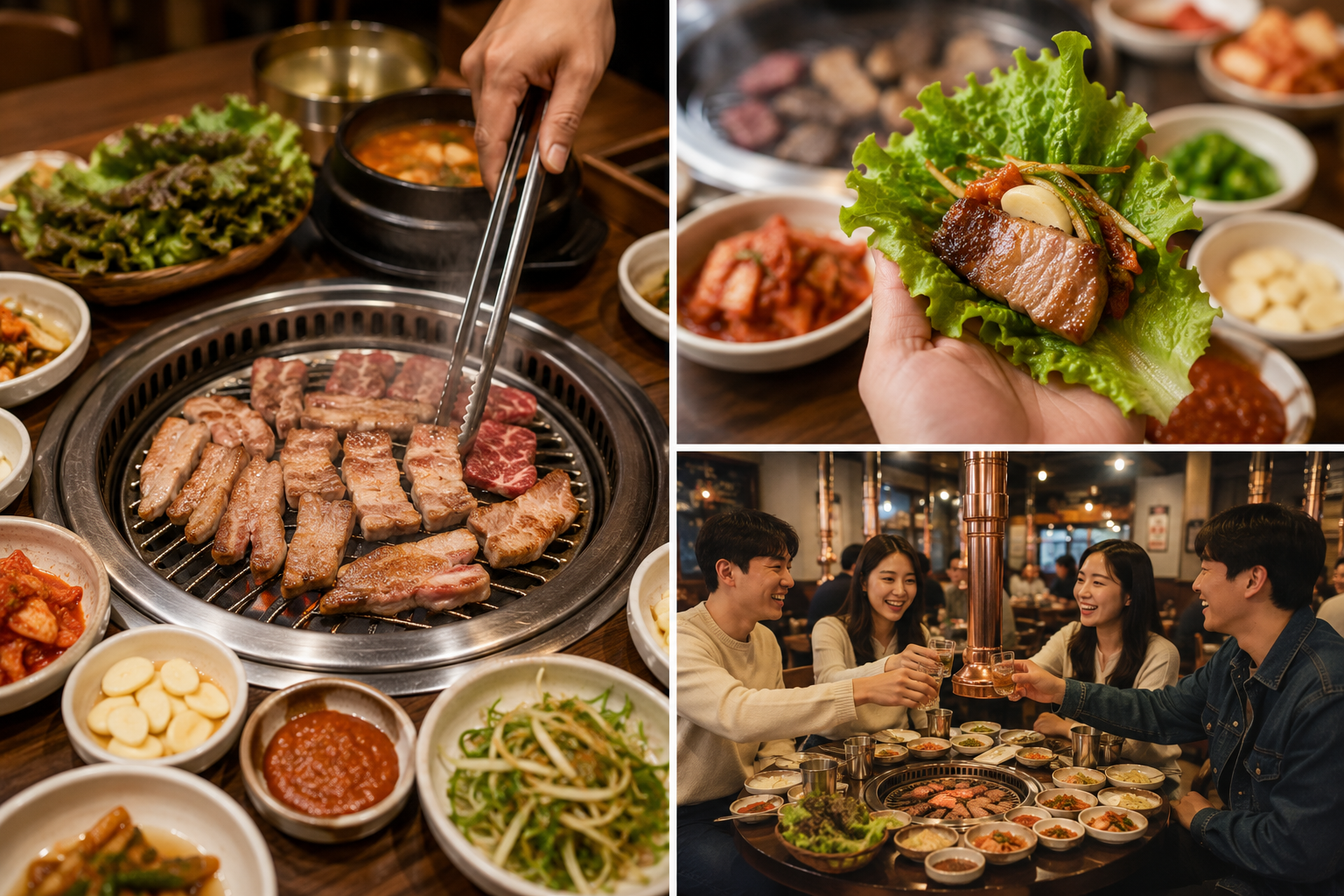

Discover why Korean BBQ is much more than grilled meat. Learn the culture of sharing food, cooking together, banchan, lettuce wraps, and why a Korean BBQ dinner is really about people, not just food.
Why Korean BBQ Is More Than Just Meat
If you ask travelers what food they most want to try in Korea, one answer appears again and again.
“Korean BBQ.”
People imagine thick slices of pork belly sizzling on a hot grill.
Beef slowly cooking over charcoal.
A table covered with colorful side dishes.
The sound of meat turning on the grill.
The smell drifting into the street.
It certainly looks delicious.
And it is.
But if you ask Koreans what makes Korean BBQ special, many will not begin by talking about the meat.
Instead, they might talk about the people sitting around the table.
That is because Korean BBQ is not simply a meal.
It is one of the clearest expressions of how Koreans build relationships.
The grill is placed in the middle for a reason.
Everyone gathers around it.
Everyone waits together.
Everyone shares.
Long before the first bite is taken, the meal has already begun.
One Grill, One Table, One Conversation
In many countries, ordering food is an individual experience.
Each person chooses a dish.
The kitchen prepares it.
Everyone eats what belongs to them.
A Korean BBQ restaurant feels different.
The table usually orders together.
Instead of asking,
“What do you want?”
People often ask,
“What shall we eat together?”
It sounds like a small difference.
But it changes the entire atmosphere of the meal.
When the food arrives, nobody immediately begins eating.
Someone grills the meat.
Another person turns it over.
Someone else refills water or places fresh lettuce in the center.
The meal becomes a small team effort.
Without realizing it, everyone participates.
Even strangers become part of the same rhythm.
Perhaps that is why business meetings, family gatherings, university celebrations, reunions and first introductions so often happen over Korean BBQ.
The food creates conversation before it creates fullness.
More Than Meat
For many first-time visitors, the biggest surprise is not the meat.
It is everything that comes before the meat.
Within minutes, the table begins filling with small dishes.
Kimchi.
Pickled radish.
Seasoned spinach.
Bean sprouts.
Potato salad.
Marinated vegetables.
Sometimes there are ten dishes.
Sometimes even more.
These are called banchan.
Unlike side dishes in many countries, banchan are meant to be shared.
And in most traditional Korean restaurants, they can be refilled without additional charge.
For many visitors, this feels surprisingly generous.
But for Koreans, it reflects something much deeper.
A good meal is measured not only by the quality of the main dish, but also by the care shown through everything surrounding it.
Banchan quietly says,
“We’re happy you’re here.”
🇰🇷 Behind the Culture
Why are there so many side dishes?
Historically, Korea experienced long winters and periods when fresh ingredients were difficult to obtain.
Communities developed numerous preservation methods, including fermentation, pickling, drying, and seasoning.
Over generations, these preserved vegetables became everyday foods rather than special occasions.
Eventually, serving several small dishes alongside rice became an expression of hospitality.
The table became richer not because people were wealthy, but because sharing many flavors together became part of Korean identity.
Even today, many Korean families prepare several small side dishes at home instead of relying on a single large plate.
Food is arranged to be shared from the beginning.
That simple habit tells us something important about Korean culture.
Meals are rarely about eating alone.
They are about eating together.
The Person Who Cooks Often Eats Last
Here is something many foreign visitors notice without fully understanding.
At many Korean BBQ restaurants, one person spends more time cooking than eating.
Parents cook for children.
Older friends cook for younger ones.
Sometimes the person who invited everyone naturally takes responsibility for the grill.
No one officially assigns this role.
It simply happens.
This tradition reflects another Korean value.
Taking care of others before taking care of yourself.
You will often hear someone say,
“Eat while it’s hot.”
Only after everyone else has food will they begin eating their own.
The person holding the tongs is not losing the meal.
They are helping create it.
Did You Know?
The famous lettuce wrap, known as ssam, is not only delicious—it represents one of Korea’s most balanced ways of eating.
A single bite often combines grilled meat, fresh vegetables, fermented kimchi, rice, garlic, and sauce.
Instead of highlighting one ingredient, it celebrates harmony between many different flavors and textures.
That idea of balance appears throughout Korean cuisine.

Wrapping More Than Food
One of the most memorable moments for first-time visitors happens just before they take their first bite.
Someone smiles and says,
“Try making a ssam.”
At first, it looks surprisingly complicated.
A fresh lettuce leaf.
A slice of grilled pork or beef.
A little rice.
Kimchi.
Garlic.
Perhaps a slice of green chili.
A spoonful of ssamjang, the rich soybean and chili paste that brings everything together.
Then comes the challenge.
Wrap everything into one neat package.
And eat it in a single bite.
It is delicious.
But it is also symbolic.
Each ingredient has its own flavor.
On its own, each is incomplete.
Together, they create something richer than any single ingredient could offer.
That simple wrap reflects a value deeply rooted in Korean culture.
Different people.
Different personalities.
Different generations.
Living, working and sharing together.
Perhaps that is why the word “ssam” feels larger than food.
It quietly teaches that harmony is created by bringing different things together.
The Sound of a Korean BBQ Restaurant
Close your eyes inside a Korean BBQ restaurant for just a moment.
You probably won’t hear quiet background music.
Instead, you’ll hear something else.
The sizzling of meat.
Laughter from the next table.
The clink of metal chopsticks.
Someone saying,
“Eat more!”
Another person pouring a drink.
Friends laughing loudly after a long week.
Children asking for another piece of meat.
Unlike restaurants where silence often signals elegance, Korean BBQ embraces energy.
The meal is meant to be lively.
Conversation is not a distraction.
It is part of the menu.
The sound of people enjoying one another’s company is just as important as the food itself.
Why “Let’s Eat Together” Means More Than You Think
In English, inviting someone to dinner often sounds simple.
“Would you like to have dinner?”
In Korean, however, the phrase “같이 먹어요 (Let’s eat together)” often carries a much deeper meaning.
Sometimes it means,
“I’d like to spend time with you.”
Sometimes it means,
“Let’s celebrate.”
Sometimes it means,
“I’ve missed you.”
Sometimes it simply means,
“I care about you.”
Sharing food has always been one of the easiest ways to build trust in Korean society.
Many friendships begin over a meal.
Business relationships often grow stronger after eating together.
Families gather around the same grill during holidays and birthdays.
The food matters.
But the relationship matters even more.
Small Etiquette That Makes a Big Difference
If you ever enjoy Korean BBQ in Korea, a few small gestures will help you feel more comfortable.
- Wait until everyone has been served before starting.
- Share the grill instead of focusing only on your own food.
- Use the serving tongs provided for the meat rather than your personal chopsticks.
- If someone cooks for you, a simple “감사합니다 (Thank you)” is always appreciated.
- Don’t worry if you aren’t perfect. Most Koreans are happy to explain the customs.
Nobody expects visitors to know every rule.
Showing curiosity and respect is far more important than getting everything exactly right.
Korean BBQ Changes with the Seasons
Although Korean BBQ can be enjoyed all year, the experience often changes with the seasons.
In spring, families gather after enjoying the cherry blossoms.
During hot summer evenings, people combine barbecue with cold beer after work.
Autumn, with its cool weather, is considered by many to be one of the best seasons for grilling outdoors.
Winter brings another kind of comfort.
Stepping into a warm restaurant, hearing meat sizzling over the grill while snow falls outside, is an experience many Koreans associate with warmth, family and friendship.
The food stays the same.
The memories change with the season.
😲 What Many Visitors Miss
Visitors often leave Korean BBQ restaurants saying,
“The meat was amazing.”
And they’re right.
But what many remember months later isn’t the flavor.
It’s the atmosphere.
The laughter.
The conversations.
The person who quietly grilled the meat for everyone else.
The unexpected refill of side dishes.
The feeling that nobody at the table was eating alone.
The meal becomes a memory not because of what was served.
But because of who shared it.
Naru’s Note
The first time I invited a foreign friend to Korean BBQ, I expected them to remember the food.
Instead, weeks later they told me something completely different.
They said,
“I’ve never been to a restaurant where everyone cooked together.”
That sentence stayed with me.
Because they weren’t talking about pork belly.
They were talking about connection.
Perhaps that is the real secret of Korean BBQ.
The grill sits in the middle of the table because the people should too.
When everyone faces the same fire, conversation becomes easier.
Differences become smaller.
Meals become memories.
And strangers often leave as friends.
Final Thoughts
If you visit Korea, don’t think of Korean BBQ as another restaurant on your travel list.
Think of it as an invitation.
Sit around the grill.
Watch how people naturally begin helping one another.
Try wrapping your first ssam.
Accept the extra serving of kimchi.
Join the conversation.
Because the most unforgettable part of Korean BBQ is rarely the first bite.
It’s the feeling that, for a little while, you were welcomed to the table like family.
“The best Korean BBQ is not the one with the most expensive meat. It’s the one where nobody wants the evening to end.”
— Naru
Discover Korea. Learn Korea. Experience Korea. Inspire a Journey.

📚 Learn 5 Korean Words Today
| English | Korean | Pronunciation | Chinese | Spanish |
|---|---|---|---|---|
| Korean BBQ | 한국 바비큐 | Han-guk Babikyu | 韩式烤肉 | Barbacoa coreana |
| Pork Belly | 삼겹살 | Sam-gyeop-sal | 五花肉 | Panceta de cerdo |
| Side Dishes | 반찬 | Ban-chan | 小菜 | Guarniciones |
| Lettuce Wrap | 쌈 | Ssam | 生菜包肉 | Envoltura de lechuga |
| Grill | 불판 | Bul-pan | 烤盘 | Parrilla |
🗣 Korean Phrase of the Day
🇰🇷 Korean
같이 먹어요!
🔊 Pronunciation
Gachi meogeoyo!
🇺🇸 English
Let’s eat together!
🇨🇳 Chinese
我们一起吃吧!
🇪🇸 Spanish
¡Comamos juntos!
😲 Did You Know?
Unlike many restaurants around the world, most traditional Korean BBQ restaurants provide free refills of side dishes (banchan).
This custom reflects Korea’s culture of hospitality, where a satisfying meal is about generosity and sharing—not just the main dish.
🇰🇷 Hidden Story
Did you know that the grill is placed in the center of the table on purpose?
In Korean culture, the center of the table belongs to everyone.
Rather than serving individual plates from the kitchen, everyone cooks, waits, and eats together.
The grill becomes more than a cooking tool—it becomes a place where conversations begin, friendships grow, and memories are made.
This is why many Koreans say that the best Korean BBQ isn’t about the meat—it’s about the people sitting around the grill.
⭐ Naru Recommends
If you’re visiting Korea for the first time, these are excellent places to experience authentic Korean BBQ:
🥇 Mapo – Famous for traditional charcoal-grilled pork.
🥩 Majang Meat Market – Buy premium Korean beef and enjoy it at nearby restaurants.
🌃 Hongdae – A lively atmosphere popular with students and travelers.
💼 Jongno – Old-fashioned restaurants loved by locals after work.
🏙️ Gangnam – Modern BBQ restaurants with premium Hanwoo beef.

한국 여행을 계획하는 외국인에게 가장 먹고 싶은 음식이 무엇인지 물어보면 빠지지 않고 등장하는 답이 있습니다.
바로 Korean BBQ입니다.
지글지글 익어가는 삼겹살.
숯불 위에서 천천히 구워지는 소고기.
테이블 가득 차려진 다양한 반찬.
고기가 익어가는 소리와 고소한 향기.
생각만 해도 군침이 돕니다.
하지만 한국 사람들에게 “한국 바비큐의 가장 큰 매력이 무엇이냐”고 묻는다면, 많은 사람들은 고기 이야기를 가장 먼저 하지 않을 것입니다.
오히려 누구와 함께 먹는지를 먼저 이야기합니다.
한국 바비큐는 단순한 식사가 아니라, 사람과 사람을 이어주는 문화이기 때문입니다.
테이블 한가운데 놓인 불판도 그 이유를 잘 보여줍니다.
모든 사람이 같은 불판을 바라보고,
같은 음식을 기다리고,
같은 시간을 함께 나눕니다.
고기가 익기 전부터 이미 식사는 시작된 것입니다.
하나의 불판, 하나의 대화
많은 나라에서는 각자 먹고 싶은 음식을 주문합니다.
내 접시는 내 것이고, 당신의 접시는 당신의 것입니다.
하지만 한국 바비큐집에서는 조금 다른 질문이 오갑니다.
“무엇을 먹을까?”
가 아니라,
“우리 뭐 먹을까?”
이 작은 차이가 식사의 분위기를 완전히 바꿉니다.
고기가 나오면 바로 먹지 않습니다.
누군가는 고기를 굽고,
누군가는 상추를 준비하고,
다른 사람은 물이나 음료를 채워 줍니다.
식사는 자연스럽게 모두가 함께 만드는 시간이 됩니다.
이런 모습은 가족 모임에서도,
친구들과의 약속에서도,
회사 회식에서도,
처음 만나는 사람과의 식사에서도 쉽게 볼 수 있습니다.
한국 바비큐는 배를 채우는 음식이기 전에, 대화를 시작하게 만드는 음식입니다.
주인공은 고기가 아니라 ‘함께 먹는 것’
외국인들이 한국 바비큐를 처음 경험하면서 가장 놀라는 것 중 하나는 고기보다 반찬입니다.
김치.
나물.
감자샐러드.
콩나물.
무절임.
계란찜.
테이블은 금세 작은 접시들로 가득 찹니다.
이 반찬을 **반찬(Banchan)**이라고 부릅니다.
한국에서는 반찬이 메인 요리를 돋보이게 하는 조연이 아닙니다.
반찬 역시 식사의 중요한 일부입니다.
그리고 대부분의 식당에서는 부족하면 무료로 더 가져다줍니다.
외국인들은 종종 이것을 보고 놀랍니다.
하지만 한국인에게는 아주 자연스러운 문화입니다.
좋은 식사는 메인 메뉴 하나만 맛있는 것이 아니라,
함께 내어지는 모든 음식에서 손님의 만족을 생각하는 마음이 담겨 있기 때문입니다.
반찬은 말없이 이렇게 이야기하는 것 같습니다.
“많이 드세요.”
왜 상추에 싸서 먹을까?
한국 바비큐를 이야기할 때 빠질 수 없는 것이 바로 쌈입니다.
상추 한 장을 펼칩니다.
갓 구운 고기를 올립니다.
밥을 조금 넣고,
김치와 마늘,
그리고 쌈장을 더합니다.
그리고 한입에 먹습니다.
처음 보는 사람에게는 조금 복잡해 보일 수도 있습니다.
하지만 쌈은 한국 음식이 가진 중요한 철학을 보여줍니다.
고기만 먹는 것이 아니라,
채소와 발효 음식,
양념과 밥이 함께 어우러집니다.
서로 다른 맛이 하나가 되어 균형을 이루는 것입니다.
이런 조화는 한국 음식 전체에서 자주 볼 수 있는 특징입니다.
고기를 굽는 사람이 가장 늦게 먹는 이유
한국 바비큐에서는 재미있는 장면을 자주 볼 수 있습니다.
고기를 굽는 사람이 정작 가장 늦게 먹는 경우입니다.
부모가 아이들에게 먼저 고기를 잘라 줍니다.
연장자가 후배의 접시에 먼저 올려 줍니다.
친구들끼리도 자연스럽게 누군가 집게를 잡습니다.
아무도 역할을 정하지 않았는데도 그렇게 됩니다.
그 이유는 아주 단순합니다.
먼저 먹는 것보다 함께 먹는 것을 더 중요하게 생각하기 때문입니다.
누군가는 “뜨거울 때 빨리 먹어.”라고 말하며 다른 사람의 접시를 먼저 챙깁니다.
불판 앞에 있는 사람은 식사를 놓치는 것이 아니라,
모두의 식사를 만들어 주고 있는 것입니다.
한국 바비큐에는 계절도 담겨 있습니다
삼겹살은 사계절 언제나 먹을 수 있습니다.
하지만 계절에 따라 분위기는 달라집니다.
봄에는 벚꽃을 보고 난 뒤 가족들이 함께 모여 먹고,
여름에는 퇴근 후 시원한 맥주와 함께 더위를 잊습니다.
가을에는 선선한 바람과 함께 야외 바비큐를 즐기고,
겨울에는 눈 오는 날 따뜻한 고깃집 안에서 보내는 시간이 더욱 특별하게 느껴집니다.
같은 음식이라도,
함께하는 사람과 계절이 바뀌면 추억도 달라집니다.
Naru’s Note
외국인 친구와 처음 한국 바비큐를 먹으러 갔던 날이 기억납니다.
저는 친구가 삼겹살 맛을 가장 먼저 이야기할 줄 알았습니다.
그런데 며칠 뒤 친구가 이렇게 말했습니다.
“다 같이 고기를 굽는 식당은 처음이었어.”
그 말이 오래 마음에 남았습니다.
친구는 고기가 아니라,
사람들의 모습을 기억하고 있었던 것입니다.
생각해 보면 한국 바비큐의 중심에는 늘 불판이 있습니다.
그리고 그 불판을 중심으로 사람들이 둘러앉습니다.
불은 고기를 익히지만,
사람들은 그 시간을 통해 서로 가까워집니다.
그래서 한국 바비큐의 진짜 주인공은 고기가 아니라,
함께하는 사람들인지도 모릅니다.
마무리
한국에서 바비큐를 먹게 된다면 맛있는 고기를 찾는 것도 좋습니다.
하지만 그것보다 더 중요한 것이 있습니다.
테이블 위에서 사람들이 어떻게 서로를 배려하는지 한번 바라보세요.
누군가 고기를 뒤집고,
다른 사람이 상추를 건네고,
모두가 같은 불판을 바라보며 이야기를 이어갑니다.
그 풍경 속에는 한국 사람들이 관계를 만들어 가는 방식이 담겨 있습니다.
그래서 한국 바비큐는 단순히 유명한 음식이 아니라,
사람과 사람이 가까워지는 하나의 문화입니다.
“가장 좋은 바비큐는 가장 비싼 고기가 있는 곳이 아니라, 모두가 집에 가기 아쉬워하는 곳이다.”
— Naru
Discover Korea. Learn Korea. Experience Korea. Inspire a Journey.

KGS-0006
为什么韩国烤肉不仅仅是“烤肉”?
一顿饭,为什么能让人与人之间变得更亲近?
如果你问准备去韩国旅行的人:
“最想吃什么?”
答案几乎都会出现同一个名字。
韩国烤肉(Korean BBQ)。
厚厚的五花肉在铁板上发出“滋滋”的声音。
牛肉慢慢烤出香气。
桌上摆满了五颜六色的小菜。
空气中弥漫着令人垂涎的香味。
这一切确实令人难以抗拒。
但是,如果你问韩国人:
“韩国烤肉最特别的地方是什么?”
很多人的答案并不是肉。
而是——一起吃饭的人。
因为韩国烤肉,从来都不只是食物。
它更像是一种把人与人联系在一起的方式。
一张桌子,一块烤盘,一场聊天
在很多国家,每个人都会点属于自己的主菜。
我的餐盘属于我。
你的餐盘属于你。
但是来到韩国烤肉店,你会发现一种完全不同的习惯。
韩国人很少问:
“你想吃什么?”
他们更常说:
“我们一起吃什么?”
看似只是几个字的不同,却改变了整顿饭的气氛。
肉端上来以后,没有人立刻开始吃。
有人负责烤肉。
有人整理生菜。
有人倒水。
有人把烤好的第一块肉夹给别人。
不知不觉之间,每个人都参与了这顿饭。
因此,无论是家庭聚餐、朋友聚会、公司聚餐,还是第一次见面的饭局,韩国烤肉总是最受欢迎的选择。
因为它不仅填饱肚子。
更让人与人开始交流。
主角其实不是肉
第一次来到韩国吃烤肉的人,通常都会被另一件事情震惊。
那就是——
桌上的小菜。
泡菜。
凉拌菠菜。
豆芽。
土豆沙拉。
腌萝卜。
鸡蛋羹……
短短几分钟,桌子已经摆满了各种小盘子。
这些统称为 반찬(Banchan,小菜)。
对于很多外国游客来说,这是一种非常特别的体验。
因为在很多国家,小菜只是配角。
而在韩国,它们和主菜一样重要。
更令人惊讶的是,大多数韩国餐厅都会免费续加。
为什么?
因为韩国人认为,一顿真正好的饭,不只是主菜好吃。
而是整张桌子都让客人感到被照顾。
这些小菜仿佛在默默告诉你:
“请多吃一点。”
为什么韩国人喜欢“包着吃”?
来到韩国烤肉店,你一定会学会一个新的词:
쌈(Ssam)
一片生菜。
一块刚烤好的肉。
一点米饭。
泡菜。
蒜片。
再加上一点香浓的韩式包饭酱(쌈장)。
最后,一口全部放进嘴里。
第一次尝试的人,往往觉得步骤很多。
但真正重要的,并不是吃法。
而是它所代表的意义。
韩国料理很少强调一种食材独自成为主角。
相反,它更强调不同食材之间的平衡。
肉、蔬菜、发酵食品、米饭、酱料……
每一种味道都不同。
组合在一起,却形成一种新的和谐。
这种“平衡”的观念,其实贯穿着整个韩国饮食文化。
为什么烤肉的人总是最后吃?
很多外国游客都会注意到一个有趣的现象。
负责烤肉的人,往往自己吃得最慢。
父母会先把肉夹给孩子。
长辈会先照顾晚辈。
朋友之间,也总有人自然拿起夹子负责烤肉。
没有人安排。
却总是如此。
因为韩国文化里有一种很自然的观念:
先照顾别人,再照顾自己。
你常常会听到一句话:
“趁热快吃。”
直到大家盘子里都有肉以后,负责烤肉的人才开始吃自己的那一份。
他并不是牺牲了自己的时间。
而是在帮助大家一起完成这顿饭。
韩国烤肉,也是四季的味道
韩国烤肉一年四季都可以吃。
但每一个季节,都有不同的感觉。
春天,人们赏完樱花后聚在一起吃烤肉。
夏天,下班后配上一杯冰啤酒。
秋天,凉爽的天气特别适合户外聚餐。
冬天,外面飘着雪,屋里却围着热腾腾的烤盘。
同样的食物。
不同的季节。
不同的人。
也会留下不同的回忆。
Naru’s Note
第一次带外国朋友去吃韩国烤肉时,我以为他们最难忘的一定是五花肉。
结果几天后,他们告诉我:
“这是我第一次看到一家餐厅,所有人一起做饭。”
那句话让我一直记到现在。
他们记住的,不是肉。
而是人与人之间的互动。
后来我才发现,
韩国烤肉的中心,其实不是烤盘。
而是围坐在烤盘周围的人。
火焰烤熟了食物。
人与人之间,也在同一张桌子上慢慢拉近了距离。
也许,
韩国烤肉真正让人难忘的,
从来不是味道。
而是人与人一起分享那段时间。
结语
如果来到韩国,请一定体验一次韩国烤肉。
当然,美味的肉值得期待。
但更值得留意的是,
坐在你身边的人。
看看大家如何互相照顾。
如何一起等待。
如何一起聊天。
因为韩国烤肉真正吸引人的地方,不只是味觉。
它让一顿饭,变成了一段共同创造的回忆。
也正因为如此,
韩国烤肉不仅仅是一道料理。
它更是一种关于分享、陪伴与连接的文化。
“最好的韩国烤肉,不一定拥有最昂贵的牛肉,而是让所有人都舍不得结束那个夜晚。”
— Naru
Discover Korea. Learn Korea. Experience Korea. Inspire a Journey.

KGS-0006
¿Por Qué la Barbacoa Coreana Es Mucho Más Que Carne?
Una comida donde lo más importante no es la parrilla, sino las personas que la rodean.
Tiempo de lectura: Aproximadamente 10 minutos
Escrito por: Naru
Si preguntas a alguien que va a viajar a Corea cuál es el plato que más desea probar, hay una respuesta que aparece una y otra vez.
La barbacoa coreana.
El sonido de la carne cocinándose sobre la parrilla.
El aroma que llena el restaurante.
La mesa cubierta de pequeños platos llenos de colores.
Todo parece delicioso.
Y realmente lo es.
Pero cuando preguntas a un coreano qué hace especial a una comida de Korean BBQ, muchas veces no empieza hablando de la carne.
Empieza hablando de las personas.
Porque, en Corea, una barbacoa nunca es solamente una comida.
Es una forma de compartir el tiempo.
Una Parrilla, Una Mesa y Muchas Conversaciones
En muchos países, cada persona pide su propio plato.
Cada uno come lo que ha elegido.
En una barbacoa coreana ocurre algo diferente.
En lugar de preguntar:
“¿Qué quieres comer?”
es mucho más común escuchar:
“¿Qué vamos a comer juntos?”
Puede parecer una diferencia muy pequeña.
Pero cambia completamente el ambiente de la comida.
Cuando llega la carne, nadie empieza a comer inmediatamente.
Alguien coloca la carne sobre la parrilla.
Otra persona prepara las hojas de lechuga.
Alguien llena los vasos.
Otro gira la carne para que no se queme.
Sin darse cuenta, todos participan.
La comida deja de ser algo individual.
Se convierte en una actividad compartida.
Quizá por eso tantas reuniones familiares, celebraciones con amigos, comidas de empresa e incluso primeros encuentros tienen lugar alrededor de una parrilla coreana.
El Verdadero Protagonista No Es la Carne
Muchos visitantes creen que la carne será la gran protagonista.
Sin embargo, la primera sorpresa suele llegar incluso antes de probar el primer bocado.
La mesa comienza a llenarse de pequeños platos.
Kimchi.
Brotes de soja.
Espinacas sazonadas.
Rábano encurtido.
Ensalada de patata.
Huevos al vapor.
Estos pequeños acompañamientos reciben el nombre de banchan.
En muchos países, una guarnición simplemente acompaña al plato principal.
En Corea ocurre algo distinto.
Cada uno de esos pequeños platos forma parte de la experiencia.
Y lo más sorprendente para muchos viajeros es que, en la mayoría de los restaurantes tradicionales, pueden rellenarse gratuitamente.
No se trata solamente de generosidad.
Es una forma silenciosa de decir:
“Nos alegra que estés aquí.”
¿Por Qué Se Come Envueltos en Lechuga?
Uno de los momentos más divertidos para quien prueba la barbacoa coreana por primera vez llega cuando alguien dice:
“Ahora haz un ssam.”
Una hoja de lechuga.
Un trozo de carne recién hecha.
Un poco de arroz.
Kimchi.
Ajo.
Una cucharada de ssamjang.
Después llega el reto.
Comerlo todo de un solo bocado.
Puede parecer una simple manera de comer.
Pero representa una idea muy presente en la cultura coreana.
Ningún ingrediente intenta destacar por encima de los demás.
La carne, las verduras, el arroz, los alimentos fermentados y la salsa encuentran equilibrio cuando se unen.
Ese equilibrio también refleja una manera de entender la convivencia.
Personas diferentes.
Generaciones distintas.
Personalidades únicas.
Compartiendo una misma mesa.
Quien Cocina Suele Comer el Último
Hay una escena que muchos visitantes observan sin darse cuenta de su significado.
La persona que cocina la carne suele ser la última en comer.
Los padres preparan la comida para sus hijos.
Los mayores sirven primero a los más jóvenes.
Entre amigos, siempre aparece alguien que toma naturalmente las pinzas.
Nadie lo organiza.
Simplemente ocurre.
Porque existe una idea muy arraigada:
Cuidar primero de los demás.
Es habitual escuchar frases como:
“Come mientras está caliente.”
Solo cuando todos tienen comida en su plato, quien cocina empieza a comer.
No está perdiéndose la comida.
Está ayudando a crear ese momento para todos.
El Sabor También Cambia con las Estaciones
La barbacoa coreana puede disfrutarse durante todo el año.
Pero cada estación le da un ambiente diferente.
En primavera, muchas familias se reúnen después de contemplar los cerezos en flor.
En verano, el pollo frito y la cerveza suelen compartir protagonismo con la carne después del trabajo.
El otoño invita a disfrutar del aire fresco mientras se comparte una larga conversación.
Y en invierno, pocas cosas resultan tan reconfortantes como entrar en un restaurante cálido mientras fuera cae la nieve.
La comida puede ser la misma.
Pero los recuerdos siempre cambian con las estaciones y con las personas que nos acompañan.
Naru’s Note
La primera vez que llevé a un amigo extranjero a comer barbacoa coreana, pensé que recordaría el sabor del cerdo o de la ternera.
Días después me dijo algo completamente diferente.
“Nunca había estado en un restaurante donde todos cocinaran juntos.”
Aquella frase se quedó conmigo.
Porque comprendí que no estaba hablando de comida.
Estaba hablando de cercanía.
La parrilla ocupa el centro de la mesa por una razón.
Las personas también.
Cuando todos miran hacia el mismo fuego, la conversación surge con facilidad.
Las diferencias parecen más pequeñas.
Y una simple cena termina convirtiéndose en un recuerdo.
Reflexión Final
Cuando visites Corea, no pienses en la barbacoa únicamente como otro restaurante famoso.
Siéntate.
Observa.
Escucha.
Fíjate en cómo las personas se sirven unas a otras.
Cómo esperan juntas.
Cómo ríen mientras la carne termina de cocinarse.
Descubrirás que el mejor recuerdo no será necesariamente el sabor.
Será la sensación de haber compartido una mesa como si formaras parte del grupo desde siempre.
Porque la auténtica esencia de la barbacoa coreana nunca ha sido la carne.
Siempre han sido las personas.
“La mejor barbacoa coreana no es la que sirve la carne más cara. Es aquella de la que nadie quiere levantarse cuando termina la noche.”
— Naru