
The First Thing You Do in a Korean Home Happens Before You Really Enter
Imagine you are visiting a Korean friend’s apartment for the first time.
The front door opens.
You step inside.
But before you walk any farther, your friend looks down at your feet.
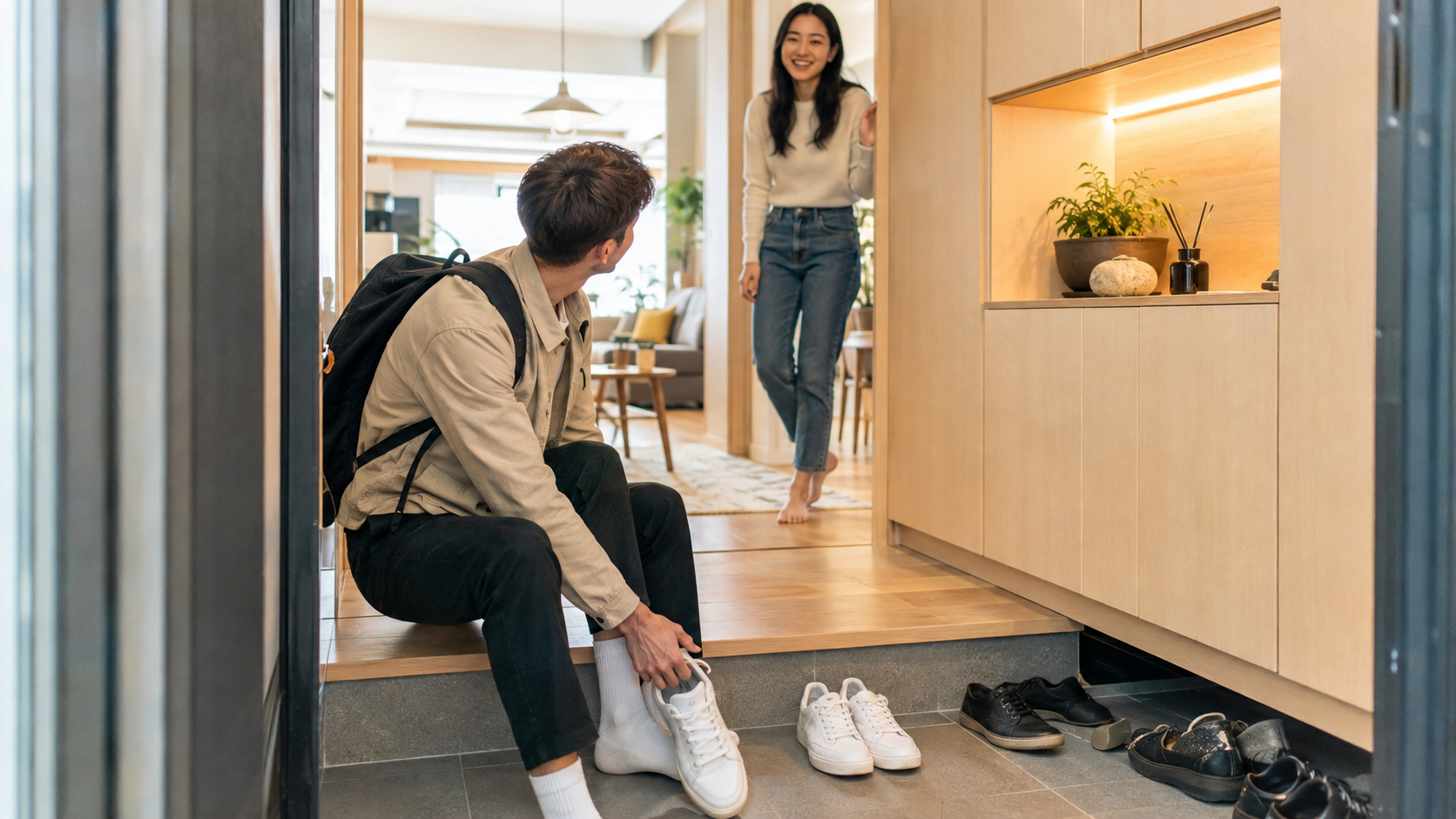
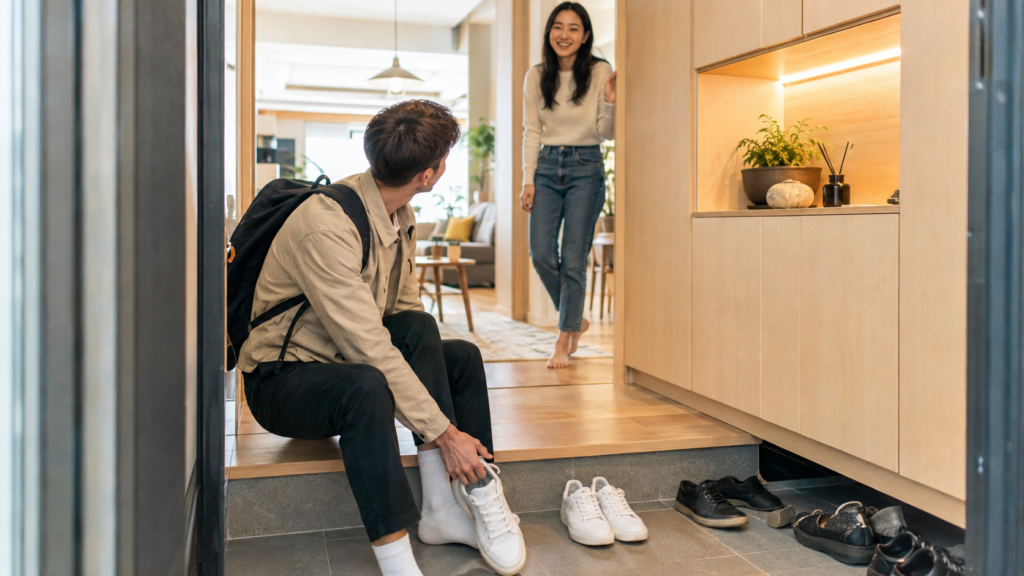
There is a small entrance area.
Shoes are lined up near the door.
A large shoe cabinet stands against the wall.
The main floor of the apartment begins just a little higher.
You quickly understand what to do.
Take off your shoes.
In Korean:
신발을 벗다
Sin-ba-reul beot-da
“To take off your shoes.”
For Koreans, this usually does not feel like a special ceremony.
It is simply what you do when entering a home.
But for someone from a country where people routinely wear outdoor shoes inside, the habit can feel surprisingly strict.
Why is the line between outside shoes and inside space so important in Korea?
The answer involves much more than cleanliness.
It takes us into the history of Korean homes, ondol floor heating, sitting culture, sleeping habits, architecture, and the Korean idea that the floor is part of the living space—not simply something you walk across.
First, Is Taking Off Your Shoes Uniquely Korean?
No.
Shoes-off customs exist in many countries and are especially common across parts of Asia, Northern Europe, and other regions.
So this is not a habit found only in Korea.
What makes the Korean version interesting is how deeply it connects with traditional Korean domestic life.
To understand it, you need to stop thinking of the floor as:
“the part of the house underneath the furniture.”
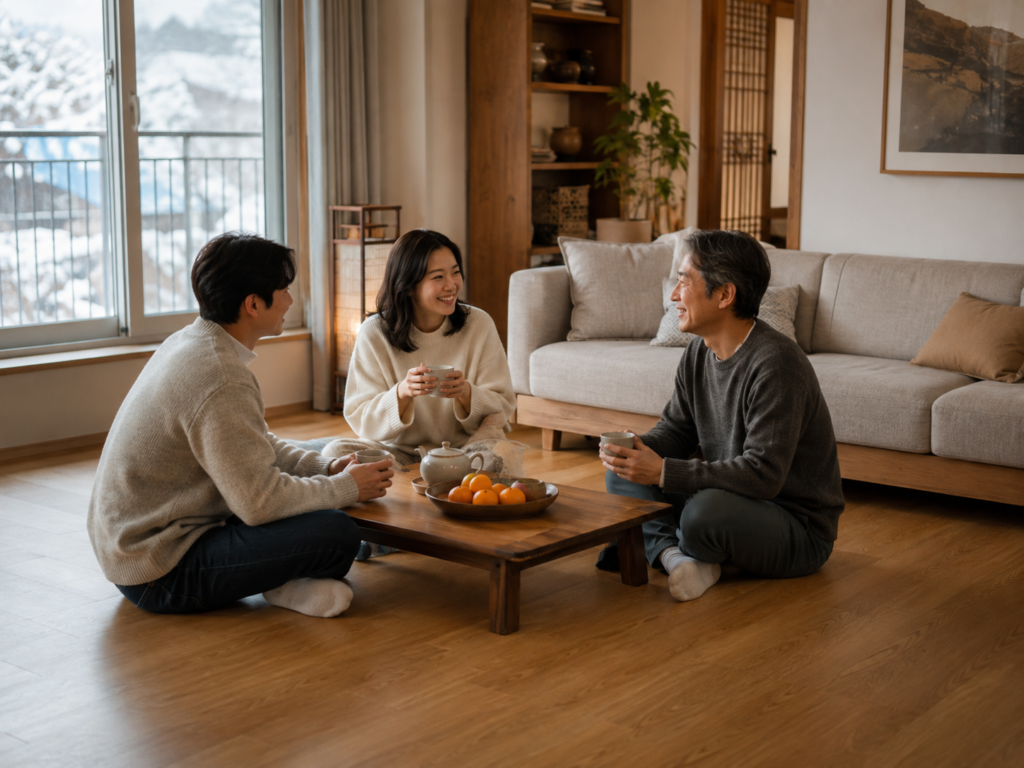
Historically, in Korean homes the floor itself was often where daily life happened.
People sat there.
Meals could be served close to it.
Children played there.
Families gathered there.
And people could sleep on bedding spread directly over it.
Once you understand that, wearing dirty outdoor shoes across the floor begins to feel very different.
The Key to Understanding It: Ondol
One of the most important words in Korean housing culture is:
온돌 — Ondol
Ondol is Korea’s traditional underfloor heating system.
Instead of heating only the air around a fireplace, traditional Korean heating sent heat underneath sections of the floor.
The floor became warm.
And because the warmest place in the room was below you, Korean domestic life naturally developed close to the ground.
People sat on the floor.
They ate near the floor.
They rested there.
They slept there.
Modern Korean apartments no longer use exactly the same traditional construction system, but underfloor heating remains extremely common in Korean homes.
Even in a high-rise apartment filled with sofas, dining chairs, computers, and modern appliances, the floor may still be warm in winter.
And people still sit on it.
That is one reason the shoes-off habit continues to feel completely natural.
Imagine Wearing Street Shoes on Your Bed
Here is perhaps the easiest way to understand the feeling.
Imagine someone walked outside all day.
They stepped on:
sidewalks,
roads,
subway platforms,
restaurant floors,
public bathrooms,
and rainy pavement.
Then they entered your bedroom and stepped directly onto your bed without removing their shoes.
You would probably feel uncomfortable.
For many Koreans, wearing outdoor shoes across the living-room floor can create a similar reaction.
Because the floor is not treated only as a walking surface.
It is part of the clean living zone.
You might sit there five minutes later.
A child might lie there.
Someone might unfold bedding there.
So the front door becomes more than an entrance.
It becomes a boundary.
The Korean Entrance: 현관 — Hyeongwan
That boundary even has its own physical space.
현관 — Hyeongwan
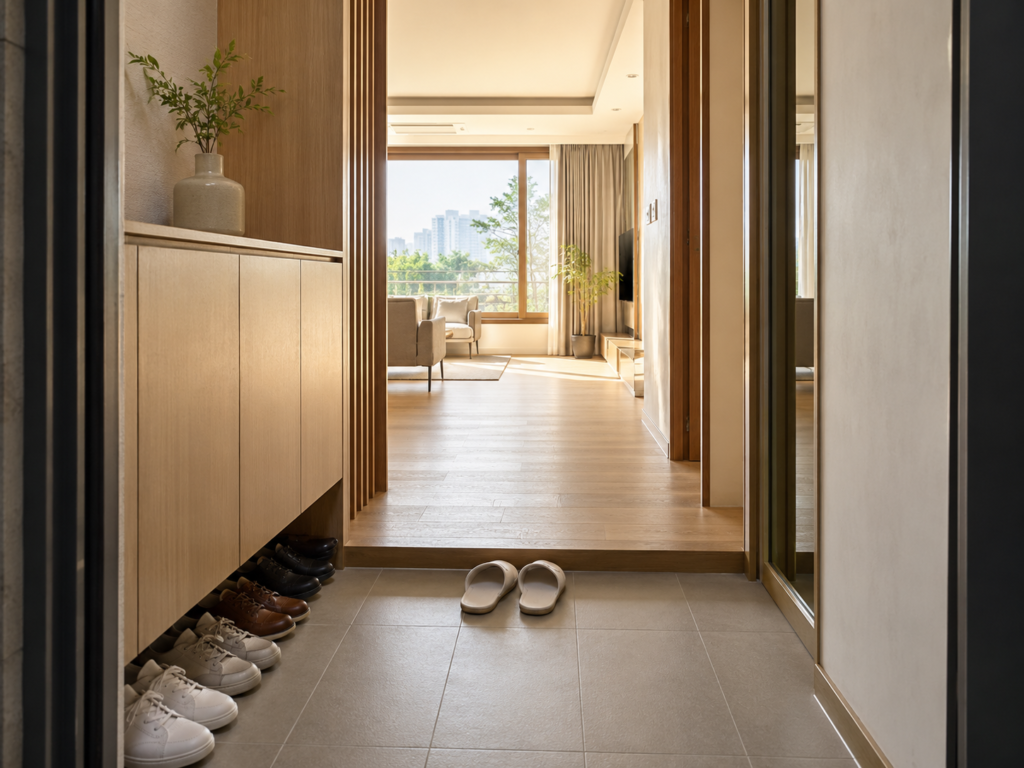
The hyeongwan is the entrance area inside a Korean home.
In many apartments, it is easy to identify because the shoe area sits slightly lower than the main interior floor.
You open the door.
Step into the entrance.
Remove your shoes.
Then step up into the home.
That tiny change in floor height communicates something important without anyone saying a word:
Outside ends here.
Inside begins there.
Many homes also have a large:
신발장 — Sinbaljang
a shoe cabinet near the entrance.
Korean households may own many pairs of shoes, but they do not need to occupy the clean interior.
They stay close to the door.
How Do You Actually Enter a Korean Home?
There is a surprisingly practical technique.
Imagine your shoes are still on.
You stand in the lower entrance area.
Take off one shoe.
Step onto the clean raised floor with your socked or bare foot.
Then remove the second shoe without stepping back into the shoe area.
It sounds complicated when written down.
In real life, Koreans do it automatically.
The important principle is simple:
Try not to step onto the indoor floor while still wearing your outdoor shoes.
And after removing them, try not to put your socked foot back onto the dirty shoe area.
You are crossing from one zone to another.
What Happens to Your Shoes?
Usually, leave them near the entrance.
If you are visiting someone’s home, your host may arrange them or tell you where to place them.
In some households, people turn guest shoes so the toes face the door, making them easier to put on when leaving.
But you do not need to panic about getting every small detail perfect.
As a visitor, the most important thing is simply:
Take them off before entering the main living area.
Do Koreans Wear Slippers Indoors?
Sometimes.
But not always.
This can surprise foreigners who assume:
“If shoes come off, indoor slippers must go on.”
Many Korean families simply walk around their homes:
in socks,
or barefoot.
Others provide slippers.
Offices, hospitals, schools, guesthouses, and specific indoor spaces may have their own shoe-changing customs.
So there is no universal rule that all Koreans wear slippers at home.
However, there is one type of slipper visitors should definitely understand.
Did You Know? Bathroom Slippers Are Their Own Category
Enter a Korean bathroom and you may find plastic slippers waiting inside.
These are:
욕실 슬리퍼 — Bathroom slippers
They are meant to remain in the bathroom.
Why?
Many Korean bathrooms have waterproof floors and floor drains, and the floor can become wet during showering or cleaning.
So the bathroom can become another small zone inside the house:
clean living area → bathroom wet zone
You put on the bathroom slippers when entering.
Then take them off before returning to the rest of the home.
One classic visitor mistake is walking out of the bathroom while still wearing them.
Your Korean host may react immediately:
“아! 슬리퍼!”
The problem is not that slippers themselves are forbidden.
You have simply carried the bathroom zone into the clean living area.
Korea Has More Invisible Indoor Boundaries Than You Might Think
Once you start noticing them, Korean spaces become easier to understand.
There can be boundaries between:
street and home
shoe zone and living floor
bathroom and living room
outdoor balcony and indoor area
restaurant entrance and floor seating
These boundaries are not always marked with signs.
People understand them through flooring, height differences, slippers, mats, or simply habit.
This is one reason Korean etiquette can sometimes feel invisible to foreigners.
Nobody explained the rule.
The architecture explained it.
What About Korean Restaurants?
Not every Korean restaurant requires you to remove your shoes.
In fact, most modern restaurants use normal tables and chairs, and customers keep their shoes on.
But traditional restaurants or establishments with:
좌식 — Floor seating
may ask customers to remove their shoes before entering the dining area.
Historically, floor seating was much more common.
Today, many restaurants have moved toward chairs and tables because they are more comfortable and accessible for a wider range of customers.
Still, if you encounter a raised wooden dining platform with shoes lined up outside it, the message is obvious:
Shoes off.
What About Hanok?
A traditional Korean house is called:
한옥 — Hanok
When visiting or staying in a hanok, the relationship between shoes and floor becomes even easier to understand.
Traditional Korean architecture often distinguishes different types of interior and semi-interior space.
There may be wooden floors.
Ondol-heated rooms.
Courtyards.
Raised thresholds.
Shoes generally remain outside the main indoor rooms.
Stepping into a warm ondol room in socks after leaving your shoes behind is not merely etiquette.
It changes how you physically experience the architecture.
You feel the floor.
You sit differently.
Suddenly, the house makes more sense.
Hidden Story: The Floor Was Furniture
Modern homes contain many pieces of furniture designed to separate the body from the floor.
Beds.
Sofas.
Chairs.
Dining tables.
Desks.
But traditional Korean life depended less heavily on tall furniture.
Instead, bedding could be folded away after sleeping.
Small dining tables could be brought out for meals.
Cushions could be placed on the floor for sitting.
One space could therefore become:
a bedroom at night,
a family room during the day,
and a dining space at mealtime.
The floor made that flexibility possible.
In a sense:
The floor itself was part of the furniture.
Once you see Korean domestic history this way, taking off your shoes is no longer just a cleanliness rule.
It is part of an entire way of using space.
Why Koreans Still Sit on the Floor in Modern Apartments
Look inside a contemporary Seoul apartment and you may see:
a large sofa,
a television,
a dining table,
a robot vacuum,
a modern kitchen,
and expensive electronics.
Then everyone sits on the floor in front of the sofa.
Why?
Habit.
Comfort.
Warmth.
Space.
Family culture.
Children often play on the floor.
People gather around low tables.
Someone may stretch out while watching television.
During family gatherings, the floor creates extra seating when chairs run out.
And during winter, heated flooring makes sitting there especially comfortable.
Modern Korea changed the house.
But it did not completely eliminate the body’s relationship with the floor.
This Is Also Why Clean Floors Matter So Much
When people live close to the floor, cleaning it becomes particularly important.
Korean households commonly:
vacuum,
mop,
use robot cleaners,
wipe floors,
and separate outdoor footwear from indoor space.
Again, this does not mean every Korean home is spotless.
Real homes are real homes.
But culturally, the expectation that outdoor shoes remain outside the living zone is extremely strong.
Even a messy Korean apartment may still have one clear rule:
Don’t walk through it in street shoes.
What If You Forget?
Suppose you enter your Korean friend’s home.
You are talking.
You are distracted.
And you take three steps inside wearing your shoes.
Your host suddenly looks horrified.
What should you do?
Stop.
Take them off.
Say:
죄송해요!
Joe-song-hae-yo!
“Sorry!”
And move on.
You have not created an international incident.
Most Koreans understand that cultural habits differ.
The easiest way to avoid the mistake is simply to look down when entering.
If everyone’s shoes are lined up near the door:
you have your answer.
What If You Aren’t Sure?
Ask.
신발은 어디에 벗으면 돼요?
Sin-ba-reun eo-di-e beo-seu-myeon dwae-yo?
“Where should I take off my shoes?”
This is one of the most useful Korean phrases for visiting a home, guesthouse, traditional restaurant, temple facility, or other shoes-off space.
Business Insight: Architecture Can Teach Behavior Without Signs
There is also an interesting design lesson here.
A well-designed Korean entrance does not need a giant sign saying:
REMOVE YOUR SHOES NOW.
The space itself communicates the behavior.
Lower shoe area.
Raised interior floor.
Shoe cabinet.
Slippers.
Different flooring materials.
The customer or guest reads the environment.
This is an example of how architecture can shape behavior.
For restaurants, hotels, spas, cultural attractions, and traditional accommodations, this matters commercially as well.
Foreign visitors may not understand Korean spatial conventions automatically.
Good hospitality design can therefore make the transition intuitive through:
clear flooring,
shoe storage,
seating,
simple multilingual guidance,
and obvious clean/dirty zones.
The easier the ritual is to understand, the more comfortable the experience becomes.
Shoes-Off Culture Is Not About Being “More Clean”
There is one important cultural trap to avoid.
It would be easy to say:
“Koreans take off their shoes because Korea is cleaner than countries where people keep them on.”
That is not a useful conclusion.
Different societies developed different relationships with:
climate,
architecture,
heating,
floor materials,
furniture,
and domestic routines.
Korea’s shoes-off culture makes sense inside Korea’s historical living system.
Another country’s indoor-shoe culture makes sense within its own history.
Understanding culture is more interesting than ranking it.
Naru’s Travel Tips
When visiting a Korean home, the easiest rule is:
Look at the entrance before walking forward.
If you see shoes lined up, remove yours.
Wear clean socks if you know you will be visiting someone’s home or a traditional indoor space.
Do not automatically assume slippers are required; your host may offer them if they are.
If you see separate plastic slippers inside the bathroom, use them there—and leave them there when you come out.
At traditional restaurants, look for a raised dining platform or shoe shelves near the entrance.
And when you are unsure, ask:
신발은 어디에 벗으면 돼요?
Nobody expects a foreign visitor to understand every invisible rule instantly.
Showing that you noticed the custom is already a good start.
Learn 5 Korean Words
| English | Korean | Pronunciation | Chinese | Spanish |
|---|---|---|---|---|
| Shoes | 신발 | sin-bal | 鞋 | Zapatos |
| Entrance | 현관 | hyeon-gwan | 玄关 | Entrada |
| Shoe cabinet | 신발장 | sin-bal-jang | 鞋柜 | Zapatero |
| Floor | 바닥 | ba-dak | 地板 | Suelo |
| Indoor shoes | 실내화 | sil-nae-hwa | 室内鞋 | Calzado de interior |
Bonus Word
온돌 — Ondol
Korea’s traditional system of heating the floor from below.
Understanding ondol helps explain much more than heating.
It helps explain:
floor sitting,
floor sleeping,
shoes-off culture,
and the entire structure of traditional Korean domestic life.
Korean Phrase of the Day
신발은 어디에 벗으면 돼요?
Pronunciation: Sin-ba-reun eo-di-e beo-seu-myeon dwae-yo?
English: Where should I take off my shoes?
Chinese: 鞋子要脱在哪里?
Spanish: ¿Dónde debo quitarme los zapatos?
A simpler version is:
신발을 벗어야 해요?
Sin-ba-reul beo-seo-ya hae-yo?
Do I need to take off my shoes?
Today’s Question
Do people wear outdoor shoes inside homes in your country?
And if not, what happens at the entrance?
Shoes?
Slippers?
Bare feet?
Socks?
Tell us in the comments.
It would be interesting to compare how homes around the world define the boundary between outside and inside.
Naru’s Quote
“To understand a Korean home, look down first. The line between outside and inside often begins at your feet.” — Naru
SEO FAQ
Why do Koreans take their shoes off indoors?
Korean shoes-off culture is connected to cleanliness, floor-centered domestic life, and the long tradition of ondol underfloor heating. Because people traditionally sat, ate, rested, and slept close to the floor, keeping outdoor footwear away from indoor living areas became especially important.
Do you have to take your shoes off in every building in Korea?
No. Shops, cafés, offices, malls, and most modern restaurants normally allow outdoor shoes. Shoes are most commonly removed in homes, many traditional accommodations, certain floor-seating restaurants, and other designated indoor spaces.
Do Koreans wear slippers at home?
Some do, but many people simply wear socks or go barefoot. Slipper use depends on the household.
What is a hyeongwan?
현관 (hyeongwan) is the entrance area of a Korean home. It commonly contains the shoe-removal space and a shoe cabinet, and in many apartments the main living floor is slightly raised above it.
What is ondol?
온돌 (ondol) is Korea’s traditional underfloor heating system. Modern Korean homes generally use modern heating technology, but warm floors remain a major feature of Korean housing.
Why are there slippers in Korean bathrooms?
Many Korean bathrooms have waterproof floors that may become wet. Dedicated bathroom slippers help keep feet dry and help maintain a boundary between the wet bathroom floor and the rest of the home.
Should tourists remove shoes in Korean restaurants?
Only when the restaurant’s layout requires it. If there is a raised floor-seating area, shoe rack, or shoes lined up near the entrance, you may be expected to remove them. Most ordinary table-and-chair restaurants do not require this.
Is it rude to wear shoes inside a Korean home?
Yes, entering the main living space of someone’s home in outdoor shoes is generally considered inappropriate. If you accidentally do it, simply apologize and remove them.
Part 3 — The Door Is Not the Real Boundary
A Korean front door tells you that you have entered the apartment.
But culturally, that may not be the true boundary.
The real boundary can be a few centimeters farther inside.
At the hyeongwan.
One side contains:
street shoes,
dust,
rain,
public space,
and the outside world.
The other side contains:
warm floors,
family,
sleeping,
eating,
children playing,
and home.
You cross that invisible border by removing your shoes.
This is what makes the custom more interesting than a simple hygiene rule.
It reflects an older way of understanding domestic space.
Traditional Korean homes were built around a close relationship between the body and the floor.
Ondol warmed it.
People sat on it.
Bedding was placed on it.
Meals happened near it.
Modern Korea introduced sofas, beds, high-rise apartments, dining tables, and completely different lifestyles.
But the boundary survived.
Walk into a Seoul apartment today and you may find smart appliances, high-speed internet, a robot vacuum, and a giant television.
Yet at the entrance:
the shoes still come off.
That tiny habit connects modern Korean life with a much older way of living.
And that is why understanding Korea sometimes begins with something incredibly ordinary.
Before looking at the palace.
Before tasting the food.
Before learning the language.
Just look down.
한국인은 왜 실내에서 신발을 벗을까?
한국 가정집에 처음 방문한 외국인은 현관에서 바로 한 가지 사실을 알게 됩니다.
신발을 벗어야 한다는 것입니다.
한국에서 이것은 특별한 예절이라기보다 매우 자연스러운 생활 습관입니다.
그 이유를 이해하려면 한국의 전통적인 온돌 문화와 바닥 생활을 함께 봐야 합니다.
한국의 전통 가옥에서는 바닥을 따뜻하게 데우는 온돌을 사용했습니다.
따뜻한 바닥에서 사람들은 앉고, 식사하고, 휴식하고, 이불을 펴고 잠을 잤습니다.
즉 바닥은 단순히 걸어 다니는 곳이 아니라 실제 생활공간이었습니다.
그래서 밖에서 신던 신발을 그대로 신고 바닥을 걷는 것은 자연스럽지 않았습니다.
이러한 문화는 현대 아파트에서도 이어집니다.
오늘날 한국 가정에는 침대, 소파, 식탁이 있지만 여전히 많은 사람들이 바닥에 앉고 아이들이 바닥에서 놀며 겨울에는 따뜻한 바닥을 즐깁니다.
한국 집에 들어가면 먼저 만나는 공간이:
현관
입니다.
현관의 신발을 두는 부분은 거실 바닥보다 약간 낮은 경우가 많습니다.
이 작은 높이 차이는 사실 매우 중요한 경계를 보여줍니다.
밖과 안의 경계입니다.
신발은 현관에 두고 실내로 들어갑니다.
또 한국 가정의 화장실에서는 별도의 욕실 슬리퍼를 볼 수도 있습니다.
욕실 바닥은 물에 젖을 수 있기 때문에 욕실 전용 슬리퍼를 사용하고, 다시 거실로 나올 때는 벗습니다.
외국인이 가장 자주 하는 실수 중 하나는 욕실 슬리퍼를 그대로 신고 거실로 나오는 것입니다.
하지만 실수해도 너무 걱정할 필요는 없습니다.
한국 집을 방문할 때 기억할 가장 간단한 방법은:
현관에서 다른 사람들의 신발을 살펴보는 것입니다.
신발이 모여 있다면 나도 벗으면 됩니다.
잘 모르겠다면 이렇게 물어보세요.
“신발은 어디에 벗으면 돼요?”
한국의 신발 문화는 단순히 청결에 대한 이야기가 아닙니다.
한국인이 집이라는 공간을 오랫동안 어떻게 사용해왔는지를 보여주는 작은 문화적 흔적입니다.
为什么韩国人在室内要脱鞋?
第一次去韩国朋友家时,你很快就会发现一个习惯:
进屋前要脱鞋。
这不仅仅是简单的卫生习惯。
要理解它,需要了解韩国传统住宅中的 **온돌(Ondol,地暖)**文化。
传统韩屋利用地板下方的热量来温暖房间。
因此,韩国人的生活长期以来与地板非常接近。
人们坐在地板上。
孩子在地板上玩。
过去,人们还会把被褥直接铺在地板上睡觉。
有时也会在低矮的饭桌旁坐在地上吃饭。
所以,地板并不只是“走路的地方”。
它也是生活空间的一部分。
这也解释了为什么韩国住宅的入口:
현관 — Hyeongwan
如此重要。
很多韩国公寓的入口鞋区会比客厅地板稍低一些。
在这里脱掉外鞋以后,才进入真正的室内空间。
这个小小的高度差,实际上是在告诉你:
外面到这里为止。
家从这里开始。
另外,在韩国浴室里你可能会看到专门的塑料拖鞋。
因为浴室地面经常会湿,所以这些拖鞋只在浴室内使用。
不要穿着浴室拖鞋走进客厅——这是外国游客很容易犯的小错误。
如果你不确定在哪里脱鞋,可以问:
신발은 어디에 벗으면 돼요?
“鞋子应该脱在哪里?”
从这个看似简单的习惯中,我们可以看到韩国住宅文化中非常重要的一点:
地板不是背景,而是生活的一部分。
🇪🇸 Español
¿Por qué los coreanos se quitan los zapatos dentro de casa?
Cuando visitas una casa coreana por primera vez, hay una costumbre que descubrirás inmediatamente:
Los zapatos se quedan en la entrada.
Esta práctica está relacionada con la limpieza, pero para entenderla completamente también hay que conocer el ondol, el sistema tradicional coreano de calefacción bajo el suelo.
En las casas tradicionales, el suelo caliente era una parte central de la vida cotidiana.
Las personas se sentaban en él.
Comían cerca de él.
Los niños jugaban sobre él.
Y por la noche se podían extender las mantas directamente sobre el suelo para dormir.
Por eso, el suelo no era solamente una superficie para caminar.
Era parte del espacio vital.
La entrada de una casa coreana se llama:
현관 — Hyeongwan
En muchos apartamentos modernos, la zona donde se dejan los zapatos está ligeramente más baja que el suelo principal de la vivienda.
Esta pequeña diferencia crea una frontera muy clara:
afuera / adentro
Los zapatos permanecen cerca de la puerta y se entra en la casa con calcetines, descalzo o, en algunas viviendas, con pantuflas.
También puedes encontrar pantuflas especiales dentro del baño.
Los baños coreanos suelen tener suelos resistentes al agua que pueden mojarse, por lo que estas pantuflas deben quedarse allí.
Si visitas una casa coreana y no sabes dónde quitarte los zapatos, simplemente pregunta:
신발은 어디에 벗으면 돼요?
“¿Dónde debo quitarme los zapatos?”
Al final, quitarse los zapatos no es únicamente una regla de etiqueta.
Es una pequeña costumbre moderna que todavía conserva la memoria de cómo los coreanos han vivido alrededor de sus suelos durante siglos.