
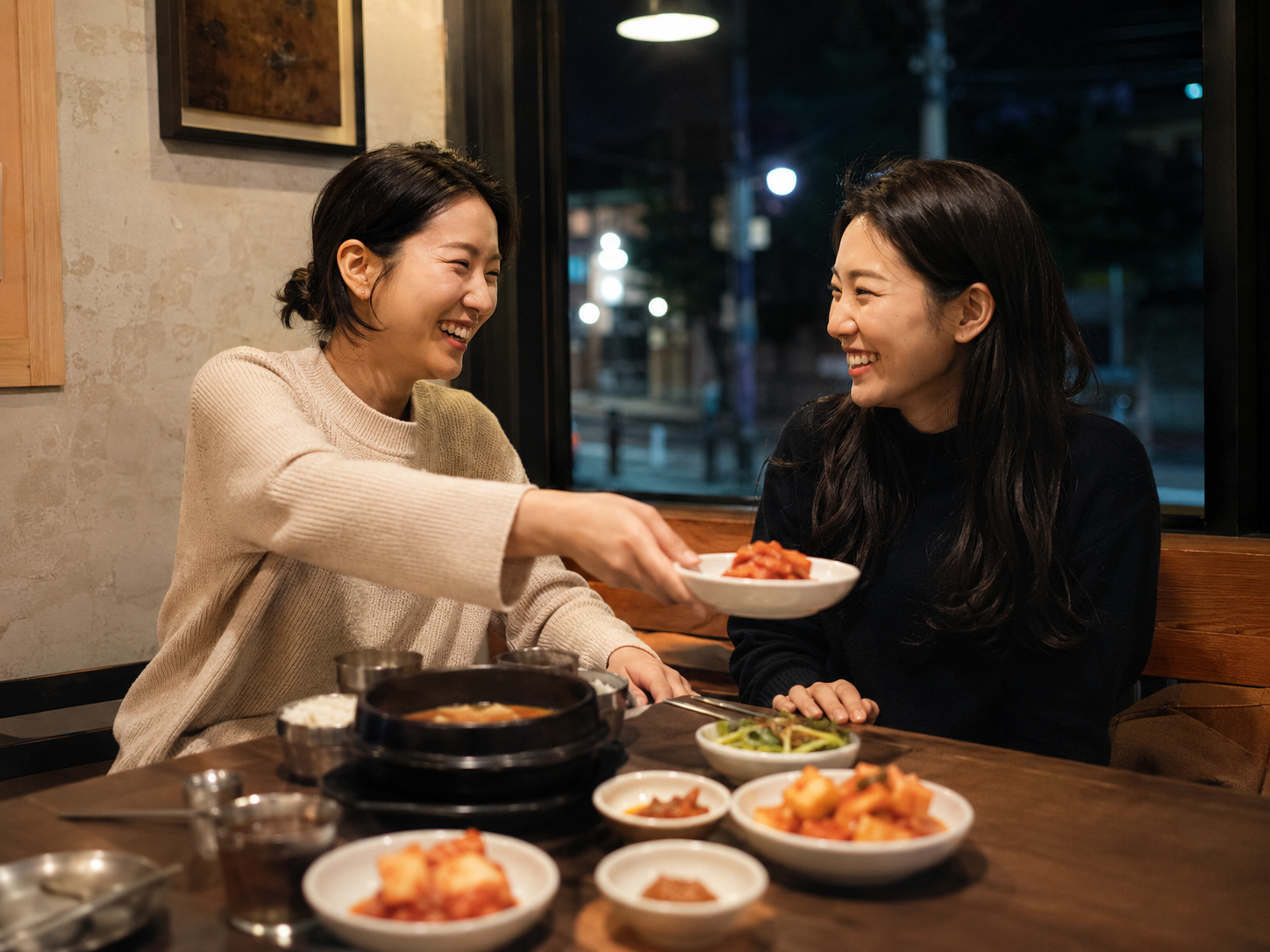

A Korean Person Asks If You’ve Eaten. But They May Not Really Be Asking About Food.
Your phone rings.
It is your Korean mother-in-law.
Your Korean friend.
Maybe a coworker you haven’t spoken to all day.
After saying hello, one of the first questions is:
“밥 먹었어?”
Bap meo-geo-sseo?
Literally:
“Did you eat?”
You pause.
Why do they want to know?
Are they inviting you to dinner?
Do you look hungry?
Did you forget to eat lunch?
Sometimes the answer really is about food.
But often, the question carries something warmer.
Depending on the relationship and context, 밥 먹었어? can feel closer to:
“Are you doing okay?”
“Have you been taking care of yourself?”
“Everything all right?”
or simply:
“I’m thinking about you.”
That is why one of the simplest questions in Korean can reveal something much bigger about Korean culture.
In Korea, food does not only feed people.
Food can also express care.
First, What Does “밥 먹었어?” Literally Mean?
Let’s break it down.
밥 — Bap
Many Korean learners first translate 밥 as:
rice.
That is correct.
But it is only half the story.
The National Institute of Korean Language’s Korean-English Learners’ Dictionary gives two core meanings for 밥:
- cooked rice
- a meal
So Koreans can say 밥 먹자 — “Let’s eat” even when the actual meal might involve noodles, barbecue, soup, or something else.
The second part is:
먹었어? — Meogeosseo?
from:
먹다 — meokda — to eat
So:
밥 먹었어?
literally means:
“Did you eat a meal?”
But language is rarely only literal.
Is It Really the Korean Version of “How Are You?”
Sometimes.
But we should be careful.
You should not replace every English “How are you?” with 밥 먹었어요?
Koreans also say:
안녕하세요?
Annyeonghaseyo?
“Hello.”
Or:
잘 지냈어요?
Jal jinaesseoyo?
“Have you been well?”
Especially when meeting someone after some time.
밥 먹었어요? works differently.
It can be:
a real question about whether you have eaten,
a casual greeting,
a conversation opener,
a way to make lunch plans,
or an expression of genuine concern.
The context decides.
That ambiguity is exactly what makes the phrase interesting.
Recent Korean-language teaching explanations describe 밥 먹었어요? as a phrase that can move between literal food inquiry and a warm social check-in.
Imagine Your Mother Calling
This may be the easiest way to understand the emotional meaning.
Imagine a Korean mother calling her adult child who lives alone.
She could ask:
“How is your emotional wellbeing?”
“Are you properly caring for your physical health?”
“Have you maintained a healthy work-life balance?”
She probably won’t.
She may simply ask:
“밥은 먹었어?”
Ba-beun meo-geo-sseo?
“Did you eat?”
And if the answer is:
“No.”
another question may immediately follow:
“왜 안 먹었어?”
“Why haven’t you eaten?”
Then:
“What are you going to eat?”
Then perhaps:
“I’ll send you something.”
The emotional message is hidden inside a practical question.
Are you looking after yourself?
Why Did Food Become a Language of Care?
One frequently cited explanation is Korea’s relatively recent experience with hardship and food scarcity.
Korea.net’s discussion of bap explains that during periods including Japanese colonial rule, the Korean War, and the difficult years surrounding them, regular meals could not always be taken for granted. Asking whether someone had eaten therefore could function as a genuine check on their wellbeing. The same article argues that the phrase survived even as Korea became wealthier, shifting toward an expression of concern and affection.
This does not mean we can trace every modern 밥 먹었어? to one exact historical moment.
Language develops gradually.
But the history helps explain why:
“Did you eat?”
could carry much more emotional weight than the literal words suggest.
For generations who remembered hunger, having eaten meant something very concrete.
You were okay.
At least for today.
Hidden Story: “Bap” Can Mean Much More Than Rice
The cultural power of 밥 appears throughout Korean language.
Consider expressions such as:
밥 먹자
“Let’s eat.”
밥 한 끼 하자
“Let’s have a meal sometime.”
밥 사줄게
“I’ll buy you a meal.”
These phrases can be about food.
But they can also be about:
friendship,
reconciliation,
gratitude,
networking,
dating,
or simply spending time together.
Korea.net describes bap not merely as a staple but as something associated culturally with sharing, strength, affection, and communal life.
So when a Korean says:
“언제 밥 한번 먹자.”
Eon-je bap han-beon meok-ja.
Literally:
“Let’s eat a meal sometime.”
the deeper meaning may be:
“Let’s see each other again.”
Food Does Emotional Work
Different cultures express affection differently.
Some families say:
“I love you.”
often.
Others express care more indirectly.
In many Korean families, affection may appear through actions such as:
cutting fruit,
packing food,
sending side dishes,
asking whether you are cold,
telling you to dress warmly,
or checking whether you have eaten.
That does not mean Koreans never express emotions directly.
Of course they do.
The interesting point is that care can also be practical.
Someone doesn’t merely say:
“I care about you.”
They ask:
“Did you eat?”
Then they try to feed you.
Why Korean Dramas Use This Phrase So Often
If you watch Korean dramas, listen closely.
A character may be going through a difficult time.
Someone visits them.
Instead of immediately asking:
“How do you feel?”
they say:
“밥은 먹었어?”
The scene works because Korean audiences understand the emotional subtext.
Sometimes the warmest thing you can do for someone who is exhausted, heartbroken, sick, or overwhelmed is not demand that they explain everything.
It is simply to make sure they have eaten.
That is why food scenes in Korean dramas can carry so much emotional meaning.
The meal is often not just the background.
Feeding someone can advance the relationship.
“밥 먹었어?” Can Also Mean: Shall We Eat Together?
Here is where foreigners need context.
Suppose someone asks at 11:50 a.m.:
“밥 먹었어요?”
You say:
“아직 안 먹었어요.”
Ajik an meogeosseoyo.
“I haven’t eaten yet.”
They might reply:
“그럼 같이 먹어요.”
Geureom gachi meogeoyo.
“Then let’s eat together.”
Now the question was not merely a greeting.
It was also testing whether lunch plans were possible.
But imagine the same person asks at 3 p.m.
You say:
“Yes, I ate.”
They nod.
Conversation moves on.
In that context, it may simply have been a friendly check-in.
This is why translating Korean word-for-word can miss what is actually happening socially.
How Should You Answer?
Fortunately, the answer is easy.
If you ate:
네, 먹었어요.
Ne, meogeosseoyo.
“Yes, I ate.”
If you haven’t:
아직 안 먹었어요.
Ajik an meogeosseoyo.
“I haven’t eaten yet.”
If someone asks casually, you usually do not need to provide your entire menu.
You do not have to say:
“Yes, at 12:17 p.m. I consumed a chicken sandwich, salad, and 400 milliliters of sparkling water.”
A simple response is enough.
Then you can return the question:
밥 먹었어요?
“Have you eaten?”
Now you sound much more natural.
Formal, Polite, and Casual Versions
Korean changes depending on relationship and politeness.
Polite
밥 먹었어요?
Bap meogeosseoyo?
“Have you eaten?”
Good for many everyday polite situations.
Casual
밥 먹었어?
Bap meogeosseo?
Used with close friends, younger people, partners, siblings, or others where casual speech is appropriate.
More respectful
식사하셨어요?
Siksa hasyeosseoyo?
“Have you had a meal?”
This uses the more formal 식사 and the honorific 하시다 construction.
You may hear it when speaking respectfully to an elder or senior person.
The underlying concern is similar.
The language adjusts to the relationship.
Why Asking About Food Feels So Natural in Korean
The more time you spend around Korean speakers, the more you notice how often food enters everyday language.
People ask:
밥 먹었어?
“Did you eat?”
뭐 먹었어?
“What did you eat?”
뭐 먹을래?
“What do you want to eat?”
밥 먹자.
“Let’s eat.”
많이 먹어.
“Eat plenty.”
잘 먹었어?
“Did you eat well?”
Some of these questions are literally about meals.
But together they reveal how naturally eating overlaps with social connection.
People do not merely meet.
They meet over food.
They do not only say goodbye.
They promise to:
“have a meal sometime.”
“Have You Eaten?” Is Not Uniquely Korean
This is also worth remembering.
Similar food-based greetings exist in several Asian languages and cultures.
Expressions asking whether someone has eaten can also be found, in different forms and contexts, in Chinese, Vietnamese, Thai, and other languages.
So it would be misleading to claim Korea uniquely invented the idea.
What matters for K-Global Stage is how strongly the expression fits Korean cultural patterns around bap, shared meals, family care, and hospitality.
Different cultures may ask the same literal question.
The social history behind it can still differ.
What Does This Tell Us About “Jeong”?
There is a Korean word international readers frequently encounter:
정 — Jeong
Jeong is difficult to translate neatly.
Depending on context, it can involve:
affection,
attachment,
warmth,
familiarity,
and the emotional bond that develops between people over time.
We should be careful not to explain every Korean behavior through jeong.
But food can certainly become one way relationships accumulate.
Someone cooks for you.
You eat together.
They remember what you like.
They bring you food next time.
You share another meal.
Over years, these small actions create familiarity.
So perhaps:
“밥 먹었어?”
is not a grand declaration of jeong.
It is something smaller.
And that may be exactly why it matters.
Did You Know?
밥 Doesn’t Have to Mean Rice
This surprises many Korean learners.
The official Korean dictionary includes “meal” as one of the core meanings of 밥.
So imagine you eat:
pasta,
pizza,
ramyeon,
or a hamburger.
A Korean friend may still ask:
“밥 먹었어?”
You do not need to reply:
“No, technically I ate noodles.”
In everyday conversation, 밥 can simply mean:
your meal.
That tiny linguistic detail tells us how central rice historically was to the structure of Korean eating.
The word for the staple became a word for the meal itself.
From “Have You Eaten?” to “Let’s Eat”
There is another beautiful progression.
Someone asks:
“밥 먹었어?”
You say:
“아니.”
“No.”
Then they say:
“그럼 같이 먹자.”
Geureom gachi meok-ja.
“Then let’s eat together.”
The greeting becomes an invitation.
The invitation becomes a meal.
The meal becomes conversation.
And conversation becomes relationship.
Maybe that is one reason food appears so often in Korean social life.
Meals create time together.
Business Insight: In Korea, Food Can Be Relationship Infrastructure
This cultural habit also provides an interesting business lesson.
Restaurants in Korea do not sell only calories.
Meals support:
dates,
family gatherings,
business discussions,
team dinners,
friendships,
celebrations,
and reunions.
Even the phrase:
“밥 한번 먹자.”
can function as relationship maintenance.
For restaurants, cafés, delivery platforms, and food brands, this means consumption is often attached to a social occasion.
The product may be:
barbecue.
coffee.
fried chicken.
a lunch box.
But the actual consumer need can be:
“I need somewhere to spend time with someone.”
That difference is important.
Food businesses compete not only on taste.
They compete on their ability to create moments where people can connect.
Modern Korea: Is the Expression Disappearing?
Not really—but language changes with generations and situations.
Younger Koreans may use:
요즘 어때?
“How are things?”
잘 지내?
“You doing well?”
or simply communicate through messages, emojis, memes, and other modern forms of checking in.
Still, 밥 먹었어? remains instantly understandable and especially natural within families, friendships, couples, and everyday relationships.
One recent Korean-language education article published in August 2026 still describes the phrase as a warm everyday expression of concern rather than merely a literal question about food.
The country changed.
The question survived.
A Small Phrase From an Older Korea
This creates an interesting contrast.
Modern Korea is associated globally with:
smartphones,
semiconductors,
K-pop,
beauty,
delivery apps,
high-speed trains,
and futuristic cities.
But someone calls home.
And the question can still be:
“밥은 먹었니?”
“Did you eat?”
A very modern society can preserve very old emotional habits.
That may be one reason everyday Korean expressions are so useful for understanding the country.
History does not always survive in museums.
Sometimes it survives in a mother’s phone call.
Naru’s Travel Tips
If someone asks you 밥 먹었어요?, don’t immediately assume they are inviting you to a restaurant.
Listen to the context.
If it is close to lunchtime or dinner, they may genuinely be making plans.
If it is a casual greeting, a simple:
네, 먹었어요.
is enough.
If you haven’t eaten:
아직 안 먹었어요.
is perfectly natural—but don’t be surprised if the next sentence is:
“그럼 같이 먹어요.”
“Then let’s eat together.”
And if you want an easy way to show warmth to a Korean friend?
Ask them:
“밥 먹었어요?”
You may be surprised how natural it feels.
Learn 5 Korean Words
| English | Korean | Pronunciation | Chinese | Spanish |
|---|---|---|---|---|
| Rice / meal | 밥 | bap | 饭 / 一餐 | Arroz / comida |
| Eat | 먹다 | meok-da | 吃 | Comer |
| Meal | 식사 | sik-sa | 用餐 | Comida |
| Together | 같이 | ga-chi | 一起 | Juntos |
| Take care / look after | 챙기다 | chaeng-gi-da | 照顾 | Cuidar |
Bonus Word
한 끼 — Han kki
One meal.
For example:
밥 한 끼 같이 해요.
Bap han kki gachi hae-yo.
“Let’s have a meal together.”
A very Korean-sounding invitation that can mean much more than simply consuming food.
Korean Phrase of the Day
밥 먹었어요?
Pronunciation: Bap meo-geo-sseo-yo?
English: Have you eaten?
Chinese: 吃饭了吗?
Spanish: ¿Has comido?
Natural Answer
네, 먹었어요.
Ne, meogeosseoyo.
“Yes, I have.”
Or:
아직 안 먹었어요.
Ajik an meogeosseoyo.
“I haven’t eaten yet.”
Today’s Question
Does your culture use food as a way of asking whether someone is okay?
Maybe your family asks:
“Did you eat?”
“Have you had dinner?”
“Are you hungry?”
Or maybe affection is expressed in a completely different way.
Tell us in the comments.
Sometimes the most interesting cultural differences are hiding inside the questions families ask every day.
Naru’s Quote
“Sometimes ‘Have you eaten?’ is not a question about your stomach. It is a quiet way of asking whether life has been taking care of you.” — Naru

SEO FAQ
Why do Koreans ask “Have you eaten?”
Depending on context, 밥 먹었어? can be a literal meal question, a greeting, an invitation, or a warm way of checking on someone’s wellbeing. Korea.net connects the expression partly to periods in Korean history when food security was a genuine concern and having eaten was an important sign that someone was doing okay.
What does “bap meogeosseo” mean?
밥 먹었어? (bap meogeosseo?) literally means “Did you eat?” or “Have you eaten?” It is casual speech and is typically used with people with whom informal language is appropriate.
Does “bap” mean rice or meal?
Both. The National Institute of Korean Language’s dictionary lists cooked rice and meal as meanings of 밥.
Is “Have you eaten?” the same as “How are you?” in Korean?
Not exactly. It can function like a warm check-in, but it can also be a real question about food or the beginning of a meal invitation. Context matters.
How do I answer “밥 먹었어요?”
If you have eaten:
네, 먹었어요.
“Yes, I have.”
If not:
아직 안 먹었어요.
“I haven’t eaten yet.”
What is the respectful way to ask an older Korean if they have eaten?
A common respectful expression is:
식사하셨어요?
Siksa hasyeosseoyo?
“Have you had your meal?”
Do Koreans still say “Have you eaten?” today?
Yes. It remains a familiar expression, especially among families, friends, couples, and people checking in on one another, even though modern Korean offers many other ways to ask how someone is doing.
Part 3 — Why This Tiny Question Explains So Much About Korea
At first:
밥 먹었어?
looks almost too simple to deserve an explanation.
Three words.
One everyday question.
But inside it are several layers of Korea.
There is rice, the historic center of the meal.
There is hardship, when whether someone had eaten could genuinely indicate their wellbeing.
There is family, where love may appear through food before it appears through words.
There is hospitality, where feeding someone is a way of welcoming them.
There is friendship, where “let’s eat sometime” becomes a promise to stay connected.
And there is modern Korea, where all of these ideas survive inside a society that looks completely different from the one in which many of those habits developed.
That is why translating:
밥 먹었어?
as simply:
“Have you eaten?”
is technically correct.
But culturally incomplete.
Sometimes it means:
“Lunch?”
Sometimes:
“Want to eat together?”
Sometimes:
“Hello.”
And sometimes:
“I was wondering if you’re okay.”
The words stay the same.
The relationship tells you what they mean.
And perhaps that is the real lesson.
To understand Korean culture, it is not enough to translate the sentence.
You have to understand who is saying it, to whom, and why.
🇰🇷 한국어
한국인은 왜 “잘 지내?” 대신 “밥 먹었어?”라고 물을까?
한국 사람과 이야기하다 보면 아주 자주 듣는 질문이 있습니다.
“밥 먹었어?”
말 그대로 해석하면 단순합니다.
“식사를 했니?”
하지만 실제 대화에서는 그보다 더 많은 의미를 가질 수 있습니다.
부모가 자녀에게 “밥 먹었어?”라고 묻는 것은 단순히 무엇을 먹었는지 궁금해서가 아닐 수 있습니다.
잘 지내고 있는지, 끼니는 챙기고 있는지, 스스로를 잘 돌보고 있는지 확인하는 표현이 되기도 합니다.
국립국어원의 한국어기초사전에서도 밥은 단순히 쌀로 지은 음식뿐 아니라 ‘끼니로 먹는 음식’, 즉 meal이라는 의미를 갖습니다.
그래서 햄버거나 국수, 고기를 먹어도 한국인은 자연스럽게:
“밥 먹었어?”
라고 할 수 있습니다.
이 표현이 왜 안부의 의미까지 가지게 되었는지에 대해서는 한국의 역사적 경험도 자주 언급됩니다.
Korea.net에서는 일제강점기와 한국전쟁을 비롯해 먹을 것이 충분하지 않았던 시절에는 상대가 밥을 먹었는지를 묻는 것이 실제로 그 사람의 생활 상태를 확인하는 중요한 질문이었다고 설명합니다. 이후 한국이 경제적으로 성장한 뒤에도 이 질문이 상대방을 걱정하고 챙기는 표현으로 남았다는 것입니다.
물론 “밥 먹었어?”가 항상 “잘 지내?”라는 뜻은 아닙니다.
점심시간 직전에 물었다면 정말 같이 밥을 먹자는 뜻일 수 있습니다.
부모가 늦게 귀가한 자녀에게 물었다면 실제로 저녁을 먹었는지 걱정하는 질문일 수 있습니다.
친구를 우연히 만났을 때는 가볍게 안부를 묻는 표현일 수도 있습니다.
즉 중요한 것은 맥락과 관계입니다.
한국에서 음식은 단순한 영양 섭취 이상의 역할을 합니다.
“밥 먹자.”
“내가 밥 살게.”
“언제 밥 한번 먹자.”
이런 말들은 결국 사람과 사람이 다시 만나는 이유가 됩니다.
그래서 “밥 먹었어?”라는 작은 질문에는 어쩌면 이런 의미도 숨어 있을 수 있습니다.
“너 괜찮아?”
“잘 챙겨 먹고 있어?”
“나는 네가 어떻게 지내는지 궁금해.”
한국어를 이해하는 것은 단어를 번역하는 것만으로 끝나지 않습니다.
누가 누구에게 그 말을 했는지를 이해해야 합니다.

为什么韩国人常问“吃饭了吗?”而不是“你好吗?”
和韩国人相处时,你可能经常听到:
밥 먹었어?
Bap meogeosseo?
字面意思是:
“吃饭了吗?”
但是在很多情况下,这句话不仅仅是在询问你吃了什么。
它也可能表达:
“你还好吗?”
“有没有好好照顾自己?”
“最近过得怎么样?”
或者只是:
“我在关心你。”
韩语中的 밥 (bap) 不仅可以指米饭,也可以表示一顿饭。韩国国立国语院的词典同时收录了“rice”和“meal”这两个核心意思。
因此,即使一个人吃的是面、汉堡或者烤肉,韩国人仍然可以问:
밥 먹었어?
关于这种表达的文化背景,一种常见解释与韩国过去的贫困和食物短缺有关。
Korea.net介绍说,在战争和经济困难时期,能否正常吃饭曾经是真正反映一个人生活状况的问题。因此,询问“吃饭了吗?”也是确认对方是否安好的实际方式。后来生活条件改善了,这种表达关心的习惯依然保留下来。
不过,这句话并不总是等于英文的“How are you?”
在午饭时间,它可能真的意味着:
“要不要一起吃?”
父母问孩子时,可能真的是担心他们没有吃饭。
朋友之间,也可能只是一种轻松的问候。
所以最重要的是:
看语境。
在韩国文化中,食物常常与关心、家庭和关系联系在一起。
有时候一句简单的:
“吃饭了吗?”
真正想表达的是:
“希望你一切都好。”
¿Por qué los coreanos preguntan “¿Has comido?” en lugar de “¿Cómo estás?”
Si pasas tiempo con coreanos, probablemente escucharás esta pregunta:
밥 먹었어?
Bap meogeosseo?
Literalmente significa:
“¿Has comido?”
Sin embargo, dependiendo de la situación, puede significar mucho más.
Puede expresar:
“¿Estás bien?”
“¿Te estás cuidando?”
“¿Cómo van las cosas?”
o simplemente:
“Estoy pensando en ti.”
La palabra coreana 밥 (bap) puede significar tanto arroz cocido como una comida completa. El diccionario oficial para estudiantes de coreano del Instituto Nacional de la Lengua Coreana incluye ambos significados.
Por eso un coreano puede preguntar 밥 먹었어? aunque hayas comido fideos, carne o incluso una hamburguesa.
Una explicación cultural frecuente relaciona esta expresión con épocas más difíciles de la historia moderna de Corea, cuando tener comida regularmente no siempre estaba garantizado. Korea.net explica que preguntar si alguien había comido podía ser una forma concreta de comprobar si esa persona estaba bien. Con el tiempo, la pregunta permaneció como una expresión de atención y afecto.
Eso no significa que “¿Has comido?” siempre sustituya a “¿Cómo estás?”
A veces la persona realmente quiere saber si has almorzado.
A veces quiere invitarte a comer.
Y otras veces simplemente está mostrando cariño.
El contexto lo decide.
Quizá por eso esta pequeña pregunta explica algo importante sobre Corea: