
What Does Chuseok Actually Look Like in Korea?
Imagine waking up early in a Korean home.
The kitchen is already busy.
Plates of food are covering the table. Someone is reheating jeon. A box of fruit has been opened. Relatives you may not have seen for months are arriving one by one.
And somewhere in the house, someone is probably saying:
“Did everyone eat yet?”
This is Chuseok.
Foreigners often hear Chuseok described simply as “Korean Thanksgiving.”
That comparison is useful, but it does not completely explain the holiday.
Chuseok is about harvest.
It is about ancestors.
It is about returning home.
But perhaps more than anything, it is about family members making time to be together.
And just like Thanksgiving, Christmas, Lunar New Year, or other major family holidays around the world, what people actually do has changed significantly over time.
So what happens on Chuseok Day in modern Korea?
Let’s follow a Korean family through the day.
1. The Morning Often Starts Earlier Than You Expect
Traditionally, Chuseok morning begins early.
Families may gather at the home of the eldest family member or at the household traditionally responsible for hosting the extended family.
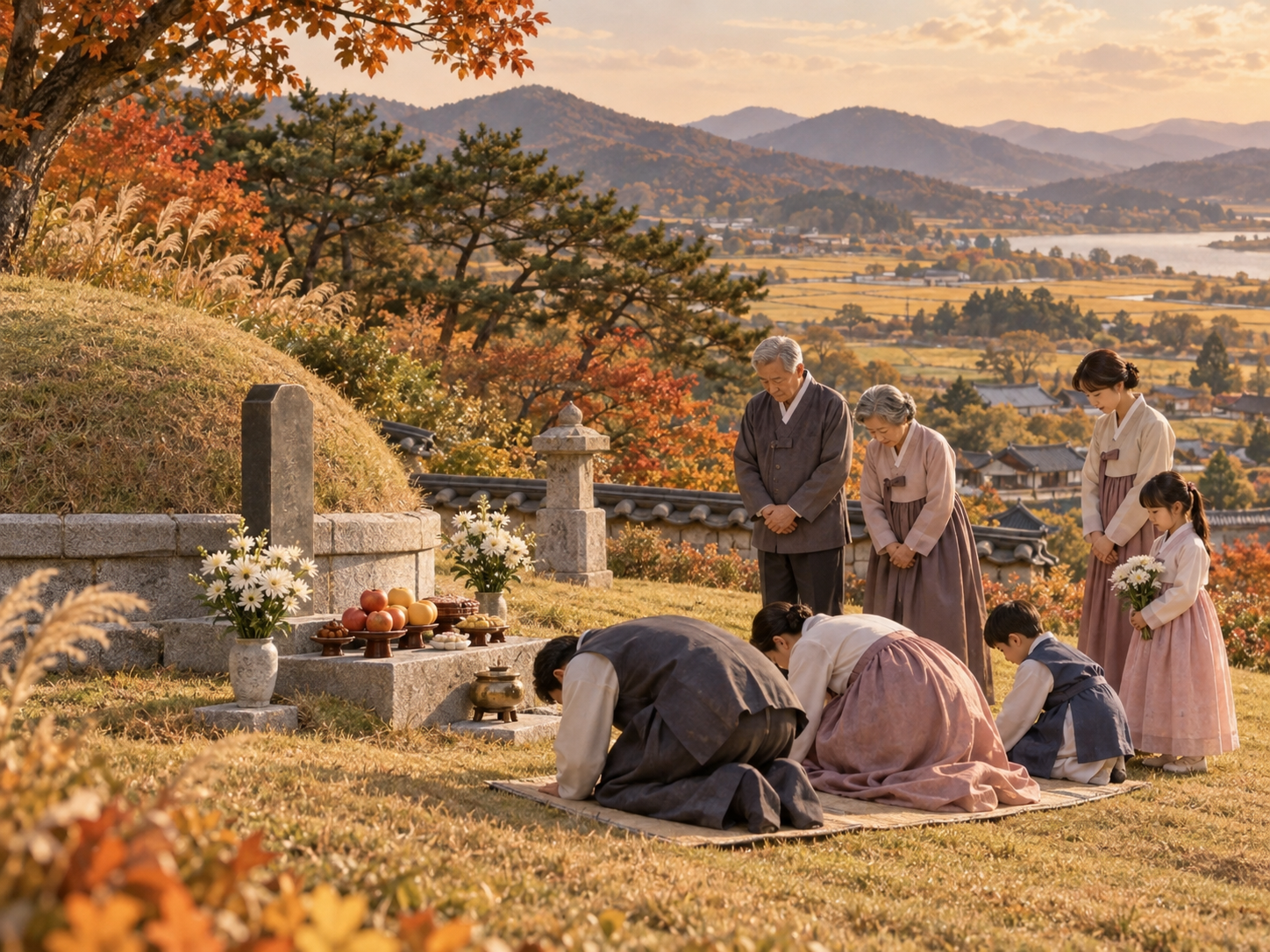
In the past, one of the most important events of the morning was Charye (차례), an ancestral memorial rite.
A table would be carefully prepared with seasonal foods such as freshly harvested rice, fruit, jeon, meat, traditional alcohol, and songpyeon.
Family members would bow and pay respect to their ancestors.
Afterward, the family would eat some of the food together, a practice known as Eumbok (음복).
Official Korean tourism information still describes Charye as one of the major traditional Chuseok customs.
But there is an important point for international readers:
Not every Korean family performs Charye today.
Modern families may simplify the ritual, replace it with a short moment of remembrance, visit ancestral graves instead, or skip ancestral rituals entirely.
Seoul’s official Chuseok information notes that such traditional rituals have become less common as Korean society has industrialized and lifestyles have changed.
That makes modern Chuseok much more diverse than the traditional image often shown in textbooks.
2. Then Comes the Real Center of Chuseok: Food
Even in families that no longer perform Charye, food remains one of the most important parts of the holiday.
A Chuseok table might include:
Songpyeon (송편) — half-moon-shaped rice cakes
Jeon (전) — savory pan-fried foods made with vegetables, seafood or meat
Japchae (잡채) — glass noodles with vegetables and meat
Galbijjim (갈비찜) — braised beef short ribs
Namul (나물) — seasoned vegetables
Fresh fruit — especially pears, apples and other seasonal produce
The exact menu varies by family and region.
But the important thing is not just what is served.
It is the quantity.
Chuseok traditionally meant preparing enough food for a large extended family, often over several meals.
So refrigerators become packed.
Dining tables disappear under plates.
And for several days afterward, families may still be asking:
“Do we have any jeon left?”
3. Songpyeon Is the Food Everyone Associates With Chuseok
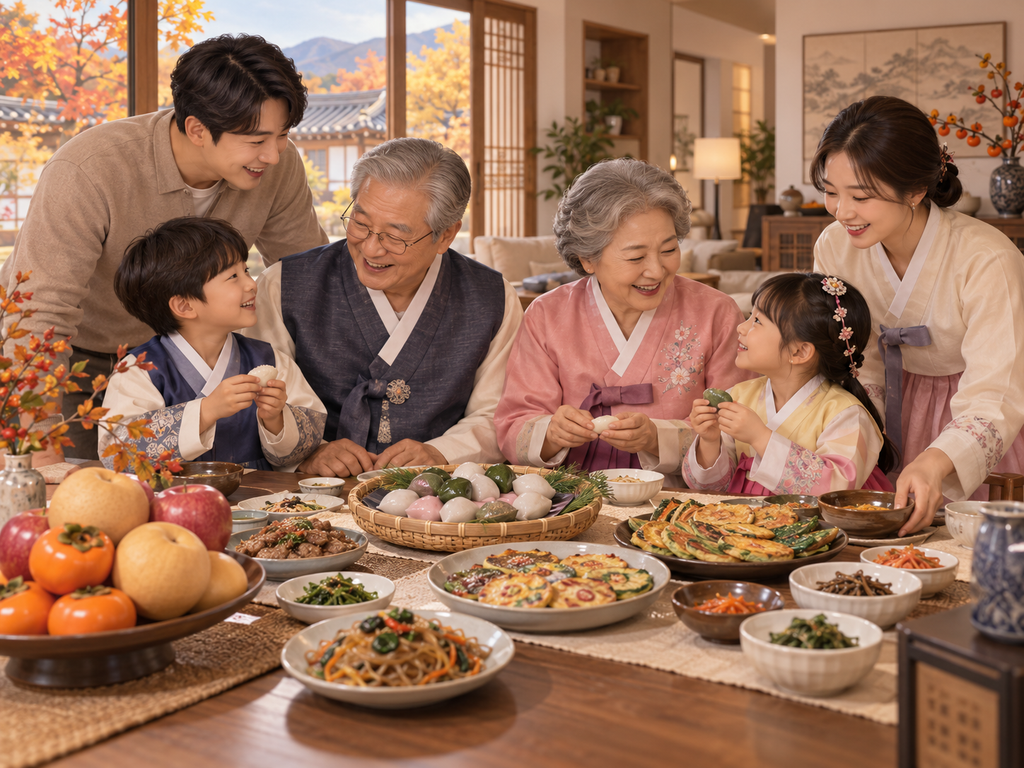
If Christmas has cookies and Thanksgiving has turkey, Chuseok has Songpyeon.
Songpyeon is made from rice flour and filled with ingredients such as sesame, beans, chestnuts or sweetened fillings.
The rice cakes are traditionally steamed with pine needles.
The word itself reflects that connection:
송 (song) = pine
편 (pyeon) = a type of rice cake
One of the most interesting things about Songpyeon is its shape.
Chuseok takes place under the full harvest moon, yet Songpyeon is traditionally shaped more like a half moon.
There are several stories and interpretations explaining why, including a famous legend connecting the waxing half moon with growth and future prosperity.
That makes Songpyeon more than holiday food.
It is also a symbol of hope for what is still to come.
4. After Eating, Some Families Visit Their Ancestors’ Graves
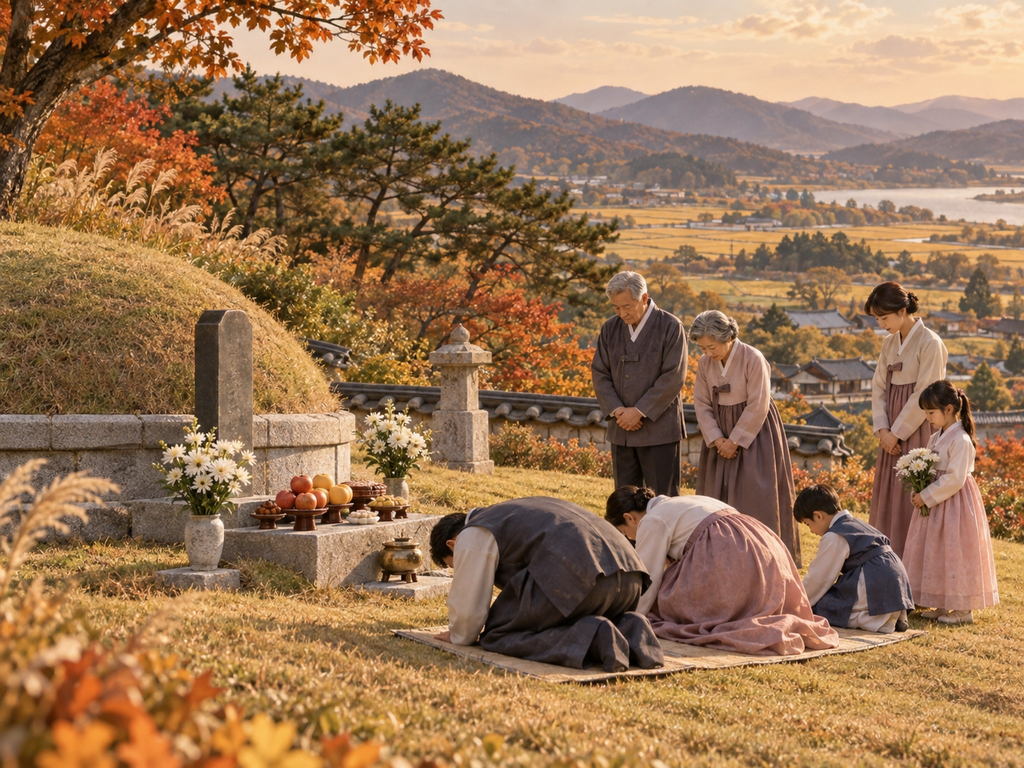
Another traditional Chuseok custom is Seongmyo (성묘).
Seongmyo means visiting ancestral graves to pay respects.
Families may clean the area, bow, and spend a short time remembering deceased relatives.
Another related custom is Beolcho (벌초)—clearing weeds and tidying the gravesite, often done before the holiday.
These customs reflect something important about Chuseok:
The holiday is not only about the people sitting around the table today.
It also connects the family with the generations who came before them.
Official descriptions of Chuseok continue to identify Seongmyo as one of the holiday’s major traditional customs.
But again, participation varies widely.
Some families visit graves every year.
Others may visit only occasionally.
Some hold simplified memorials.
And some do not observe ancestral rites at all.
There is no single modern Korean Chuseok.
5. Then Everyone Starts Relaxing
This may be the most realistic part of modern Chuseok.
After all the traveling, cooking, eating and family greetings…
people rest.
Someone turns on the television.
Children start looking at their phones.
Adults talk over coffee.
Someone falls asleep on the sofa.
Another person starts cutting fruit.
Older relatives ask younger relatives what they are doing with their lives.
And eventually somebody suggests another meal—even though everyone said they were completely full an hour ago.
In other words, Chuseok is not a nonstop traditional ceremony.
For many Koreans, much of the day looks surprisingly ordinary:
eating, talking, resting and spending time with family.
And that may actually be the most important tradition of all.
6. What About Yutnori?
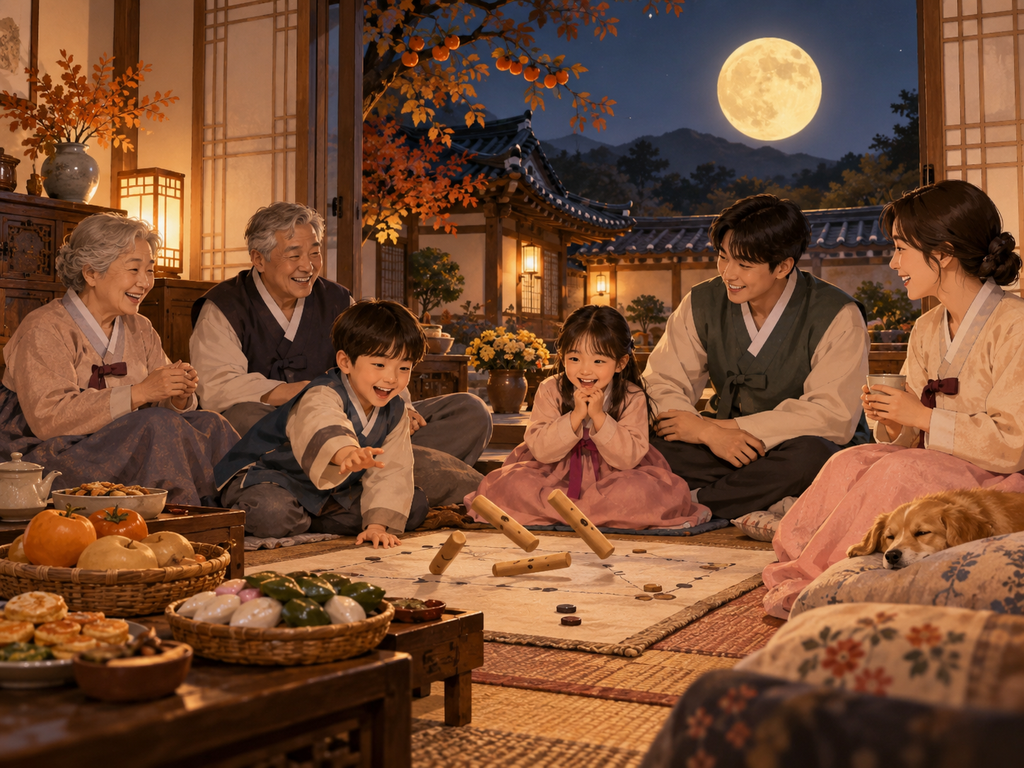
You may see images of Korean families playing Yutnori (윷놀이) during Chuseok.
Yutnori is a traditional Korean board game played by throwing four wooden sticks called Yut (윷).
Different combinations determine how far your pieces move around the board.
Traditionally, the results are called:
Do (도)
Gae (개)
Geol (걸)
Yut (윷)
Mo (모)
It is easy to learn, works across generations, and can become surprisingly competitive.
But does every Korean family sit down for Yutnori after lunch?
No.
Today you are especially likely to encounter it at cultural festivals, museums, hanok villages, schools, or families that enjoy maintaining traditional holiday games.
For international visitors, though, Chuseok is one of the best times to try it.
7. The Full Moon Still Matters
Chuseok falls on the 15th day of the eighth month of the lunar calendar, traditionally associated with the full harvest moon.
It is also called Hangawi (한가위).
The full moon has long carried ideas of abundance, completion and good fortune.
Traditionally, people might look at the full moon and make wishes.
One famous Chuseok-related tradition is Ganggangsullae (강강술래), a Korean circle dance historically performed by women under the bright full moon.
Today you are more likely to encounter Ganggangsullae as a cultural performance or festival activity than as something every neighborhood performs on Chuseok night.
Still, the image remains powerful:
families together,
the harvest completed,
and a huge moon rising over autumn Korea.
8. What Do Younger Koreans Do Differently?
This is where Chuseok is changing most visibly.
Many younger Korean families still visit parents or grandparents.
But the expectation that everyone must follow a fixed traditional schedule has weakened.
Some families order food instead of cooking everything themselves.
Some eat at restaurants.
Some take domestic or overseas trips.
Some meet only for one meal.
Some couples divide the holiday between two families.
Some people simply use the long weekend to rest.
And some families have stopped holding Charye because of the amount of preparation involved.
This does not necessarily mean Chuseok is disappearing.
It may mean that the holiday’s form is changing while its core idea survives.
The traditional question was:
“Did we perform everything correctly?”
The modern question may increasingly be:
“Did we spend meaningful time together?”
9. Why Does Everyone Travel at the Same Time?
Because Chuseok is one of Korea’s biggest family holidays, millions of people travel across the country around the same time.
This creates the famous Gwiseong-gil (귀성길)—the journey back to one’s hometown.
Highways become crowded.
Train tickets become highly sought after.
Highway rest stops fill with travelers.
Then, once the holiday ends, everyone heads back toward the cities in what is called Gwigyeong (귀경).
For many Koreans, the exhausting journey itself has become part of the Chuseok story.
You can spend hours in traffic…
to spend a few hours sitting around a table with your family.
And millions still do it.
10. What Does Chuseok Mean in 2026?
In 2026, Chuseok Day falls on Friday, September 25, the 15th day of the eighth lunar month. The traditional three-day public holiday covers September 24–26.
For visitors staying in Seoul instead of joining a family celebration, the city is also turning Chuseok into an opportunity to experience traditional culture.
For example, the 2026 Namsangol Chuseok Festival runs September 25–27 with traditional performances, cultural experiences and a Chuseok food market. Unhyeongung Palace is hosting traditional games, crafts and performances from September 24–27, while several museums and traditional venues are also holding holiday programs.
This creates two very different versions of Chuseok happening at the same time.
Inside Korean homes, families gather privately.
Outside, visitors can experience the public cultural traditions of the holiday.
So, What Do Koreans Actually Do on Chuseok?
The traditional answer is:
They honor their ancestors.
They eat Songpyeon.
They visit family graves.
They play traditional games.
They look at the full moon.
But the modern answer is simpler.
They go home.
They eat.
They talk.
They rest.
They see people they have not seen for a while.
Some families still perform centuries-old rituals.
Others order food and watch Netflix.
Most are somewhere in between.
And perhaps that is the best way to understand Chuseok.
Traditions do not always survive by staying exactly the same.
Sometimes they survive because each generation finds its own way to keep coming home.
🌕 Did You Know?
Chuseok is also called Hangawi (한가위).
Han (한) carries the sense of something great or large, while gawi (가위) is an old term connected with the middle of the eighth lunar month or autumn. VISITKOREA describes Hangawi as another traditional name for Chuseok, the great autumn harvest holiday.
There is even an old Korean saying:
더도 말고 덜도 말고 한가위만 같아라.
It means approximately:
“May every day be neither more nor less, but just like Hangawi.”
In other words:
May life always be as abundant, comfortable and joyful as Chuseok.
🕰️ Hidden Story: Chuseok Is Changing
One of the biggest mistakes foreigners can make is imagining Chuseok as a perfectly preserved ancient ritual performed identically in every Korean household.
It isn’t.
Korea changed dramatically through urbanization, industrialization, smaller families and apartment living.
Holiday culture changed with it.
Traditional Charye may be shortened.
Food may be purchased instead of prepared from scratch.
Family members may meet in restaurants.
Some may travel instead of returning to the ancestral hometown.
The interesting story is therefore not:
“Koreans are losing Chuseok.”
It is:
“How is Chuseok adapting to the way Koreans live now?”
💡 Naru’s Tips for Foreigners During Chuseok
If you are visiting Korea during Chuseok, don’t assume everything will be closed.
Major tourist areas, cultural attractions and some restaurants may remain open, while family-run businesses and other venues may close or operate shorter hours.
Public transportation can also become extremely busy around the beginning and end of the holiday.
And if a Korean family invites you to their Chuseok gathering, bringing a small gift is a thoughtful gesture.
Most importantly, observe before worrying about complicated etiquette.
Every family celebrates differently.
🗣 Korean Phrase of the Day
즐거운 추석 보내세요!
Jeulgeoun Chuseok bonaeseyo!
English: Have a happy Chuseok!
中文: 祝你中秋佳节愉快!
Español: ¡Que pases un feliz Chuseok!
This is one of the easiest and most useful greetings to say to a Korean during the holiday.
📚 5 Korean Words to Learn Today
| English | Korean | Pronunciation | 中文 | Español |
|---|---|---|---|---|
| Chuseok | 추석 | chu-seok | 秋夕 | Chuseok |
| Family | 가족 | ga-jok | 家庭 | Familia |
| Ancestor | 조상 | jo-sang | 祖先 | Antepasado |
| Full moon | 보름달 | bo-reum-dal | 满月 | Luna llena |
| Holiday | 명절 | myeong-jeol | 节日 | Festividad |
Bonus Words
차례 (Charye) — ancestral memorial rite
성묘 (Seongmyo) — visiting ancestral graves
귀성 (Gwiseong) — returning to one’s hometown for a holiday
윷놀이 (Yutnori) — traditional Korean board game
한가위 (Hangawi) — another traditional name for Chuseok
❓ Today’s Question
What does your family actually do on the biggest holiday of the year?
Do you cook together?
Visit relatives?
Travel?
Play games?
Or simply eat too much and fall asleep afterward?
Tell me in the comments—I would love to compare holiday traditions around the world.
💬 Naru’s Quote
“A holiday is easier to understand when you stop asking what it means—and start watching what people actually do.” — Naru
🇰🇷 한국어 버전
한국 사람들은 추석 당일 실제로 무엇을 할까?
외국인들에게 추석은 흔히 **“Korean Thanksgiving”**이라고 설명됩니다.
하지만 실제 한국인의 추석 하루는 조금 더 복잡합니다.
추석은 수확에 감사하는 명절이면서 조상을 기억하는 날이고, 동시에 오랜만에 가족들이 한자리에 모이는 날입니다.
전통적으로 추석 아침에는 차례를 지냈습니다.
햅쌀, 송편, 전, 과일 등 음식을 차려 조상에게 예를 올리고, 차례가 끝난 뒤에는 가족들이 음식을 함께 나누어 먹었습니다.
하지만 오늘날 모든 가정이 차례를 지내는 것은 아닙니다.
간소하게 진행하거나, 성묘만 가거나, 가족 식사만 하는 집도 많아졌습니다. 한국 사회와 가족의 형태가 변화하면서 추석을 보내는 방식 역시 다양해지고 있습니다.
그래도 여전히 추석의 중심에는 음식과 가족이 있습니다.
송편, 전, 잡채, 갈비찜, 나물, 과일 등을 함께 먹고, 오랜만에 만난 가족들과 이야기를 나눕니다.
식사가 끝나면?
의외로 특별한 일을 하지 않을 수도 있습니다.
TV를 보고, 커피를 마시고, 아이들은 휴대폰을 하고, 누군가는 소파에서 낮잠을 잡니다.
바로 이런 평범한 시간이 현대 한국의 추석을 가장 잘 보여줄지도 모릅니다.
전통적으로는 성묘를 가서 조상 묘를 찾아뵙기도 하고, 윷놀이를 하거나 보름달을 보며 소원을 빌기도 했습니다.
하지만 현대의 추석은 더 다양합니다.
음식을 사서 먹는 가족도 있고, 식당에서 만나는 가족도 있고, 국내외 여행을 떠나는 사람들도 있습니다.
그렇다고 추석이 사라지는 것은 아닙니다.
오히려 추석의 모습이 변화하고 있는 것입니다.
과거에는 “전통을 제대로 지켰는가?”가 중요했다면, 지금은 점점 더
“가족과 좋은 시간을 보냈는가?”
가 중요해지고 있습니다.
2026년 추석 당일은 9월 25일 금요일입니다.
결국 현대 한국인의 추석을 가장 간단하게 표현하면 이렇습니다.
집에 간다.
함께 먹는다.
이야기한다.
쉰다.
그리고 오랜만에 가족을 만난다.
전통은 항상 같은 모습으로 남아야만 살아남는 것은 아닙니다.
때로는 새로운 세대가 자신들의 방식으로 계속 집으로 돌아오기 때문에 살아남습니다.
🇨🇳 简体中文版
韩国人在中秋节当天到底会做什么?
外国人经常把韩国的 **Chuseok(秋夕)**称为“Korean Thanksgiving”。
这个解释并没有错,但它并不能完全说明这个节日。
秋夕既是庆祝丰收的节日,也是纪念祖先、与家人团聚的重要日子。
传统上,秋夕早晨一些家庭会举行 茶礼(차례 / Charye)。
家人准备新米、松饼、煎饼、水果等食物,向祖先行礼并表达感谢。
仪式结束后,家人会一起分享食物。
不过,现代韩国并不是每个家庭都会举行传统茶礼。
有些家庭简化仪式,有些只去扫墓,还有很多家庭只是一起吃饭、聊天和休息。韩国官方资料也指出,随着社会和生活方式的变化,传统仪式已经不像过去那样普遍。
秋夕最重要的部分之一仍然是食物。
松饼(송편)、煎饼(전)、杂菜(잡채)、炖牛排骨(갈비찜)以及各种水果经常出现在节日餐桌上。
吃完以后呢?
很多家庭其实会做非常普通的事情。
看电视、喝咖啡、聊天、玩手机,甚至在沙发上睡午觉。
一些家庭还会进行 省墓(성묘),前往祖先墓地表达敬意。
传统游戏 Yutnori(윷놀이) 和赏满月也是秋夕文化的一部分。
然而,今天的年轻韩国人正在用更多不同的方式度过秋夕。
有人在餐厅见家人。
有人直接购买节日食品。
有人利用假期旅行。
也有人只是好好休息。
所以现代秋夕最重要的并不是每个家庭都完成相同的传统仪式。
真正持续存在的核心可能更简单:
回家。
一起吃饭。
聊天。
休息。
与很久没见的人重新见面。
2026年的秋夕当天是 9月25日星期五。
传统并不一定要保持完全相同的形式才能继续存在。
有时,它之所以能够留下来,是因为每一代人都找到了属于自己的“回家”方式。
🇪🇸 Versión en Español
¿Qué hacen realmente los coreanos el día de Chuseok?
A menudo, Chuseok se explica a los extranjeros como el “Día de Acción de Gracias coreano”.
La comparación ayuda, pero Chuseok significa mucho más.
Es una celebración de la cosecha, un momento para recordar a los antepasados y, sobre todo, una de las ocasiones más importantes para reunirse con la familia.
Tradicionalmente, algunas familias comienzan la mañana de Chuseok con Charye (차례), un rito conmemorativo dedicado a los antepasados.
Se preparan alimentos como arroz de la nueva cosecha, songpyeon, jeon y frutas. Los miembros de la familia hacen reverencias y después comparten la comida.
Sin embargo, no todas las familias coreanas realizan Charye hoy en día.
Algunas simplifican la ceremonia, otras visitan las tumbas familiares y muchas simplemente se reúnen para comer. Las propias autoridades coreanas señalan que estas ceremonias tradicionales son menos comunes que en el pasado debido a los cambios de la sociedad y del estilo de vida.
La comida sigue siendo fundamental.
En la mesa pueden aparecer songpyeon, jeon, japchae, galbijjim, verduras sazonadas y frutas.
¿Y después?
Muchas veces, nada extraordinario.
La familia mira televisión.
Toma café.
Habla.
Los niños utilizan sus teléfonos.
Alguien se queda dormido en el sofá.
Y alguien vuelve a sacar comida aunque todos aseguraron que estaban llenos.
Algunas familias también practican Seongmyo (성묘), visitando las tumbas de sus antepasados.
Yutnori, un juego tradicional coreano, y las actividades relacionadas con la luna llena también forman parte de la cultura de Chuseok.
Pero el Chuseok moderno está cambiando.
Algunas familias compran la comida preparada.
Otras se reúnen en restaurantes.
Algunas aprovechan las vacaciones para viajar.
Y otras simplemente descansan.
Esto no significa necesariamente que Chuseok esté desapareciendo.
Significa que la forma de celebrarlo está evolucionando.
En 2026, el día principal de Chuseok cae el viernes 25 de septiembre.
Entonces, ¿qué hacen realmente los coreanos en Chuseok?
La respuesta moderna puede ser muy sencilla:
Vuelven a casa.
Comen juntos.
Hablan.
Descansan.
Y vuelven a encontrarse con personas a las que no habían visto durante mucho tiempo.
Las tradiciones no siempre sobreviven permaneciendo exactamente iguales.
A veces sobreviven porque cada generación encuentra su propia manera de volver a casa.