
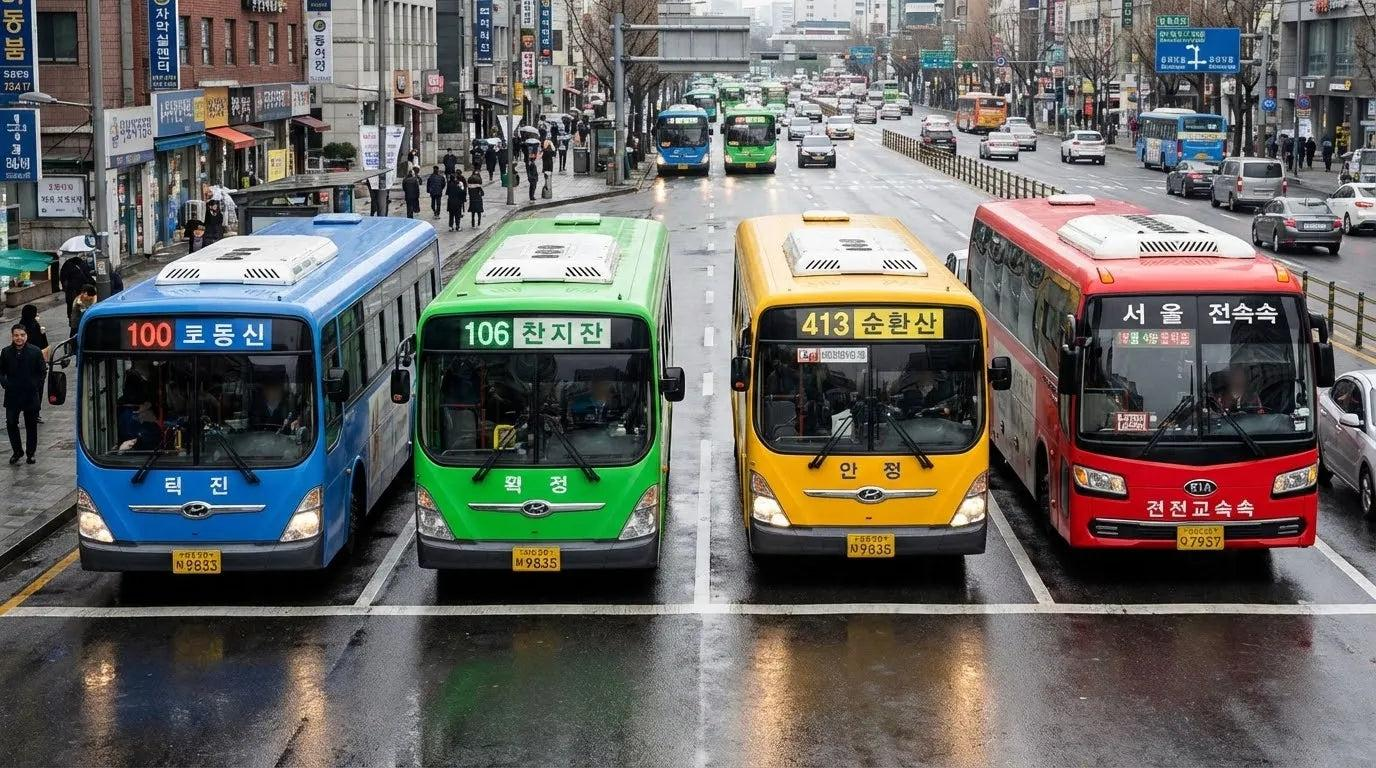
Why Are Seoul Buses Different Colors?
You are standing at a bus stop in Seoul.
A blue bus arrives.
Then a green one.
A few minutes later, you see a red bus.
And somewhere downtown, you may even spot a yellow one.
At first, the colors can look decorative.
They aren’t.
In Seoul, the color of a bus tells you something about what kind of journey it is designed to make.
Blue generally means a major route across the city.
Green usually means a more local connection, often linking neighborhoods with subway stations or major bus routes.
Red connects Seoul with the wider metropolitan area.
Yellow is associated with circulation within central or sub-central districts.
Once you understand the colors, Seoul’s enormous bus network suddenly becomes a little less intimidating.
But why did the city create this system in the first place?
The answer takes us back to one of the biggest transportation reforms in modern Seoul.
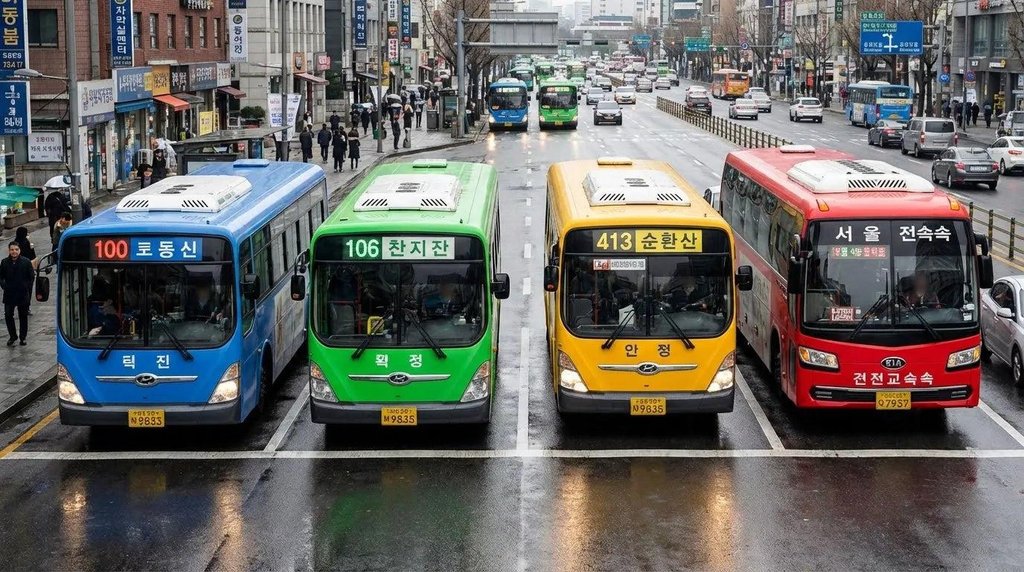
1. The Colors Are Really a Map of How Seoul Moves
The easiest way to understand Seoul buses is not to think about individual routes first.
Think about jobs.
Different buses have different jobs.
Officially, Seoul classifies its routes according to operating characteristics.
🔵 Blue — Trunk Buses
Blue buses are known as 간선버스 (ganseon beoseu), or trunk buses.
Their job is to connect major parts of Seoul.
They typically travel relatively long distances across the city, linking:
- outer districts,
- major urban centers,
- downtown,
- and important transportation corridors.
Think of blue buses as the main arteries of the bus network.
If a bus is crossing several districts on a major road, there is a good chance it is blue.
2. 🟢 Green Buses Fill in the Gaps
Green buses are generally 지선버스 (jiseon beoseu)—branch or feeder buses.
Instead of focusing primarily on long cross-city travel, they help connect neighborhoods with:
- subway stations,
- blue trunk routes,
- transportation hubs,
- and nearby districts.
Seoul’s official description emphasizes their role in providing access and supporting transfers to trunk buses and the subway.
This is why green buses can be especially useful when your destination is not directly beside a subway station.
There are also 마을버스 (maeul beoseu), or neighborhood buses, which are generally green as well.
These often travel through smaller residential streets where larger buses or subway lines do not reach easily.
So if blue buses are Seoul’s arteries, green buses are closer to its capillaries.
They take public transportation deeper into neighborhoods.
3. 🔴 Red Buses Go Beyond Seoul
Red buses are the easiest to understand once you see where they go.
In Seoul’s system, red indicates 광역버스 (gwangyeok beoseu) or rapid/inter-regional buses.
Their role is to connect central Seoul with places in the wider metropolitan area.
That can mean commuters traveling between Seoul and surrounding cities.
The important word here is:
광역 — gwangyeok
It means something like metropolitan / wide-area.
So when you see a red bus, think:
“This bus may be traveling beyond the normal Seoul city network.”
One practical caution for visitors: the Seoul metropolitan region contains buses operated by multiple jurisdictions, so do not rely on color alone to identify the exact operator or destination.
Always check the route number and destination.
4. 🟡 Yellow Buses Circulate Within Key Areas
Yellow buses are 순환버스 (sunhwan beoseu)—circulation buses.
Their role is different.
Rather than connecting distant parts of the city, they are designed for circulation within central or sub-central districts, including areas with significant business and shopping demand.
The Korean word helps explain the idea:
순환 — sunhwan
means circulation or going around a loop/system.
So yellow buses are the closest thing to:
“Move around within this particular urban area.”
They are much less common than blue and green buses, so a tourist may spend several days in Seoul without using one.
Seoul Bus Colors at a Glance
| Color | Korean Type | Main Role | Easy Way to Remember |
|---|---|---|---|
| 🔵 Blue | 간선버스 | Longer major routes across Seoul | Main arteries |
| 🟢 Green | 지선버스 / 마을버스 | Neighborhood and subway connections | Local connectors |
| 🔴 Red | 광역버스 | Seoul ↔ metropolitan area | Go farther |
| 🟡 Yellow | 순환버스 | Circulation in central areas | Loop around |
The color is therefore not primarily about branding.
It is information.
5. Why Did Seoul Need a Color System?
To understand the colors, you need to understand Seoul in the early 2000s.
The city already had a large bus network.
But the system was difficult to understand and did not work as efficiently as city planners wanted.
Routes had developed over time under multiple operators, and coordinating buses with the expanding subway network had become increasingly important.
Then Seoul made a major change.
On July 1, 2004, the city introduced a sweeping public transportation reform.
Bus routes were reorganized into trunk, branch, metropolitan and circulation functions.
A semi-public operating model was introduced.
The fare and transfer systems were changed.
And perhaps most visibly for ordinary passengers:
buses received colors according to their function.
Contemporary Seoul information from June 2004 explained the idea very simply: passengers should be able to look at a bus and quickly understand roughly what kind of route it operates.
Blue = trunk.
Green = branch.
Red = metropolitan.
Yellow = circulation.
In a huge city, color became a navigation tool.
6. The Bus Number Has a Secret Too
The color is only half of the system.
The number can also contain information.
Seoul divided the city and surrounding areas into numbered zones, and bus numbers were designed in part to indicate departure and destination areas.
The exact format differs depending on bus type, but Seoul’s transportation authority still explains that route numbers use two to four digits and are classified according to departure and destination.
For example, trunk and feeder numbers can contain zone information for where the route begins and where it travels.
Red metropolitan routes use their own numbering pattern.
Night buses begin with N.
Airport buses follow another numerical system.
Do tourists need to memorize all of this?
No.
Google Maps, Naver Map, KakaoMap and real-time transit information have made memorization largely unnecessary.
But once you know that the numbers are not random, Seoul’s transportation system starts to feel more deliberately designed.
7. There Are More Than Four Kinds of Bus
Blue, green, red and yellow are the famous four colors.
But Seoul’s bus ecosystem is broader.
🏘 Maeul Bus — 마을버스
These are neighborhood buses.
They operate shorter routes and often enter residential streets where larger city buses are inconvenient.
They are especially useful for connecting hillside neighborhoods or apartment areas with nearby subway stations.
🌙 Night Bus — N Bus
Seoul also operates late-night routes commonly known as Owl Buses.
The route number begins with N, for night.
These services help move passengers after much of the regular subway network has stopped running. Seoul’s official visitor guidance identifies N buses as the city’s late-night bus service.
For travelers staying out late in Hongdae, Gangnam, Jongno or other nightlife areas, recognizing that N can be very useful.
8. Why Not Just Use the Subway?
This is something many first-time visitors ask.
Seoul has one of the world’s largest subway systems.
So why bother learning buses?
Because the bus and subway systems solve different problems.
The subway is excellent for:
longer predictable journeys between major areas.
But Seoul is a city of:
hills,
small streets,
dense neighborhoods,
apartment complexes,
universities,
markets,
and destinations far from stations.
Buses fill those gaps.
A subway station might leave you with a 20-minute uphill walk.
A green neighborhood bus may take you almost to the door.
That is why Seoul designed buses and the subway as an integrated network, rather than as two competing systems.
9. The Transfer System Is the Real Secret
Color coding makes the network easier to understand.
But the transfer system makes it practical.
When using a transportation card, passengers should tap when boarding and when leaving the bus.
That second tap matters.
It allows the system to calculate distance and recognize eligible transfers between buses and subway lines.
Seoul’s current rules generally require the next boarding to take place within 30 minutes, extended to 60 minutes between 9 PM and 7 AM. Eligible discounted transfers can cover up to four transfers, or five boardings in total.
This is one reason green feeder buses are so important.
You can:
green bus → subway → blue bus
and the transport system treats the journey as an integrated trip rather than three completely independent products.
That sounds technical.
But it changed how Seoul residents move.
10. Color Coding Is Really Service Design
Imagine trying to understand thousands of buses using only numbers.
Now imagine doing it as:
- a tourist,
- an elderly passenger,
- a child,
- or someone who does not read Korean quickly.
Color gives passengers information before they even read the route number.
A red bus suggests a metropolitan journey.
A green bus suggests a local connection.
A blue bus suggests a major city route.
This is a basic principle of good service design:
Don’t make users read everything.
Give them visual clues first.
That is why Seoul’s buses are an interesting design story—not merely a transportation story.
11. The 2004 Reform Changed More Than Bus Paint
It would be easy to look at the colorful buses and imagine that Seoul simply rebranded its vehicles.
The reform was much larger.
The city reorganized routes and introduced a semi-public bus operation system, integrated transfers, IT-based management, transportation-card systems and expanded transportation infrastructure.
The Seoul Archives notes that the reform used both colors and route numbers to make trunk, feeder, origin and destination information more intuitive to passengers.
So the paint color was really the visible layer of a deeper transformation.
Underneath it was a new idea:
Bus + subway should function as one network.
12. What Should a Tourist Actually Remember?
You do not need to study Seoul’s entire transportation system before your trip.
Remember just four things.
🔵 Blue = longer Seoul routes
Useful when moving across larger parts of the city.
🟢 Green = local connection
Often useful between a neighborhood and a subway station.
🔴 Red = metropolitan
Double-check the destination because you may be heading beyond central Seoul.
🟡 Yellow = circulation
Think local loop or central-area movement.
And one more important rule:
Tap your card when you get off.
That matters for transfer calculations.
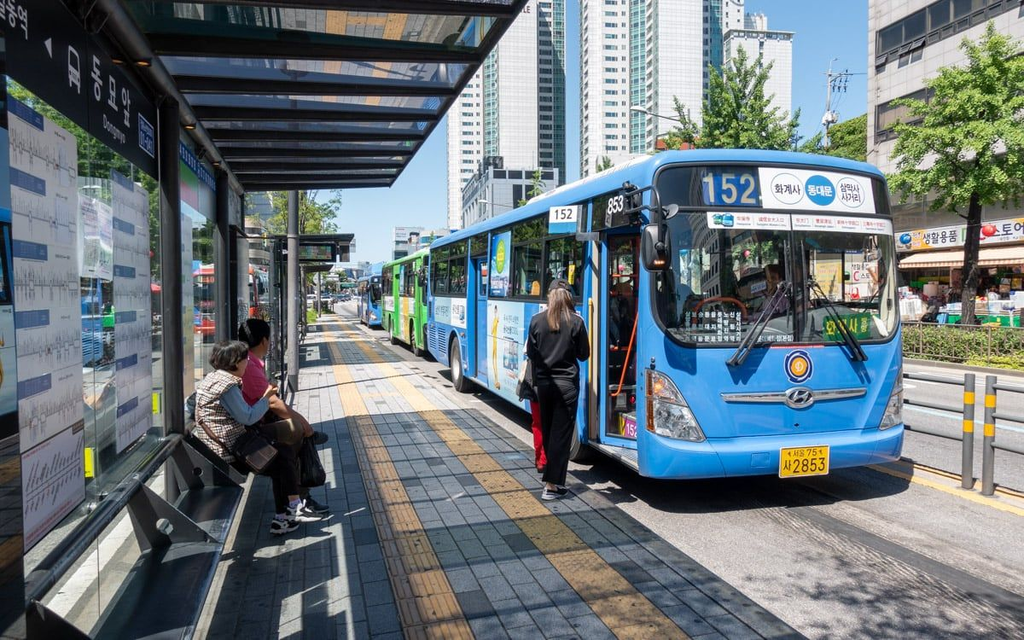
13. A Bus Can Show You a Different Seoul
There is another reason I recommend taking buses in Seoul.
The subway is efficient.
But most of the journey happens underground.
On a bus, Seoul becomes visible.
You pass:
traditional markets,
palace walls,
apartment complexes,
small restaurants,
mountains,
university neighborhoods,
the Han River,
office districts,
and streets you might otherwise never see.
A blue bus crossing the city can sometimes function like an inexpensive sightseeing tour.
You are not simply getting somewhere.
You are watching how Seoul connects together.
🔎 Did You Know?
Seoul’s modern color-coded bus system dates to the city’s major July 1, 2004 public transportation reform.
Before the change, buses were categorized differently.
The new structure divided routes according to function and gave each major type a distinctive color so passengers could recognize its role quickly.
So the blue, green, red and yellow buses you see today are not random.
They are the visual legacy of a transportation reform more than two decades old.
🕵️ Hidden Story: Bus Numbers Are a Mini Geography Lesson
A Seoul bus number can tell a story about geography.
The city divided Seoul and surrounding areas into zones.
Route-number formats were then linked to starting areas, destination areas and route types. Seoul’s official transportation materials still describe a 2-to-4-digit system based partly on origin and destination.
Most Seoul residents today do not consciously decode every digit.
Apps make that unnecessary.
But the logic remains embedded in the network.
What looks like just a number can actually be a miniature map.
💼 Naru’s Business Insight: Good Systems Explain Themselves
Seoul’s bus colors illustrate a useful business lesson.
Complex systems create friction.
A restaurant menu with 100 items is complex.
An airport is complex.
A shopping mall is complex.
A transportation system serving millions of journeys is extremely complex.
You can respond by giving customers more instructions.
Or you can redesign the system so users need fewer instructions.
Seoul used:
color → route role
number → geography
signage → destination
transport card → integrated payment
Each layer reduces uncertainty.
The principle applies well beyond transportation:
The best customer experience is often not better explanation.
It is a system that requires less explanation.
💡 Naru’s Tips for Taking a Bus in Seoul
Check the destination, not only the color.
Color tells you the bus type—not whether it goes where you need.
Use Naver Map or KakaoMap for detailed Korean transit navigation.
They can be particularly useful for stop-level information.
Tap when boarding and getting off.
This is important for transfer and distance calculations.
Press the stop button before your stop.
Do not assume the bus automatically stops everywhere.
Watch the screen and listen to announcements.
Major stops are commonly announced in Korean and English.
Try the bus at least once.
The subway moves you efficiently through Seoul. The bus lets you actually see it.
🗣 Korean Phrase of the Day
이 버스는 시청에 가요?
I beoseuneun sicheonge gayo?
English: Does this bus go to City Hall?
中文: 这辆公交车去市政府吗?
Español: ¿Este autobús va al Ayuntamiento?
A useful structure is:
이 버스는 ___에 가요?
Does this bus go to ___?
Simply replace the destination.
📚 5 Korean Words to Learn Today
| English | Korean | Pronunciation | 中文 | Español |
|---|---|---|---|---|
| Bus | 버스 | beo-seu | 公交车 | Autobús |
| Bus stop | 정류장 | jeong-nyu-jang | 公交站 | Parada de autobús |
| Bus route | 노선 | no-seon | 路线 | Ruta |
| Transfer | 환승 | hwan-seung | 换乘 | Transbordo |
| Transportation card | 교통카드 | gyo-tong-ka-deu | 交通卡 | Tarjeta de transporte |
Bonus Words
간선버스 (ganseon beoseu) — trunk / blue bus
지선버스 (jiseon beoseu) — branch / green bus
광역버스 (gwangyeok beoseu) — metropolitan / red bus
순환버스 (sunhwan beoseu) — circulation / yellow bus
마을버스 (maeul beoseu) — neighborhood bus
❓ Today’s Question
Does your city use colors to make public transportation easier to understand?
If not, would a system like Seoul’s make buses easier for visitors?
Tell me in the comments.
💬 Naru’s Quote
“A good city does not just move people efficiently. It helps them understand how to move before they even ask.” — Naru
SEO FAQ
What do the different bus colors in Seoul mean?
Blue buses generally serve major trunk routes across Seoul. Green buses provide local and feeder connections. Red buses connect Seoul with the metropolitan region, while yellow buses serve circulation routes within central or sub-central areas.
Are green buses and village buses the same?
Not exactly. Green is used for branch buses, while smaller maeul buses provide neighborhood-level connections and supplement larger routes. Both commonly use green in Seoul’s system.
What is an N bus in Seoul?
N buses are Seoul’s late-night bus routes. The “N” stands for night, and they operate when much of the regular subway system is no longer running.
Do I need to tap my transportation card when leaving a Seoul bus?
Yes. Tapping when you get off is important for calculating eligible transfers and distance-based fares.
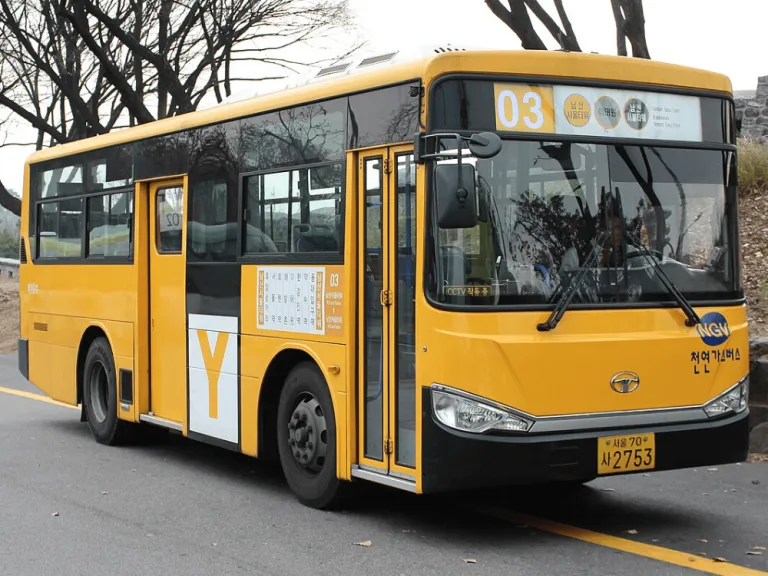
왜 서울 버스는 색깔이 다를까?
서울에서 버스를 보다 보면 파란색, 초록색, 빨간색, 노란색 등 서로 다른 색깔을 쉽게 볼 수 있습니다.
이 색깔은 단순한 디자인이 아닙니다.
버스가 어떤 역할을 하는지 보여주는 정보입니다.
파란색 간선버스는 서울의 주요 지역을 비교적 길게 연결합니다.
초록색 지선버스는 동네와 지하철역, 주요 간선버스를 연결하는 역할을 합니다. 마을버스 역시 주로 초록색으로, 큰 버스가 들어가기 어려운 주거지역을 연결합니다.
빨간색 광역버스는 서울과 수도권 지역을 연결합니다.
노란색 순환버스는 도심이나 부도심 안에서 이동하는 순환형 노선입니다.
이 색상체계의 중요한 배경은 2004년 7월 1일 서울 대중교통체계 개편입니다.
당시 서울시는 버스노선을 간선·지선·광역·순환 등의 기능으로 재편하고, 승객들이 버스의 역할을 한눈에 알아볼 수 있도록 색상을 부여했습니다.
버스 번호에도 의미가 있습니다.
서울을 여러 권역으로 나누고 출발지와 도착지 정보를 노선번호에 반영하는 방식입니다. 그래서 버스의 색깔은 역할, 번호는 이동지역에 대한 단서를 제공하는 구조입니다.
여행객이라면 모든 숫자 규칙을 외울 필요는 없습니다.
간단하게 기억하면 됩니다.
파랑 = 서울 주요 장거리 노선
초록 = 동네·지하철 연결
빨강 = 서울과 수도권 연결
노랑 = 도심 순환
그리고 가장 중요한 실전 팁 하나:
교통카드를 사용할 때는 탈 때뿐 아니라 내릴 때도 태그해야 합니다. 그래야 환승과 거리요금이 정확하게 계산됩니다.
서울 지하철이 가장 빠르게 목적지를 연결해 준다면,
버스는 이동하는 동안 서울이라는 도시 자체를 보여주는 교통수단입니다.
为什么首尔公交车有不同的颜色?
在首尔,你会看到蓝色、绿色、红色和黄色的公交车。
这些颜色并不仅仅是为了好看。
它们代表公交线路的不同功能。
蓝色公交车主要运行首尔市内较长距离的主要线路。
绿色公交车负责连接社区、地铁站和主要公交线路。小型社区巴士也通常采用绿色。
红色公交车连接首尔与周边首都圈地区。
黄色公交车主要在市中心或副中心区域进行循环运行。
今天的颜色系统与首尔在 2004年7月1日进行的大规模公共交通改革密切相关。
改革重新设计了公交线路,并使用不同颜色让乘客能够快速判断公交车的功能。
公交车号码也并非完全随机。
首尔把城市和周边地区划分成不同区域,部分公交号码会反映出发区域和目的区域。
对于游客来说,不需要记住整个编号系统。
只需记住:
蓝色 = 首尔主要线路
绿色 = 社区连接
红色 = 首都圈长距离线路
黄色 = 市中心循环线路
另外,在使用交通卡乘坐公交时,上车和下车都应该刷卡,这对换乘优惠和距离计费非常重要。
首尔地铁让你快速穿过城市。
而公交车则让你在移动过程中真正看见首尔。
🇪🇸 Versión en Español
¿Por qué los autobuses de Seúl tienen diferentes colores?
En Seúl verás autobuses azules, verdes, rojos y amarillos.
Los colores no son simplemente decorativos.
Indican el tipo de servicio que realiza cada autobús.
Los autobuses azules recorren rutas principales y relativamente largas dentro de Seúl.
Los autobuses verdes conectan barrios con estaciones de metro, rutas principales y centros de transporte.
Los autobuses rojos conectan Seúl con otras zonas del área metropolitana.
Los autobuses amarillos funcionan principalmente como rutas de circulación dentro de zonas centrales o subcentrales.
El sistema actual tiene una importante conexión histórica con la gran reforma del transporte público de Seúl del 1 de julio de 2004.
La ciudad reorganizó las rutas según sus funciones y utilizó colores para que los pasajeros pudieran reconocer rápidamente el papel de cada autobús.
Los números también contienen información.
Seúl divide la ciudad y las áreas circundantes en zonas, y algunos números de ruta reflejan el área de origen y de destino.
Para un visitante no es necesario memorizar todo el sistema.
Basta recordar:
Azul = rutas principales de Seúl
Verde = conexiones locales
Rojo = conexiones metropolitanas
Amarillo = rutas circulares
Y un consejo muy importante:
Si utilizas una tarjeta de transporte, pásala por el lector tanto al subir como al bajar del autobús para que los transbordos y las tarifas se calculen correctamente.
El metro puede ser la forma más rápida de atravesar Seúl.
Pero desde un autobús puedes ver los mercados, barrios, montañas, apartamentos y calles que hacen que Seúl sea Seúl.