Silver Grass:
A Beautiful Autumn Landscape With an Unexpected Secret
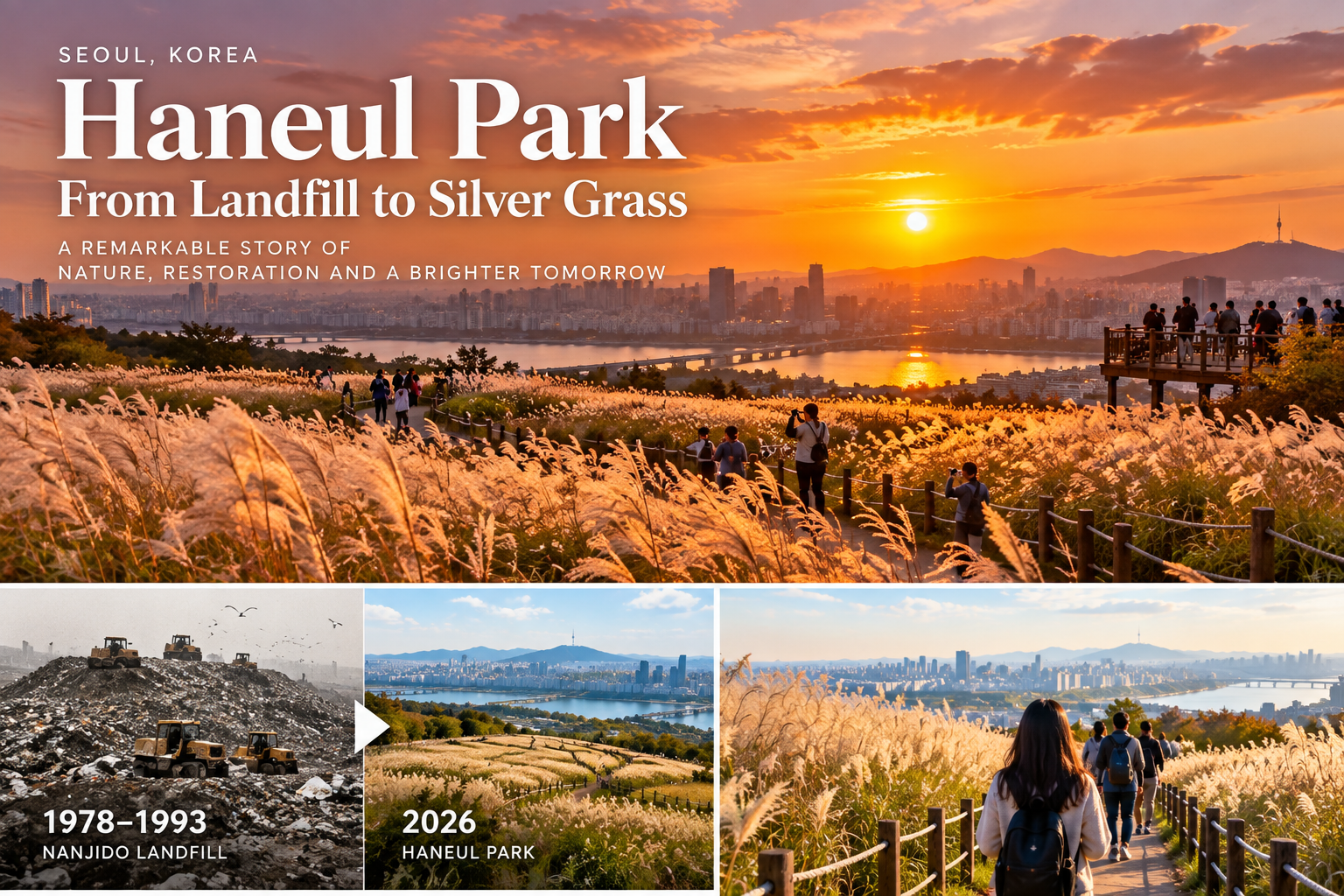
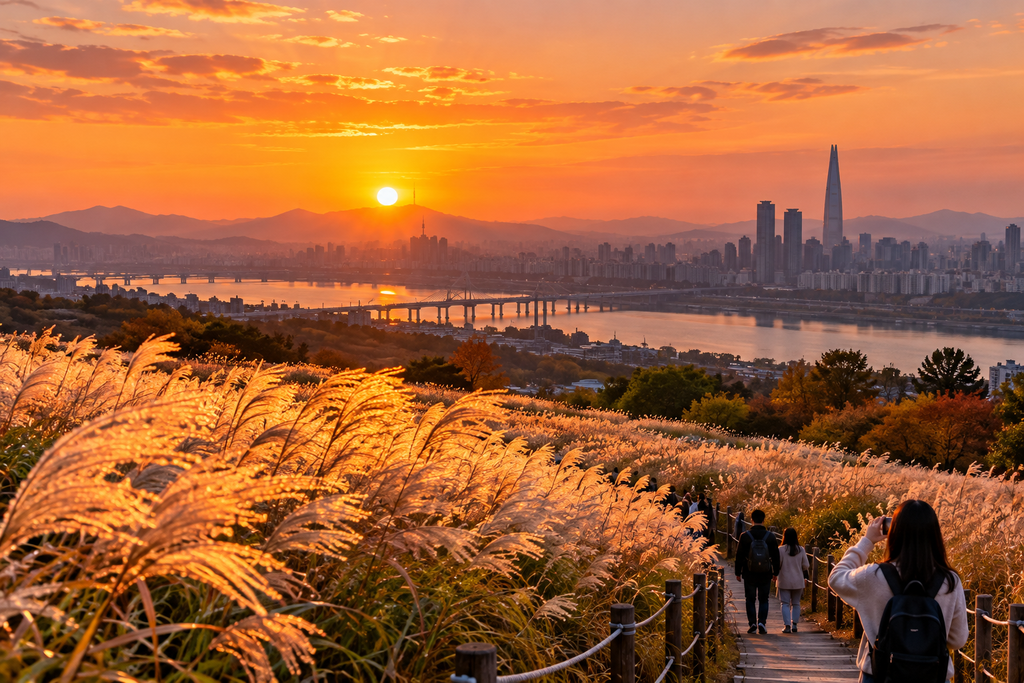
Imagine standing on a hill overlooking Seoul.
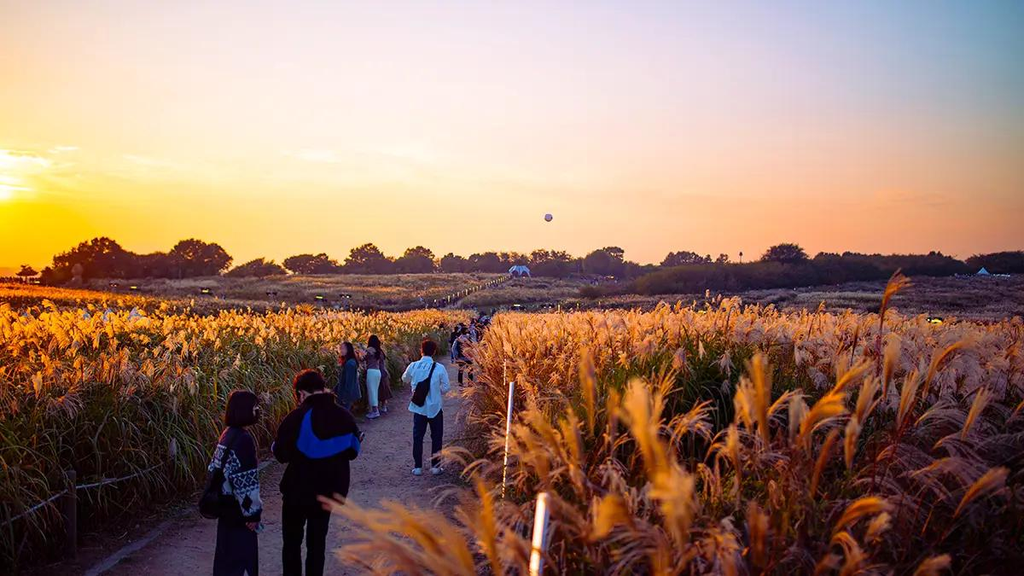
Thousands of silver grass stems move gently in the wind. The afternoon sun catches their feathery tips, turning an entire field into an ocean of gold.
In the distance, you can see the Han River and Seoul’s enormous skyline.
Couples take photographs.
Families wander along narrow paths.
Photographers wait patiently for sunset.
Everything looks peaceful.
Now imagine someone telling you that the hill beneath your feet was once made of garbage.
Not a small pile of garbage.
An enormous landfill that received waste from across Seoul for 15 years.
Welcome to Haneul Park (하늘공원), one of the most surprising places to visit in South Korea.
Its name means Sky Park.
But its story begins underground.
And every October, when the silver grass reaches its most photogenic season, thousands of visitors come to admire one of Seoul’s most remarkable environmental transformations.
1. Before the Silver Grass, There Was a Mountain of Garbage
To understand Haneul Park, we need to travel back to the 1970s.
South Korea was industrializing rapidly. Seoul was expanding, apartment buildings were appearing everywhere, and the city’s population was growing.
But rapid urban development created an unavoidable problem.
Where should all the garbage go?
The answer, at least temporarily, was Nanjido.
Located near the Han River in western Seoul, Nanjido became the city’s main waste-disposal site.
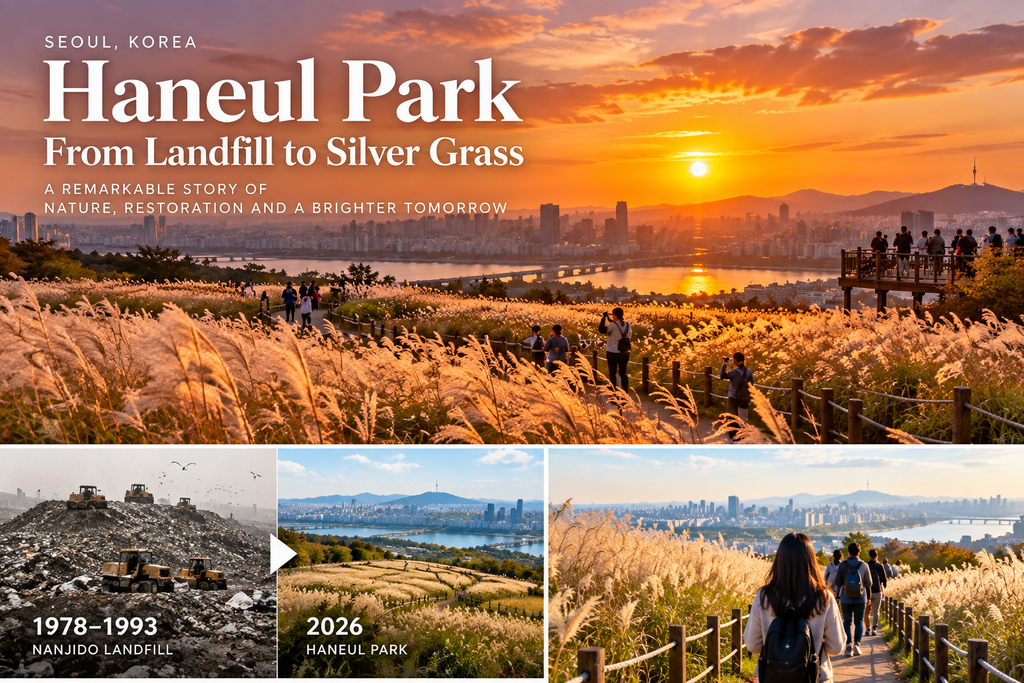
Between 1978 and 1993, enormous quantities of household and industrial waste accumulated there.
By the time the landfill closed, the wider site had received approximately 92 million tons of garbage, creating waste mountains approaching 100 meters in height.
The environmental consequences were severe.
Unpleasant odors spread into surrounding neighborhoods. Methane generated by decomposing waste contributed to fires, while contaminated water threatened nearby ecosystems.
Imagine looking at the beautiful silver grass fields today and realizing what this landscape once represented.
It wasn’t somewhere people wanted to visit.
It was somewhere Seoul needed to repair.
Source: Korea.net — From Trash to Tranquility
2. How the 2002 World Cup Helped Transform the Landscape
The landfill closed in 1993.
However, closing a landfill does not immediately solve its environmental problems.
Decomposing waste can continue producing gas and contaminated water for years.
Seoul needed more than landscaping.
It needed an environmental restoration project.
The upcoming 2002 FIFA World Cup, jointly hosted by South Korea and Japan, provided an important opportunity.
With the new Seoul World Cup Stadium being developed nearby, authorities began transforming Nanjido into a major ecological park.
The project involved collecting landfill gas, managing contaminated water, stabilizing the waste beneath protective layers and creating conditions for vegetation to grow.
In May 2002, the regenerated landscape opened to the public as part of World Cup Park.
What had once been associated with garbage and pollution became a new public space.
But the most interesting part was how the city used the restored land.
It didn’t simply cover the old landfill with grass and forget its history.
It created a landscape where visitors could experience the relationship between nature, urban development and environmental recovery.
3. Why Is It Called Haneul Park?
The Korean word 하늘 (haneul) means sky.
Haneul Park is the highest of the five parks that make up the World Cup Park complex.
The five parks are:
- Haneul Park — Sky Park
- Noeul Park — Sunset Park
- Pyeonghwa Park — Peace Park
- Nanjicheon Park
- Nanji Hangang Park
Each has a different character.
Haneul Park is especially recognizable for its enormous silver grass fields.
Noeul Park is associated with expansive sunset views.
Together, these landscapes demonstrate how one large restoration project can create several different recreational and ecological environments.
Haneul Park’s elevated position also provides panoramic views of the Han River, Seoul’s skyline and the surrounding mountains.
Its name could hardly be more appropriate.
When you’re standing in the middle of the fields, the sky feels enormous.
4. Why Does Silver Grass Make Haneul Park So Special?
Haneul Park is beautiful throughout the year.
But autumn is when it becomes extraordinary.
The main attraction is eoksae (억새), commonly translated as silver grass.
Unlike a dense forest of colorful autumn leaves, silver grass creates a landscape dominated by movement and light.
Each stem carries a feathery flower head.
When sunlight touches those flowers, they appear to glow.
As the wind moves through the fields, thousands of plants bend together, creating waves across the hillside.
The effect changes throughout the day.
In the morning, the grass can look soft and pale.
Around midday, the feathery tips catch the sunlight and appear almost silver.
Before sunset, they turn warmer, reflecting shades of gold and amber.
This is why photographers particularly enjoy visiting Haneul Park during autumn.
You’re not simply photographing plants.
You’re photographing what happens when thousands of plants interact with wind and sunlight.
One small travel tip: Eoksae is often confused with galdae, or common reed. Both create attractive autumn landscapes, but they are different plants. Haneul Park is particularly famous for its silver grass.
5. The 2026 Seoul Silver Grass Festival
If you’re planning an October trip, this year’s festival offers a particularly good reason to visit.
The 25th Seoul Silver Grass Festival takes place from October 17 to October 23, 2026.
Its Korean theme is:
억새, 자연이 건네는 위로
A natural English interpretation would be:
Silver Grass: Comfort Offered by Nature.
The festival combines the autumn landscape with cultural programming and evening lighting.
The city has also announced a resource-circulation market, known as the Re-born Market, featuring businesses and creators working with reuse and sustainability.
It is an appropriate addition to a festival held on a former landfill.
A place once defined by discarded materials now hosts activities exploring how materials can be given another life.
2026 Festival Information
| Information | Details |
|---|---|
| Event | 25th Seoul Silver Grass Festival |
| Dates | October 17–23, 2026 |
| Festival hours | 10:00 AM–9:00 PM |
| Location | Haneul Park, World Cup Park |
| Address | 95 Haneulgongwon-ro, Mapo-gu, Seoul |
| Main theme | Silver Grass: Comfort Offered by Nature |
| Resource-circulation market | October 17–23, 2:30–6:30 PM, as announced |
Schedules for individual activities may change. Check the official Seoul festival announcement before visiting.
6. The Best Time to Visit Haneul Park
For photography, late afternoon is particularly attractive.
Arrive while there is still plenty of daylight.
Walk through the fields.
Explore the viewpoints.
Then watch as the setting sun gradually changes the color of the grass.
You can enjoy three very different versions of the same landscape in one visit.
Daylight: The grass appears pale and silvery.
Golden hour: The entire landscape takes on warm golden tones.
Early evening: The changing sky adds contrast to the grass and Seoul’s skyline. During the festival, planned lighting provides an additional experience.
However, there is one important distinction.
Haneul Park has seasonal opening hours, and nighttime access is restricted to protect the park’s ecology.
For October 2026, the officially announced festival program runs until 9 PM. Do not assume the same hours apply on ordinary days.
7. How to Get to Haneul Park
Haneul Park is in Mapo-gu, western Seoul.
The most straightforward public transportation option is Seoul Subway Line 6.
Get off at World Cup Stadium Station and take Exit 1.
From there, follow directions toward World Cup Park and Haneul Park.
Be aware that reaching the park itself involves an uphill journey.
The festival organizers advise allowing approximately 40 minutes to walk from the suggested subway approaches to the festival area, depending on your route and pace.
There are two common ways to reach the elevated park.
Walking: Follow the park’s walking paths and stairs. Choose this option if you enjoy a moderately energetic walk.
Electric shuttle: The Maengkkongi electric shuttle normally operates between the Nanjicheon Park parking area and the elevated park. It is a paid service; confirm current fares, operating hours and availability before traveling.
Public transportation is strongly recommended during the festival because the surrounding roads and parking areas can become crowded.
8. Haneul Park Offers More Than Silver Grass
It would be easy to visit only for photographs.
But you would miss much of what makes the park special.
Look beyond the grass.
From the elevated viewpoints, you can see the Han River winding across the city.
You can also appreciate how the surrounding parks fit together.
The landscape includes walking paths, other grasslands, seasonal flowers and spaces designed for ecological appreciation.
The park’s wind turbines provide another visible reminder of its environmental identity.
If you have additional time, explore the wider World Cup Park area.
A visit to nearby Peace Park or Noeul Park can turn a short silver grass outing into a longer experience of western Seoul.
9. The Hidden Engineering Beneath the Beautiful Landscape
There is an important detail that photographs cannot show.
The former landfill did not disappear.
Its waste was stabilized and covered as part of the restoration project.
The environmental engineering underneath the landscape is a major part of the park’s story.
According to the Korean government’s account of the restoration, gas-extraction wells were installed to collect methane.
Some of the collected gas was used as an energy source for facilities including the nearby stadium and surrounding developments.
Contaminated water was collected and treated, while engineered protective layers helped create conditions suitable for plants.
This distinction matters.
Haneul Park is not an example of garbage magically turning into healthy soil.
It demonstrates what can be achieved through environmental engineering, long-term management, ecological restoration and a different approach to urban land.
The silver grass is what visitors see.
The environmental infrastructure is part of what makes that scenery possible.
10. Why Haneul Park Represents a Different Side of Seoul
When international travelers think about Seoul, they often imagine futuristic buildings, K-pop, shopping districts, palaces or famous restaurants.
Haneul Park offers another perspective.
It tells the story of a city confronting the environmental consequences of its own growth.
The transformation didn’t erase Nanjido’s past.
Instead, that history became part of the park’s identity.
And this gives visitors a particularly interesting reason to come.
You can enjoy the view without knowing the history.
But once you understand what lies beneath the grass, the experience becomes something more meaningful.
The landscape is beautiful.
Its transformation is equally remarkable.
Did You Know?
Seoul’s Silver Grass Grows on a Former Waste Mountain
The broader Nanjido landfill received approximately 92 million tons of waste before its closure in 1993.
Restoration work enabled the site to become part of World Cup Park, which opened in 2002.
Today, many visitors come specifically to photograph the very hill that once represented one of Seoul’s most challenging waste-management problems.
The contrast is one of the most remarkable aspects of Haneul Park.
Hidden Story: From Landfill Gas to Useful Energy
One of the lesser-known parts of the Nanjido restoration was its approach to methane.
Instead of simply allowing landfill gas to escape, the restoration project installed collection infrastructure and used captured gas as an energy source.
That makes Haneul Park’s story about much more than planting silver grass.
It is also a story about recognizing resources within what society had thrown away.
Naru’s Business Insight: A City Can Redesign Its Reputation
Haneul Park provides an interesting lesson in destination development.
The land initially had almost no appeal as a leisure destination.
Its history created substantial environmental and reputational challenges.
Restoration provided the foundation for public use.
Landscape design gave people a reason to visit.
The annual silver grass festival created a recurring seasonal occasion.
Photography and visitor experiences helped turn the location into a recognizable destination.
The process can be understood as:
Environmental restoration → Public space → Distinctive landscape → Recurring festival → Destination identity
A festival alone could never have achieved this transformation.
But once the landscape had been restored, the festival helped people appreciate and rediscover it.
This is how a difficult urban legacy can become part of a city’s cultural identity.
Naru’s Tips: Before You Go
Visit before sunset. Allow enough time to explore the fields rather than arriving just as the light disappears.
Wear comfortable shoes. The journey includes a climb, and walking is a major part of the experience.
Use public transportation. Traffic and parking may be particularly challenging during the festival.
Respect the restoration. Stay on marked paths and avoid damaging or picking the grass.
Check the hours. Festival operating hours differ from ordinary seasonal park hours.
Plan for two to three hours. That allows time for the approach, leisurely exploration, photography and sunset.
Korean Phrase of the Day
하늘공원에 어떻게 가요?
Haneul Gongwon-e eotteoke gayo?
English: How do I get to Haneul Park?
中文: 请问怎么去天空公园?
Español: ¿Cómo llego al Parque Haneul?
Learn 5 Korean Words
| English | Korean | Pronunciation | 中文 | Español |
|---|---|---|---|---|
| Silver grass | 억새 | eok-sae | 芒草 | Miscanto |
| Sky | 하늘 | ha-neul | 天空 | Cielo |
| Landfill | 쓰레기 매립지 | sseu-re-gi mae-rip-ji | 垃圾填埋场 | Vertedero |
| Restoration | 복원 | bok-won | 生态修复 | Restauración |
| Sunset | 노을 | no-eul | 晚霞 | Atardecer |
Bonus word: 재탄생 (jae-tan-saeng) — rebirth or being born again.
Today’s Question
If you discovered that one of your city’s most beautiful parks was once an enormous garbage dump, would that change how you see it?
Does your city have a place that has been given a second life?
Share its story in the comments.
Naru’s Quote
“The most beautiful thing about Haneul Park isn’t the silver grass. It’s the possibility that even a damaged landscape can have a second life.” — Naru
SEO FAQ
When is the Seoul Silver Grass Festival in 2026?
The 25th Seoul Silver Grass Festival is scheduled for October 17–23, 2026, with the main festival program operating from 10 AM to 9 PM.
Is Haneul Park free to visit?
General park admission is free. Additional fees may apply for the electric shuttle or certain activities.
Where is Haneul Park located?
Haneul Park is located at 95 Haneulgongwon-ro, Mapo-gu, Seoul, within the World Cup Park complex.
Which subway station is closest to Haneul Park?
World Cup Stadium Station on Line 6 is a convenient starting point. Use Exit 1 and follow directions toward the park.
Why was Haneul Park built on a landfill?
Haneul Park was developed as part of the restoration of Seoul’s former Nanjido landfill. The project was associated with preparations for the 2002 FIFA World Cup and the creation of World Cup Park.
What is the best time to photograph silver grass?
Late afternoon through sunset generally produces particularly attractive lighting. The grass can look silvery under stronger daylight and golden as the sun gets lower.
쓰레기 매립지에서 은빛 억새 명소로: 서울 하늘공원의 놀라운 변화
서울에서 가장 아름다운 가을 풍경을 볼 수 있는 장소 중 하나인 하늘공원.
바람이 불면 은빛 억새가 물결처럼 흔들리고, 해 질 무렵에는 공원 전체가 황금빛으로 변합니다.
하지만 이 아름다운 언덕이 과거에는 거대한 쓰레기 매립지였다는 사실을 알고 계셨나요?
1978년부터 1993년까지 난지도에는 서울에서 발생한 엄청난 양의 쓰레기가 쌓였습니다. 전체 매립량은 약 9,200만 톤에 달했습니다.
악취와 먼지, 매립가스와 침출수 문제로 심각한 환경적 어려움을 겪었던 장소입니다.
1993년 매립장이 폐쇄된 이후, 서울시는 환경 복원사업을 추진했습니다.
매립가스를 포집하고, 오염된 물을 관리하며, 쓰레기 위에 보호층과 흙을 덮어 식물이 자랄 수 있는 환경을 만들었습니다.
그리고 2002년 한일 월드컵을 앞두고 이곳은 월드컵공원이라는 새로운 모습으로 시민들에게 돌아왔습니다.
하늘공원은 이 복원사업을 통해 탄생한 대표적인 공원입니다.
오늘날 이곳을 유명하게 만든 것은 바로 억새입니다.
가을이 되면 광활한 억새밭이 은빛으로 빛나고, 바람이 불 때마다 수많은 줄기가 함께 흔들립니다.
오후 늦게 방문하면 햇빛을 받은 억새가 황금빛으로 바뀌는 장면도 볼 수 있습니다.
2026년 서울억새축제
올해 제25회 서울억새축제는 10월 17일부터 23일까지 진행됩니다.
축제의 주제는 **’억새, 자연이 건네는 위로’**입니다.
자연과 빛을 활용한 경관 연출뿐 아니라, 자원순환과 지속가능성을 강조하는 리본(Re-born) 마켓도 준비되고 있습니다.
한때 버려진 물건들이 쌓이던 공간에서 이제는 자원순환을 이야기하는 행사가 열린다는 사실이 특히 흥미롭습니다.
하늘공원은 단순히 단풍이나 억새를 감상하는 관광지가 아닙니다.
도시가 과거의 환경문제를 어떻게 해결하고 새로운 공공공간을 만들어 갈 수 있는지 보여주는 장소입니다.
방문 팁
지하철 6호선 월드컵경기장역에서 하차하면 됩니다.
공원 정상까지는 오르막길이므로 편한 신발을 준비하는 것이 좋습니다. 유료 맹꽁이 전기차도 이용할 수 있으니 운행 여부를 확인하세요.
사진을 찍고 싶다면 일몰 약 한 시간 전까지 도착하는 것을 추천합니다.
은빛 억새가 황금빛으로 변하는 순간을 감상할 수 있기 때문입니다.
하늘공원의 진짜 아름다움은 억새만이 아닙니다. 한때 버려졌던 땅이 새로운 생명을 얻었다는 사실입니다.
从垃圾填埋场到银色芒草海洋:首尔天空公园的重生
首尔的天空公园(Haneul Park)是韩国秋季非常受欢迎的景点之一。
每到秋天,大片芒草在风中轻轻摇曳。
阳光照射在草穗上,整个山丘仿佛变成了一片银色的海洋。
夕阳西下时,银色又会逐渐变成温暖的金色。
然而,这片美丽的土地曾经是一座巨大的垃圾填埋场。
1978年至1993年,首尔的大量生活垃圾被运往兰芝岛。整个填埋场累计接收了约9200万吨垃圾。
垃圾产生的恶臭、甲烷以及受污染的渗滤液给周边环境造成了严重问题。
1993年,填埋场关闭。
此后,首尔开始进行大规模生态修复。
工程包括收集填埋气体、处理受污染的水、覆盖垃圾并创造适合植物生长的环境。
2002年,为迎接韩日世界杯,世界杯公园正式开放。
天空公园正是这一修复工程的重要成果之一。
如今,这里因秋天的芒草景观而闻名。
2026年首尔芒草节
2026年第25届首尔芒草节将于10月17日至23日举行。
今年的主题是 “芒草:大自然带来的慰藉”。
活动将结合自然景观、夜间灯光以及资源循环利用理念,并设置相关市集。
过去,这里是大量废弃物堆积的地方。
今天,人们却在这里讨论如何减少浪费、重新利用资源。
这种转变使天空公园成为一个特别的旅游目的地。
游览建议
游客可以乘坐首尔地铁6号线,在世界杯竞技场站下车,从1号出口前往天空公园。
上山需要步行,也可以根据运营情况选择付费电动接驳车。
如果希望拍摄漂亮的照片,建议在日落之前到达。
秋天的天空公园不仅拥有美丽的风景,还讲述了城市环境修复和土地重生的故事。
真正令人难忘的不只是金色的芒草,而是一片曾经受损的土地重新获得生命的过程。
Spanish Version
De vertedero a un mar de hierba plateada: la transformación del Parque Haneul en Seúl
El Parque Haneul es uno de los lugares más fotogénicos de Seúl durante el otoño.
Cada año, enormes campos de hierba plateada se mueven suavemente con el viento.
Durante la tarde, la luz del sol transforma las espigas en una superficie dorada.
Desde la parte más alta del parque, los visitantes pueden disfrutar de vistas panorámicas del río Han y de la ciudad.
Sin embargo, este hermoso paisaje esconde una historia sorprendente.
El lugar fue anteriormente parte de un enorme vertedero.
Entre 1978 y 1993, el antiguo vertedero de Nanjido recibió aproximadamente 92 millones de toneladas de residuos procedentes de Seúl.
El gas generado por los residuos, los malos olores y el agua contaminada provocaron graves problemas ambientales.
Después del cierre del vertedero en 1993, la ciudad emprendió un proyecto de restauración.
Se instalaron sistemas para recoger gas, tratar aguas contaminadas y estabilizar el terreno.
Con motivo de la Copa Mundial de la FIFA de 2002, la zona se transformó en el complejo ecológico conocido como World Cup Park.
El Parque Haneul es uno de sus espacios más emblemáticos.
Hoy es especialmente conocido por sus extensos campos de miscanto o hierba plateada.
En otoño, miles de visitantes recorren sus senderos para fotografiar el paisaje y contemplar el atardecer.
Festival de la Hierba Plateada de Seúl 2026
La 25.ª edición se celebrará del 17 al 23 de octubre de 2026.
El festival tiene como tema el consuelo que ofrece la naturaleza.
Además de las instalaciones y la iluminación nocturna, se ha anunciado un mercado dedicado a la reutilización de recursos.
Es una iniciativa especialmente apropiada para un parque construido sobre un antiguo vertedero.
Consejos para tu visita
Puedes llegar utilizando la línea 6 del metro de Seúl y bajando en World Cup Stadium Station.
Desde allí, sigue las indicaciones hacia el parque.
Ten en cuenta que el acceso incluye un recorrido cuesta arriba. También suele estar disponible un servicio de transporte eléctrico de pago.
Para disfrutar de las mejores condiciones fotográficas, llega antes del atardecer.
Así podrás ver cómo el color plateado de la hierba se transforma lentamente en dorado.
Haneul Park no es simplemente otro parque bonito.
Es una demostración de cómo una ciudad puede enfrentarse a los daños ambientales del pasado y transformar un lugar degradado en un espacio para las generaciones futuras.
La verdadera belleza de Haneul Park no reside únicamente en su paisaje, sino también en la historia de recuperación que representa.