
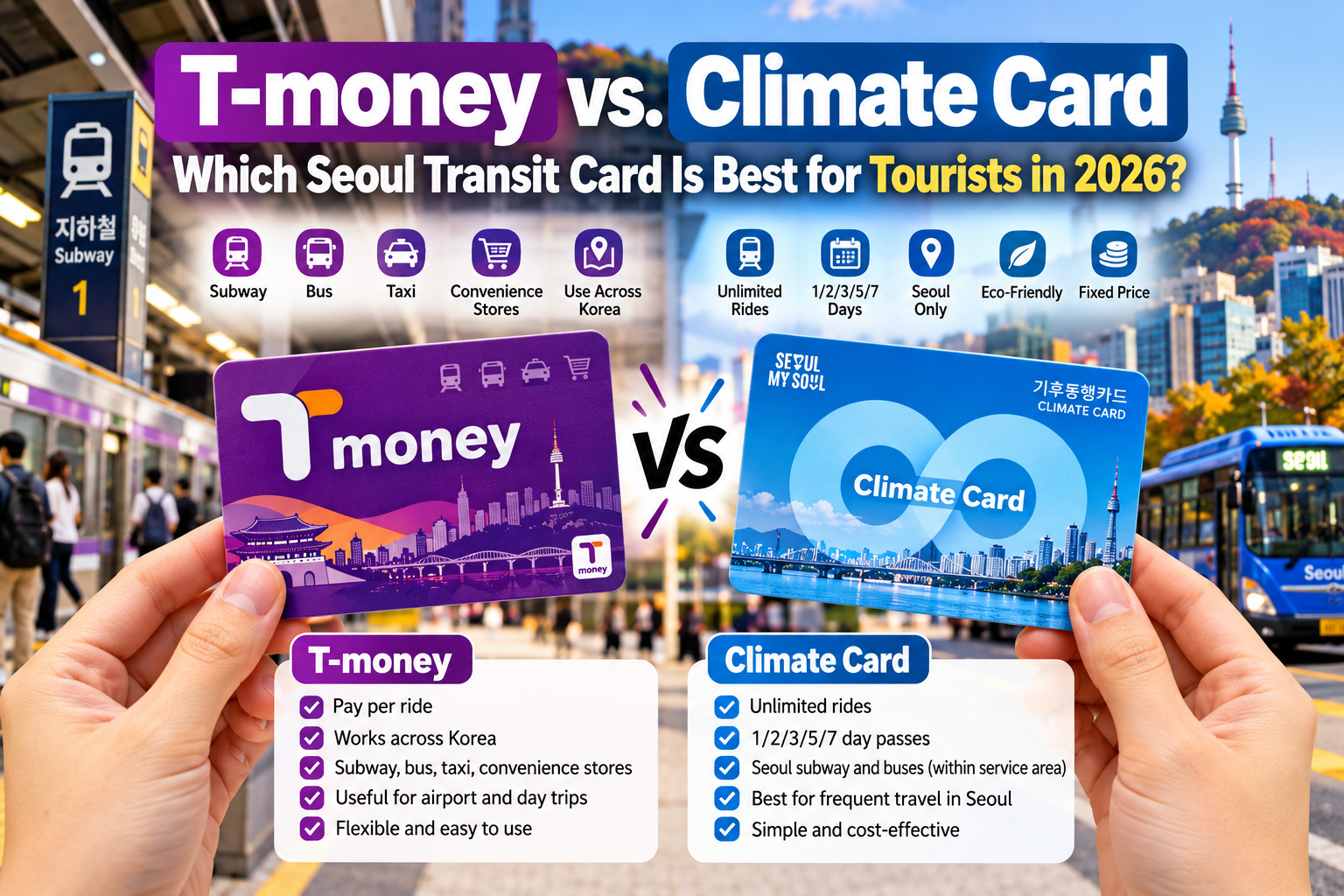
T-money or Climate Card? The Simple Answer
You have just arrived in Korea.
You need to take the subway to Myeongdong.
Tomorrow, you want to visit Gyeongbokgung Palace, Seongsu, Gangnam, and the Han River.
Then perhaps you are planning a day trip to Suwon or another city.
Which transportation card should you buy?
For many international visitors, the answer used to be simple:
Buy a T-money card.
But Seoul’s Climate Card has changed the equation.
And as of October 1, 2026, another important change has taken effect: the traditional 30-day Climate Card has been discontinued, while short-term passes designed for stays of 1, 2, 3, 5, or 7 days continue to be available.
So which card is actually better?
Here’s the simplest answer:
Mostly staying in Seoul and taking public transportation frequently? → Climate Card
Traveling outside Seoul or wanting maximum flexibility? → T-money
But there are several important exceptions.
Let’s break them down.
First, What Is T-money?
T-money (티머니) is Korea’s most widely recognized rechargeable transportation card.
Think of it as Korea’s version of London’s Oyster Card or Japan’s Suica.
You load money onto the card and pay each time you travel.
A standard T-money card usually costs around ₩3,000–₩5,000, before adding transportation credit. It is sold at convenience stores such as CU, GS25, and 7-Eleven, as well as transportation facilities.
Its biggest advantage is simple:
It works almost everywhere.
T-money can be used on public transportation throughout Korea, including most:
- Subways
- City buses
- Intercity transportation
- Taxis
- Airport transportation
It can also be used at many stores and vending machines displaying the T-money logo.
For a traveler visiting Seoul + Busan + Jeju + Suwon, T-money is usually the easiest card to understand.
Then, What Is the Climate Card?
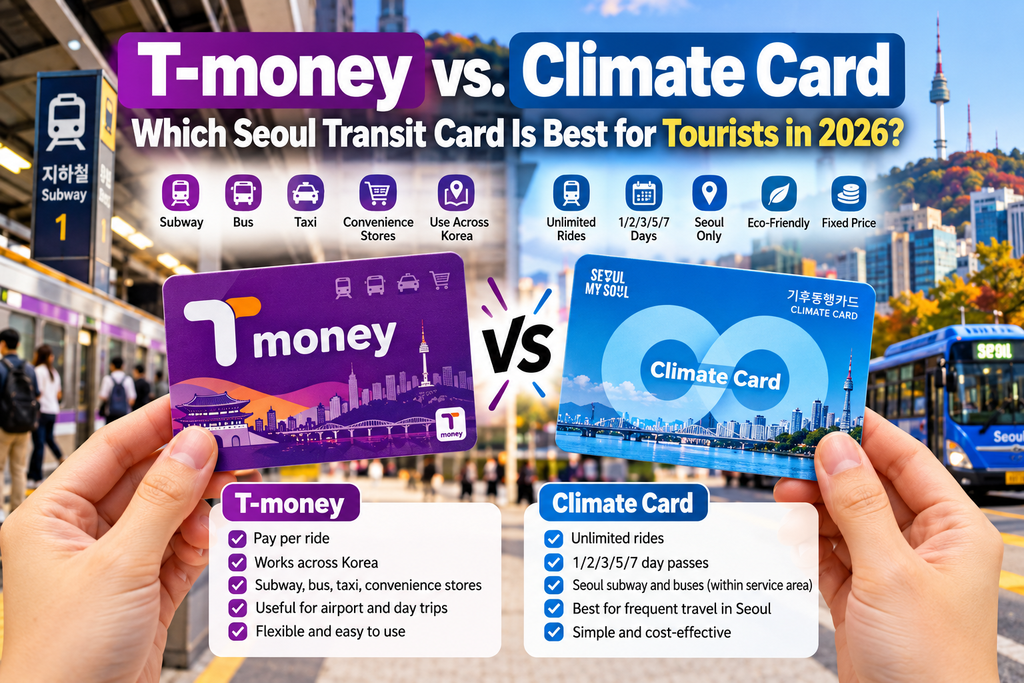
The Climate Card (기후동행카드) works differently.
Instead of paying for each journey, you purchase a pass and receive unlimited eligible public transportation rides during the pass period.
As of October 2026, the tourist-friendly short-term passes are:
| Pass | Price |
|---|---|
| 1 Day | ₩5,000 |
| 2 Days | ₩8,000 |
| 3 Days | ₩10,000 |
| 5 Days | ₩15,000 |
| 7 Days | ₩20,000 |
The physical Climate Card itself costs an additional ₩3,000 when purchasing one for the first time.
That means a first-time visitor buying a 3-day pass would initially pay:
₩3,000 card + ₩10,000 pass = ₩13,000
But the physical card can be reused.
The Biggest 2026 Change You Need to Know
Until September 2026, Korea also had 30-day versions of the Climate Card.
That system changed.
Starting October 1, 2026, the 30-day prepaid and postpaid Climate Cards were discontinued as Seoul transitioned long-term residents toward the new Climate Pass / K-Pass structure.
However, the tourist-oriented:
1-day / 2-day / 3-day / 5-day / 7-day Climate Card passes remain available.
For international tourists, this actually makes the choice easier.
Think of it this way:
Climate Card = short Seoul trip
T-money = flexible Korea transportation wallet
T-money vs. Climate Card at a Glance
| T-money | Climate Card | |
|---|---|---|
| Payment style | Pay per ride | Unlimited rides |
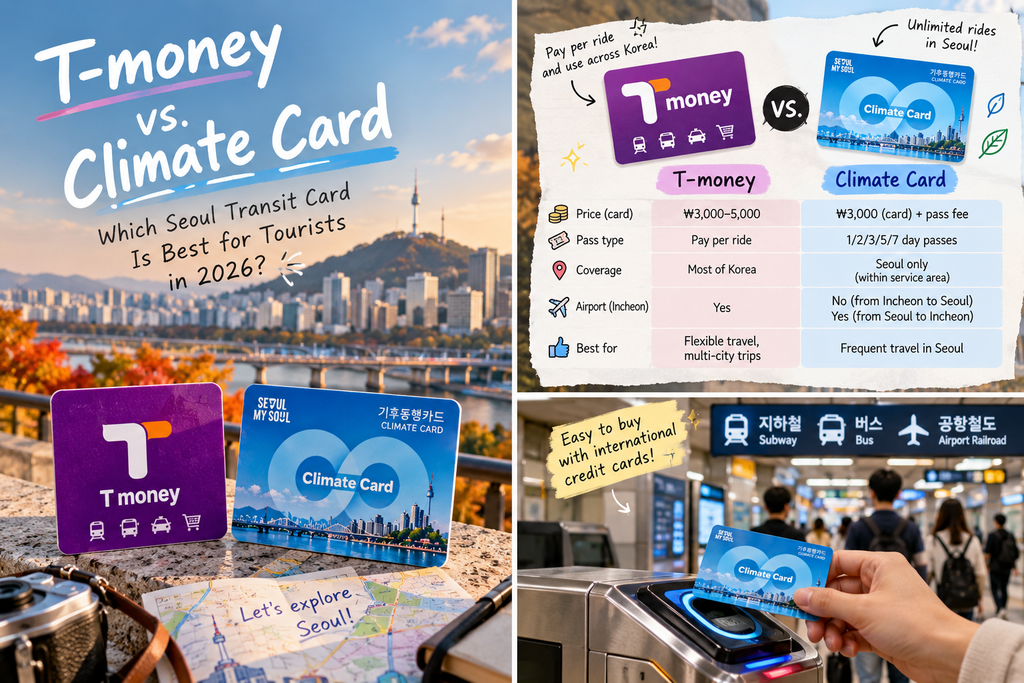
| Card price | Approx. ₩3,000–₩5,000 | ₩3,000 |
| Best for | Flexible travel | Frequent Seoul travel |
| Seoul subway | ✅ | ✅ |
| Seoul buses | ✅ | ✅ |
| Travel outside Seoul | ✅ | Limited |
| GTX | Depends on service | ❌ |
| Shinbundang Line | ✅ Pay per ride | ❌ |
| Incheon Airport → Seoul | ✅ | ❌ |
| Seoul → Incheon Airport | ✅ | ✅ Eligible route |
| Convenience-store payment | Many locations | No — transit pass |
| Need to calculate balance | Yes | No |
| Unlimited rides | ❌ | ✅ |
For most first-time visitors, where you plan to travel matters more than how many days you stay.
So When Does the Climate Card Become Cheaper?
This is where things become interesting.
The adult base subway fare using a transportation card in Seoul is currently ₩1,550 for a standard-distance journey. Longer journeys may cost more.
Using ₩1,550 as a simple benchmark:
| Climate Pass | Price | Approx. Break-Even Point |
|---|---|---|
| 1 Day | ₩5,000 | 4 separate journeys |
| 2 Days | ₩8,000 | 6 journeys total |
| 3 Days | ₩10,000 | 7 journeys total |
| 5 Days | ₩15,000 | 10 journeys total |
| 7 Days | ₩20,000 | 13 journeys total |
This calculation excludes the physical card cost because both T-money and Climate Card require buying a card if you don’t already own one.
Also remember:
Korea has an integrated transfer system.
If you transfer properly between eligible buses and subways, you generally do not pay a completely new base fare for every vehicle you board. You must tap your transportation card when entering and exiting to receive the appropriate transfer calculation.
So think in terms of separate journeys, not simply subway gates or buses boarded.
A Real Tourist Example
Imagine this 3-day Seoul itinerary.
Day 1
Hotel → Gyeongbokgung
Gyeongbokgung → Myeongdong
Myeongdong → Dongdaemun
Dongdaemun → Hotel
4 journeys
Day 2
Hotel → Seongsu
Seongsu → Gangnam
Gangnam → Banpo Hangang Park
Banpo → Hotel
4 journeys
Day 3
Hotel → Hongdae
Hongdae → Yeouido
Yeouido → Seoul Station
Seoul Station → Hotel
4 journeys
That’s approximately 12 separate journeys.
At a simple ₩1,550 base fare:
12 × ₩1,550 = ₩18,600
A 3-day Climate Card pass costs:
₩10,000
Potential transportation difference:
₩8,600
Actual savings will vary according to distance and transfers, but for a tourist moving around Seoul several times per day, the Climate Card can become attractive very quickly.
But Here’s the Catch: Seoul vs. Korea
This is the most important difference.
T-money is designed for transportation across Korea.
The short-term Climate Card is fundamentally a Seoul-focused pass.
From October 1, 2026, its coverage was narrowed primarily to travel within Seoul, while previous coverage in several neighboring Gyeonggi cities was removed.
That matters if your itinerary includes places such as:
- Suwon
- Incheon city
- Gapyeong
- Yongin
- Other destinations outside Seoul
For these trips, T-money is much more flexible.
The Incheon Airport Rule Many Tourists Miss
This is probably the most useful tip in this article.
Arriving at Incheon Airport
You cannot start your Climate Card journey at Incheon International Airport.
So if you have just landed and want to travel:
Incheon Airport → Seoul
use T-money or purchase a separate airport transportation ticket.
T-money works conveniently with the AREX all-stop train and other supported transportation services.
Leaving Korea
The rule is different in the opposite direction.
A Climate Card short-term pass can be used for an eligible trip that starts within its Seoul service area and ends at Incheon International Airport.
So:
Incheon Airport → Seoul: ❌ Climate Card
Seoul → Incheon Airport: ✅ Climate Card on eligible service
That asymmetry surprises many visitors.
What About Gimpo Airport?
Gimpo Airport is much easier.
The updated Climate Card short-term service area includes Gimpo Airport Station, making it practical for travelers using Gimpo for domestic or regional flights.
If your trip is:
Seoul → Gimpo Airport → Jeju,
the Climate Card can therefore still be useful for the Seoul portion of the journey.
Another Big Improvement for Foreign Tourists in 2026
Until recently, buying and recharging Korean transportation cards could sometimes require cash.
Seoul improved this significantly in 2026.
Starting March 17, 2026, Seoul introduced 440 new transportation-card vending machines at 273 subway stations on Lines 1–8.
These machines accept internationally issued cards such as Visa and Mastercard, as well as supported mobile payment methods, for Climate Card short-term passes and single-journey tickets.
This means international visitors no longer necessarily need Korean cash simply to purchase or recharge a Climate Card—provided they use one of the compatible new machines.
Payment methods can still vary by sales location, so don’t assume every convenience store or older machine accepts your foreign card.
Naru’s Quick Decision Guide
Choose T-money if:
You are visiting multiple Korean cities.
You are taking a day trip outside Seoul.
You want to use the same card for transportation throughout your Korea trip.
You are arriving at Incheon Airport and want one card immediately.
You expect to take only one or two separate journeys per day.
You don’t want to think about service-area restrictions.
Choose the Climate Card if:
You are staying mainly inside Seoul.
You expect to use the subway or bus several times each day.
You are visiting many neighborhoods in a short period.
You like knowing your transportation cost in advance.
You don’t want to worry about checking your remaining transit balance.
What Would I Choose?
For a typical first-time visitor spending 3–5 days entirely in Seoul, I would choose:
Climate Card.
A first-time tourist often visits several areas each day:
Gyeongbokgung in the morning.
Myeongdong at lunch.
Seongsu in the afternoon.
The Han River in the evening.
Hongdae at night.
Those movements add up quickly.
But for someone doing:
Seoul → Suwon → Busan → Gyeongju → Seoul
I would choose:
T-money.
The convenience of nationwide transportation coverage becomes more valuable than unlimited Seoul rides.
The Best Strategy May Actually Be Both
Here’s something many guides overlook.
You don’t necessarily have to choose only one.
For a longer Korea trip, a smart setup can be:
Climate Card → everyday transportation inside Seoul
T-money → airport arrival + trips outside Seoul + backup
Because the cards themselves are inexpensive and reusable, carrying both can make sense for travelers spending several days in Seoul before exploring other parts of Korea.
💡 Did You Know?
The Climate Card was originally launched by Seoul in January 2024 as Korea’s first unlimited public transportation pass.
By 2026, the idea had influenced a much broader national transportation-support system.
The national K-Pass / Everyone’s Card and Seoul’s new Climate Pass now target longer-term residents, while the original Climate Card survives primarily in the form most useful to tourists:
short-term unlimited passes.
In other words, a transportation experiment that began in Seoul helped influence how Korea thinks about public-transit pricing nationwide.
🔎 Hidden Story: Why Korea Loves Transportation Cards
Transportation cards in Korea are not simply payment cards.
They are part of an integrated transportation philosophy.
When passengers move from:
bus → subway → bus
the system can calculate the journey as connected transportation rather than treating every boarding as an entirely separate trip.
To receive these transfer benefits, passengers need to tap their card properly when entering and leaving buses and subway systems.
That is why you will see Koreans tapping their cards when getting off the bus.
For visitors from countries where you only tap when boarding, this small habit can initially seem strange.
🇰🇷 5 Korean Words to Learn Today
| English | Korean | Pronunciation | Chinese | Spanish |
|---|---|---|---|---|
| Transportation card | 교통카드 | gyotong kadeu | 交通卡 | tarjeta de transporte |
| Recharge | 충전 | chungjeon | 充值 | recarga |
| Fare | 요금 | yogeum | 票价 | tarifa |
| Transfer | 환승 | hwanseung | 换乘 | transbordo |
| Subway | 지하철 | jihacheol | 地铁 | metro |
🇰🇷 Korean Phrase of the Day
이 카드로 지하철을 탈 수 있어요?
I kadeuro jihacheoreul tal su isseoyo?
English: Can I take the subway with this card?
中文: 可以用这张卡坐地铁吗?
Español: ¿Puedo tomar el metro con esta tarjeta?
Another useful phrase:
교통카드 충전해 주세요.
Gyotong kadeu chungjeonhae juseyo.
Please recharge my transportation card.
Naru’s Tips
Don’t load too much money onto T-money.
You can always recharge it later.
Activate a Climate Card short-term pass when you are ready to use it.
The validity period begins when the pass is loaded, so don’t activate it unnecessarily early.
Always tap when leaving a bus.
This is important for Korea’s transfer-fare system.
Check your destination before using Climate Card.
A station being connected to the Seoul subway network does not automatically mean it is inside the Climate Card service area.
Keep T-money even after your trip.
You can reuse it on your next visit to Korea.
❓ Today’s Question
When you travel, which do you prefer: an unlimited transportation pass or paying only for the rides you actually take?
And if you have visited Seoul before, tell me:
How many subway or bus journeys did you usually make in one day?
✍️ Naru Quote
“The best transportation card isn’t the one with the most benefits. It’s the one that matches the way you actually travel.” — Naru
SEO FAQ
Is T-money or Climate Card better for tourists?
For tourists staying primarily in Seoul and taking public transportation several times per day, the Climate Card can offer better value. T-money is generally better for travelers visiting multiple cities or destinations outside Seoul.
How much is the Climate Card for tourists in 2026?
Short-term passes cost:
1 day: ₩5,000
2 days: ₩8,000
3 days: ₩10,000
5 days: ₩15,000
7 days: ₩20,000
A new physical Climate Card costs an additional ₩3,000.
Can foreigners buy a Climate Card?
Yes. Climate Card short-term passes are suitable for international visitors. Compatible new Seoul subway vending machines also accept internationally issued credit and debit cards.
Can I use the Climate Card from Incheon Airport to Seoul?
No. Under the current short-term pass rules, you cannot board at Incheon International Airport using the Climate Card.
However, an eligible journey from the Seoul service area to Incheon International Airport is allowed.
Can I use T-money outside Seoul?
Yes. T-money is accepted on public transportation throughout much of Korea, making it significantly more flexible for multi-city trips.
How many subway rides make the Climate Card worthwhile?
Using Seoul’s ₩1,550 adult base subway fare as a simple benchmark, the 1-day pass begins to outperform individual base fares at roughly four separate journeys, while longer passes require fewer journeys per day to break even.
Actual savings depend on journey distance and transfer discounts.
티머니 vs 기후동행카드: 2026년 서울 여행자는 무엇을 사야 할까?
서울을 처음 방문하는 외국인 관광객들이 가장 많이 고민하는 것 중 하나가 교통카드입니다.
T-money를 사야 할까요?
아니면
기후동행카드를 사야 할까요?
2026년 10월부터 답이 조금 더 명확해졌습니다.
기존의 30일 기후동행카드는 종료되었지만 관광객에게 유용한 1일·2일·3일·5일·7일 단기권은 계속 운영됩니다.
가장 간단하게 정리하면:
서울 안에서 많이 움직인다 → 기후동행카드
서울 밖으로도 여행한다 → T-money
입니다.
가격은?
기후동행카드 단기권은 다음과 같습니다.
| 기간 | 가격 |
|---|---|
| 1일 | ₩5,000 |
| 2일 | ₩8,000 |
| 3일 | ₩10,000 |
| 5일 | ₩15,000 |
| 7일 | ₩20,000 |
실물 카드는 처음 구매할 때 별도로 ₩3,000이 필요합니다.
서울 지하철의 성인 교통카드 기본요금은 현재 ₩1,550입니다.
따라서 단순 계산하면 1일권은 약 4번 정도 별도의 이동을 하면 경제성이 생기기 시작합니다.
특히 3일권은 ₩10,000이기 때문에 하루 3~4번씩 서울 곳곳을 이동하는 관광객이라면 상당히 유리할 수 있습니다.
하지만 서울 밖으로 나간다면?
수원, 인천, 용인 등 서울 밖으로 이동하거나 부산·경주 등 다른 도시까지 여행한다면 T-money가 훨씬 편리합니다.
T-money는 사실상 한국 여행 전체를 위한 교통카드라고 생각하면 쉽습니다.
인천공항에서는 특히 주의하세요.
외국인 관광객이 가장 많이 헷갈리는 부분입니다.
인천공항 → 서울
기후동행카드로 탑승할 수 없습니다.
반대로,
서울 → 인천공항
은 유효한 서울 서비스 구간에서 출발하는 경우 단기권으로 인천공항까지 하차할 수 있습니다.
그래서 한국 도착 첫날에는 T-money가 여전히 매우 유용합니다.
Naru의 추천
서울에서 3~5일 머물면서 매일 여러 지역을 돌아다닌다면:
기후동행카드
서울뿐 아니라 수원, 부산, 경주, 제주 등 여러 지역을 여행한다면:
T-money
그리고 서울에 며칠 머문 뒤 지방 여행까지 한다면:
두 장 모두 사용하는 것도 좋은 방법입니다.
기후동행카드는 서울에서,
T-money는 공항과 서울 외 지역에서 사용하면 됩니다.
T-money还是气候同行卡?2026年首尔游客交通卡选择指南
第一次来韩国旅行时,很多游客都会遇到同一个问题:
应该买T-money,还是首尔的气候同行卡?
从2026年10月开始,这个问题变得更容易回答。
30天版本的气候同行卡已经停止,但适合游客的:
1日 / 2日 / 3日 / 5日 / 7日
短期通票仍然继续销售。
简单来说:
主要在首尔旅行,而且每天经常坐地铁和公交 → 气候同行卡
要去首尔以外地区 → T-money
气候同行卡短期票价格如下:
| 有效期 | 价格 |
|---|---|
| 1日 | ₩5,000 |
| 2日 | ₩8,000 |
| 3日 | ₩10,000 |
| 5日 | ₩15,000 |
| 7日 | ₩20,000 |
实体卡首次购买还需要支付 ₩3,000。
目前首尔地铁使用交通卡的成人基础票价为 ₩1,550。
因此,如果一天乘坐大约4次独立行程,1日气候同行卡就可能开始具有价格优势。
对于每天在景福宫、明洞、圣水、江南、弘大、汉江等多个地区移动的游客来说,短期气候同行卡非常方便。
但是去首尔以外怎么办?
如果你的韩国旅行包括水原、釜山、庆州、济州等地区,T-money通常更加方便。
T-money最大的优势就是:
适用范围广。
仁川机场有一个重要规则
从仁川机场进入首尔时:
仁川机场 → 首尔:不能使用气候同行卡上车。
但是从首尔离开韩国时:
首尔 → 仁川机场:符合条件的路线可以使用。
因此,很多游客最实用的方法其实是:
首尔市内 → 气候同行卡
机场和首尔以外 → T-money
不一定只能选择其中一张。
🇪🇸 Versión en Español
T-money vs. Climate Card: ¿qué tarjeta de transporte conviene más en Seúl en 2026?
Una de las primeras preguntas que muchos viajeros se hacen al llegar a Corea es:
¿Compro una tarjeta T-money o una Climate Card?
Desde octubre de 2026, la comparación es más sencilla.
Los antiguos pases Climate Card de 30 días dejaron de funcionar, pero continúan disponibles los pases turísticos de:
1, 2, 3, 5 y 7 días.
La regla básica es:
Si vas a moverte mucho dentro de Seúl → Climate Card
Si vas a viajar fuera de Seúl → T-money
Los precios actuales son:
| Duración | Precio |
|---|---|
| 1 día | ₩5.000 |
| 2 días | ₩8.000 |
| 3 días | ₩10.000 |
| 5 días | ₩15.000 |
| 7 días | ₩20.000 |
La tarjeta física cuesta ₩3.000 adicionales la primera vez.
La tarifa básica para adultos del metro de Seúl con tarjeta de transporte es actualmente de ₩1.550.
Por eso, un visitante que realice varios trayectos independientes al día puede ahorrar bastante con la Climate Card.
¿Y si viajas fuera de Seúl?
En ese caso, T-money suele ser la opción más práctica.
Puede utilizarse en gran parte del sistema de transporte público de Corea, por lo que es especialmente útil para viajes que incluyen varias ciudades.
Atención con el aeropuerto de Incheon
Existe una regla poco intuitiva.
Aeropuerto de Incheon → Seúl: no puedes comenzar el viaje utilizando la Climate Card.
Pero:
Seúl → Aeropuerto de Incheon: sí puedes utilizar un pase de corta duración en servicios elegibles desde la zona válida de Seúl hasta el aeropuerto.
Por eso, para muchos viajeros la mejor solución no es elegir una sola tarjeta.
Puede ser:
Climate Card para moverse por Seúl
T-money para el aeropuerto y los viajes fuera de Seúl
Dos tarjetas, dos funciones diferentes.
Y mucha menos preocupación por el transporte.