Imagine Walking Across the Han River With No Cars Around You
Seoul has dozens of bridges crossing the Han River.
Most of them are places you pass through.
But on certain Sundays, one bridge becomes somewhere you actually want to stay.
Welcome to Jamsugyo Bridge (잠수교).
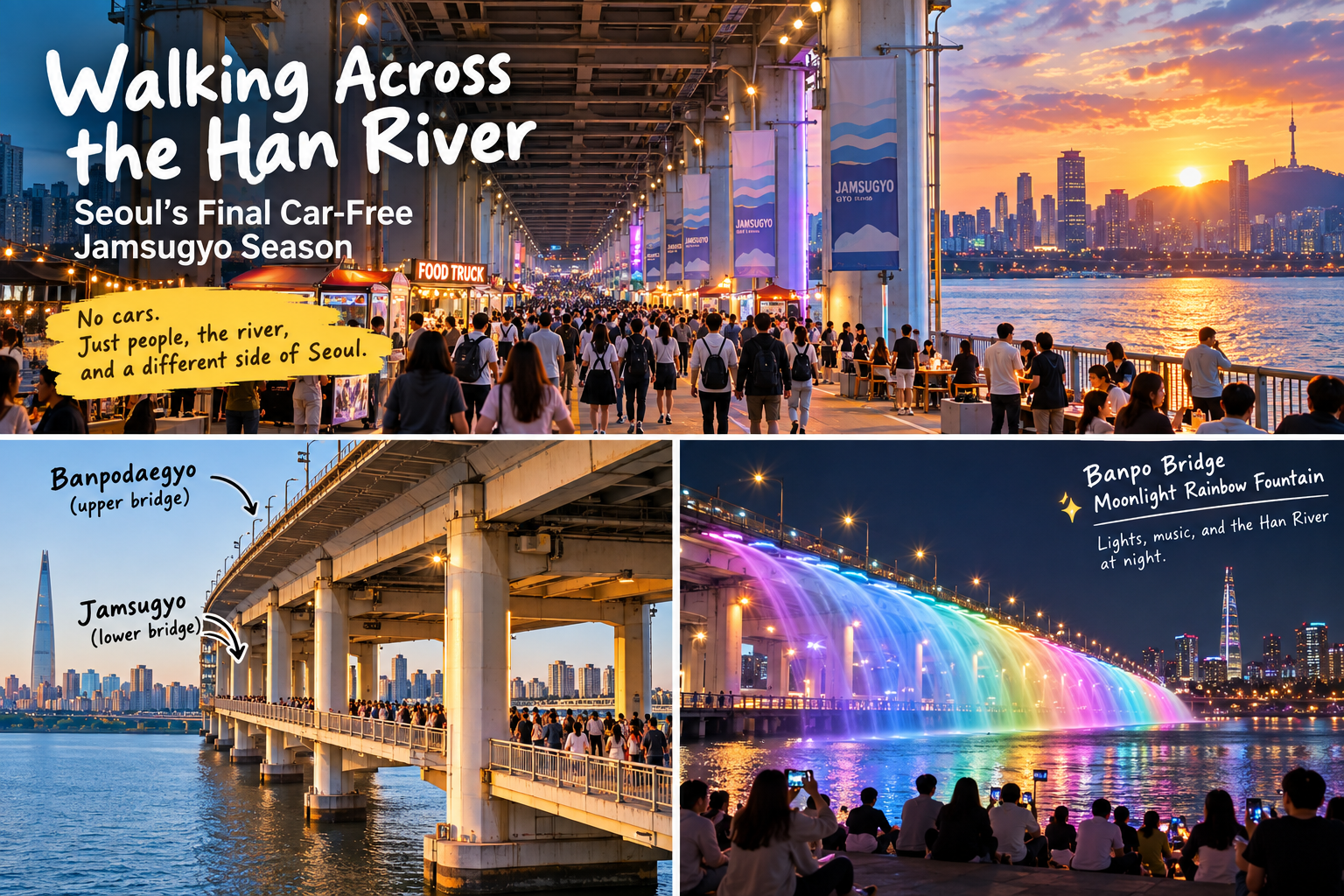
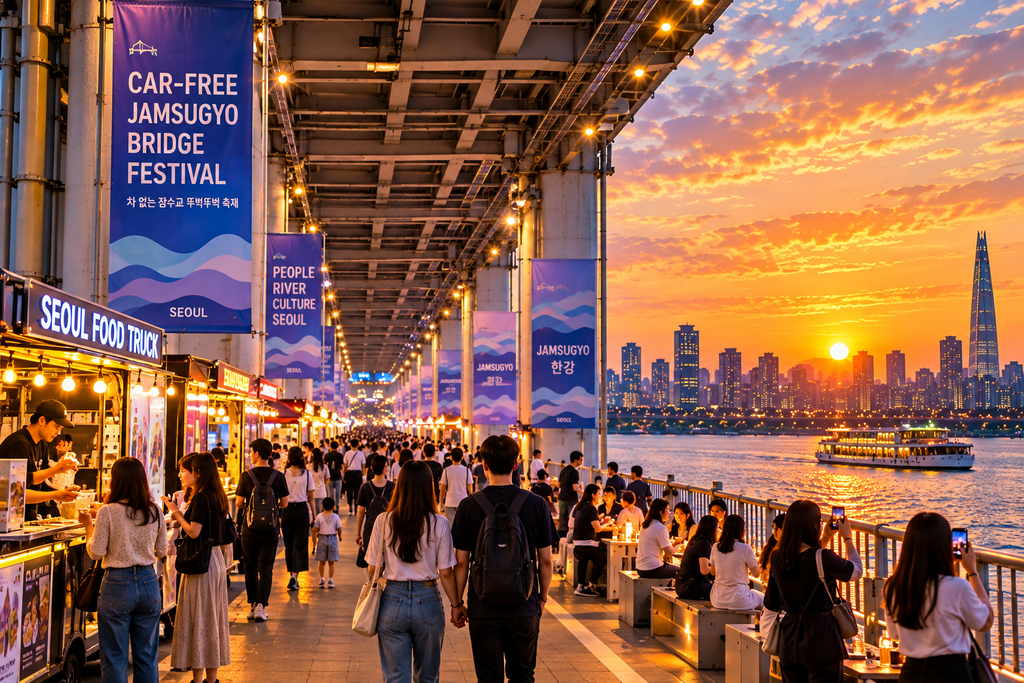
During Seoul’s Car-Free Jamsugyo Bridge Festival, traffic disappears and the bridge fills with pedestrians, families, couples, food trucks, performances, picnic areas, and people simply enjoying the river.
And autumn 2026 is particularly special.
The festival runs every Sunday from September 6 to October 25, from 2 PM to 10 PM. Seoul says this will be the final season of the festival in its current “car-free” format before Jamsugyo is planned to become a fully pedestrianized bridge in the second half of 2027.
So if you are visiting Seoul this autumn, you are seeing Jamsugyo at an interesting moment in its history:
no longer just a road, but not yet a permanent pedestrian space.
First: Why Is It Called Jamsugyo?
Here is the most interesting part.
잠수교 (Jamsugyo) literally means something close to “submersible bridge.”
That is not just a nickname.
Completed in 1976, Jamsugyo sits only about 2.7 meters above the normal river level, much lower than most bridges crossing the Han River.
During major floods, the bridge was designed to become submerged beneath the rising river.
It even serves as a visual indicator of the Han River’s water level.
That unusual design creates another experience when the weather is good.
Because you are so close to the water, walking across Jamsugyo can feel very different from crossing one of Seoul’s higher bridges.
The river does not feel far below you.
It feels like you are walking beside it.
There Is Actually Another Bridge Above You
Look up while walking across Jamsugyo and you will notice something unusual.
There is another bridge directly above it.
That is Banpodaegyo Bridge (반포대교).
Banpodaegyo and Jamsugyo form Korea’s first double-deck bridge structure: cars travel on the upper bridge while Jamsugyo occupies the lower level.
This creates one of Seoul’s most distinctive urban spaces.
A river below you.
A bridge above you.
And, during the festival, a pedestrian street running through the middle.
At night, the structure becomes even more dramatic when lights, music, and the famous Moonlight Rainbow Fountain transform the area.
What Happens When Seoul Removes the Cars?
A surprisingly simple idea changes the entire atmosphere:
Close the road. Give it to people.
The Car-Free Jamsugyo Bridge Festival has grown into one of Seoul’s signature Han River events, attracting more than 6.47 million cumulative visitors according to the Seoul Metropolitan Government.
Instead of traffic, visitors can find food trucks, performances, rest areas, markets, cultural activities, music, and seasonal programs.
But perhaps the best activity is the simplest one.
Just walk.
Stand in the middle of a bridge that normally carries vehicles and look toward the Seoul skyline.
Watch people sit near the river.
Stay until sunset.
This is a side of Seoul that feels very different from Myeongdong, Hongdae, or Gangnam.
Why October 2026 Is a Great Time to Go
October has some of the most interesting programs of the autumn season.
On October 11, “Moonlight Jamsugyo” will turn the bridge structure into a nighttime media-art space. From 7 PM to 10 PM, lights inspired by the Milky Way will be combined with music across Jamsugyo and Banpodaegyo.
On October 18, “Jamsugyo Refresh Day” shifts the mood toward wellness, with yoga, stretching, and meditation programs.
The festival itself continues through October 25.
Autumn also brings another advantage.
Seoul evenings become cooler, making a long walk along the Han River much more comfortable than during the humid summer months.
Don’t Miss the Moonlight Rainbow Fountain
If you visit in the evening, stay for the Banpo Bridge Moonlight Rainbow Fountain (달빛무지개분수).
Water jets stretch along both sides of Banpodaegyo Bridge while lights and music turn the river into a nighttime show.
During October, the fountain normally operates several times each evening, although schedules can change because of weather or operating conditions.
For a first-time visitor, combining Jamsugyo with the fountain is probably the best way to experience this part of Seoul.
Naru’s recommended timing:
Arrive around 5 PM → walk around Banpo Hangang Park → explore Jamsugyo → watch the sunset → have something to eat → stay for the fountain and nighttime atmosphere.
The Bigger Story: Seoul Is Turning a Road Into Public Space
Jamsugyo is interesting for another reason.
It shows how Seoul is rethinking the Han River.
The city plans to transform Jamsugyo into the first pedestrian-only bridge crossing the Han River.
The bridge, which spans about 795 meters, is expected to become a cultural and recreational space incorporating exhibitions, performances, river views, and public areas. Seoul selected a design concept known as “The Longest Gallery” through an international design process.
The full pedestrianization is currently planned for the second half of 2027.
That makes the 2026 festival more than another weekend event.
It is almost a preview of what the bridge is becoming.
A Small Business Lesson Hidden in the Festival
There is also an interesting business story here.
Cities traditionally treated infrastructure such as bridges primarily as transportation assets.
But Jamsugyo demonstrates another possibility:
Infrastructure can become an experience.
When pedestrians replace cars, the bridge suddenly creates opportunities for food trucks, performances, markets, tourism, nighttime activities, and nearby businesses.
Seoul has even extended the autumn festival until 10 PM as part of efforts to strengthen the city’s nighttime economy.
It is a useful example of how cities can turn ordinary infrastructure into destinations.
Sometimes the attraction does not need to be built from scratch.
You simply need to change how people are allowed to use the space.
How to Get There
The easiest approach for most international visitors is from the southern side of the river.
Express Bus Terminal Station — Lines 3, 7 and 9
Use Exit 8-1 and walk toward Banpo Hangang Park and Jamsugyo.
The northern side can also be reached from Seobinggo Station on the Gyeongui–Jungang Line. Previous official festival guidance lists the northern end at roughly a 10-minute walk from Exit 2.
Public transportation is strongly recommended during festival days because vehicle access around Jamsugyo is restricted and parking around Banpo Hangang Park can become congested.
Naru’s Tips
Go before sunset.
You get two versions of Seoul in one visit: the daytime river landscape and the illuminated nighttime city.
Don’t rush across the bridge.
Jamsugyo is less about reaching the other side and more about spending time on the bridge itself.
Combine it with Banpo Hangang Park.
Bring a picnic or buy something nearby and spend a few hours along the river.
Check the weather before visiting.
Outdoor programs and the fountain can be affected by weather conditions.
Sunday is the key day.
The 2026 autumn Car-Free Jamsugyo Festival runs on Sundays through October 25.
🇰🇷 5 Korean Words to Learn Today
| English | Korean | Pronunciation | Chinese | Spanish |
|---|---|---|---|---|
| Han River | 한강 | Hangang | 汉江 | río Han |
| Bridge | 다리 | dari | 桥 | puente |
| Jamsugyo Bridge | 잠수교 | Jamsugyo | 潜水桥 | puente sumergible |
| Walk / Stroll | 산책 | sanchaek | 散步 | paseo |
| Pedestrian | 보행자 | bohaengja | 行人 | peatón |
🇰🇷 Korean Phrase of the Day
잠수교까지 걸어갈 수 있어요?
Jamsugyokkaji georeogal su isseoyo?
English: Can I walk to Jamsugyo Bridge?
中文: 可以走路去潜水桥吗?
Español: ¿Puedo ir caminando hasta el puente Jamsugyo?
💡 Did You Know?
Jamsugyo is not simply a bridge with an unusual name.
The word 잠수 (jamsu) means “submersion” or “diving,” while 교 (gyo) means “bridge.”
So 잠수교 literally describes what the bridge was designed to do: go underwater when the Han River rises significantly.
That is why its unusually low position above the river is not an architectural accident.
🔎 Hidden Story
When Jamsugyo was completed in 1976, Seoul was rapidly building transportation infrastructure to support a growing modern city.
Almost exactly half a century later, the same bridge is being reconsidered for a completely different purpose.
Instead of asking:
“How can cars cross the river faster?”
Seoul is increasingly asking:
“How can people enjoy the river better?”
That shift tells us something about how Seoul itself has changed.
Infrastructure that once represented economic development is now being redesigned around quality of life, culture, leisure, and experience.
❓ Today’s Question
Would you like your city to turn a major road or bridge into a permanent pedestrian space? Why or why not?
Tell me in the comments—and let me know which city you are from.
✍️ Naru Quote
“Sometimes a city becomes more interesting not when it builds something new, but when it gives an old space a new purpose.” — Naru
SEO FAQ
Is Jamsugyo Bridge open to pedestrians?
Yes. Jamsugyo includes pedestrian access, and during the Car-Free Jamsugyo Bridge Festival the festival area is closed to vehicle traffic so visitors can enjoy the bridge as a pedestrian-focused public space.
When is the 2026 Car-Free Jamsugyo Bridge Festival?
The autumn festival runs every Sunday from September 6 through October 25, 2026, from 2 PM to 10 PM.
Why is Jamsugyo called a submersible bridge?
The bridge sits unusually close to the Han River—around 2.7 meters above normal river level—and was designed to become submerged during major flooding.
Will Jamsugyo become a pedestrian bridge?
Yes. Seoul currently plans to fully pedestrianize Jamsugyo in the second half of 2027, transforming it into a cultural and recreational space over the Han River.
What is the best time to visit Jamsugyo?
Late afternoon through evening is ideal because visitors can experience the river before sunset, the Seoul nightscape afterward, and potentially the Moonlight Rainbow Fountain.
한강을 걸어서 건넌다: 2026년, 지금 잠수교에 가야 하는 이유
서울에는 수많은 한강 다리가 있습니다.
대부분의 다리는 어딘가로 이동하기 위해 지나가는 곳입니다.
하지만 잠수교는 조금 다릅니다.
일요일이 되면 자동차가 사라지고 그 자리를 사람들이 채웁니다.
가족과 연인들이 산책하고, 푸드트럭에서 음식을 먹고, 공연을 보고, 한강의 노을을 즐깁니다.
특히 2026년은 잠수교에게 의미 있는 해입니다.
2026년 가을 차 없는 잠수교 뚜벅뚜벅 축제는 9월 6일부터 10월 25일까지 매주 일요일 오후 2시부터 10시까지 진행됩니다. 그리고 2027년 하반기 예정된 잠수교 전면 보행화 이전, 현재 형태로 열리는 마지막 시즌입니다.
왜 이름이 ‘잠수교’일까?
잠수교의 이름에는 다리의 특징이 그대로 들어 있습니다.
1976년 완공된 잠수교는 평상시 한강 수면에서 약 2.7m 높이에 위치합니다. 홍수로 한강 수위가 크게 올라가면 다리가 물에 잠기도록 설계되었습니다.
그래서 다른 한강 다리보다 물을 훨씬 가까이에서 느낄 수 있습니다.
그리고 고개를 들어보면 잠수교 바로 위에 또 하나의 다리가 있습니다.
바로 반포대교입니다.
이 독특한 구조 덕분에 잠수교에서는 아래로는 한강을, 위로는 반포대교를 바라보며 걸을 수 있습니다.
2026년 가을이 특별한 이유
10월 11일에는 Moonlight Jamsugyo가 열립니다. 저녁 7시부터 10시까지 은하수를 모티브로 한 미디어아트와 음악이 잠수교와 반포대교 구조물을 비춥니다.
10월 18일에는 요가, 스트레칭, 명상 등을 즐기는 Jamsugyo Refresh Day가 진행됩니다.
그리고 2027년 하반기부터 잠수교는 자동차가 다니는 다리가 아닌 한강 최초의 전면 보행교로 변신할 예정입니다.
결국 지금의 잠수교는 서울이 자동차 중심 도시에서 사람과 경험 중심의 도시로 변화하고 있는 모습을 보여주는 흥미로운 공간입니다.
Naru’s Tip
오후 5시쯤 도착해 보세요.
반포한강공원 산책 → 잠수교 → 한강 노을 → 간단한 음식 → 달빛무지개분수 → 서울 야경 순서로 즐기면 좋습니다.
잠수교에서는 목적지에 빨리 도착하려고 하지 마세요.
이곳에서는 다리를 건너는 것 자체가 목적입니다.
步行穿越汉江:为什么2026年秋天值得去首尔潜水桥?
首尔有许多横跨汉江的大桥。
大多数桥只是连接城市两岸的交通设施。
但潜水桥(Jamsugyo)不一样。
在“无车潜水桥节”期间,每到星期日,汽车暂时离开,行人接管整座桥。人们可以散步、看表演、品尝美食,并欣赏汉江日落与首尔夜景。
2026年尤其特别。
今年秋季活动从9月6日至10月25日,每周日下午2点至晚上10点举行。这也是潜水桥计划于2027年下半年全面步行化之前,以目前“无车节”形式举行的最后一个秋季。
为什么叫“潜水桥”?
韩语“잠수”意为潜水或浸没,“교”则代表桥。
潜水桥于1976年建成,距离正常汉江水面仅约2.7米。
当汉江因暴雨而水位大幅上升时,这座桥甚至可能被河水淹没。
因此,走在这里时,你会感觉自己不是高高地跨越汉江,而是在水面旁边行走。
更有趣的是,潜水桥上方还有另一座桥——盘浦大桥。
这形成了首尔非常独特的双层桥景观。
一座桥,也可以成为城市客厅
2027年,首尔计划将潜水桥改造成汉江第一座全面步行化的大桥。
未来这里不仅是过河的地方,还将成为拥有艺术、展览、表演和休闲空间的城市公共场所。
这也说明了首尔城市发展的一个变化:
过去的问题是——
“怎样让汽车更快地过河?”
现在的问题逐渐变成——
“怎样让人们更好地享受汉江?”
有时候,一座城市最有趣的创新并不是建造新的东西。
而是重新思考我们如何使用已经存在的空间。
Cruzar el río Han caminando: por qué 2026 es un año especial para visitar el puente Jamsugyo
Seúl tiene decenas de puentes que cruzan el río Han.
La mayoría son lugares por los que simplemente pasamos para llegar a otro sitio.
Jamsugyo es diferente.
Durante el festival Car-Free Jamsugyo, los automóviles desaparecen temporalmente y el puente se llena de peatones, familias, parejas, puestos de comida y espectáculos.
En otoño de 2026, el festival se celebra todos los domingos, del 6 de septiembre al 25 de octubre, de 14:00 a 22:00. Además, será la última temporada en su formato actual antes de la transformación prevista del puente en un espacio completamente peatonal en 2027.
¿Por qué se llama Jamsugyo?
La palabra coreana 잠수 (jamsu) significa sumergirse, mientras que 교 (gyo) significa puente.
Y el nombre es muy literal.
Construido en 1976, Jamsugyo se encuentra a solo unos 2,7 metros sobre el nivel normal del río. Cuando el río Han sube considerablemente durante una inundación, el puente puede quedar sumergido.
Eso también explica por qué caminar por aquí es una experiencia diferente.
El agua parece estar mucho más cerca.
De infraestructura a experiencia
Seúl planea convertir Jamsugyo en el primer puente completamente peatonal que cruza el río Han.
El objetivo no es simplemente eliminar los automóviles. El proyecto busca convertir el puente en un espacio para caminar, disfrutar del paisaje, ver exposiciones y espectáculos y pasar tiempo junto al río.
Jamsugyo representa así un cambio interesante en la forma de pensar sobre las ciudades.
Una infraestructura creada originalmente para transportar vehículos puede convertirse décadas después en un destino cultural.
Y quizá esa sea la historia más interesante de Jamsugyo.
No se trata solamente de cruzar el río Han.
Se trata de aprender a disfrutarlo.