
In a Country Where Everyone Has a Smartphone, Why Pay to Take Four More Photos?
Imagine spending the afternoon with Korean friends in Seoul.
You eat lunch.
Walk through a few shops.
Get coffee.
Then, just before everyone goes home, somebody says:
“네컷 찍을래?”
Ne-keot jjigeullae?
“Want to take four-cut photos?”
Five minutes later, everyone is standing in front of a mirror fixing their hair.
Someone grabs a ridiculous headband.
Another person is searching online for poses.
You squeeze into a tiny studio.
The countdown begins.
One photo.
Quickly change poses.
Another.
Again.
Again.
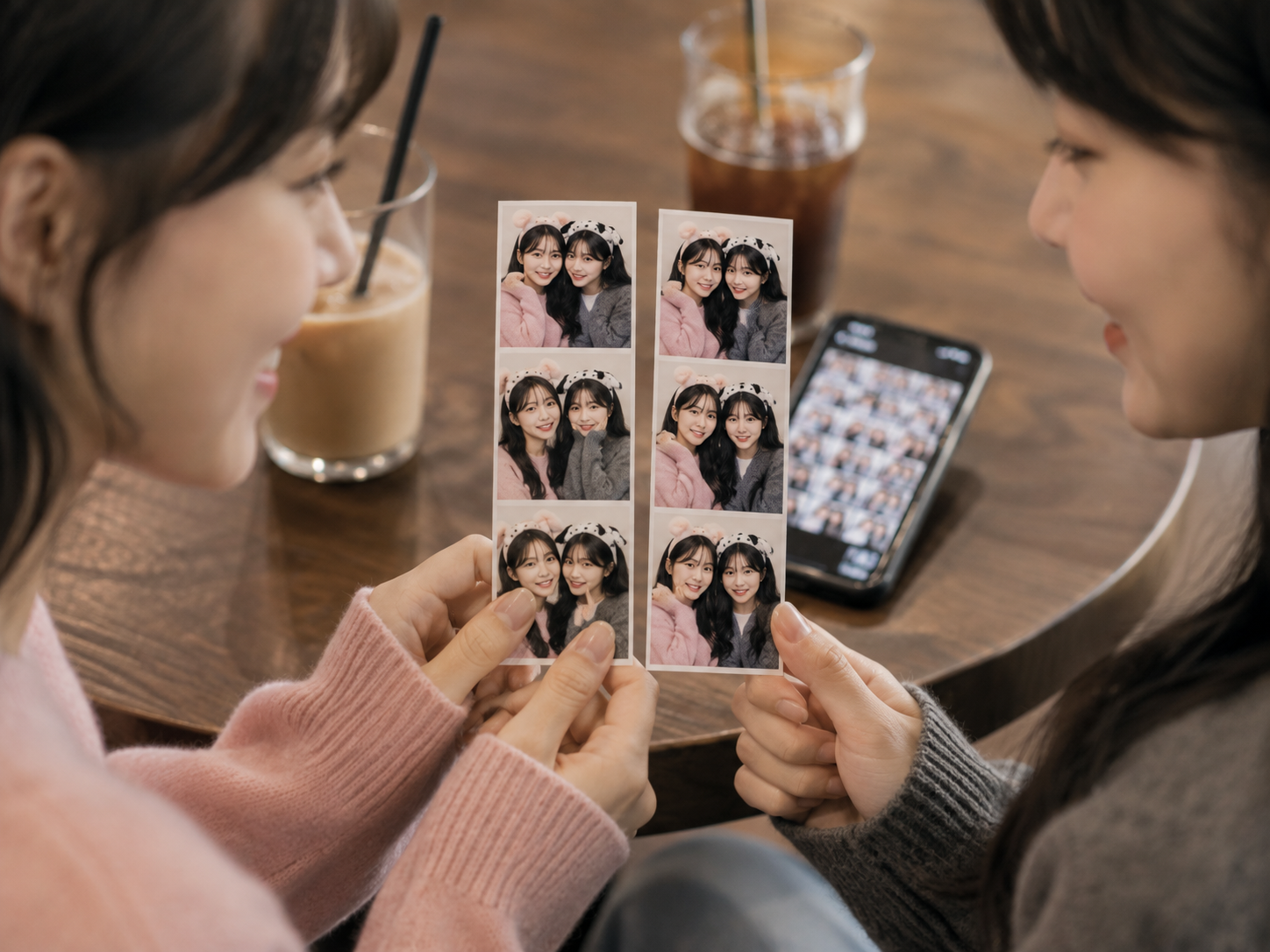
A few minutes later, a machine prints two narrow strips containing four photographs.
One goes to you.
One goes to your friend.
The entire experience may cost less than a café drink.
And somehow, those four tiny pictures can feel more memorable than the fifty smartphone photos already sitting in your camera roll.
That is the strange appeal of Korea’s 네컷사진 — ne-keot sajin, or “four-cut photos.”
Photo booths have become particularly common among Korean teenagers and people in their twenties. Korea Tourism Organization reported that the number of unmanned four-cut photo booths increased from 1,006 in 2023 to more than 3,000 in 2024, with teens and twenty-somethings accounting for more than 80% of users.
So why, in one of the world’s most digitally connected societies, did printed photo strips become so popular again?
Because the real product may not be the photograph.
It is the moment of making it together.
First, What Is a Korean Four-Cut Photo?
The basic format is simple.
You enter a self-service photo studio, choose a frame, stand in front of the camera, and take several photographs in quick succession.
You then select your favorite images.
The machine prints them vertically—often as four images on one narrow strip.
That format is commonly called:
네컷사진
Ne-keot sajin
Four-cut photo.
Another expression you will constantly hear is:
인생네컷
Insaeng ne-keot
Literally, something like:
“four cuts of life.”
But there is an interesting detail.
Life Four Cuts (인생네컷) began as an actual brand, launching from a single unmanned booth in Daegu in 2017. As the format became enormously popular, the brand name began to be used conversationally almost like a generic term for the activity itself.
Someone might therefore say:
“인생네컷 찍자.”
“Let’s take Life Four Cuts.”
Even when the photo studio belongs to another brand.
Reason No. 1: A Printed Photo Feels Different From a Phone Photo
Your smartphone may contain thousands of photographs.
How many do you actually look at?
That is the paradox.
We have never taken more photographs.
But individual photographs may feel less precious because there are so many of them.
A four-cut strip changes that.
You only get a few frames.
You can hold them.
Put one inside your phone case.
Stick one on your wall.
Place one on your desk.
Keep one in a wallet.
Give one to the friend who appears beside you.
Korea JoongAng Daily interviewed young Korean users who specifically described the analog, printable quality of photo strips as part of their appeal compared with pictures that disappear into an enormous smartphone gallery.
So the technology is modern.
But the emotion is surprisingly analog.
Digital convenience created a new desire for something physical.
Reason No. 2: Taking the Photo Is the Entertainment
A Korean photo booth is not simply a vending machine that produces photographs.
The process is part of the fun.
You enter with friends.
Look through props.
Fix your hair.
Choose the frame.
Argue about poses.
Someone forgets the countdown.
Everyone laughs.
The third picture is terrible.
The fourth somehow becomes your favorite.
Then you stand around waiting for the strip to print.
This is important.
If the only goal were obtaining a high-quality picture, smartphones would probably win.
But the photo booth creates a five-minute social activity.
Korea JoongAng Daily described this combination of affordability, convenience, transformation through props, and instant gratification as a major part of the format’s appeal.
In other words:
The photo is the souvenir.
The awkward posing is the experience.
Reason No. 3: Four Photos Force You to Create a Story
One photograph asks:
“How should we pose?”
Four photographs ask:
“What should we do next?”
That small difference changes everything.
First frame:
Smile.
Second:
V signs.
Third:
Finger hearts.
Fourth:
Everyone does something ridiculous.
Suddenly, the strip has a beginning, middle, and ending.
Social media has made this even more playful. Korean users regularly share pose ideas for couples, groups, friends, birthdays, graduations, and special themes. Korea JoongAng Daily noted that the four-frame format itself encouraged people to develop and circulate coordinated pose ideas online.
So the limitation—only a few frames—is actually part of the creativity.
Reason No. 4: Korea Loves Small Rituals Between Friends
A photo booth visit can happen after:
a date,
dinner,
a birthday,
graduation,
a trip,
a concert,
a reunion,
or an ordinary Saturday afternoon.
And that is exactly the point.
You do not need a major life event.
The photo makes an ordinary meeting feel worth remembering.
Korea Tourism Organization describes four-cut photography as a popular activity when friends meet, rather than simply as formal portrait-taking.
Think about the difference.
In the past, a photograph might mark:
“Something important happened.”
Today, the Korean four-cut ritual can say:
“We were together today. That was enough.”
That may be one of the most appealing ideas behind it.
Hidden Story: This Isn’t Korea’s First Photo-Booth Craze
Before today’s four-cut studios, another generation of Korean teenagers loved:
스티커사진
Seutikeo sajin
Sticker photos.
In the 2000s, Japanese-style purikura machines became extremely popular in Korea.
Users could take photographs, decorate them digitally, enlarge their eyes, add graphics, and print the result as small stickers.
Korea JoongAng Daily notes that sticker photography was hugely popular through the 2000s before declining, and that today’s self-photo boom returned around 2017 with higher-resolution images and a more natural visual style.
So Korean Gen Z did not invent the desire to play with instant photographs.
They reinvented it.
The old version was:
photo + decoration + sticker
The new version became:
photo + aesthetic + experience + social media + physical souvenir
Different technology.
Very similar human desire.
Reason No. 5: The Photos Usually Make You Look Good
There is another practical reason people return.
The lighting is designed for faces.
The camera position is controlled.
Backgrounds are carefully selected.
Some studios offer subtle skin correction, color adjustment, or filters.
Korea Tourism Organization notes that many modern booths use high-quality lighting and increasingly sophisticated image-processing features; some offer AI-based filters and beauty adjustments.
That makes the experience different from handing your phone to a stranger and hoping for the best.
You know where to stand.
You see yourself.
You control the timing.
You choose the photos.
The result is predictable enough to feel safe but spontaneous enough to remain fun.
Yet Koreans Don’t All Want the Same Face
Interestingly, different photo-booth brands became known for different visual styles.
Some produce bright, clean images.
Others emphasize gray tones.
Some apply stronger retouching.
Others deliberately look more natural.
Some resemble studio portraits.
Others lean into retro aesthetics.
Korea Tourism Organization even provides travelers with guidance distinguishing several popular four-cut styles, from more natural-looking photography to heavily styled booths.
That means choosing a photo-booth brand can become almost like choosing a café.
You are not only asking:
“Where should we take photos?”
You are asking:
“What mood do we want?”
Reason No. 6: K-Pop Turned the Frame Into Merchandise
Now the business model gets especially interesting.
Suppose your favorite K-pop idol has a comeback.
A photo-booth company releases a limited frame featuring the artist.
You enter the booth.
Pose in specific locations.
When the photographs print, it looks almost as if you took the pictures with the idol.
Korea Tourism Organization describes celebrity, influencer, animation, webtoon, and character collaboration frames as a major part of contemporary four-cut culture. These frames may only be available at selected locations for limited periods.
This transforms the photo strip from:
photograph
into:
collectible merchandise.
And unlike ordinary merchandise, you are inside it.
That is brilliant.
The fan does not merely buy a product featuring the celebrity.
The fan becomes part of the product.
One Photo Booth Can Become a Fan Destination
Limited frames create scarcity.
Scarcity changes behavior.
If your favorite artist’s frame is available only for two weeks, you have a reason to visit now.
If only certain locations carry it, you have a reason to travel there.
KTO notes that fans may even change meeting locations based on where limited collaboration frames are available.
That means the photo booth can create:
foot traffic,
repeat visits,
fandom spending,
social-media posts,
and nearby restaurant or café visits.
A tiny booth becomes part of a larger entertainment economy.
Reason No. 7: You Get Both Analog and Digital
Here is another reason the format fits modern Korea perfectly.
You receive the printed strip.
But many booths also provide a QR code.
Scan it and you may obtain:
digital versions of the pictures,
and sometimes a short video showing the moments during the shoot.
Both Korea Tourism Organization and Korea JoongAng Daily describe QR-linked downloads as a familiar feature of modern Korean photo booths.
So you do not need to choose between:
physical memory
and
digital sharing.
You get both.
That may be one of the smartest aspects of the product.
The paper goes into your wallet.
The digital version goes onto Instagram.
Why Foreign Travelers Love Them Too
Photo booths have also become an easy Korean travel experience.
You usually do not need:
a reservation,
advanced Korean,
much time,
or a large budget.
You can walk in.
Take the pictures.
Leave with a souvenir.
Korea Tourism Organization now describes four-cut photo booths as must-visit experiences for tourists and highlights areas such as Gangnam, Seongsu, and Hongdae where multiple options are easy to find.
Compare that with many souvenirs.
A refrigerator magnet tells you:
“I visited Korea.”
A four-cut strip tells you:
“This is what we looked like while we were there.”
That is much more personal.
Photo Booths Also Fit Korean Dating Culture Perfectly
Imagine a date.
Dinner finishes.
Neither person wants to go home yet.
Going for another full meal seems unnecessary.
The photo booth provides a perfect five-minute extension.
“Want to take four-cut photos?”
Now you have to stand close together.
Choose poses.
Maybe make a heart.
And you leave with something that records the date.
KTO notes that four-cut pictures have become particularly common as part of dates and relationship milestones, including in Korean entertainment content.
The resulting strip can become almost like a tiny relationship timestamp.
First date.
100 days.
Birthday.
Anniversary.
Another strip.
Over time, the photographs create a visual timeline.
Business Insight: Photo Booths Sell “Affordable Experience”
From a business perspective, Korean photo booths are fascinating.
The physical product is tiny.
Four photographs.
Some paper.
But the customer is really buying several things simultaneously:
self-expression + entertainment + memory + social content + collectible + souvenir
The operating model is also attractive.
Many locations are unmanned.
The footprint can be relatively compact.
A session takes only a few minutes.
Digital technology controls the experience.
New frames can refresh the offer without completely redesigning the store.
Collaborations create reasons for existing customers to return.
This is a classic example of experience economy meeting automated retail.
And the category continues evolving.
In 2025, Life Four Cuts launched a more immersive flagship concept in Seoul’s Ikseon-dong, combining themed booths with sensory and spatial design rather than treating the experience as only a simple machine transaction.
The evolution is telling:
machine → store → entertainment venue.
Why This Is Such a Korean Business Story
Korea repeatedly takes simple consumer activities and adds another layer of experience.
Drink coffee?
Build a destination café.
Buy merchandise?
Turn it into a pop-up.
Take a photograph?
Build a themed self-photo experience around it.
The product becomes more than its functional purpose.
That is particularly powerful with younger consumers because the experience produces something that can be:
remembered,
displayed,
and shared.
The four-cut photo does all three.
Did You Know?
More Than 3,000 Four-Cut Booths Were Operating in Korea by 2024
According to Korea Tourism Organization, the number of unmanned four-cut photo booths rose from 1,006 in 2023 to more than 3,000 in 2024. More than 80% of users were teenagers or people in their twenties.
That means this is no longer just a cute niche trend.
It became a recognizable part of Korea’s youth and leisure landscape.
Naru’s Travel Tips
If you want to try a Korean photo booth, the easiest places to find multiple styles are youth-heavy commercial districts such as Hongdae, Gangnam, and Seongsu.
Before entering the booth, decide on at least two or three poses. The countdown between pictures can be much faster than first-time visitors expect.
Use the props if you want, but do not feel that you need to make every picture perfect. Some of the funniest four-cut strips work precisely because one frame went wrong.
If the machine provides a QR code, save the digital content soon after the session because download availability may be temporary.
And if you see a celebrity or character frame you like, check whether it is limited edition.
It might not be there next month.
Learn 5 Korean Words
| English | Korean | Pronunciation | Chinese | Spanish |
|---|---|---|---|---|
| Photo | 사진 | sa-jin | 照片 | Foto |
| Four-cut photo | 네컷사진 | ne-keot-sa-jin | 四格照片 | Foto de cuatro cuadros |
| Photo booth | 포토부스 | po-to-bu-seu | 拍照亭 | Fotomatón |
| Pose | 포즈 | po-jeu | 姿势 | Pose |
| Memory | 추억 | chu-eok | 回忆 | Recuerdo |
Bonus Expression
인생네컷 — Insaeng Ne-keot
Originally a photo-booth brand name, the expression became so familiar that it is often used casually when talking about taking four-cut photos in general.
Korean Phrase of the Day
같이 네컷 찍을래요?
Pronunciation: Ga-chi ne-keot jji-geul-lae-yo?
English: Want to take four-cut photos together?
Chinese: 要一起拍四格照吗?
Spanish: ¿Quieres que nos hagamos unas fotos de cuatro cuadros juntos?
A simpler version is:
같이 사진 찍을래요?
Ga-chi sa-jin jji-geul-lae-yo?
“Want to take a photo together?”
Today’s Question
Would you rather keep 100 digital photos on your phone—or one printed photo strip with someone you care about?
And if Korean-style four-cut photo booths exist in your country, have you tried one yet?
Tell us in the comments.
Naru’s Quote
“A smartphone can record almost everything. Maybe that is exactly why four small printed photos can still feel special.” — Naru
SEO FAQ
Why are photo booths so popular in Korea?
They combine inexpensive entertainment, flattering photography, physical souvenirs, social-media content, and time with friends or partners. The experience is especially popular among younger consumers. KTO reported more than 3,000 unmanned four-cut booths in Korea by 2024.
What is a Korean four-cut photo?
A 네컷사진 (ne-keot sajin) is a photo strip containing a sequence of four photographs, usually created inside a self-service photo booth.
What does “Insaeng Necut” mean?
인생네컷 (Insaeng Ne-keot) is the name of Life Four Cuts, a Korean photo-booth brand that began in Daegu in 2017. Its popularity became so widespread that the expression is also often used conversationally for four-cut photo experiences more generally.
How much do Korean photo booths cost?
Prices differ by brand, format, and collaboration frame, but standard sessions are designed as relatively inexpensive entertainment rather than professional studio photography.
Do Korean photo booths give digital photos?
Many do. QR codes printed with the photo may allow customers to download digital images and sometimes short video clips.
Why are K-pop idols on Korean photo-booth frames?
Photo-booth operators collaborate with entertainment companies, celebrities, influencers, and character IP owners to create limited-edition frames. Fans can then pose in a layout that visually places them beside their favorite artist or character.
Where can tourists find Korean photo booths in Seoul?
They are particularly easy to find in busy youth and shopping districts such as Hongdae, Gangnam, and Seongsu.
Part 3 — Why Four Photos Explain Something Bigger About Modern Korea
At first, Korea’s photo-booth culture looks like a story about pictures.
But it may actually be a story about something else:
how people create memories in an age when everything is recorded.
Your phone automatically saves thousands of images.
Cloud storage may preserve them for years.
Technology made photographs almost unlimited.
And that changed their value.
When photographs were difficult to produce, simply having one was special.
Now the challenge is different.
How do you make one photo feel important?
Korean four-cut culture offers one answer.
Limit the number.
Make people stand together.
Give them a countdown.
Make them decide how to pose.
Print the result.
Give each person a copy.
Suddenly, taking a photograph becomes an event again.
There is also a very Korean combination inside the experience:
high-tech camera + analog print
automated store + human connection
physical souvenir + QR download
ordinary friendship + highly designed experience
personal memory + K-pop merchandise
None of those elements alone explains the success.
The magic is in the combination.
Maybe that is why the format survived after the novelty should have disappeared.
People were never really paying for four photographs.
They were paying for a tiny ritual that says:
“We were here together.”
And in a world overflowing with digital images, that little piece of paper can still matter.

한국인은 왜 포토부스를 이렇게 좋아할까?
스마트폰만 있으면 언제 어디서든 사진을 찍을 수 있는 시대입니다.
그런데 한국에서는 오히려 작은 포토부스에 들어가 돈을 내고 네 장의 사진을 찍는 문화가 크게 성장했습니다.
바로:
네컷사진
문화입니다.
대표적으로 인생네컷이라는 브랜드가 2017년 대구에서 무인 포토부스로 시작했고, 이후 네컷사진 문화가 크게 확산되면서 인생네컷이라는 이름 자체가 네컷사진을 뜻하는 표현처럼 사용되기도 했습니다.
한국관광공사에 따르면 무인 네컷사진 점포는 2023년 1,006개에서 2024년 3,000개 이상으로 증가했고, 주요 이용자의 80% 이상이 10대와 20대였습니다.
그렇다면 왜 이렇게 인기가 많을까요?
첫 번째 이유는 사진을 찍는 과정 자체가 놀이이기 때문입니다.
친구와 소품을 고르고, 거울 앞에서 머리를 정리하고, 어떤 포즈를 할지 고민하다가 빠르게 이어지는 촬영 때문에 웃긴 표정이 나오기도 합니다.
결과물만 중요한 것이 아닙니다.
함께 찍는 몇 분 자체가 추억이 됩니다.
두 번째는 실물 사진의 매력입니다.
스마트폰에는 수천 장의 사진이 있지만 다시 보지 않는 경우가 많습니다.
반면 네컷사진은 손에 들 수 있고, 휴대전화 케이스나 지갑에 넣거나 벽에 붙일 수 있습니다.
디지털 시대이기 때문에 오히려 작은 실물 사진이 특별해진 것입니다. 한국의 젊은 이용자들도 인쇄된 사진의 아날로그적인 느낌을 포토부스의 매력으로 이야기해왔습니다.
또 다른 이유는 K-pop과 팬덤 문화입니다.
최근 포토부스 업체들은 연예인, 캐릭터, 웹툰 등과 협업한 한정 프레임을 지속적으로 선보입니다.
팬은 자신의 사진과 좋아하는 스타가 함께 있는 것처럼 보이는 결과물을 만들 수 있습니다.
그래서 네컷사진은 단순 사진이 아니라:
사진 + 경험 + 굿즈
가 됩니다.
흥미로운 것은 이런 사진 문화가 완전히 새로운 것은 아니라는 점입니다.
2000년대 한국에서는 스티커사진이 큰 인기를 끌었습니다. 일본의 프리쿠라 문화에서 시작된 스티커사진은 사진을 찍고 꾸민 뒤 작은 스티커로 출력하는 방식이었습니다.
스티커사진이 사라진 뒤 2017년경부터 보다 자연스럽고 고화질인 현재의 포토부스 문화가 다시 대중화되었습니다.
즉 세대는 바뀌었지만 사람들이 친구와 함께 사진을 찍고 실물로 남기고 싶은 마음은 계속 남아 있었던 셈입니다.
어쩌면 한국의 네컷사진 문화에서 가장 중요한 것은 사진이 아닐지도 모릅니다.
“우리가 오늘 같이 있었다.”
라는 작은 증거를 남기는 것입니다.

为什么韩国人这么喜欢拍照亭?
现在,只要有智能手机,任何时候都可以拍照。
那么为什么韩国年轻人还愿意走进照相亭,花钱拍四张照片呢?
韩国非常流行一种叫:
네컷사진
的“四格照片”。
其中最著名的品牌之一是 인생네컷(Life Four Cuts)。它从2017年大邱的一台无人照相亭开始发展。随着这种拍照方式越来越流行,品牌名称也逐渐成为人们日常谈论四格照时经常使用的表达。
韩国观光公社数据显示,无人四格照店铺从2023年的1,006家增加到2024年的3,000多家,其中超过80%的消费者是十几岁和二十多岁的年轻人。
为什么这么受欢迎?
因为人们购买的不只是照片。
大家一起选择道具、整理头发、设计动作,然后在很短的倒计时中不断更换姿势。
有时拍得很好。
有时非常搞笑。
但是这个过程本身就是娱乐。
另外,四格照片是一件真正可以拿在手里的东西。
手机里可能有几千张照片,但一张打印出来的小照片可以放在钱包、手机壳或者房间的墙上。
在数字照片无限丰富的时代,实体照片反而变得特别。
K-pop文化也让这种体验进一步发展。
照相亭品牌会与偶像、演员、网络人物和卡通角色合作推出限时相框。粉丝可以拍出看起来像和自己喜欢的明星一起合影的照片。
因此,一张四格照可以同时成为:
回忆 + 娱乐 + 周边商品 + 旅行纪念品。
或许韩国人喜欢照相亭的真正原因并不是需要更多照片。
而是因为四张小小的照片能够告诉我们:
“那一天,我们在一起。”
🇪🇸 Español
¿Por qué a los coreanos les gustan tanto los fotomatones?
Vivimos en una época en la que un teléfono puede tomar miles de fotografías.
Sin embargo, en Corea muchas personas jóvenes siguen pagando para entrar en pequeños estudios automáticos y hacerse cuatro fotos.
Esta cultura se conoce como:
네컷사진 — ne-keot sajin
o fotografías de cuatro cuadros.
Una de las marcas que popularizó el formato fue Life Four Cuts (인생네컷), que comenzó con un pequeño fotomatón automático en Daegu en 2017. Con el enorme crecimiento del formato, su nombre llegó a utilizarse de manera coloquial para hablar de este tipo de fotografías en general.
Según la Organización de Turismo de Corea, el número de establecimientos automáticos de cuatro fotos aumentó de 1.006 en 2023 a más de 3.000 en 2024, y más del 80 % de sus usuarios eran adolescentes y personas de veintitantos años.
Parte del atractivo está en que sacar la foto es una actividad social.
Los amigos eligen accesorios.
Preparan poses.
Se ríen cuando alguien pierde el momento del disparo.
Y al final reciben una pequeña tira impresa.
Aunque tenemos miles de imágenes digitales, una fotografía física puede sentirse más especial precisamente porque es limitada.
Además, la cultura K-pop convirtió los marcos en productos coleccionables.
Las marcas colaboran con artistas, personajes y otras propiedades intelectuales para ofrecer marcos temporales que permiten a los fans crear imágenes en las que parece que están posando junto a sus celebridades favoritas.
Así, el producto ya no es solamente una fotografía.
Es:
una experiencia, un recuerdo, contenido para redes sociales y, a veces, mercancía de fandom.
Quizá esa sea la verdadera razón por la que cuatro pequeñas fotografías siguen teniendo valor en una sociedad completamente digital.
No dicen solamente:
“Tomamos una foto.”
Dicen: