

For a Few Days Every Autumn, Korea Starts Moving
Imagine Seoul a few days before Chuseok.
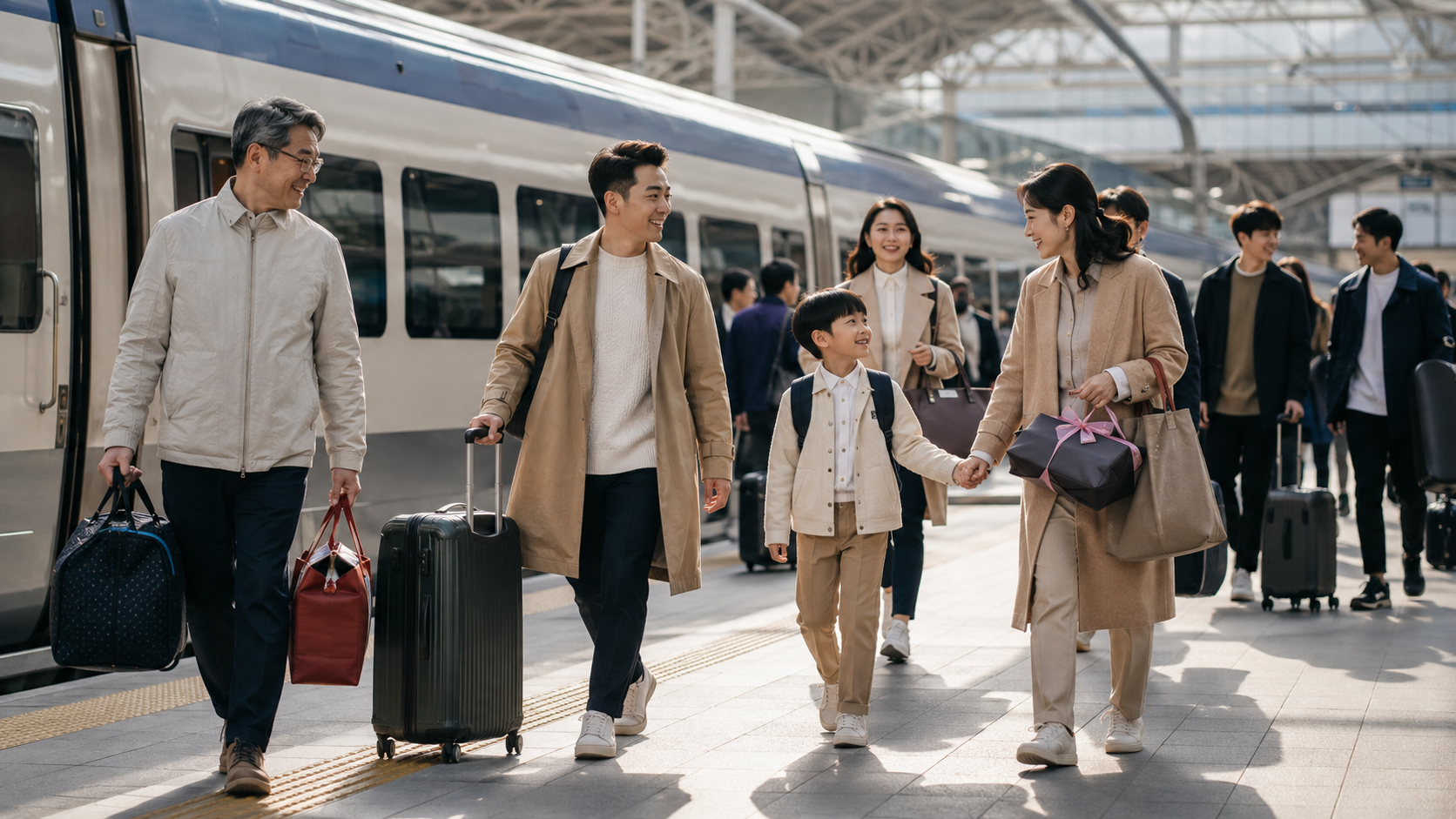
At Seoul Station, people are pulling suitcases.
Parents carry boxes of fruit and gift sets.
Young adults stare at train apps, hoping a canceled seat suddenly appears.
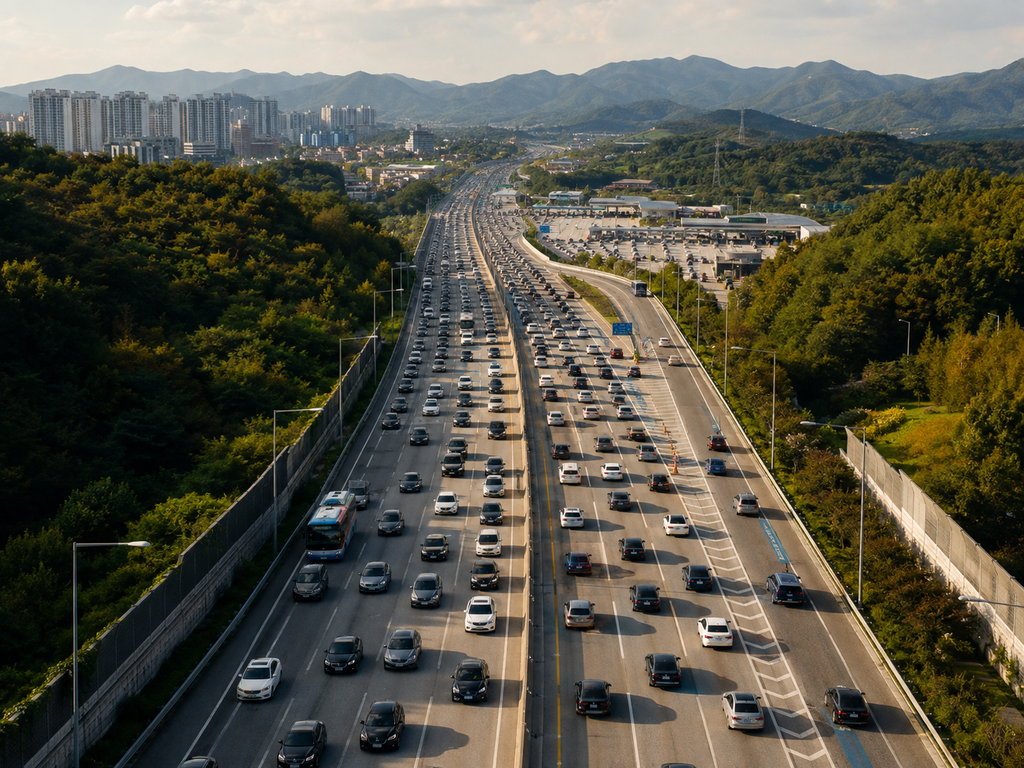
Cars begin filling expressways leading away from the capital.
At highway rest stops, families stretch their legs before continuing south.
Everyone seems to be going somewhere.
The destination may be Busan.
Daegu.
Jeonju.
Gwangju.
A small town.
A rural village.
Or simply the apartment where someone’s parents now live.
The reason is:
추석 — Chuseok
One of Korea’s most important traditional holidays.
And for generations of Koreans, Chuseok has meant more than simply having several days off work.
It means:
Going home.
In 2026, Chuseok itself falls on Friday, September 25, with the official Chuseok holidays running September 24–26. Because September 27 is Sunday, many five-day-workweek employees effectively receive a four-day break from Thursday through Sunday.
Korea Tourism Organization notes that during Chuseok and Seollal, millions of Koreans visit their hometowns to celebrate with family.
But why does an entire country seem to move at the same time?
To understand that, we need to understand not only Chuseok.
We need to understand:
family, hometown, ancestors, urbanization, and what “home” means in Korea.
First, What Is Chuseok?
Chuseok is celebrated on the 15th day of the eighth month of the Korean lunar calendar.
It is also traditionally known as:
한가위 — Hangawi
Historically, Chuseok is associated with the autumn harvest.
Families gave thanks for abundant crops, prepared food using newly harvested ingredients, honored ancestors, and gathered with relatives.
The full moon is one of the holiday’s most recognizable symbols.
Korea Tourism Organization describes Chuseok as one of Korea’s biggest traditional holidays, when family members from near and far gather to share food, stories, and gratitude toward their ancestors.
That sounds similar to many harvest festivals around the world.
But there is one Korean element that makes the holiday especially visible:
Everyone has to get there first.
Why Do Koreans “Go Home” for Chuseok?
The Korean word you will hear constantly before the holiday is:
귀성 — Gwiseong
It means traveling back to one’s hometown, especially for an important holiday.
And the destination is often described as:
고향 — Gohyang
Hometown.
But gohyang can carry more emotional weight than simply the city written on your passport.
It can mean:
the town where you grew up,
where your parents live,
where your extended family comes from,
or where your family’s roots remain.
For many Koreans, Chuseok traditionally brings those dispersed family members back together.
That is why the journey itself became part of the holiday.
Hidden Story: Modern Korea Made Families Geographically Separate
Here is the deeper reason the Chuseok migration became so enormous.
Modern Korea urbanized extremely quickly.
Over the second half of the twentieth century, millions of people moved from smaller cities and rural areas toward Seoul and other major urban centers for:
jobs,
universities,
business,
and opportunity.
Their parents or extended families often remained elsewhere.
Their children later grew up in the metropolitan area.
The result was a country where everyday life became geographically separated from family roots.
Then Chuseok arrived.
And for a few days:
those lines reversed.
People living around Seoul traveled south.
City workers returned to provincial hometowns.
Adult children returned to parents.
Grandchildren met grandparents.
The modern city emptied outward toward older family geography.
That is why the Chuseok traffic jam is not merely a transportation problem.
It is urban history happening on the highway.
The Train Ticket Can Become Part of the Holiday Drama
Weeks before Chuseok, another Korean ritual begins.
Not cooking.
Not ancestral rites.
Booking transportation.
KTX seats.
SRT seats.
Intercity buses.
Flights.
Tickets for the most desirable departure times can become extremely difficult to obtain around major holidays.
Korea Tourism Organization describes holiday travel preparations as a rush in which people compete to secure bus, train, or plane tickets before they sell out; road travel can also take dramatically longer than usual during major traditional holidays.
This leads to a very modern Chuseok experience.
Your grandparents may remember making songpyeon.
Your parents may remember endless expressway traffic.
Your generation may remember repeatedly refreshing a railway reservation app.
Different technology.
Same objective:
Get home.
Then Come the Highways
If the trains are full, millions of travelers use cars.
And because so many people have similar schedules, traffic becomes concentrated.
Before Chuseok:
cars flow away from Seoul and other major cities.
After Chuseok:
the direction reverses.
This creates two useful Korean expressions.
귀성길 — Gwiseong-gil
The journey to the hometown.
And:
귀경길 — Gwigyeong-gil
Traditionally, the journey back toward Seoul/the capital after visiting home, and more broadly the return journey after the holiday.
News broadcasts around Chuseok often discuss exactly when each wave of traffic will peak.
In 2025, Korea’s Ministry of Land, Infrastructure and Transport established an 11-day special Chuseok transportation period; during that period, approximately 32 million total passenger movements were recorded. That figure includes all travel movements during the special period rather than only people returning to hometowns, but it shows the extraordinary scale of holiday mobility.
On Chuseok day in 2025, highway traffic had been expected to reach as many as 6.67 million vehicles.
In Korea, the phrase “holiday traffic” can therefore mean something very literal.
But Why Go Through All That Trouble?
Imagine:
train tickets are difficult.
Traffic is terrible.
The journey takes twice as long.
You carry gifts.
You arrive exhausted.
Why keep doing it?
Because traditionally, Chuseok is fundamentally about:
gathering.
The meal only works if people are there.
The family conversation only happens if people arrive.
And many of the older holiday traditions are tied physically to:
family homes,
ancestral locations,
and hometowns.
So the inconvenience became part of the ritual.
There is almost a familiar sequence:
Pack → travel → complain about traffic → arrive → eat → meet relatives → travel back.
People may complain every year.
Then many of them do it again the next year.
Chuseok Is About the Living — and the People Who Came Before Them
Traditionally, family gathering has another important purpose.
Remembering ancestors.
One Chuseok custom is:
차례 — Charye
A memorial rite held for ancestors during major traditional holidays.
The National Folk Museum of Korea defines charye as an ancestral memorial service performed at holidays including Seollal and Chuseok, expressing gratitude toward one’s ancestors.
Families historically prepared a table containing foods such as:
freshly harvested rice,
fruit,
traditional alcohol,
songpyeon,
and other dishes.
After the ceremony, the family could share the food.
KTO describes this post-ritual sharing as:
음복 — Eumbok
family members eating the food that had been presented during the ancestral rite.
This means Chuseok connects three generations at once:
ancestors
the family gathered today
the children who carry the family forward
That helps explain why location historically mattered so much.
And Then There Is Seongmyo
Another Chuseok tradition is:
성묘 — Seongmyo
visiting ancestral graves.
Families may travel to burial sites to pay respects and maintain family graves.
The National Folk Museum notes that grave visits can also become occasions for extended relatives to meet and strengthen family connections.
Again, geography matters.
You cannot visit a family grave from a video call.
Historically, this connected Chuseok with actual ancestral land.
So “going home” could mean more than seeing your parents.
It could mean:
returning to where your family came from.
Food Gives Everyone a Reason to Stay
Then, naturally, there is the food.
Chuseok tables may include:
송편 — songpyeon
전 — jeon
갈비 — galbi
seasonal fruit,
namul,
fish,
and many other dishes depending on family and region.
KTO describes freshly harvested rice, alcohol, and songpyeon among foods traditionally associated with the holiday’s ancestral offerings.
But food has another function.
It keeps everyone around the same table.
Cousins who rarely meet sit together.
Grandparents ask about school.
Parents ask about work.
Someone brings fruit.
Someone cuts pears.
Children disappear into another room.
Someone inevitably eats too much.
For many families, these ordinary moments are now more important than strict ritual.
“Home” Doesn’t Always Mean Your Birthplace Anymore
Modern Korea makes this story more complicated.
Suppose you were born in Seoul.
Your parents were born in Seoul.
Your grandparents moved from Jeolla decades ago.
Where exactly is your hometown?
Or perhaps your parents sold their provincial family home and now live in Bundang.
Do you still “go home” for Chuseok if you take the subway twenty minutes to their apartment?
Traditions adapt.
Today, Chuseok family gatherings may happen in:
parents’ apartments,
restaurants,
resorts,
hotels,
or whichever location is easiest for everyone.
So the emotional idea of going home can survive even when the geography changes.
Modern Chuseok Is Changing Fast
This is important for international readers.
Do not imagine that every Korean family performs the same traditional ceremony.
They do not.
In fact, holiday customs are changing substantially.
A Korea Rural Economic Institute survey reported in 2025 found that only 40.4% of respondents planned to prepare a traditional charye table, down significantly from 74.4% in 2016. Researchers linked the shift to smaller families, simplified customs, and changing attitudes among younger generations.
Other Koreans use the holiday for:
domestic travel,
overseas vacations,
rest,
meeting friends,
or simply spending several quiet days at home.
Recent reporting has increasingly described younger Koreans combining or replacing traditional gatherings with travel and more individualized holiday experiences.
So:
“Millions travel home” is still true.
But:
“Everyone travels home” is not.
That distinction matters.
Even Charye Is Becoming Simpler
Traditional holiday food preparation could require enormous amounts of labor.
Multiple dishes.
Shopping.
Cooking.
Cleaning.
Preparing ritual tables.
For years, this burden generated debate within Korean families, particularly around the unequal amount of holiday labor historically carried by women.
That is one reason many families have simplified rituals.
Even Confucian organizations have promoted simpler versions of the Chuseok table, emphasizing that family harmony matters more than preparing an unnecessarily elaborate feast.
That is a fascinating evolution.
The tradition is no longer necessarily:
“Follow every old rule exactly.”
For many families it is becoming:
“How can we preserve the meaning without making everyone miserable?”
The Great Chuseok Paradox
Chuseok therefore contains an interesting contradiction.
It celebrates:
home
but creates enormous travel.
It celebrates:
rest
but can involve stressful preparation.
It celebrates:
family
but can also generate family tension.
It celebrates:
tradition
while traditions are rapidly changing.
And perhaps that is precisely why Chuseok is so revealing.
Culture is rarely neat.
People negotiate it every generation.
Why Seoul Can Feel Different During Chuseok
Foreign travelers sometimes expect Seoul to operate normally during the holiday.
It may not.
Some:
family-run restaurants,
neighborhood businesses,
clinics,
traditional shops,
and smaller businesses
may close or reduce hours.
At the same time, major tourist attractions can remain active. Korea Tourism Organization notes that while government offices and banks close for official public holidays, palaces, museums, department stores, and amusement facilities generally remain open, though Chuseok can cause some businesses to close for several days.
Historically, central Seoul could even feel unusually quiet as residents departed while tourist areas remained busy.
So Chuseok Seoul can feel strange:
one street is empty.
The next attraction is crowded.
Why Travelers Should Care About Chuseok Transportation
If you visit Korea during Chuseok, the holiday itself can be fascinating.
But transportation requires planning.
Long-distance trains can be difficult to reserve.
Intercity buses may be busy.
Highways may be severely congested.
Domestic travel demand can increase.
And the busiest travel periods may not align with what an international visitor expects.
So if your itinerary is:
Seoul → Busan → Gyeongju → Seoul
during Chuseok weekend, do not assume you can book everything at the last minute.
Holiday transport is not ordinary Korea.
It is Korea moving simultaneously.
Naru’s Travel Tips
If you visit Korea during Chuseok, first check your long-distance transportation plans early. For 2026, the official Chuseok holidays are September 24–26, with Chuseok itself on September 25, and the following Sunday effectively extends the break for many people.
Second, confirm individual restaurant and shop opening hours instead of assuming everything is closed—or everything is open.
Third, consider staying in Seoul during the heaviest outbound travel period rather than fighting holiday traffic unnecessarily. Palaces, museums, and cultural programs can make Chuseok an interesting time to experience Korean traditions.
And finally, if a Korean friend says:
“이번 추석에 고향 내려가요.”
you now understand that this can represent far more than a weekend journey.
It can mean returning to family roots.
Did You Know?
Koreans Have Different Words for the Two Directions of the Chuseok Journey
귀성 — gwiseong
Going back to one’s hometown.
귀성길 — gwiseong-gil
The journey home for the holiday.
Then:
귀경 — gwigyeong
Traditionally, returning toward the capital after visiting one’s hometown.
귀경길 — gwigyeong-gil
The return journey after the holiday.
Around Chuseok, weather reports and traffic news regularly use these expressions.
The national holiday migration is so established that the journey itself has its own vocabulary.
Learn 5 Korean Words
| English | Korean | Pronunciation | Chinese | Spanish |
|---|---|---|---|---|
| Chuseok | 추석 | chu-seok | 秋夕 / 中秋节 | Chuseok |
| Hometown | 고향 | go-hyang | 故乡 | Pueblo natal |
| Homecoming for holiday | 귀성 | gwi-seong | 返乡 | Regreso al pueblo natal |
| Ancestral rite | 차례 | cha-rye | 祭祖仪式 | Rito ancestral |
| Grave visit | 성묘 | seong-myo | 扫墓 | Visita a tumbas ancestrales |
Bonus Word
귀성길 — Gwiseong-gil
Literally:
“the road home.”
More specifically, it refers to the journey back to one’s hometown for holidays such as Chuseok or Seollal.
For many Koreans, just hearing gwiseong-gil can evoke:
traffic,
packed trains,
gift boxes,
and finally arriving at the family home.
Korean Phrase of the Day
이번 추석에는 고향에 내려가요.
Pronunciation: I-beon Chu-seo-ge-neun go-hyang-e nae-ryeo-ga-yo.
English: I’m going back to my hometown this Chuseok.
Chinese: 这个中秋假期我要回老家。
Spanish: Este Chuseok voy a volver a mi pueblo natal.
Another useful phrase:
기차표 예매했어요?
Gi-cha-pyo ye-mae-hae-sseo-yo?
“Did you book your train ticket?”
A very practical Chuseok question.
Today’s Question
Does your country have a holiday when almost everyone tries to return home at the same time?
Thanksgiving?
Lunar New Year?
Christmas?
Eid?
Diwali?
Or another family holiday?
And what happens to transportation when everyone starts moving?
Tell us in the comments.
Naru’s Quote
“During Chuseok, Korea does not simply take a holiday. For a few days, millions of people trace the invisible lines connecting where they live now to where their families came from.” — Naru
SEO FAQ
Why do Koreans travel home for Chuseok?
Chuseok is traditionally a family holiday. Many Koreans travel to their hometowns or parents’ homes to gather with relatives, share food, honor ancestors, and spend time together. Korea Tourism Organization states that millions visit their hometowns during Korea’s major traditional holidays.
When is Chuseok in 2026?
Chuseok falls on September 25, 2026. The official holiday period is September 24–26. For many workers, Sunday September 27 creates a four-day break.
What does “gwiseong” mean?
귀성 (gwiseong) means returning to one’s hometown, particularly for an important holiday such as Chuseok or Seollal.
Why is Chuseok traffic so bad?
Large numbers of people travel during a highly concentrated period, often using similar highway routes from major urban areas toward provincial regions. In 2025, 32 million total passenger movements were recorded during the government’s extended Chuseok special transportation period.
What is charye?
차례 (charye) is a traditional ancestral memorial ceremony performed during holidays such as Chuseok and Seollal.
What is seongmyo?
성묘 (seongmyo) means visiting ancestral graves to pay respects. It has traditionally been part of Chuseok for many families.
Does every Korean perform ancestral rites at Chuseok?
No. The practice has declined significantly. A 2025 survey found 40.4% of respondents planned to prepare a charye table, reflecting the continuing simplification of holiday traditions.
Is Korea closed during Chuseok?
Government offices and banks close, and some businesses may close for several days. However, many major palaces, museums, department stores, amusement facilities, and tourist attractions remain open or hold special programs. Always check specific opening hours.
Part 3 — The Traffic Jam Tells a Bigger Story
A traffic jam does not usually sound like culture.
It sounds like:
cars,
horns,
delays,
and frustration.
But the Chuseok traffic jam is different.
Look closely at all those cars leaving Seoul.
Inside one is a daughter who works in the city but grew up in Daegu.
Another carries grandchildren to meet grandparents in Jeolla.
Another family has boxes of pears in the trunk.
Someone else is returning to a village where almost nobody from their generation lives anymore.
Modern Korea pulled people toward cities.
Chuseok traditionally pulled them back.
That is why the highway tells a story.
It maps the distance between:
career and family
city and hometown
present and ancestry
modern Korea and older Korea.
Of course, the pattern is changing.
Some families no longer perform charye.
Some meet at restaurants.
Some parents now live near their children.
Some young Koreans travel abroad.
Some simply sleep through the holiday.
That does not mean Chuseok has disappeared.
It means the meaning of home is changing.
Perhaps that is the most interesting part.
For previous generations:
home may have been an ancestral village.
For their children:
home might be their parents’ apartment.
For the next generation:
perhaps home is simply wherever the family chooses to meet.
But every September, one question still appears:
“이번 추석엔 어디 가?”
“Where are you going this Chuseok?”
And behind that ordinary question is a much bigger one:
“Where is home?”
🇰🇷 한국어
왜 수백만 명의 한국인은 추석에 고향으로 갈까?
추석이 가까워지면 한국에서는 거대한 이동이 시작됩니다.
서울역과 고속버스터미널에는 짐과 선물세트를 든 사람들이 모이고, 고속도로에는 고향으로 향하는 자동차가 늘어납니다.
이것을:
귀성
이라고 합니다.
2026년 추석 당일은 9월 25일 금요일이며 공식 추석 연휴는 9월 24일부터 26일까지입니다. 27일이 일요일이기 때문에 주 5일 근무자 기준으로는 목요일부터 일요일까지 4일간 쉬게 되는 경우가 많습니다.
왜 이렇게 많은 사람이 한꺼번에 이동할까요?
가장 큰 이유는 추석이 오랫동안 가족이 함께 모이는 명절이었기 때문입니다.
한국은 산업화와 도시화 과정에서 많은 사람들이 일자리와 교육을 위해 서울과 대도시로 이동했습니다.
하지만 부모와 친척, 가족의 뿌리는 다른 지역에 남아 있는 경우가 많았습니다.
그래서 추석이 되면 평소 도시로 향하던 이동이 잠시 반대 방향으로 움직입니다.
서울에서 부산으로.
수도권에서 전라도로.
도시에서 농촌으로.
자녀가 부모에게로.
이것이 한국의 추석 귀성문화가 거대한 교통현상이 된 중요한 이유입니다.
전통적으로 가족들은 추석에 모여 차례를 지내고 성묘를 하기도 했습니다.
차례는 조상에게 감사와 예를 표현하는 명절 의례이며, 성묘는 가족의 묘를 찾아가는 것입니다.
하지만 오늘날의 추석은 빠르게 변하고 있습니다.
모든 가정이 차례를 지내는 것도 아니고, 일부 가족은 명절 음식을 간소화합니다.
2025년 조사에서는 차례상을 준비하겠다는 응답자가 40.4%로 나타나 과거보다 크게 감소했습니다.
어떤 사람들은 추석에 여행을 갑니다.
어떤 가족은 식당에서 만납니다.
어떤 사람은 서울에 남습니다.
그래도 추석이 되면 여전히 수많은 사람이 가족을 만나기 위해 이동합니다.
그래서 한국의 추석 교통체증은 단순한 교통 문제가 아닙니다.
어쩌면 그것은:
현재 사는 곳과 가족이 있는 곳을 연결하는 지도
라고 볼 수도 있습니다.
수많은 자동차와 기차가 움직이는 모습을 따라가 보면 한국인의 가족과 고향에 대한 생각도 함께 보이기 때문입니다.

为什么数百万韩国人在秋夕回老家?
每当韩国的秋夕临近,全国就会开始一次巨大的移动。
火车站挤满旅客。
高速公路出现长时间堵车。
人们带着水果、礼盒和行李前往父母和亲戚居住的地方。
这种返乡叫:
귀성 — Gwiseong
2026年的秋夕是9月25日星期五,法定秋夕假期为9月24日至26日。由于27日是星期日,许多实行五天工作制的人实际上可以连续休息四天。
为什么韩国人在这几天集中回家?
其中一个重要原因与韩国快速的城市化有关。
过去几十年里,大量人口为了工作和教育从地方迁往首尔和其他大城市。
但是父母、亲戚以及家族的传统故乡往往仍然在其他地区。
所以到了秋夕,日常的人口流动突然反过来。
城市里的子女回到父母身边。
孙辈去见祖父母。
大家重新聚在一张桌子旁。
传统上,一些家庭还会举行:
차례(Charye)— 祭祖仪式
以及:
성묘(Seongmyo)— 扫墓
来纪念祖先。
不过,现代韩国的秋夕文化正在快速变化。
越来越多的家庭简化祭祖仪式,有些人利用假期旅游,也有人选择在城市休息。
2025年的调查显示,准备传统秋夕祭桌的人只有40.4%,明显低于过去。
因此,并不是所有韩国人都会在秋夕回老家。
但是仍然有数百万人这样做。
所以韩国秋夕的高速公路堵车不仅仅是交通问题。
它也显示了一件更深的事情:
韩国人现在生活的地方,与他们家族来源的地方,往往并不相同。
🇪🇸 Español
¿Por qué millones de coreanos vuelven a casa durante Chuseok?
Cuando se acerca Chuseok, Corea comienza a moverse.
Las estaciones de tren se llenan.
Las autopistas se congestionan.
Las familias cargan maletas, cajas de fruta y regalos en sus automóviles.
Muchos regresan a la ciudad o pueblo donde viven sus padres y familiares.
Este viaje se llama:
귀성 — gwiseong
En 2026, Chuseok cae el viernes 25 de septiembre, y los días festivos oficiales son del 24 al 26. Como el 27 es domingo, muchas personas con una semana laboral de cinco días disfrutarán en la práctica de cuatro días consecutivos de descanso.
¿Por qué ocurre una migración tan grande?
Una razón importante está relacionada con la rápida urbanización de Corea.
Durante décadas, muchas personas se trasladaron desde regiones más pequeñas hacia Seúl y otras grandes ciudades para estudiar y trabajar.
Sin embargo, sus padres y familiares permanecieron en otras regiones.
Así, durante Chuseok, ese movimiento se invierte.
Los hijos vuelven con sus padres.
Los nietos visitan a los abuelos.
Las familias vuelven a reunirse alrededor de una mesa.
Tradicionalmente, algunas familias también celebran charye, una ceremonia en honor de los antepasados, y practican seongmyo, la visita a las tumbas familiares.
Sin embargo, Chuseok está cambiando.
Muchas familias simplifican las ceremonias.
Otras viajan de vacaciones.
Algunas se reúnen en restaurantes.
Y muchas personas jóvenes pasan el descanso de nuevas maneras.
Una encuesta de 2025 mostró que solo el 40,4 % de los encuestados tenía previsto preparar una mesa tradicional de charye.
Por eso, no todos los coreanos regresan a su pueblo durante Chuseok.
Pero millones todavía lo hacen.
Y quizá los famosos atascos de Chuseok cuentan algo mucho más profundo que una simple historia de tráfico.
Muestran las líneas invisibles que conectan:
dónde viven los coreanos hoy
con
el lugar al que todavía llaman hogar.