
Korea Celebrates a Full Moon With a Half-Moon Rice Cake
Every Chuseok, something interesting appears on Korean tables.
Outside, people look up at the bright full harvest moon.
But on the table, they eat rice cakes shaped like:
half-moons.
They are called:
송편 — Songpyeon
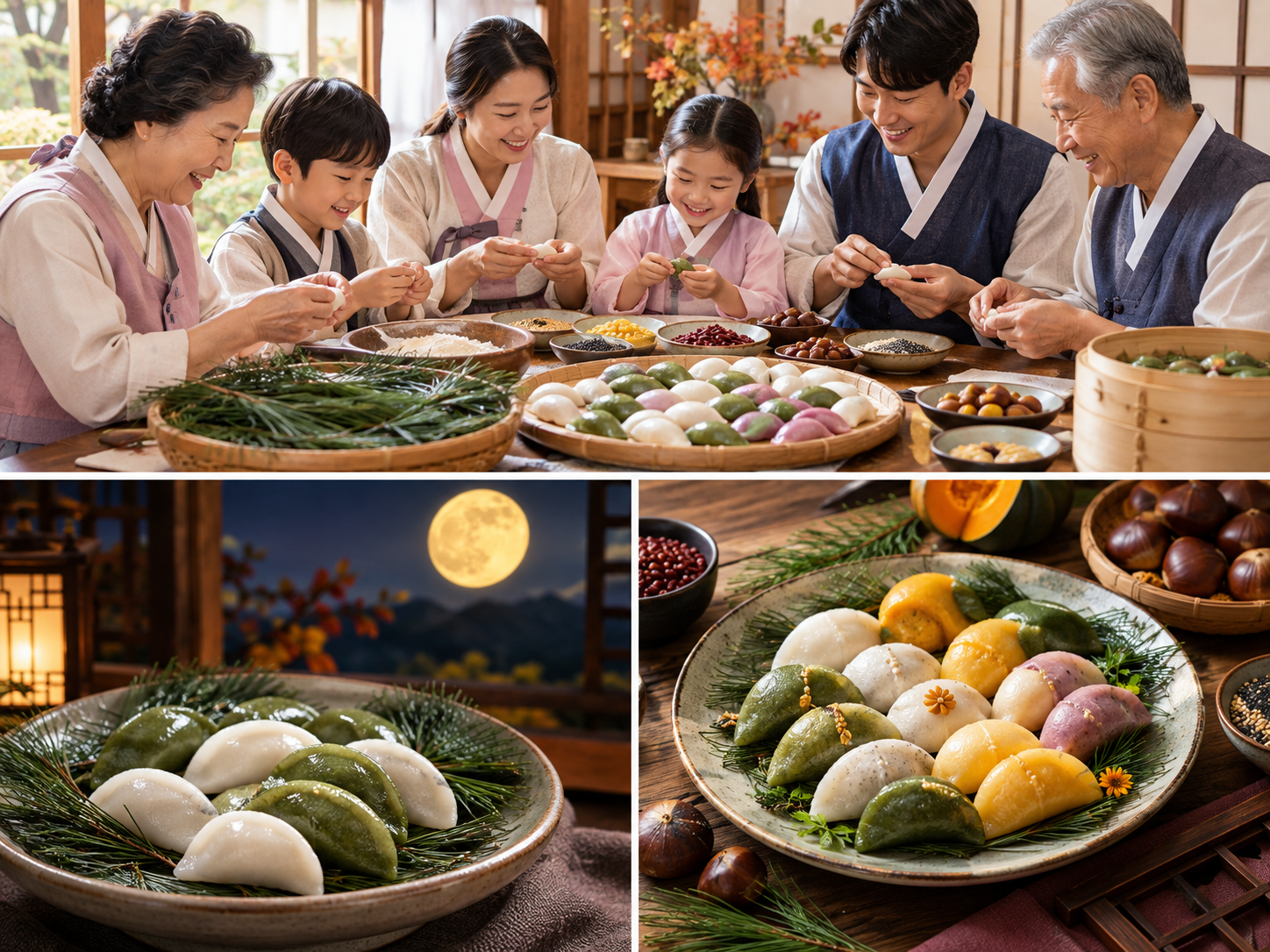
Small, chewy rice cakes filled with ingredients such as sesame seeds, beans, red beans, or chestnuts and traditionally steamed over pine needles.
Songpyeon is so closely associated with Chuseok that for many Koreans, seeing a plate of colorful half-moon rice cakes immediately signals the arrival of the holiday.
Korea Tourism Organization describes songpyeon as one of the most representative foods of Chuseok, traditionally made with rice flour, filled with seasonal ingredients, and steamed over pine needles that give the rice cakes their characteristic fragrance.
But that creates an obvious question.
Chuseok occurs under a full moon.
So:
Why is Korea’s most famous Chuseok food shaped like only half of one?
The answer leads into harvest, family, pine trees, regional food traditions—and even an ancient Korean legend about the rise and fall of kingdoms.
First, What Exactly Is Songpyeon?
Songpyeon is a type of:
떡 — Tteok
Korean rice cake.
The dough is generally made from non-glutinous rice flour mixed with hot water.
A small piece of dough is shaped into a cup.
A filling is placed inside.
The dough is closed.
Then it is shaped into the familiar half-moon form.
Common fillings include:
- sesame seeds
- beans
- red beans
- chestnuts
Modern versions may use many other ingredients as well.
During steaming, pine needles are traditionally placed underneath and between the rice cakes. Korea Tourism Organization explains that the “song” in songpyeon refers to pine, and the needles give the finished rice cake its distinctive scent.
So even the name tells us something about how the food is made.
Why Pine Needles?
If you have never seen songpyeon being prepared, this can be surprising.
Why place rice cakes on pine needles?
The first reason is sensory.
Steam passes through the pine needles and gives songpyeon its subtle forest-like aroma.
The needles also physically separate the rice cakes while they steam.
Traditional songpyeon therefore is not simply:
rice cake + filling.
It also carries the smell of pine.
That detail is important because traditional Korean food often reflects not only taste but season, fragrance, texture, and presentation.
Chuseok takes place at the beginning of autumn.
Fresh rice.
Chestnuts.
Beans.
Pine aroma.
The ingredients themselves tell you what season it is.
Songpyeon Is a Harvest Food
To understand why songpyeon belongs to Chuseok, we also need to understand Chuseok itself.
Chuseok is celebrated on the 15th day of the eighth month of the lunar calendar and is one of Korea’s most important traditional holidays.
It is associated with the autumn harvest, family reunions, gratitude, ancestral remembrance, and seasonal food.
In 2026, the official Chuseok holiday runs from September 24 to 26, with Chuseok day on September 25.
Traditionally, songpyeon could be made using newly harvested rice.
The National Folk Museum of Korea documents songpyeon made from the new crop of rice as part of Chuseok ancestral offerings, while Korea.net describes Chuseok songpyeon as an expression of gratitude for an abundant harvest.
This is the deeper connection.
Songpyeon is not merely a dessert served during a holiday.
It turns the year’s harvest into something the family can make, offer, and eat together.
But Why Is Songpyeon Shaped Like a Half Moon?
Now we reach the most interesting part.
There is an old Korean legend connected with the Three Kingdoms period.
According to a story associated with the final years of the Baekje kingdom, a mysterious prophecy said:
Baekje was a full moon, while Silla was a half moon.
The interpretation was symbolic.
A full moon had already reached its maximum size and would soon begin to shrink.
A half moon, however, still had room to grow.
Baekje would decline.
Silla would rise.
Korea’s Ministry of Culture, Sports and Tourism presents this as one traditional explanation for the crescent shape of songpyeon, with the half moon coming to symbolize growth and the possibility of better things ahead.
It is best understood as a cultural legend rather than a proven single origin story for songpyeon’s shape.
But its symbolism is beautiful.
The full moon is complete.
The half moon still has a future.
A Half Moon Can Represent Hope
This makes Korean Chuseok symbolism especially interesting.
People celebrate beneath a full moon.
Yet they eat a half moon.
Why?
Because completeness is not always the only positive symbol.
A half moon can suggest:
growth,
development,
potential,
and something still becoming complete.
Korea.net similarly explains songpyeon’s crescent form as a symbol associated with growth and hopes for a better future.
So the little rice cake can carry an optimistic message:
Today may not be complete.
But tomorrow can become fuller.
That idea gives songpyeon a meaning far beyond its ingredients.
Hidden Story: Songpyeon Starts as a Full Moon
There is another lovely visual detail.
Before the filling is enclosed, the rice dough is often opened into a roughly round form.
Place the filling inside.
Fold it.
Seal it.
And the shape becomes a half moon.
The Hansik archive points out this transformation: the dough begins round and becomes crescent-shaped once filled and folded.
So in a single piece of rice cake you can almost see:
full moon → half moon
or perhaps:
present → future
It is a small piece of food with an unusually large amount of symbolism.
Families Traditionally Made Songpyeon Together
Songpyeon is also important because of how it was made.
Traditionally, Chuseok preparation was family work.
Rice flour had to be prepared.
Fillings had to be made.
The dough had to be shaped.
Each piece had to be sealed.
Pine needles had to be arranged.
And dozens—or many more—might be needed for a large family gathering.
Korea Tourism Organization describes it as an old Chuseok tradition for the whole family to make songpyeon together on the eve of the holiday.
Imagine everyone sitting together.
One person makes perfect crescents.
Another makes enormous ones.
A child puts in too much sesame filling.
Someone’s songpyeon breaks.
Someone insists theirs is the prettiest.
The kitchen becomes part production line, part family entertainment.
The finished rice cakes contain not only filling.
They contain evidence that people made something together.
The Famous “Pretty Songpyeon” Belief
And naturally, Koreans developed a story around who made the most beautiful one.
A well-known traditional saying holds that someone who shapes beautiful songpyeon will have:
a beautiful child.
Korea Tourism Organization and Korea.net both document this folk belief.
Of course, nobody needs to treat this as a serious prediction.
It is better understood as part of holiday folklore.
But it adds another layer of fun to the family activity.
Suddenly everyone has a reason to carefully shape the edges.
Your future child’s appearance is apparently at stake.
No pressure.
Songpyeon Is Not the Same Everywhere in Korea
Another mistake would be to imagine that there is one universal songpyeon.
Regional Korean food culture created different versions.
Korea’s Ministry of Culture, Sports and Tourism highlights several examples:
Seoul: colorful osaek songpyeon, or five-colored songpyeon.
Chungcheong region: pumpkin may be incorporated into hobak songpyeon.
Gangwon region: locally grown potatoes appear in gamja songpyeon, producing a different chewy texture.
Gyeongsang region: regional variations include larger chik songpyeon, associated with arrowroot.
This is a useful reminder for international readers:
“Korean food” is not one single flavor.
Geography matters.
Local crops matter.
Climate matters.
What grows easily in one province may become part of that region’s version of a national holiday food.
The Fillings Tell Their Own Story
Even within a single family, people can disagree about the best filling.
One person wants:
깨 — Kkae
Sesame.
Another prefers:
밤 — Bam
Chestnut.
Someone else likes beans.
The basic structure remains the same, but every bite can be different.
This is part of the pleasure of eating a mixed plate of songpyeon.
From the outside, two rice cakes may look similar.
Inside?
Completely different.
It is almost the Korean holiday version of a small edible surprise.
Songpyeon Also Belongs on the Charye Table
For families that observe traditional ancestral rites, songpyeon has another role.
During:
차례 — Charye
foods are offered to ancestors during major holidays.
The National Folk Museum of Korea specifically identifies songpyeon as the seasonal rice cake associated with Chuseok charye, just as tteokguk is associated with Seollal.
KTO also notes that freshly harvested rice, alcohol, and songpyeon have traditionally been prepared as Chuseok offerings before the family shares food afterward.
So songpyeon connects:
the harvest,
the living family,
and previous generations.
That is why describing it simply as “Korean dessert” misses much of the story.
Chuseok Food Is Really About Time
Think about what songpyeon connects.
The rice comes from:
this year’s harvest.
The recipe comes from:
previous generations.
The family making it exists:
today.
The half-moon symbolism points toward:
the future.
Past.
Present.
Future.
All inside one tiny rice cake.
Perhaps that is why traditional holiday foods survive.
People are not only eating ingredients.
They are eating a calendar.
But Do Korean Families Still Make Songpyeon at Home?
Some do.
But today, you certainly do not need to spend hours grinding rice and shaping dough to eat songpyeon.
Before Chuseok, songpyeon appears throughout Korea in:
traditional tteok shops,
markets,
department stores,
supermarkets,
and specialty dessert shops.
Modern versions may be more colorful, more decorative, smaller, premium, individually packaged, or reinterpret traditional fillings.
This gives modern families options.
Make everything together.
Buy everything.
Or do some of both.
The tradition can survive even when the labor changes.
And that matters.
Sometimes keeping a food alive requires allowing the way people access it to evolve.
Business Insight: Traditional Food Can Become a Seasonal Product Platform
From a food-business perspective, songpyeon is fascinating.
The core product is extremely old.
Yet it naturally supports:
seasonal demand
premium gifting
regional flavors
modern colors
new fillings
beautiful packaging
and
limited availability
That makes songpyeon almost perfectly suited to modern seasonal retail.
A traditional rice-cake shop can sell the classic version.
A premium department-store brand can elevate presentation.
A modern café can reinterpret the flavor.
A hotel can include it in a Chuseok set.
A tourist can buy it as a cultural experience.
The cultural meaning stays recognizable while the commercial expression keeps changing.
Tradition Survives Through Reinvention
This pattern appears repeatedly in Korea.
Hanbok becomes contemporary fashion.
Hanok becomes boutique accommodation.
Yakgwa becomes café dessert.
Traditional markets host pop-ups.
And songpyeon moves from the family kitchen into modern retail while still remaining unmistakably associated with Chuseok.
That does not necessarily weaken the tradition.
It can sometimes help more people participate in it.
The interesting question becomes:
What must stay the same for something to remain traditional?
The shape?
The rice?
The pine scent?
The family memory?
Perhaps tradition is not one ingredient.
Perhaps it is the relationship among all of them.
Did You Know?
“Song” in Songpyeon Refers to Pine
The distinctive feature of traditional songpyeon is that it is steamed over:
솔잎 — Sollip
Pine needles.
KTO explains that the rice cakes get both their name and characteristic aroma from this preparation method.
So when you eat traditional songpyeon, smell it before taking the first bite.
That subtle pine aroma is not accidental.
It is part of the identity of the food.
Naru’s Travel Tips
If you are traveling in Korea before Chuseok, visit a traditional:
떡집 — Tteokjip
Rice-cake shop.
This is one of the easiest ways to see seasonal Korean food culture in real life.
Try more than one filling if possible.
Sesame and chestnut can taste very different.
If you see colorful songpyeon, do not assume every color is artificial decoration; traditional and modern recipes may use various plant-based ingredients to create different colors and flavors.
And if someone gives you homemade songpyeon?
Try it.
Even if the shape looks a little strange.
Especially if the shape looks a little strange.
Someone probably made that one by hand.
Learn 5 Korean Words
| English | Korean | Pronunciation | Chinese | Spanish |
|---|---|---|---|---|
| Songpyeon | 송편 | song-pyeon | 松饼 / 韩式半月年糕 | Songpyeon |
| Rice cake | 떡 | tteok | 年糕 | Pastel de arroz |
| Chuseok | 추석 | chu-seok | 秋夕 / 中秋节 | Chuseok |
| Pine needle | 솔잎 | sol-lip | 松针 | Aguja de pino |
| Harvest | 수확 | su-hwak | 收获 | Cosecha |
Bonus Word
빚다 — Bit-da
This verb means to shape or make something by hand, and it is commonly used when talking about making dumplings or rice cakes.
So Koreans often say:
송편을 빚다
Songpyeoneul bitda
“to make/shape songpyeon.”
Korean Phrase of the Day
송편 드셔 보세요.
Pronunciation: Song-pyeon deu-syeo bo-se-yo.
English: Please try some songpyeon.
Chinese: 请尝尝松饼。
Spanish: Pruebe un poco de songpyeon.
And if you want to ask what is inside:
안에 뭐가 들어 있어요?
An-e mwo-ga deu-reo i-sseo-yo?
What’s inside?
A very useful question when facing a mixed plate of songpyeon.
Today’s Question
What food in your culture tells you immediately that a major holiday has arrived?
Pumpkin pie?
Mooncake?
Panettone?
Tamales?
Christmas cookies?
Or something your family makes only once a year?
Tell us in the comments.
Naru’s Quote
“Songpyeon may look like only half a moon, but its meaning is full of harvest, family, memory, and hope for what comes next.” — Naru
SEO FAQ
What is songpyeon?
Songpyeon (송편) is a Korean rice cake strongly associated with Chuseok. It is usually made from rice flour, filled with ingredients such as sesame seeds, beans, red beans, or chestnuts, shaped like a half moon, and traditionally steamed over pine needles.
Why do Koreans eat songpyeon during Chuseok?
Chuseok is a harvest holiday, and songpyeon has traditionally been prepared using rice from the new harvest. It is eaten by families and has also been used as a seasonal food in ancestral rites.
Why is songpyeon shaped like a half moon?
One traditional legend connects the shape to an ancient prophecy comparing Baekje to a full moon destined to decline and Silla to a half moon with room to grow. The crescent therefore came to symbolize development and hope for the future. This should be understood as cultural folklore rather than a definitively proven origin.
Why is songpyeon steamed with pine needles?
Pine needles give traditional songpyeon its characteristic fragrance and are used during steaming. The Korean word song (송) in songpyeon refers to pine.
What is inside songpyeon?
Common fillings include sesame seeds, beans, red beans, and chestnuts. Recipes vary by family and region.
Are all songpyeon the same?
No. Korea has regional variations using local ingredients, including potato-based songpyeon in Gangwon and pumpkin varieties in Chungcheong, among others.
Do Koreans still make songpyeon together?
The tradition of families shaping songpyeon together remains culturally familiar, although today people can also easily buy professionally made songpyeon from rice-cake shops and retailers. KTO describes family songpyeon-making on the eve of Chuseok as a longstanding holiday custom.
When is Chuseok in 2026?
The official Chuseok holiday in 2026 is September 24–26, with the main Chuseok day falling on September 25.
Part 3 — Why Korea Celebrates a Full Moon With a Half Moon
This is the question I like most about songpyeon.
Chuseok is a full-moon festival.
So why isn’t Korea’s iconic rice cake round?
Maybe the answer tells us something larger.
A full moon represents:
completion.
There is nowhere else to grow.
A half moon, however, is incomplete.
And that can sound negative.
Unless you look at it differently.
The empty half is:
possibility.
Tomorrow can be fuller than today.
That is why the old Silla-Baekje legend attached such powerful symbolism to the crescent.
And songpyeon itself follows the same logic.
It begins with harvested rice—something produced by months of work.
Families shape it using knowledge passed from earlier generations.
They eat it together today.
And the half-moon shape looks toward the future.
Harvest → gratitude → family → hope.
That is an extraordinary amount of meaning to place inside something small enough to hold between two fingers.
Perhaps that is what traditional foods do best.
They make big cultural ideas edible.
So when you visit Korea during Chuseok and see a plate of green, white, pink, or yellow half-moon rice cakes, don’t just ask:
“What does this taste like?”
Ask:
“Why is it shaped this way?”
Because sometimes the shape of a Korean rice cake can tell you a story stretching back hundreds of years.
🇰🇷 한국어
한국인은 왜 추석에 송편을 먹을까?
추석이 되면 한국 식탁에서 빠지지 않는 대표적인 음식이 있습니다.
바로:
송편
입니다.
송편은 쌀가루로 만든 반죽 안에 깨, 콩, 팥, 밤 등의 소를 넣고 반달 모양으로 빚어 솔잎을 깔고 찌는 전통 떡입니다. 솔잎 위에서 찌기 때문에 특유의 향이 나며, 한국관광공사 역시 송편을 대표적인 추석 음식으로 소개합니다.
송편이 추석과 연결된 가장 중요한 이유 중 하나는 수확입니다.
과거에는 새로 수확한 쌀로 송편을 만들어 조상에게 올리고 가족이 함께 나누어 먹었습니다. 국립민속박물관 자료에서도 햅쌀로 만든 송편이 추석 차례 음식으로 등장합니다.
그런데 재미있는 질문이 있습니다.
추석은 보름달을 보는 명절인데:
왜 송편은 반달 모양일까요?
이에 대해서는 신라와 백제에 관한 오래된 설화가 전해집니다.
백제는 이미 가득 찬 보름달이고 신라는 앞으로 차오를 반달이라는 예언이 있었으며, 이후 반달이 성장과 발전, 더 나은 미래를 상징하게 되었다는 이야기입니다. 문화체육관광부 역시 송편의 반달 모양과 관련된 대표적인 전통 설화로 이를 소개하고 있습니다.
물론 이를 송편 모양의 역사적으로 확정된 단 하나의 기원이라고 볼 수는 없습니다.
하지만 상징은 매우 흥미롭습니다.
보름달은 이미 완성됐지만, 반달은 앞으로 더 차오를 수 있기 때문입니다.
또 과거에는 추석 전날 가족이 함께 모여 송편을 빚는 것이 중요한 명절 풍경이었습니다.
“송편을 예쁘게 빚으면 예쁜 아이를 낳는다”는 옛 이야기도 전해집니다.
오늘날에는 떡집이나 백화점, 시장 등에서 다양한 송편을 쉽게 살 수 있지만 송편을 보면 여전히 많은 한국인이 추석을 떠올립니다.
그래서 송편은 단순한 떡이 아닙니다.
그 안에는:
수확
가족
조상
계절
그리고
앞으로 더 좋아질 것이라는 희망
이 함께 들어 있습니다.
为什么韩国人在秋夕吃Songpyeon?
韩国秋夕最具代表性的食物之一就是:
송편 — Songpyeon
它是一种韩式米糕。
米粉面团中通常包入芝麻、豆类、红豆或栗子,然后做成半月形,并放在松针上蒸熟。
松针会为米糕带来独特的香气。“Songpyeon”中的 **song(송)**也与松树有关。
Songpyeon与秋夕密切相关的一个重要原因是:
收获。
过去,人们会使用新收获的大米制作Songpyeon,并在秋夕祭祖时献上这些季节食品,然后由家人一起分享。
不过,最有趣的问题是:
秋夕是赏满月的节日。
为什么Songpyeon却是半月形?
韩国流传着一个古老传说。
故事把百济比作已经圆满、即将开始亏缺的满月,把新罗比作未来仍会继续变大的半月。
因此,半月逐渐被赋予:
成长、发展和未来希望
的象征意义。
这个故事更适合作为文化传说理解,而不是唯一被历史证明的起源。
但它让Songpyeon的形状变得非常有意思。
满月已经完成。
半月还有成长的空间。
所以一块小小的Songpyeon里,可能同时装着韩国人对于:
收获、家庭、祖先和未来
的想象。
🇪🇸 Español
¿Por qué los coreanos comen songpyeon durante Chuseok?
Uno de los alimentos más representativos de Chuseok es:
송편 — Songpyeon
Es un pequeño pastel coreano de arroz que suele rellenarse con ingredientes como sésamo, frijoles, judías rojas o castañas.
Tradicionalmente, se cocina al vapor sobre agujas de pino, que le aportan un aroma característico. De hecho, song (송) está relacionado con el pino.
Songpyeon está estrechamente relacionado con Chuseok porque esta festividad celebra la cosecha.
Tradicionalmente, las familias podían preparar estos pasteles con arroz de la nueva cosecha, ofrecerlos durante ceremonias ancestrales y después compartirlos.
Sin embargo, existe una pregunta especialmente interesante.
Chuseok se celebra bajo una:
luna llena.
Entonces, ¿por qué el songpyeon tiene forma de:
media luna?
Una antigua leyenda coreana relaciona la forma con los reinos de Baekje y Silla.
Baekje fue comparado con una luna llena que ya había alcanzado su máximo y comenzaría a disminuir.
Silla fue comparada con una media luna que todavía tenía espacio para crecer.
Por eso, la media luna llegó a representar simbólicamente:
crecimiento y esperanza para el futuro.
Es una leyenda cultural y no debe entenderse como un origen histórico definitivamente demostrado.
Pero contiene una idea hermosa.
Una luna llena está completa.
Una media luna todavía puede crecer.
Y quizá por eso este pequeño pastel de arroz representa mucho más que comida.
También representa:
familia, cosecha, gratitud y esperanza.