
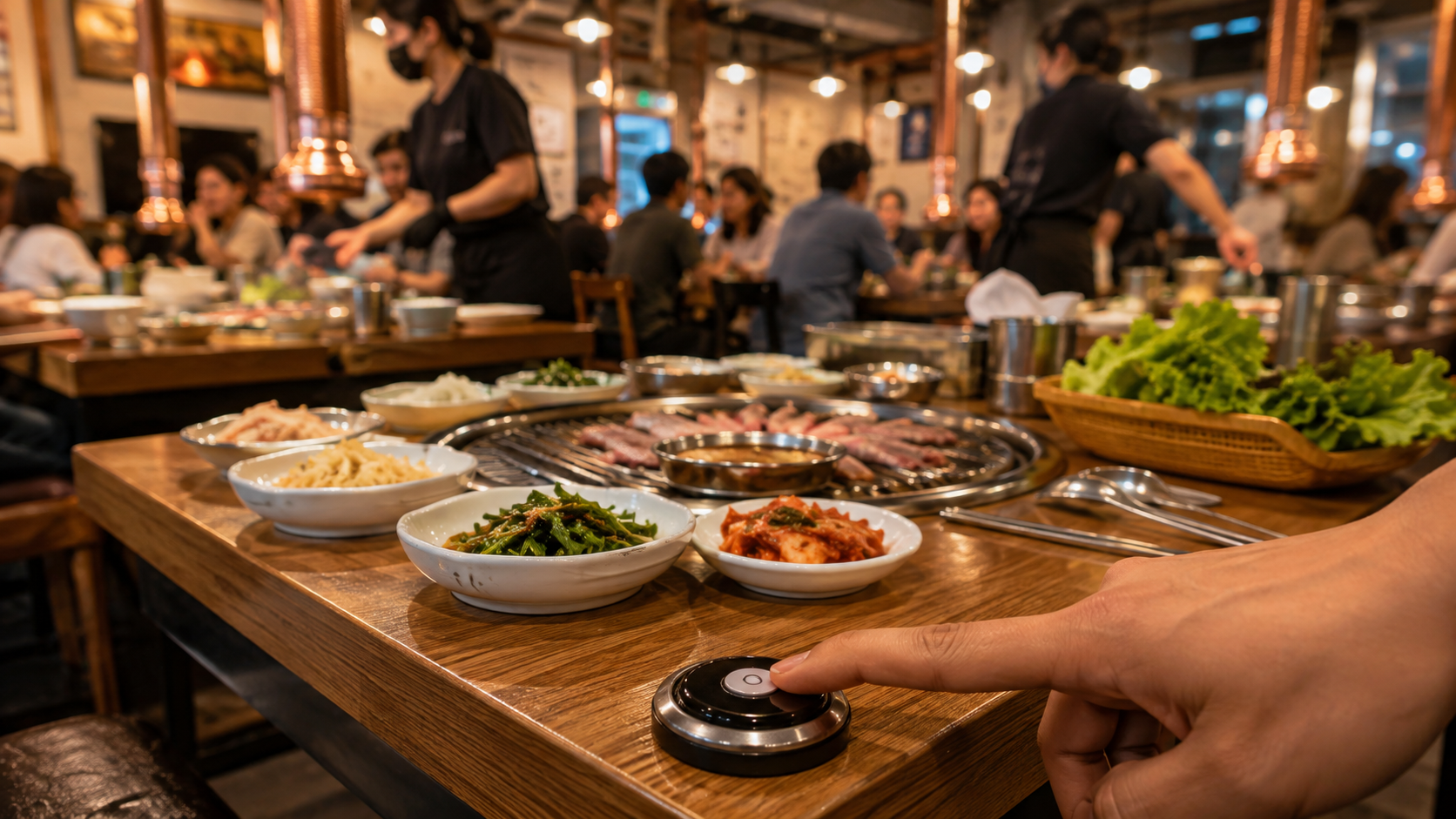

There Is a Button on Your Table in Korea. Yes, You Are Supposed to Press It.
You walk into a Korean barbecue restaurant.
Sit down.
Open the menu.
The restaurant is busy.
Servers are carrying trays of meat, changing grill plates, delivering side dishes, and running between tables.
You are ready to order.
But nobody comes.
Five minutes pass.
Should you wave?
Make eye contact?
Raise your hand?
Then you notice something attached to the corner of the table.
A small black button.
Maybe it says:
CALL
or:
호출 — Hocheul
Call
Your first thought might be:
“Is this an emergency button?”
It isn’t.
Press it.
Ding-dong.
A few moments later, someone comes to your table.
For many visitors, this feels surprisingly futuristic.
For Koreans?
It is completely ordinary.
Many casual sit-down restaurants in Korea use a 호출벨 — hocheul-bel, or call bell, so customers can request service when they actually need it. Current Korea dining guides specifically tell visitors to look for a small bell on or around the table and use it to summon staff.
And although the title of this article says “every table,” that is not literally true. Smaller traditional restaurants, cafés, fine-dining restaurants, and newer digitally ordered concepts may use different systems.
But in Korean barbecue restaurants, stew restaurants, pubs, casual family restaurants, and many neighborhood eateries?
The little button is everywhere.

So why did Korea put a button on restaurant tables when many other countries didn’t?
The answer is bigger than convenience.
It tells us something about how Koreans think about:
service, speed, personal space, labor, and technology.
First, What Is the Korean Restaurant Call Bell?
In Korean, it is commonly called:
호출벨
Ho-chul-bel
Literally:
call bell.
The technology is simple.
You press the button.
A wireless signal identifies your table.
Depending on the restaurant, the staff may hear a chime, see your table number on a display, or receive the notification through another device.
You do not place the entire order through the basic bell.
The button simply communicates:
“We need someone.”
When the employee arrives, you might:
place your order,
ask for more water,
request another plate,
order another bottle of soju,
ask for additional side dishes,
or request a grill change.
One press replaces an entire awkward ritual of searching the room for someone willing to make eye contact.
Reason No. 1: Korean Restaurant Service Is Often On-Demand
This is perhaps the biggest difference international visitors need to understand.
In some countries, good restaurant service means:
The server regularly checks on you.
“How is everything?”
“Would you like another drink?”
“Can I get you anything else?”
In many casual Korean restaurants, good service can work differently.
Staff leave you alone until you need something.
Then you call them.
This does not necessarily mean they are ignoring you.
It may mean they are giving you space.
A restaurant does not need an employee repeatedly asking:
“Is everything okay?”
because the customer already has a direct communication channel.
The bell.
This changes the service relationship.
Instead of:
staff decides when to visit
it becomes:
customer decides when service is required.
That is a surprisingly important difference.
Reason No. 2: Korean Meals Often Create More Service Requests
Think about Korean barbecue.
You may need:
more lettuce,
more kimchi,
another bowl,
another bottle of beer,
another portion of meat,
a grill plate change,
more garlic,
more sauce,
or eventually fried rice.
One meal can involve many small interactions.
The same is true at restaurants serving shared stews, side dishes, or alcohol.
Without a bell, customers would repeatedly have to:
look around,
wave,
call out,
or wait.
The button turns all those moments into one standardized action.
Press.
Ask.
Continue eating.
From an operations perspective, it is incredibly simple.
Reason No. 3: You Don’t Need to Interrupt the Server
There is another advantage.
Imagine a crowded restaurant with twenty tables.
A server is carrying food to Table 8.
Table 4 needs water.
Table 11 wants another beer.
Table 15 is ready to order.
Without a system, everyone may try to catch the employee’s attention while they are moving.
With a call bell, the request becomes information that can wait a few seconds until the employee is free.
This reduces one type of social friction.
The customer does not need to chase the server.
The server does not need to constantly scan every customer’s face.
It creates a basic queue.
Not sophisticated.
But useful.
Before the Button, Koreans Called:
여기요!
Yeogiyo!
Literally:
“Over here!”
Or:
저기요!
Jeogiyo!
A very common expression meaning something like:
“Excuse me!”
These expressions are still completely useful.
If there is no bell, a visitor can raise a hand slightly and say 저기요.
Current restaurant guides for visitors recommend exactly that when no table bell is available.
And importantly:
calling 저기요! across a casual Korean restaurant is not automatically rude in the way shouting for service might feel in some other cultures.
Context matters.
Korean restaurants can be lively places.
People talk.
Grills sizzle.
Dishes move.
Staff move quickly.
The call bell simply made that communication quieter and more systematic.
Hidden Story: Korean Restaurant Call Bells Are Older Than You Might Think
The button may look like part of today’s smart-restaurant revolution.
But the Korean restaurant call bell is not new.
A historical account tracing Korean call bells points to 1990, when the Kyunghyang Shinmun introduced a wireless call device developed by a company called Worldcup in its “New Technology, New Product” section.
The device reportedly cost around ₩500,000 at the time and initially spread in places such as hospitals and restaurants.
Think about that date.
No smartphones.
No QR ordering.
No restaurant tablets.
No delivery apps.
But the fundamental problem already existed:
“How can a customer request attention immediately without physically finding an employee?”
Korea’s answer was remarkably simple.
Put a wireless button at the point where the customer needs service.
Korea Was Already Living in a World of “Calling”
The timing is culturally interesting too.
Korea’s wireless paging era began in the 1980s.
The National Folk Museum of Korea notes that commercial wireless pager service began in 1982, and pagers—known universally in Korea as 삐삐 (ppi-ppi)—became enormously popular during the 1990s.
Restaurant bells and personal pagers were different technologies.
We should not claim that one directly caused the other.
But they belonged to the same technological era:
press/send a signal → identify who needs attention → respond.
Long before smartphones made instant communication ordinary, Korean consumers were becoming comfortable with small electronic signals that said:
“Someone is calling you.”
Inside restaurants, that basic logic never disappeared.
Reason No. 4: It Fits Korea’s Love of Speed
International visitors often encounter the Korean expression:
빨리빨리
Ppalli-ppalli
Literally:
quickly, quickly.
It is often used to describe Korea’s famously fast-paced approach to daily life.
The idea can be exaggerated—Koreans are not literally rushing through everything—but restaurant operations are one place where speed genuinely matters.
A busy Korean restaurant may have:
high table turnover,
many shared dishes,
multiple refills,
tabletop cooking,
alcohol orders,
and customers who expect quick responses.
The call button removes a small delay from each interaction.
One second here.
Thirty seconds there.
Repeated over dozens of tables.
Small efficiencies accumulate.
And that is exactly what good operational systems often do.
The Button Also Protects Your Conversation
There is another interpretation worth considering.
When staff do not constantly approach the table, customers can continue talking.
For friends eating Korean barbecue, a couple on a date, or colleagues having dinner, the table becomes relatively private until service is requested.
The employee does not need to interrupt:
“Anything else?”
every few minutes.
The customer has control.
This creates an interesting service principle:
Less attention can sometimes feel more comfortable.
Hospitality does not always mean constant interaction.
Sometimes it means:
“We are available whenever you need us.”
The call bell communicates exactly that.
But Don’t Press It Ten Times
Here is your first practical rule.
Press once.
You do not need:
ding-dong.
ding-dong.
ding-dong.
ding-dong.
The system already registered your request.
Staff may be:
carrying hot soup,
changing a grill,
taking another order,
or handling payment.
If nobody comes immediately, wait a little before pressing again.
The bell gives you access to service.
It does not teleport the employee.
What Should You Say When the Staff Arrives?
The bell only calls them.
You still need to tell them what you need.
Here are some extremely useful phrases.
To order:
주문할게요.
Jumunhalgeyo.
“We’re ready to order.”
More water:
물 좀 주세요.
Mul jom juseyo.
“Could we have some water?”
More side dishes:
반찬 좀 더 주세요.
Banchan jom deo juseyo.
“Could we have some more side dishes?”
One more beer:
맥주 하나 더 주세요.
Maekju hana deo juseyo.
“One more beer, please.”
The structure:
___ 주세요
___ juseyo
means:
“Please give me ___.”
Learn this one pattern and Korean restaurants become much easier.
Did You Know? Some Bells Can Tell Staff What You Want
The simplest bell says only:
CALL.
But Korea has also experimented with more specialized versions.
Some systems distinguish specific requests such as:
beer,
soju,
or general assistance.
In other words, the customer does not necessarily need a server to arrive, ask:
“What do you need?”
leave,
retrieve it,
and return.
The request itself can carry information.
That is a small but important step toward what restaurants now call:
table ordering.
And this is where our tiny call button starts connecting to a much bigger story.
From Call Bell → Table Order
Walk into newer Korean restaurants today and the little button may have evolved.
Instead of one call button, you may see:
a tablet.
A touchscreen.
A QR code.
A digital menu.
The customer can:
browse,
order,
add items,
and sometimes pay
without waiting for staff at all.
Recent Korean food-service data shows how quickly this transition is moving.
A 2025 national survey cited in August 2026 reporting found that 13.0% of food-service businesses surveyed were using unmanned ordering devices, up from 4.5% in 2021. Among those systems, kiosks represented 57.1%, table-ordering devices 23.6%, and customers’ own mobile phones using QR ordering 19.3%. The survey covered 3,138 businesses.
That does not mean traditional human service is disappearing.
But it shows a clear direction:
Call someone only when necessary.
Then:
Order without calling someone.
Eventually:
Automate more of the service journey.
And Then Came the Serving Robot
Imagine this sequence.
Generation 1
Customer shouts:
“저기요!”
Generation 2
Customer presses:
🔔 CALL
Generation 3
Customer orders through:
📱 tablet / kiosk / QR
Generation 4
Food arrives via:
🤖 serving robot
That progression is visible in Korea today.
South Korea’s Ministry of Agriculture, Food and Rural Affairs explicitly includes technologies such as cooking robots and food-serving robots in its food-tech strategy. In July 2026, the government announced its first statutory master plan for developing the food-tech industry under the country’s Food Tech Industry Promotion Act.
Meanwhile, restaurants and other retail businesses are increasingly experimenting with robots and self-service as labor shortages and operating costs increase.
The little restaurant bell therefore looks less like an isolated Korean curiosity.
It looks like an early version of a broader philosophy:
Use technology to remove unnecessary service steps.
Business Insight: The Call Bell Changes Labor Productivity
Imagine two restaurants.
Restaurant A
Every server continuously watches a group of tables.
They walk around asking:
“Need anything?”
“No.”
“How about you?”
“No.”
“Anything here?”
“No.”
Much of that labor creates no transaction.
Restaurant B
Employees focus on:
serving food,
clearing dishes,
preparing side dishes,
changing grills,
and processing orders.
Customers signal only when something is needed.
Neither model is automatically superior.
Different cultures expect different styles of hospitality.
But Restaurant B can potentially allocate labor differently.
That matters enormously in a high-volume restaurant.
The call bell essentially turns part of service into a:
demand-driven system.
Service is triggered by actual customer demand.
That is operationally elegant.
Why This Matters More as Labor Gets Expensive
Restaurant owners everywhere face the same equation:
How do I deliver good service with limited labor?
Korea’s response increasingly includes:
kiosks,
self-service stations,
table ordering,
QR menus,
robots,
and unmanned concepts.
Reuters reported in July 2026 that labor shortages and rising costs were accelerating the spread of robots, self-service systems, and unmanned businesses across South Korea.
The call bell solved an older version of that same problem.
It did not eliminate the employee.
It simply made each interaction more intentional.
That distinction is important.
Good technology does not always replace humans.
Sometimes it just tells humans exactly when they are needed.
The Korean Restaurant Is Full of Small Efficiency Systems
Once you notice the bell, start looking around.
You may find:
A drawer under the table
Inside:
spoons,
chopsticks,
napkins.
No employee needs to set every utensil individually.
A self-service station
Extra:
water,
kimchi,
side dishes,
or utensils.
Again, no need to call staff.
A grill built into the table
Cooking moves closer to the customer.
Kitchen scissors
Food can be portioned where it is eaten.
Table ordering
Ordering becomes customer-controlled.
Call bell
Human assistance arrives on demand.
Each invention is small.
Together they create a restaurant designed around:
minimizing unnecessary movement.
That is what makes this topic interesting.
The button is not really the story.
The system around the button is.
Is This “Better” Than Western Table Service?
Not necessarily.
It is different.
Some customers love frequent server interaction.
They want recommendations.
Conversation.
Wine service.
Personalized attention.
Fine dining depends heavily on anticipation.
A call-button system would not automatically improve that experience.
But casual Korean restaurants optimize for a different environment.
Often:
busy,
social,
shared,
fast,
high-volume,
and customer-directed.
The lesson is not:
“Korean restaurants discovered the perfect service system.”
The more useful lesson is:
Service design should match how customers actually use the restaurant.
That is a business principle that travels very well.

Why Foreign Visitors Often Love the Button
There is something satisfying about knowing exactly what to do.
No uncertainty.
No:
“Has the waiter seen me?”
No awkward half-raised hand.
No eye-contact competition.
You press.
They know.
That removes what designers call:
friction.
And friction is especially noticeable when traveling abroad.
A traveler may not speak Korean.
But a button requires almost no language.
That makes it one of the smallest examples of Korea being remarkably easy to navigate once you understand the system.
Naru’s Travel Tips
When eating at a casual Korean restaurant, look around the table before trying to call someone.
The call bell may be:
on the tabletop,
attached to the side,
under the table edge,
or incorporated near the napkin or utensil holder.
If you find one, simply press it once.
When the employee comes, make your request.
If there is no button, say:
저기요!
Jeogiyo!
“Excuse me!”
That is normal in many casual restaurants.
And if you see a tablet instead of a bell?
Congratulations.
You have entered the next generation of the same system.
Learn 5 Korean Words
| English | Korean | Pronunciation | Chinese | Spanish |
|---|---|---|---|---|
| Call bell | 호출벨 | ho-chul-bel | 呼叫铃 | Botón de llamada |
| Order | 주문 | ju-mun | 点餐 / 订单 | Pedido |
| Staff | 직원 | jik-won | 店员 | Personal |
| Table | 테이블 | te-i-beul | 餐桌 | Mesa |
| Service | 서비스 | seo-bi-seu | 服务 | Servicio |
Bonus Word
호출 — Hocheul
Calling / summoning
You may see this printed directly on a restaurant button.
If you see:
호출
you now know exactly what to do.
Press it.
Korean Phrase of the Day
주문할게요.
Pronunciation: Ju-mun-hal-ge-yo.
English: We’re ready to order.
Chinese: 我们要点餐。
Spanish: Estamos listos para pedir.
Another essential phrase:
저기요!
Jeo-gi-yo!
Excuse me! / Over here!
Use this when you need staff and there is no call bell.
Today’s Question
Would you prefer a restaurant where the server checks on you regularly—or one where they leave you alone until you press a button?
Which feels more like good service to you?
Tell us in the comments.
Naru’s Quote
“Sometimes good service is not about someone constantly asking what you need. It is about making it effortless to ask when you actually need something.” — Naru
SEO FAQ
Why do Korean restaurants have call buttons?
Many Korean restaurants use call bells so customers can request staff only when they need service. They are particularly common in casual restaurants where diners may need multiple refills, additional dishes, drinks, or assistance during a meal. Current visitor guides to Korean dining specifically recommend using the table bell where available.
What is the button on Korean restaurant tables called?
It is commonly called 호출벨 (hocheul-bel), meaning “call bell.”
Is it rude to press the call button in Korea?
No. If the restaurant provides one, it is there to be used. Pressing it once when you need assistance is normal restaurant behavior.
Should I press the Korean restaurant bell more than once?
Usually one press is enough. Give staff some time to finish whatever they are doing before pressing again.
What should I say when the server comes?
For ordering, say:
주문할게요 (Jumunhalgeyo) — “We’re ready to order.”
For a specific request, ___ 주세요 (___ juseyo) — “Please give me ___” — is extremely useful.
What if there is no call button?
Raise your hand slightly and say:
저기요! (Jeogiyo!)
meaning “Excuse me!” Current Korean dining guides recommend this when no bell is available.
When did restaurant call bells appear in Korea?
Historical reporting traces Korean wireless call bells to around 1990, when a wireless calling device was introduced in a Korean newspaper’s new-technology section and subsequently became popular in places including restaurants and hospitals.
Are table-ordering systems replacing restaurant bells in Korea?
They are increasingly common, but both systems coexist. A 2025 survey reported that 13% of surveyed food-service businesses used unmanned ordering systems, up from 4.5% in 2021; kiosks, table-order devices and QR/mobile systems were all represented.
Are serving robots common in Korea?
They are increasingly visible, particularly as Korea’s food-service industry experiments with automation and responses to labor shortages. Serving robots are specifically included in the Korean government’s food-tech development strategy.
Part 3 — One Small Button Explains Something Bigger About Korea
The restaurant button seems trivial.
It costs little.
It performs one function.
Press.
Ding.
Someone comes.
But look more closely.
It represents a particular way of thinking about service.
The customer does not need an employee hovering nearby.
The employee does not need to interrupt the customer repeatedly.
Instead, technology sits quietly between them.
Nothing happens until:
someone actually needs something.
That philosophy now appears throughout Korean daily life.
Restaurant buzzers.
Hospital waiting screens.
Digital waiting lists.
Kiosks.
QR ordering.
Pickup lockers.
Serving robots.
Unmanned stores.
Different technologies.
Similar question:
“Can we remove the unnecessary step?”
That may be one reason Korea often feels technologically advanced to visitors.
The technology is not always spectacular.
Sometimes it is almost embarrassingly simple.
A button.
A number.
A notification.
But if that tiny system removes friction from something millions of people do every day, it matters.
And perhaps that is the bigger lesson from Korea’s restaurant bell.
Innovation does not always begin with artificial intelligence.
Sometimes innovation begins when somebody asks:
“Why are customers waving their arms across the restaurant?”
and somebody else answers:
“Why don’t we just give them a button?”
🇰🇷 한국어
한국 식당에는 왜 테이블마다 호출벨이 있을까?
한국의 고깃집이나 찌개집, 주점 같은 식당에 가면 테이블 한쪽에서 작은 버튼을 발견할 수 있습니다.
바로:
호출벨
입니다.
버튼을 누르면 직원에게 해당 테이블에서 호출했다는 신호가 전달됩니다.
한국인에게는 너무나 익숙하지만 외국인 관광객에게는 상당히 신기한 식당 문화입니다. 최근 외국인을 위한 한국 식당 이용 가이드에서도 많은 식당에서 테이블의 호출벨을 이용해 직원을 부르며, 호출벨이 없다면 **“저기요”**라고 부르면 된다고 안내합니다.
물론 모든 한국 식당에 호출벨이 있는 것은 아닙니다.
하지만 고깃집, 찌개 전문점, 술집, 가족식당 등 많은 캐주얼 식당에서 쉽게 볼 수 있습니다.
호출벨이 발전한 가장 큰 이유 중 하나는 효율성입니다.
한국 식당에서는 식사 도중 직원에게 여러 가지를 요청하는 경우가 많습니다.
물을 추가로 달라고 할 수도 있고,
반찬을 리필할 수도 있고,
고기를 추가 주문하거나,
불판을 교체하거나,
술을 한 병 더 주문할 수도 있습니다.
그때마다 직원을 찾아 눈을 맞추거나 손을 흔드는 대신 버튼 한 번으로 직원에게 필요한 순간을 알릴 수 있습니다.
또 한국의 캐주얼 식당에서는 직원이 몇 분마다 테이블에 와서 “필요한 것이 있으세요?”라고 묻지 않는 경우가 많습니다.
오히려 고객이 필요할 때 직원을 부릅니다.
즉:
직원이 서비스 시점을 정하는 방식
보다
고객이 서비스가 필요한 시점을 정하는 방식
에 가깝습니다.
흥미롭게도 한국의 무선 호출벨 역사는 생각보다 오래되었습니다.
관련 역사 자료에 따르면 1990년 이미 국내 신문에 무선 호출 장치가 신기술 제품으로 소개되었고 이후 식당과 병원 등에 빠르게 확산되었습니다.
이후 호출벨은 더 발전했습니다.
저기요! → 호출벨 → 키오스크 → 테이블오더 → QR 주문 → 서빙로봇
으로 식당의 주문과 서비스 과정이 점차 디지털화되고 있습니다.
2025년 외식업체 조사에서는 무인 주문기기 사용률이 13%로 2021년의 4.5%에서 크게 증가했습니다. 해당 시스템 중 키오스크가 57.1%, 테이블오더가 23.6%, QR 등 고객 스마트폰 주문 방식이 19.3%였습니다.
2026년 한국 정부 역시 조리로봇과 서빙로봇 등을 포함한 푸드테크 산업 육성을 위한 첫 법정 기본계획을 발표했습니다.
그래서 호출벨을 단순히 재미있는 한국 식당 문화라고만 볼 필요는 없습니다.
작은 버튼 하나에는:
속도
효율성
고객의 선택
직원의 생산성
그리고
서비스 자동화
라는 한국 외식업의 특징이 들어 있습니다.
좋은 기술은 꼭 사람을 없애는 기술일 필요는 없습니다.
때로는:
사람이 필요한 순간을 더 정확하게 알려주는 기술
이면 충분합니다.

为什么韩国餐厅的桌子上经常有一个按钮?
第一次在韩国餐厅吃饭时,你可能会在桌子的角落发现一个小按钮。
它叫:
호출벨 — Hocheul-bel
也就是:
呼叫铃。
当你需要点餐、加水、增加小菜或再点饮料时,可以直接按下按钮。
工作人员就会知道你的桌子需要服务。
对很多韩国人来说,这是一件非常普通的事情。
但对外国游客来说,却可能是韩国餐厅里最令人惊讶的小细节之一。
这种系统特别适合韩国餐饮方式。
韩国烤肉等餐厅在一顿饭中可能需要很多次服务:
增加小菜,
换烤盘,
追加肉类,
增加饮料,
或者拿更多餐具。
如果每一次都要寻找服务员,就会浪费很多时间。
因此,呼叫铃把整个过程变成:
需要服务 → 按按钮 → 工作人员过来。
这也体现了一种不同的服务观念。
在一些国家,优秀的服务意味着服务员不断回到桌边询问客人。
但在许多韩国休闲餐厅里,工作人员可以先让客人安静用餐。
客人有需要时再叫他们。
韩国的餐厅呼叫铃其实也并不是最近才出现。
相关历史报道将无线呼叫设备在韩国餐厅的出现追溯到1990年前后。
今天,这种逻辑继续发展成:
呼叫铃 → 自助点餐机 → 桌面点餐 → QR点餐 → 送餐机器人。
韩国餐饮业的数字化也在加速。
2025年的一项餐饮企业调查显示,13%的受访企业已经使用无人点餐设备,而2021年这一比例只有4.5%。
因此,小小的呼叫铃并不仅仅是一种有趣的韩国文化。
它也代表了一种更大的思维方式:
只在真正需要服务的时候,让服务发生。
🇪🇸 Español
¿Por qué los restaurantes coreanos tienen un botón en la mesa?
Cuando comes por primera vez en un restaurante coreano, es posible que encuentres un pequeño botón en una esquina de la mesa.
Se llama:
호출벨 — hocheul-bel
o:
botón de llamada.
Cuando necesitas pedir, solicitar más agua, pedir otra bebida o pedir ayuda, simplemente lo presionas.
El personal recibe la señal y se acerca a tu mesa.
Para muchos coreanos es completamente normal.
Para un visitante extranjero puede parecer una pequeña innovación sorprendente.
El sistema funciona especialmente bien con la comida coreana.
En una cena de barbacoa, por ejemplo, quizá necesites:
más acompañamientos,
otra bebida,
más carne,
un nuevo plato para la parrilla,
o diferentes utensilios.
En lugar de buscar constantemente al camarero, puedes simplemente pulsar el botón.
También representa una filosofía diferente del servicio.
En algunos países, un camarero vuelve regularmente a la mesa para preguntar:
“¿Todo bien?”
En muchos restaurantes informales coreanos, el personal puede dejarte comer tranquilamente hasta que tú necesites algo.
Entonces:
tú decides cuándo necesitas servicio.
Los botones de llamada tampoco son una innovación reciente. Fuentes históricas sitúan la introducción de sistemas inalámbricos de llamada en Corea alrededor de 1990, y posteriormente se extendieron a restaurantes y hospitales.
Hoy esa idea está evolucionando.
Botón → kiosco → pedido desde la mesa → QR → robot de servicio.
Una encuesta de 2025 indicó que el 13% de los negocios de restauración estudiados utilizaba dispositivos de pedido sin personal, frente al 4,5% en 2021.
Por eso, ese pequeño botón cuenta una historia mucho más grande sobre Corea.
Habla de:
velocidad, eficiencia, comodidad y tecnología.
A veces la innovación no necesita ser complicada.
A veces basta con preguntarse: