

Most of East Asia Uses Chopsticks. So Why Are Korea’s Made of Metal?
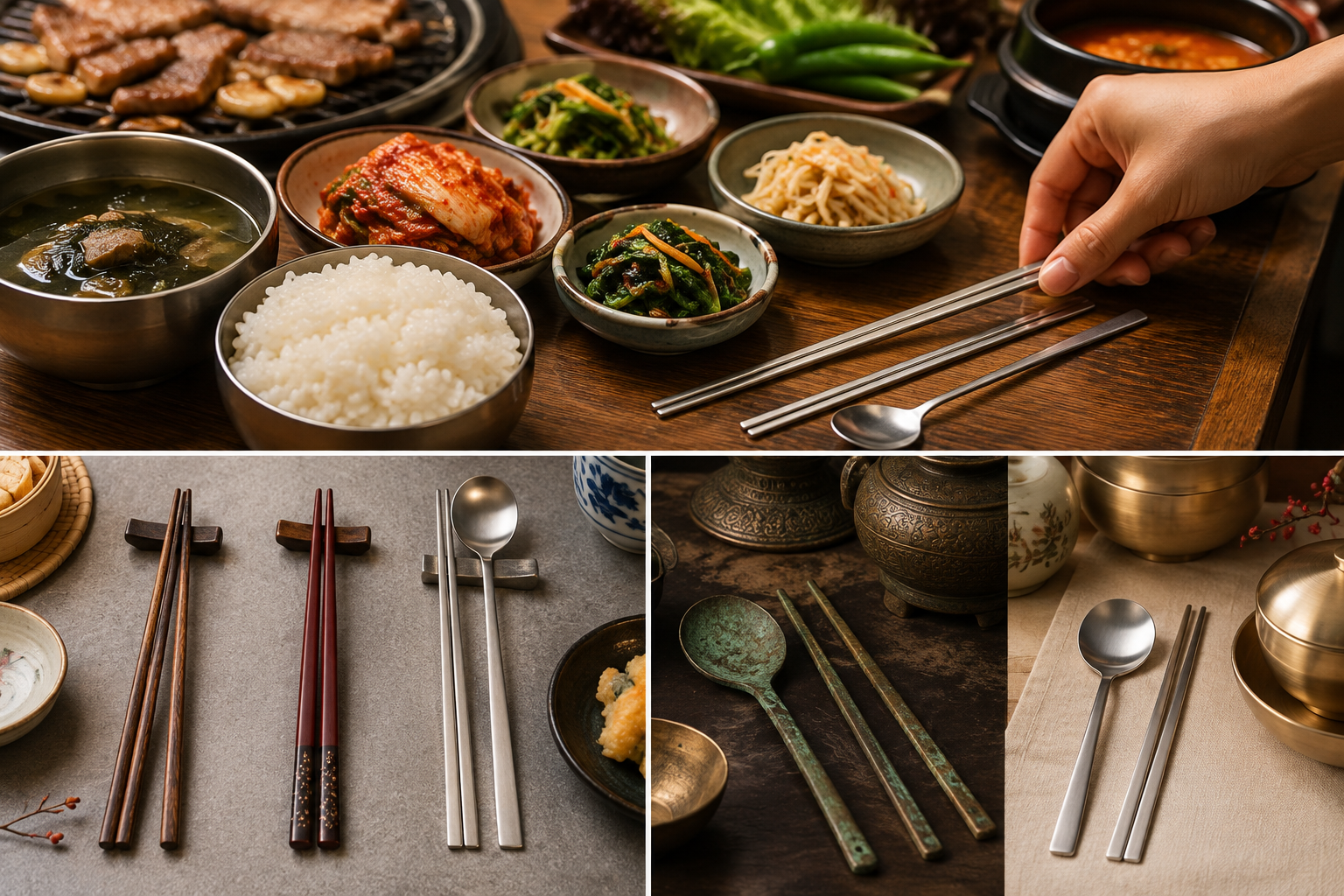
You sit down at a Korean restaurant.
A bowl of steaming rice arrives.
Then kimchi.
Soup.
Several small side dishes.
And beside them:
a spoon and a pair of thin, flat, stainless-steel chopsticks.
You pick them up.
Immediately, you notice something.
They are heavier than wooden chopsticks.
They are smoother.
They feel thinner.
And that first piece of kimchi somehow slips away.
Again.
And again.
If you learned to use chopsticks in a Chinese or Japanese restaurant, your first experience with Korean chopsticks can feel surprisingly difficult.
So naturally, many travelers ask:
Why does Korea use metal chopsticks?
The easy answer would be:
“Because Korean kings used silver chopsticks to detect poison.”
You will find that explanation all over the internet.
There is some history behind silver and metal utensils.
But the full story is much more complicated—and much more interesting.
Korea has a long archaeological tradition of using metal spoons and chopsticks together. The National Museum of Korea holds multiple sets of bronze chopsticks and bronze spoon-and-chopstick sets dating to the Goryeo Dynasty, showing that metal tableware was already firmly present centuries ago.
To really understand Korean chopsticks, we need to look at more than the chopsticks.
We need to look at:
the entire Korean table.
First, Korean Chopsticks Are Only Half of the Story
In Korea, chopsticks are traditionally paired with:
숟가락 — Sutgarak
Spoon
Together, the spoon and chopsticks are called:
수저 — Sujeo
The word combines ideas associated with spoon and chopsticks into a single everyday concept.
This pairing matters.
In many Korean meals:
the spoon handles rice and soup
while
the chopsticks handle side dishes and solid foods.
You might use your spoon for:
rice,
doenjang-jjigae,
seaweed soup,
or broth.
Then use your chopsticks for:
kimchi,
namul,
meat,
fish,
jeon,
and other banchan.
Archaeological finds show that the spoon-and-chopstick pairing has deep roots. The National Museum of Korea notes that spoons and chopsticks have been excavated together from Goryeo-period sites, showing that both utensils were used as part of everyday dietary culture.
So the question is not simply:
“Why metal chopsticks?”
A better question is:
“Why did Korea develop such a strong spoon-and-chopstick culture—and why did metal become so important within it?”
Korea’s Metal Chopsticks Are Not a Modern Invention
Stainless steel may look modern.
The tradition is not.
The National Museum of Korea’s collection contains bronze chopsticks from the Goryeo Dynasty, 918–1392, including examples approximately 22 to 27 centimeters long. It also holds complete bronze spoon-and-chopstick sets.
Another archaeological discovery from a Goryeo-period tomb included:
bronze food vessels,
a spoon,
and bronze chopsticks.
The tomb was believed to belong to someone of very high social status.
These finds tell us something important.
Koreans were using metal eating utensils long before stainless steel existed.
The materials changed over time.
Bronze.
Brass.
Silver among elites.
Later, modern stainless steel.
But metal itself has a long relationship with Korean dining culture.
Hidden Story: Korea Has a Deep Tradition of Metal Craft
Metal utensils also make more sense when you look beyond the dining table.
Korea has a long history of sophisticated metalworking.
One traditional Korean alloy is:
방짜유기 — Bangjja yugi
A type of hand-forged bronze ware.
The Academy of Korean Studies’ Encyclopedia of Korean Culture explains that bangjja brassware was traditionally used to make a range of household objects including:
bowls,
basins,
spoons,
and chopsticks.
In other words, metal tableware was not some strange isolated experiment.
It belonged to a much larger craft tradition.
That changes the way we understand Korean chopsticks.
They are not simply:
wooden chopsticks remade in steel.
They are part of Korea’s historical relationship with metal household objects.
What About the Famous Poison Story?
Now we need to address the story almost everyone hears.
According to a popular explanation:
Korean royalty used silver chopsticks because silver would change color if food contained poison.
There is some historical basis for associating silver utensils with elites.
A Korea.net overview notes traditions of precious-metal chopsticks among royalty and upper-status users, while more ordinary people historically also used materials such as wood or brass.
And the National Museum of Korea has a Goryeo-period object consisting of a silver spoon and bronze chopsticks, demonstrating that precious metals did appear in elite tableware.
But here is where the story needs nuance.
Silver is not a reliable universal poison detector.
Silver tarnishes primarily when it reacts with sulfur compounds, forming dark silver sulfide. The Canadian Conservation Institute identifies sulfur-containing gases as the main cause of silver tarnishing.
Historical arsenic compounds could sometimes contain sulfides or sulfur impurities that reacted with silver.
So under certain conditions, silver might darken.
But that does not mean silver reliably detects arsenic—or poison in general.
A chemistry review specifically examining the historical silver-chopstick claim found that solid silver would only respond to certain arsenic sulfide compounds, while other arsenic forms could escape detection; sulfur naturally present in food could also create false positives.
So the popular story should be told like this:
Reasonable:
Silver tableware existed among elites, and people historically believed it could reveal certain poisons.
Too simple:
Koreans use metal chopsticks today because kings invented them to detect poison.
There is not enough evidence to reduce centuries of Korean utensil culture to that single explanation.
The Myth Is Popular Because It Is a Great Story
And you can understand why it survives.
Imagine a royal court.
Political rivals.
Secret poison.
A silver chopstick turns black just before the king takes a bite.
That is much more exciting than:
“Korea had a long metalworking tradition and utensils changed gradually over many centuries.”
History often loses to storytelling.
But for K-Global Stage, the distinction is important.
Cultural legends are valuable.
We simply should not confuse:
a memorable explanation
with:
the complete historical explanation.
So Why Did Metal Remain Popular in Modern Korea?
Historical tradition alone does not explain why stainless-steel chopsticks are still everywhere today.
Metal also has several practical advantages.
1. Durability
Metal chopsticks do not easily:
warp,
split,
crack,
or absorb moisture.
A restaurant can wash and reuse them repeatedly.
That matters enormously in high-volume food service.
2. Easy Cleaning
Korean meals can involve strongly flavored foods:
kimchi,
gochujang,
soy marinades,
garlic,
sesame oil,
fermented sauces.
Metal does not absorb these flavors and odors in the same way unfinished wood can.
Korea.net notes durability, resistance to food staining and odor, and ease of washing among the practical advantages of metal chopsticks.
3. Heat Resistance
Korean dining frequently puts hot food directly on the table.
Stews bubble.
Meat cooks on grills.
Stone bowls remain extremely hot.
Metal utensils handle heat and repeated washing well.
4. Reusability
In restaurants, durable reusable utensils reduce dependence on disposable chopsticks.
That makes metal especially suitable for standardized restaurant operations.
Why Are Korean Chopsticks So Flat?
Visitors often notice something else.
Chinese chopsticks are commonly:
longer and thicker.
Japanese chopsticks are often:
shorter with more pointed ends.
Korean metal chopsticks are frequently:
medium-length, thin, and relatively flat.
Why?
There is no single proven historical reason that completely explains today’s standardized shape.
But metal itself affects design.
A thick solid-metal chopstick would be heavy.
Making the utensil thinner reduces weight and material use.
Flatness can also help keep the pair from rolling easily on a table.
Modern manufacturing has further standardized the familiar Korean stainless-steel form.
The result is a utensil that feels distinctly different from round bamboo chopsticks.
And Yes, They Are Harder for Beginners
If your first thought was:
“These are impossible.”
you are not alone.
Metal chopsticks offer less friction than wood.
They can be:
smooth,
thin,
and relatively heavy.
That means foods such as:
beans,
glass noodles,
small pieces of garlic,
or slippery rice cake
can be challenging.
Korea.net similarly notes that Korean metal chopsticks often require more control for beginners because they are thinner and smoother.
But there is good news.
After several meals, your hand adapts.
And eventually wooden chopsticks can start feeling unusually light.
Naru’s Chopstick Tip No. 1: Don’t Hold Them Too Low
Many beginners grip Korean chopsticks close to the food.
That makes control harder.
Instead, hold them around:
one-third of the way down from the top.
Your lower chopstick should remain relatively stable.
Your upper chopstick does most of the movement.
Think:
one fixed
one moving.
That reduces the amount of effort needed.
Naru’s Chopstick Tip No. 2: Use the Flat Surfaces
Korean metal chopsticks are not always perfectly round.
Try to align their flat sides against the food.
For something slippery like:
a piece of mushroom,
kimchi,
or meat,
you want:
surface contact
rather than just pinching with the very tips.
That creates more grip.
Naru’s Chopstick Tip No. 3: Remember You Have a Spoon
Here is the biggest secret.
You do not need chopsticks for everything.
Korean dining already gives you another tool.
The spoon.
If rice is difficult to pick up?
Use the spoon.
Soup?
Spoon.
Loose pieces mixed into rice?
Spoon.
Trying to prove that you can eat everything using chopsticks is unnecessary.
In fact, it can be less Korean.
The whole system was designed around:
spoon + chopsticks.
How Should You Place Korean Chopsticks?
Korean dining etiquette includes several useful habits.
When you are not using your chopsticks, place them neatly on the table or utensil rest if one is provided.
Avoid:
sticking them vertically into a bowl of rice.
Why?
Vertically placed utensils can evoke ancestral ritual offerings and therefore feel inappropriate during an ordinary meal.
Traditional Korean ancestral rites explicitly include specific arrangements of spoons and chopsticks on the ceremonial table.
Also avoid casually pointing at people with chopsticks or waving them around.
These are not uniquely Korean rules, but they are useful basic table manners.
One Important Difference: Koreans Often Eat Rice With a Spoon
This can surprise travelers familiar with Japanese dining.
You may watch a Korean person eat and notice:
rice → spoon
banchan → chopsticks
soup → spoon
meat → chopsticks
back to rice → spoon.
That rhythm is central to the meal.
The spoon is not secondary.
It is half of the system.
The National Museum of Korea notes that metal spoons were already widely used on the Korean Peninsula from at least the Three Kingdoms period, with spoon-and-chopstick use clearly visible in Goryeo archaeological evidence.
This helps explain why Korean chopsticks do not need to perform every task.
Did You Know? “Sujeo” Is One Concept, Not Two Separate Tools
The Korean term:
수저 — Sujeo
often refers collectively to the eating utensils used at a meal.
That linguistic detail is revealing.
The spoon and chopsticks are separate objects.
But culturally, they form a set.
You may even see elegant matching:
수저세트 — Sujeo set
sold as:
wedding gifts,
household goods,
traditional crafts,
or premium souvenirs.
Korea.net has documented Korean artisan chopstick sets being presented as diplomatic and ceremonial gifts, showing how everyday utensils can also function as Korean craft objects.
The utensil becomes:
function + design + culture.
Korean Chopsticks Can Also Be Art
Not every Korean chopstick is plain stainless steel.
Traditional and contemporary versions may feature:
lacquer,
mother-of-pearl,
wood,
brass,
bronze,
silver,
or decorative handles.
Korea has even held international chopstick exhibitions presenting historical reproductions alongside works by contemporary craftspeople.
This points to another interesting idea.
Chopsticks are extremely ordinary objects.
People use them every day.
But ordinary objects often carry some of the deepest cultural information.
A palace tells you how kings lived.
A pair of chopsticks tells you how everyone eats.
Korea vs. China vs. Japan: Why Chopsticks Look Different
International visitors often assume:
“Chopsticks are chopsticks.”
Not really.
The forms evolved differently alongside different cuisines and table habits.
Chinese chopsticks
Often longer and thicker.
A traditional shared-table meal can involve reaching toward dishes placed in the center.
Japanese chopsticks
Often shorter and more pointed.
Fine tips work well with fish and smaller food items.
Korean chopsticks
Often medium-length, thin, flat, and metal.
And importantly:
paired with a spoon.
These are broad tendencies—not universal rules.
Modern restaurants across all three countries use many different materials and shapes.
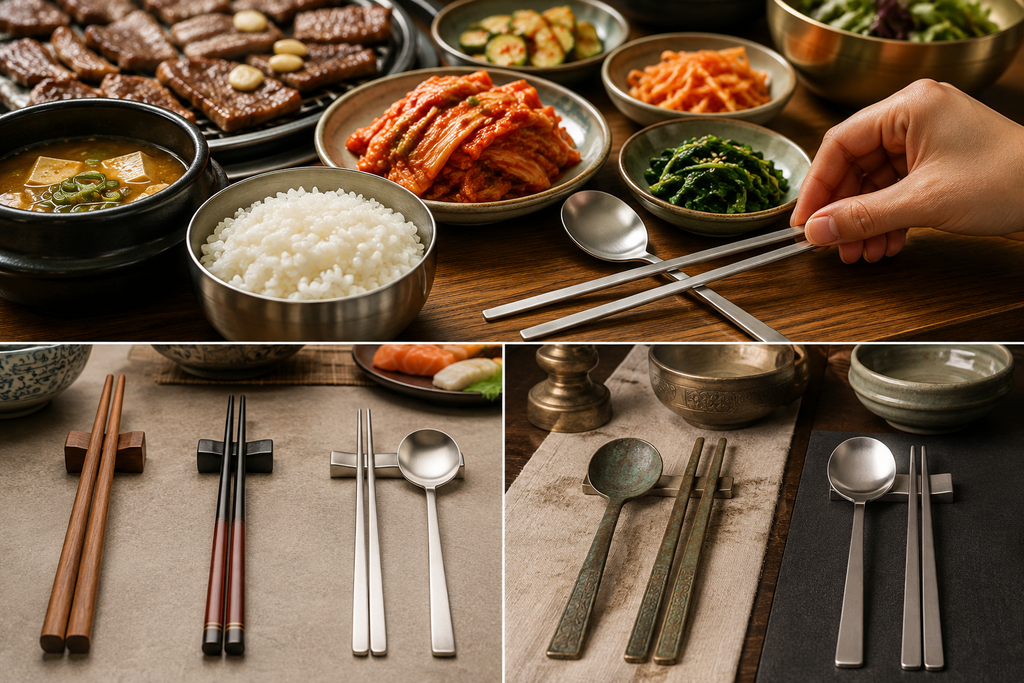
But placing the three side by side is one of the easiest ways to visually explain how a simple utensil reflects food culture.
What Korean Food Is Hardest With Metal Chopsticks?
My candidates:
콩 — Kong
Beans.
Small.
Round.
Uncooperative.
Then:
잡채 — Japchae
Slippery glass noodles.
And perhaps:
도토리묵 — Dotorimuk
Soft acorn jelly.
Try grabbing a slippery piece of dotorimuk with polished metal chopsticks and you may begin questioning your entire hand-eye coordination system.
But this is part of the experience.
The utensil changes how you interact with the food.
And that makes Korean metal chopsticks more than a visual curiosity.
You feel the difference immediately.
Business Insight: The Best Restaurant Tools Disappear Into the Operation
From a restaurant-business perspective, metal chopsticks are interesting because they solve several problems at once.
They are:
durable
washable
standardized
reusable
resistant to strong food flavors
and
culturally familiar.
Now imagine a restaurant serving hundreds of customers every day.
If an utensil lasts far longer than wood and can repeatedly pass through commercial washing systems, the operational logic becomes obvious.
The same principle appears throughout Korean restaurants:
metal cups,
stainless-steel rice bowls,
metal spoons,
kitchen scissors,
tabletop grills,
call buttons,
self-service stations.
Each item may look small.
Together they form a restaurant ecosystem designed for:
repetition and efficiency.
Korean Restaurant Design Often Prioritizes Durability
Think about a Korean barbecue restaurant after dinner.
There may be:
oil,
smoke,
gochujang,
sesame oil,
kimchi,
hot grills,
and dozens of dishes.
This is not an environment where delicate tableware always makes operational sense.
Metal works well.
Wash it.
Sterilize it.
Reuse it.
Again.
Again.
Again.
That practical durability is one reason modern stainless steel feels so natural in Korean restaurants.
Historical tradition and operational logic reinforce each other.
So Is Metal Better Than Wood?
Not necessarily.
Wood has advantages.
It is:
lighter,
warmer to touch,
and often easier for beginners because it provides more friction.
Metal is:
more durable,
less absorbent,
and highly reusable.
Different eating cultures optimized different combinations of:
material,
shape,
food,
and etiquette.
The interesting question is not:
“Which chopstick is best?”
It is:
“What does each design tell us about the food culture that uses it?”
Naru’s Travel Tips
When you eat in Korea, do not panic if metal chopsticks feel slippery at first.
Try these four things:
1. Hold them higher.
You will have more control.
2. Move only the upper chopstick.
Keep the lower one stable.
3. Use the flat surfaces to grip food.
4. Use your spoon for rice and soup.
And remember:
Nobody expects a traveler to win a chopstick competition.
If a piece of food falls?
Pick it up again.
Congratulations.
You are now participating in Korean dining culture.
Learn 5 Korean Words
| English | Korean | Pronunciation | Chinese | Spanish |
|---|---|---|---|---|
| Chopsticks | 젓가락 | jeot-ga-rak | 筷子 | Palillos |
| Spoon | 숟가락 | sut-ga-rak | 勺子 | Cuchara |
| Spoon & chopsticks | 수저 | su-jeo | 匙筷 | Cuchara y palillos |
| Metal | 금속 | geum-sok | 金属 | Metal |
| Table setting | 상차림 | sang-cha-rim | 餐桌摆设 | Servicio de mesa |
Bonus Word
젓가락질 — Jeotgarakjil
Using chopsticks / chopstick technique
Someone may say:
젓가락질 잘하네요!
Jeotgarakjil jalhaneyo!
“You’re good with chopsticks!”
For a first-time visitor, that is an achievement.
Korean Phrase of the Day
젓가락 좀 주세요.
Pronunciation: Jeotgarak jom juseyo.
English: Could I have some chopsticks, please?
Chinese: 请给我一双筷子。
Spanish: ¿Me puede dar unos palillos, por favor?
Another useful phrase:
숟가락도 주세요.
Sutgarakdo juseyo.
“Please give me a spoon too.”
Today’s Question
Which do you prefer: metal, wooden, or bamboo chopsticks?
And if you have tried Korean metal chopsticks:
What was the hardest Korean food to pick up?
Tell us in the comments.
Naru’s Quote
“A pair of Korean metal chopsticks looks like a tiny difference at the dinner table. But follow its story, and you find centuries of food, craft, design, and everyday life.” — Naru
SEO FAQ
Why do Koreans use metal chopsticks?
There is no single proven reason. Korea has a long history of metal tableware, including bronze spoon-and-chopstick sets dating to the Goryeo Dynasty. In modern restaurants, stainless steel also offers practical advantages such as durability, reusability, and easy cleaning.
Are Korean chopsticks always metal?
No. Koreans also use wooden, bamboo, plastic, lacquered, and other chopsticks. However, reusable stainless-steel chopsticks are particularly common in homes and restaurants.
Did Korean kings use silver chopsticks to detect poison?
Silver tableware did exist among elites, and there is a long-standing belief that silver could reveal certain poisons. But silver is not a reliable general poison detector. It primarily tarnishes through reactions with sulfur compounds, and only certain arsenic-containing substances could indirectly produce such a reaction.
Why are Korean chopsticks flat?
Modern Korean metal chopsticks are often thin and flat. There is no universally proven single historical explanation for the precise form, but the design works well with metal construction, limits weight, and prevents the chopsticks from rolling as easily as perfectly round utensils.
Why are Korean chopsticks harder to use?
Metal is smoother and provides less friction than unfinished wood or bamboo. Korean chopsticks are also often relatively thin, so beginners may need greater finger control.
Do Koreans eat rice with chopsticks?
Often, Koreans use a spoon for rice and soup and chopsticks for side dishes and other solid foods. The spoon-and-chopstick combination is called sujeo (수저).
How old are Korean metal chopsticks?
Archaeological evidence confirms metal chopsticks from at least the Goryeo Dynasty. The National Museum of Korea preserves multiple bronze chopsticks and complete bronze spoon-and-chopstick sets from that period.
What is “sujeo” in Korean?
수저 (sujeo) refers to the spoon-and-chopstick utensils used for eating, reflecting the importance of both tools within Korean dining culture.
Part 3 — A Pair of Chopsticks Can Explain an Entire Dining Culture
Imagine removing everything from a Korean dining table except:
a spoon
and
two metal chopsticks.
Even those three objects can tell you a surprising amount about Korea.
The spoon tells you:
there will probably be rice.
There may be soup.
There may be stew.
The chopsticks tell you:
there will be multiple solid dishes to pick from.
The metal tells you:
these utensils are meant to survive repeated use.
The matching set tells you:
the meal has been designed around both tools.
Then add the table back.
Kimchi.
Rice.
Soup.
Namul.
Grilled meat.
Jeon.
Shared side dishes.
Suddenly the design makes sense.
This is what makes everyday objects so interesting.
Culture is not only found in:
palaces,
traditional clothing,
festivals,
or museums.
Sometimes culture is sitting quietly beside your rice bowl.
And because it is so ordinary, nobody explains it.
Koreans rarely sit down before dinner and think:
“Today I am participating in centuries of Korean metalworking and dining history.”
They just pick up the chopsticks.
Eat.
Put them down.
That is how culture usually works.
The things that tell us the most about a society are often the things its people no longer notice.
So next time Korean metal chopsticks feel frustratingly slippery, don’t only think:
“Why are these so difficult?”
Look at the spoon beside them.
Look at the soup.
Look at the side dishes.
Look at the stainless-steel bowls.
Then ask:
“What kind of meal were these utensils designed for?”
That question takes you much closer to understanding Korea.
🇰🇷 한국어
한국인은 왜 금속 젓가락을 사용할까?
한국 식당에 처음 온 외국인이 식탁에서 가장 먼저 발견하는 차이 중 하나가 있습니다.
바로:
금속 젓가락
입니다.
중국이나 일본에서 사용하는 나무 젓가락에 익숙한 사람에게 한국의 얇고 납작한 스테인리스 젓가락은 처음에는 상당히 어렵게 느껴질 수 있습니다.
그렇다면 왜 한국에서는 금속 젓가락을 많이 사용할까요?
흔히 알려진 이야기는 **“왕이 음식에 독이 들었는지 확인하기 위해 은수저를 사용했다”**는 것입니다.
하지만 이것만으로 한국의 금속 젓가락 문화를 설명하기는 어렵습니다.
국립중앙박물관에는 고려시대의 청동 젓가락과 청동 수저 세트가 여러 점 남아 있습니다. 즉 한국에서 금속 식기를 사용하는 전통은 현대의 스테인리스 젓가락보다 훨씬 오래되었습니다.
한국 식문화를 이해할 때 더 중요한 것은 젓가락만 보지 않는 것입니다.
한국에서는 젓가락과 숟가락을 함께 사용하며 이를:
수저
라고 합니다.
밥과 국은 숟가락으로 먹고 반찬이나 고기 등은 젓가락으로 먹는 방식이 일반적입니다.
국립중앙박물관 자료에서도 고려시대 유적에서 숟가락과 젓가락이 함께 출토된 사례를 확인할 수 있습니다.
한국의 금속 젓가락은 오랜 금속공예 문화와도 연결됩니다.
전통적인 방짜유기로도 수저와 젓가락을 만들었으며, 한국민족문화대백과사전에서도 방짜놋쇠를 이용한 전통 생활용품에 수저와 젓가락이 포함되어 있음을 확인할 수 있습니다.
그렇다면 은수저가 독을 감지한다는 이야기는 사실일까요?
일부는 맞지만 과장된 부분도 있습니다.
은은 황 성분과 반응해 검게 변할 수 있습니다. 역사적으로 일부 비소 화합물에 황 성분이나 불순물이 포함되어 있었다면 은이 변색될 가능성이 있었습니다.
하지만 모든 독이나 모든 비소가 은과 반응하는 것은 아닙니다.
따라서 **“은수저 = 완벽한 독 감지기”**라고 이해하는 것은 정확하지 않습니다.
현대 한국에서 스테인리스 젓가락이 널리 사용되는 데에는 실용적인 이유도 있습니다.
금속은:
튼튼하고
반복적으로 세척할 수 있으며
음식 냄새가 잘 배지 않고
오랫동안 사용할 수 있습니다.
특히 김치, 고추장, 마늘, 각종 양념처럼 맛과 향이 강한 음식을 많이 다루는 한국 식당에서는 매우 실용적인 소재입니다.
또 한국의 젓가락 문화는 숟가락과 함께 이해해야 합니다.
밥까지 모든 것을 젓가락으로 먹을 필요가 없습니다.
밥과 국은 숟가락.
반찬과 고기는 젓가락.
이 두 가지 도구가 하나의 시스템처럼 움직입니다.
그래서 한국의 금속 젓가락은 단순히 특이한 식기가 아닙니다.
그 안에는:
역사
금속공예
한국 음식의 구조
식당 운영의 효율성
그리고
현대적인 디자인
이 함께 들어 있습니다.
为什么韩国人使用金属筷子?
第一次在韩国餐厅吃饭时,很多外国游客都会发现一个明显的不同:
韩国筷子通常是:
金属制的。
而且它们往往比较薄、比较扁,也比木筷更滑。
为什么?
最常见的说法是:
“韩国王室使用银筷来检测食物中的毒药。”
这个故事并非完全没有历史背景,但它不能完整解释韩国的金属筷子文化。
韩国国立中央博物馆收藏了多件高丽时代的青铜筷子,以及青铜勺子和筷子的组合。这说明韩国使用金属餐具的历史已经有数百年。
理解韩国餐具还有一个关键:
韩国人通常把:
勺子 + 筷子
一起使用。
这种组合叫:
수저 — Sujeo
米饭和汤通常用勺子。
小菜、肉类和其他固体食物则用筷子。
关于银筷检测毒药的故事,也需要谨慎理解。
银会与含硫物质发生反应并变黑。古代某些含砷毒物可能含有硫化物或杂质,因此银器在某些情况下可能发生颜色变化。
但银并不能检测所有毒物,也不能可靠地检测所有形式的砷。
现代韩国广泛使用不锈钢筷子还有非常实际的理由。
它们:
耐用
容易清洗
可以反复使用
不容易吸收食物气味
因此非常适合大量使用泡菜、酱料、烤肉和热汤的韩国餐饮环境。
所以韩国金属筷子的故事并不仅仅是一个关于王室和毒药的故事。
它同时包含了:
历史、饮食习惯、金属工艺、设计和现代餐饮效率。
🇪🇸 Español
¿Por qué los coreanos usan palillos de metal?
Una de las primeras diferencias que muchos visitantes observan en un restaurante coreano son los palillos.
Son:
delgados, planos y normalmente metálicos.
Si estás acostumbrado a palillos de madera, pueden resultar sorprendentemente difíciles de utilizar.
Entonces, ¿por qué Corea utiliza metal?
Una explicación popular afirma que la realeza coreana utilizaba utensilios de plata para detectar veneno.
Existe cierta base histórica para relacionar los metales preciosos con la vajilla de las élites, pero esta historia no explica por sí sola la tradición coreana.
El Museo Nacional de Corea conserva varios palillos de bronce y juegos de cuchara y palillos del período Goryeo, lo que demuestra que el uso de utensilios metálicos tiene raíces profundas en Corea.
Además, los palillos coreanos no deben entenderse solos.
Normalmente se utilizan junto con una:
숟가락 — sutgarak
cuchara.
La combinación de cuchara y palillos se denomina:
수저 — sujeo
La cuchara se utiliza frecuentemente para el arroz y las sopas, mientras que los palillos sirven para acompañamientos, carne y otros alimentos sólidos.
¿Y la famosa historia del veneno?
La plata puede oscurecerse cuando reacciona con compuestos que contienen azufre. Algunos venenos históricos con arsénico podían contener sulfuros o impurezas capaces de producir esta reacción.
Sin embargo, la plata no es un detector universal de venenos y no puede detectar de forma fiable todas las formas de arsénico.
En los restaurantes modernos, el acero inoxidable también tiene ventajas prácticas.
Es:
duradero
reutilizable
fácil de limpiar
y
resistente a olores y sabores intensos.
Por eso los palillos metálicos son un buen ejemplo de cómo un objeto cotidiano puede conectar:
historia, gastronomía, artesanía, diseño y eficiencia moderna.