In Korea, Sometimes the Coffee Is Almost the Least Important Part
Imagine this.
You drive an hour outside Seoul.
Not to visit a palace.
Not to climb a mountain.
Not to eat at a famous restaurant.
You are going to:
a café.
When you arrive, there is a huge parking lot.
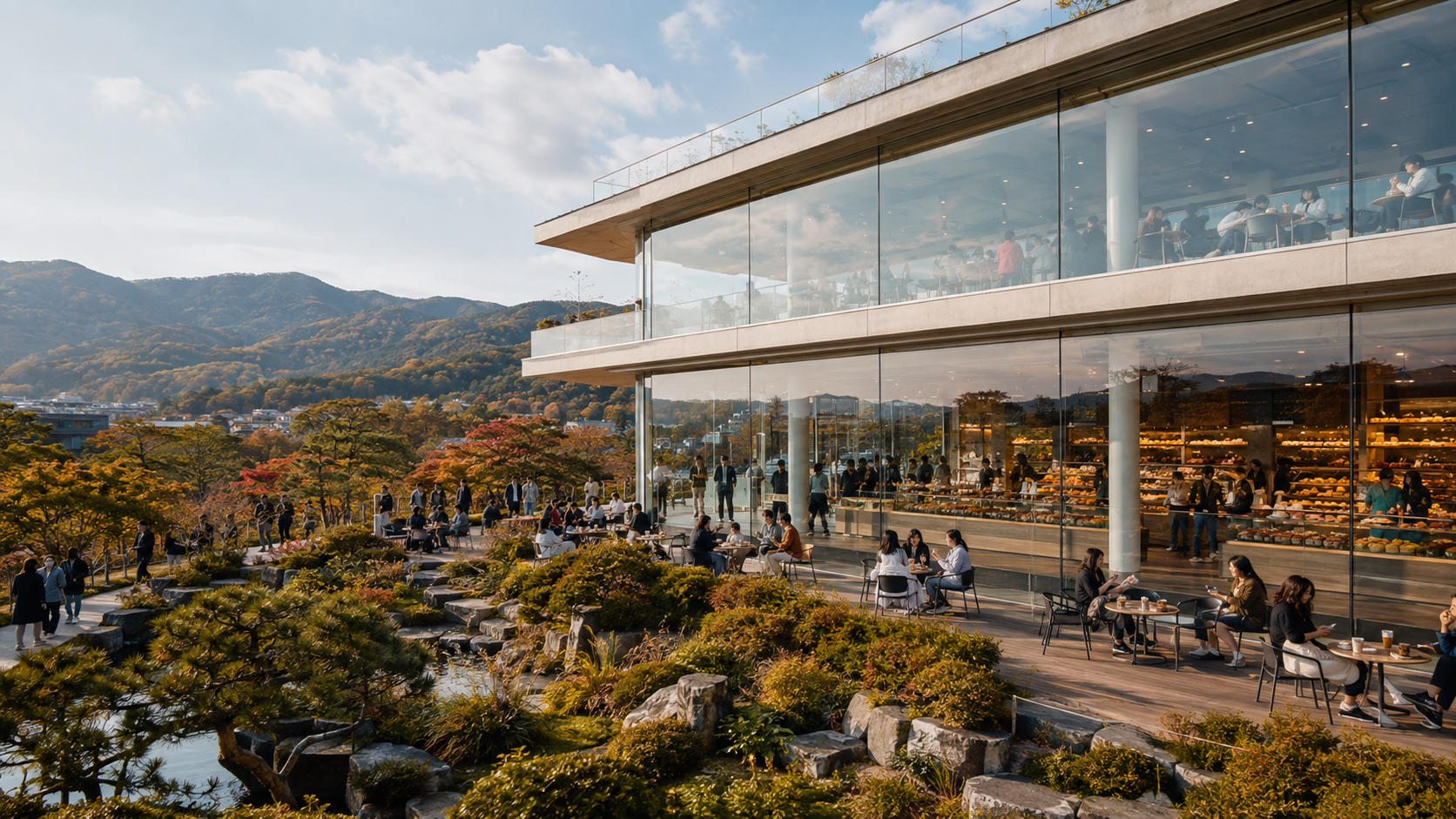
The building has three floors.
One wall is made entirely of glass.
There is a bakery inside.
A garden outside.
Maybe a rooftop.
Perhaps a river view.
People are taking pictures before they even order.
A couple is on a date.
A family has brought their grandparents.
Someone is working on a laptop.
Another person is reading alone.
Two friends are photographing a croissant beside a carefully designed latte.
Eventually, you remember:
Oh, right. This is supposed to be a coffee shop.
Welcome to Korean café culture.
In August 2026, Korea’s Ministry of Agriculture, Food and Rural Affairs reported that the country’s coffee industry had reached approximately ₩3.74 trillion in 2024, up 35.6% from 2018. Even more strikingly, Korea had 106,452 coffee shops in 2023, representing roughly 13.4% of all food-service businesses—close to one in seven.
That number tells us something important.
Korea doesn’t just drink coffee.
Korea uses cafés.
For meetings.
Dates.
Study.
Work.
Dessert.
Photography.
Rest.
Travel.
And increasingly:
as destinations in themselves.
So why did Korean cafés become so much more than places to buy coffee?
The answer lies in Korea’s density, long social days, digital lifestyle, competitive food industry—and a consumer culture that increasingly values space and experience as much as the product itself.
First, Korea Really Does Have a Lot of Cafés
Before talking about culture, we need to understand the scale.
According to Korea’s Ministry of Agriculture, Food and Rural Affairs and the Korea Rural Economic Institute, the number of coffee shops reached 106,452 in 2023, rising 5.7% from the year before. The share of cafés among all food-service establishments climbed from 9.3% in 2018 to 13.4% in 2023.
That means cafés are not a niche lifestyle business.
They are part of Korea’s everyday urban infrastructure.
Walk through:
Seoul,
Busan,
Daegu,
Daejeon,
Jeju,
or almost any Korean neighborhood,
and you may see cafés separated by only a few doors.
Large franchises.
Tiny independent shops.
Specialty roasters.
Dessert cafés.
Bakery cafés.
Study-oriented cafés.
Traditional hanok cafés.
Warehouse cafés.
Character cafés.
Rooftop cafés.
Garden cafés.
River-view cafés.
The competition is intense.
So selling decent coffee is often not enough.
A café needs another reason for people to choose it.
That is where Korean café culture becomes interesting.
Reason No. 1: The Café Became Korea’s “Second Destination”
Many Korean social outings follow a familiar rhythm:
Meal → Café
You meet friends.
Eat Korean barbecue.
Or pasta.
Or tteokbokki.
Or dinner.
Then someone says:
카페 갈까?
Kape galkka?
“Shall we go to a café?”
The meal may already be finished.
Nobody is particularly hungry.
But the evening is not finished.
The café becomes the place where the conversation continues.
This matters because restaurants and cafés perform different social functions.
At the restaurant:
you eat.
At the café:
you stay.
You talk.
You stretch the date.
You open gifts.
You take photos.
You discuss what happened at dinner.
You decide what to do next.
The café gives people another hour—or two—without needing a formal reason.
Why Not Just Stay at the Restaurant?
In some countries, diners may remain at a restaurant long after eating.
In many Korean casual restaurants, that is not always the natural rhythm.
Restaurants can be:
busy,
high-turnover,
loud,
focused on food,
and designed to move customers through the meal.
A café offers a different environment.
Softer seating.
Dessert.
Coffee.
Music.
Air conditioning.
Longer conversations.
And no steaming grill between you.
So the café becomes a kind of:
social living room outside the home.
That idea is especially powerful in dense urban areas where many people may not have large homes designed for entertaining groups.
Reason No. 2: Korean Cafés Sell Time
A coffee may take ten minutes to drink.
But a customer might remain for:
one hour,
two hours,
or even longer.
That changes the economics and psychology of the café.
You are not only purchasing:
coffee.
You are purchasing permission to occupy:
a table,
a chair,
Wi-Fi,
air conditioning,
electricity,
a view,
background music,
and a semi-public personal space.
That is one reason the atmosphere matters so much.
Consumers are effectively asking:
“Where would I like to spend the next two hours?”
Not simply:
“Where can I buy an Americano?”
Hidden Korean Word: 카공족
Korea even has a word for people who study in cafés.
카공족 — Kagongjok
It combines:
카페 — café
공부 — study
and
족 — tribe/group
A 2026 Korea JoongAng Daily report described the deeply established cagongjok culture, with cafés increasingly building power outlets, individual lamps, partitions, and seats specifically designed for customers who work or study for long periods.
Some café floors now resemble:
a coffee shop,
library,
and coworking space
at the same time.
That tells us how far the concept has evolved.
The customer is no longer merely drinking.
The café is hosting an activity.
Reason No. 3: Korea Turned the Café Into a Study Room
For students and office workers, cafés can provide a very specific environment.
Home may be too distracting.
A library may feel too silent.
An office may feel too formal.
A café offers:
Wi-Fi,
power outlets,
background noise,
food and drinks,
and other people working nearby.
The same 2026 reporting noted that major Korean café chains are actively adapting to this behavior, with specialized work or “focus” zones appearing in some locations.
This creates one of the most distinctly modern Korean café scenes:
A table with:
one Americano,
a laptop,
an iPad,
earphones,
a textbook,
a charger,
and a customer who might remain until dinner.
But This Creates a Business Problem
From the customer’s perspective:
Great value.
Buy one drink.
Use the space for three hours.
From the café owner’s perspective:
That seat could potentially have served several customers.
This tension has been debated for years.
Some extreme cases even led to customers bringing large computer equipment into cafés, prompting major chains to restrict items such as desktop computers, printers, and large power setups.
But the industry has also begun responding more intelligently.
Instead of asking:
“How do we stop customers from staying?”
some operators ask:
“How do we sell more to customers who are going to stay anyway?”
That might mean:
sandwiches,
bagels,
salads,
desserts,
second drinks,
or all-day food bundles.
One Korean café chain reported strong growth in deli sales after targeting long-stay café users with food offerings.
That is classic business adaptation.
Do not fight the behavior.
Monetize the behavior.
Reason No. 4: Korean Cafés Are Date Venues
Ask a Korean couple what they did on a weekend date and the answer may include:
restaurant,
café,
walk,
another café.
The café works especially well as a date environment because it allows conversation without forcing constant activity.
You can:
sit face-to-face,
share cake,
take photos,
exchange gifts,
look at the view,
and stay for a long time.
And because there are so many cafés, choosing one can itself become part of the date.
Not:
“Should we get coffee?”
but:
“Which café should we experience?”
That distinction explains a lot.
Reason No. 5: The Interior Is Part of the Product
This may be one of the biggest differences international visitors notice.
Korean cafés can invest heavily in:
architecture,
furniture,
lighting,
gardens,
staircases,
mirrors,
art,
terraces,
water features,
and enormous windows.
Why?
Because the customer does not only consume coffee.
The customer also consumes:
the environment.
A plain white cup of coffee may be difficult to differentiate.
But a cup of coffee served:
inside a renovated factory,
beside a river,
inside a hanok,
under a glass ceiling,
next to an indoor garden,
or overlooking mountains
becomes a different product.
The liquid may be similar.
The memory is not.
Seongsu Shows How Powerful This Can Become
Seongsu-dong is one of the clearest examples.
The neighborhood was historically associated with:
factories,
printing shops,
auto repair businesses,
and handmade shoe workshops.
Over time, old industrial spaces were repurposed into:
cafés,
galleries,
shops,
restaurants,
and cultural venues.
Korea Tourism Organization describes Seongsu’s café street as an area where old factory architecture was retained and combined with new cafés and cultural spaces, helping create the district’s distinctive identity.
This is important.
The café did not merely move into the neighborhood.
The café helped reinterpret the neighborhood.
Industrial space became aesthetic space.
Old brick became “Instagrammable.”
Warehouse scale became dramatic architecture.
The neighborhood’s past was not completely erased.
It became part of the branding.
Business Insight: A Café Can Change Real Estate
Once a neighborhood develops:
one interesting café,
then another,
then a bakery,
then a boutique,
then a pop-up,
the reason people visit the neighborhood begins to change.
Foot traffic grows.
Social media attention increases.
New tenants arrive.
Rents may change.
Developers notice.
Tourism organizations notice.
Eventually, the café is not merely benefiting from the location.
The café is helping create the location.
Seoul’s recent expansion of the Jamsil Special Tourist Zone offers another example. In August 2026, the city expanded the zone to include Songridan-gil, specifically recognizing the value of its artisan cafés and neighborhood culture as part of a broader tourism destination.
That is a significant evolution.
Cafés are no longer simply amenities beside tourist attractions.
In some districts:
cafés are part of the attraction.
Reason No. 6: Korea Made the Café a Photo Studio
You order a dessert.
What happens next?
Eat it?
Not yet.
First:
사진 찍어야지.
Sajin jjigeoyaji.
“We have to take a picture.”
Move the coffee slightly.
Rotate the cake.
Remove the receipt.
Put the flowers in the background.
Take another picture.
Maybe move to the window.
Now eat.
This is not uniquely Korean, of course.
People photograph cafés everywhere.
But Korea’s highly visual social-media culture has pushed cafés to design with photography in mind.
A photogenic:
staircase,
wall,
window,
garden,
mirror,
or dessert
can become a marketing asset.
Customers produce the advertising themselves.
The Customer Becomes the Marketing Department
Think about the economics.
A café builds one unusual feature.
Perhaps:
a giant window framing mountains.
A pink staircase.
A hanok courtyard.
An indoor tree.
A reflecting pool.
Thousands of visitors photograph it.
They post:
Instagram,
TikTok,
blogs,
Naver,
YouTube,
and travel reviews.
Other people see the images and visit.
Then they take their own images.
The café has created a:
user-generated marketing loop.
This is why Korean café design can sometimes look theatrical.
The café must look good not only:
in person
but also:
inside a vertical smartphone screen.
Reason No. 7: Korean Cafés Became Bakeries
Walk into a large Korean café and you may find:
croissants,
salt bread,
cakes,
bagels,
garlic bread,
scones,
sandwiches,
madeleines,
seasonal fruit desserts,
and rows of beautifully arranged pastries.
At some establishments, calling the business a “coffee shop” almost understates what it is.
It is closer to:
bakery + café + restaurant + destination.
This makes business sense.
Coffee may bring the customer in.
Bread increases the ticket.
Dessert extends the visit.
Visual food increases social sharing.
And customers who travel a long way to visit a café are more likely to want a fuller experience than one Americano.
Bread Can Even Become Tourism
The relationship between bakery culture and travel is becoming increasingly visible in Korea.
Recent national tourism campaigns have highlighted local bakeries and food businesses as destinations in their own right, reflecting a shift toward travelers choosing places based on specific food experiences rather than only conventional landmarks.
Daejeon provides an especially striking example of food-driven tourism. Recent reporting highlighted the city’s transformation into a “city of bread,” with food-related visits playing a major role in tourism and local bakery success helping reshape the city’s image.
This is bigger than coffee.
It means:
food retail can become place branding.
Reason No. 8: Then Came the Mega Café
Now leave central Seoul.
Drive into Gyeonggi Province.
Suddenly, cafés become enormous.
Some have:
hundreds of seats,
multi-story buildings,
huge parking lots,
gardens,
rooftops,
art installations,
walking paths,
and bakery production areas.
Korea Tourism Organization itself lists large bakery cafés and cultural café complexes as travel attractions, including venues combining cafés with art, retail, outdoor sculptures, regional food ingredients, and large landscaped sites.
At that point, the word:
“café”
starts to feel almost inadequate.
Why Build a Giant Café Outside the City?
Because suburban economics and consumer behavior are different.
Outside central Seoul, operators may have access to:
larger sites,
parking,
views,
nature,
and lower land costs relative to prime city-center locations.
Customers arrive by car.
And when they drive thirty or sixty minutes, they expect more.
So the business needs:
space,
food,
something to photograph,
and enough experience to justify the trip.
The result is a kind of:
café theme park without rides.
You stroll.
Eat bread.
Take photos.
Drink coffee.
Move upstairs.
Look at the view.
Take more photos.
Spend two hours.
Go home.
The café itself was the outing.
Hidden Story: Koreans Have a Word for Café Touring
People sometimes talk about:
카페 투어 — Kape tueo
Café tour.
Or:
카페 투어 다니다
going around visiting different cafés.
The idea sounds strange if you think of cafés only as coffee suppliers.
Nobody says:
“Today I’m touring three petrol stations.”
But cafés offer distinct experiences.
So visiting several can become a hobby.
A 2025 Korea Times report on changing café spending described people in their 50s and 60s increasingly using cafés for social meetings and even going on weekend “café tours,” showing that the culture is no longer limited to younger consumers.
That is another major evolution.
Café culture has become intergenerational.
Reason No. 9: Cafés Offer a Rare Kind of Personal Space
Korea is densely populated.
Many people live in apartments.
Urban streets are busy.
Restaurants are busy.
Offices are busy.
Public transit is busy.
A café can provide something surprisingly valuable:
temporary personal territory.
You choose a table.
Place down your bag.
Open your laptop.
Put on headphones.
For the next hour:
this little square of space feels like yours.
You are in public.
But also slightly private.
That balance is one reason cafés work so well for:
solo customers,
students,
freelancers,
couples,
and people who simply need somewhere to exist between appointments.
Reason No. 10: Cafés Are One of Korea’s Most Flexible Social Spaces
Consider how many activities can happen in the same café.
At Table 1:
two students studying.
Table 2:
a first date.
Table 3:
three retirees talking.
Table 4:
a freelancer editing video.
Table 5:
a family eating bread.
Table 6:
a tourist planning the next stop.
Table 7:
two friends exchanging birthday gifts.
The café has no single function.
That flexibility may be its greatest strength.
It does not ask:
“Why are you here?”
It simply sells enough space and food to let you decide.
Korea’s Coffee Market Is Splitting in Two Directions
Another fascinating current trend is that Korean consumers do not all want the same kind of café.
Government analysis shows the market increasingly dividing between:
premium experiences
and:
value coffee.
Some consumers seek specialty beans, distinctive roasting, and premium experiences.
Others want inexpensive, large-volume coffee for commuting or after meals.
MAFRA describes this as a clear bifurcation of Korea’s coffee market between premium and value-oriented consumption.
This explains why Korea can support both:
a 2,000-won takeaway Americano
and
a destination café where customers spend far more on bread, dessert, architecture, and an afternoon out.
They are solving different customer needs.
The Same Customer May Want Both
This is important.
The person who buys:
cheap coffee Monday morning
may drive to:
a beautiful bakery café Sunday afternoon.
Consumers are not necessarily:
“premium customers”
or
“value customers.”
They switch according to occasion.
Morning commute:
speed + price.
Date:
atmosphere + dessert.
Study:
outlet + chair + Wi-Fi.
Weekend drive:
view + architecture + parking.
Tourism:
uniqueness + photos + memory.
The coffee changes function depending on the mission.
That is a powerful way to understand the Korean market.
Business Insight: Korean Cafés Don’t Sell Coffee. They Sell Occasions.
This may be the single most important business insight.
Imagine trying to compete with 100,000 other coffee shops by saying:
“Our coffee is good.”
That is not enough.
You need to own an occasion.
For example:
Morning caffeine
→ low-price chain.
Serious coffee enthusiast
→ specialty roaster.
Study
→ laptop-friendly café.
Date
→ beautiful dessert café.
Family outing
→ large bakery café.
Travel
→ scenic destination café.
Social media
→ photo-driven concept café.
Neighborhood culture
→ adaptive-reuse independent café.
Once the business understands the occasion, it can design:
menu,
seating,
lighting,
hours,
parking,
price,
music,
and architecture
around that mission.
That is far more sophisticated than simply opening a coffee shop.
More Space Can Mean a Higher Perceived Value
Why would someone pay a relatively high price for coffee at a destination café?
Part of the answer is that the customer may not mentally assign the full price to the beverage.
Imagine:
Coffee: ₩6,500.
But you also receive:
two hours in a beautiful building,
a mountain view,
a garden,
air conditioning,
parking,
photographs,
and a family outing.
Suddenly the price comparison changes.
The customer is not comparing:
₩6,500 coffee vs. ₩3,000 coffee.
They may be comparing:
“What does our family do this afternoon?”
That is a completely different competitive set.
This Is Why Korean Cafés Can Compete With Attractions
Once a café becomes an experience business, its competitors are no longer only other cafés.
They might include:
parks,
shopping malls,
museums,
restaurants,
cinemas,
and weekend attractions.
That is why tourism agencies themselves now regularly feature distinctive cafés in official travel content.
The category boundary has blurred.
Café?
Bakery?
Gallery?
Garden?
Retail store?
Tourist destination?
Sometimes:
all of them.
What About Traditional Korean Cafés?
Not every Korean café is futuristic or enormous.
Another powerful trend is the opposite:
looking backward.
Hanok cafés use:
wooden beams,
courtyards,
traditional roofs,
Korean ceramics,
and garden views.
Menus may include:
coffee,
but also:
tea,
yakgwa,
injeolmi,
black sesame,
mugwort,
red bean,
or traditional flavors.
This creates an interesting cultural fusion.
The activity is modern:
going out for coffee.
The setting and flavors reference older Korea.
Again, cafés become a platform for cultural reinterpretation.

Korean Ingredients Are Becoming Café Ingredients
Traditional ingredients can now appear in formats such as:
쑥라떼 — Ssuk latte
Mugwort latte
흑임자라떼 — Heugimja latte
Black sesame latte
인절미 디저트 — Injeolmi dessert
약과 디저트 — Yakgwa dessert
These products make Korean flavors easier to encounter in modern settings.
A traveler who may not visit a traditional tea house could discover:
mugwort,
black sesame,
or rice-cake flavors
through a trendy café.
In that sense, cafés help translate Korean food culture into new formats.
Naru’s Travel Tips
If you are traveling in Korea, do not search only for:
“best coffee.”
Search according to the experience you want.
Try:
For trendy urban culture:
성수 카페 — Seongsu cafe
Seongsu’s converted industrial architecture makes it one of Seoul’s most recognizable café districts.
For neighborhood café hopping:
Look for streets ending in:
-리단길 — “-ridan-gil”
These names are often used for neighborhoods known for cafés, restaurants, and independent shops.
For spectacular scenery:
Search:
뷰 좋은 카페
Byu joeun kape
“Café with a good view.”
For large destination cafés:
Search:
대형 카페
Daehyeong kape
“Large café.”
or:
베이커리 카페
Beikeori kape
“Bakery café.”
For working or studying:
Look for photos showing:
power outlets,
individual seating,
large tables,
and laptop users.
Not every beautiful café wants you to stay with a laptop for four hours.
One More Travel Tip: Order One Item Per Person When Appropriate
Korean café policies differ.
Some large or popular cafés may require:
1인 1메뉴
Irin il-menu
Literally:
one menu item per person.
This may mean one drink per customer or one qualifying menu item each.
Especially if a café is crowded or you plan to stay for a long time, check the policy.
Do not assume that buying one Americano gives four people unlimited use of a table.
Did You Know?
Nearly One in Seven Korean Food-Service Businesses Was a Coffee Shop
According to Korean government analysis, coffee shops represented 13.4% of all food-service establishments in 2023, with more than 106,000 coffee shops operating nationwide.
That helps explain why Korean cafés must constantly differentiate themselves.
When coffee is everywhere:
the experience becomes the competitive advantage.
Learn 5 Korean Words
| English | Korean | Pronunciation | Chinese | Spanish |
|---|---|---|---|---|
| Café | 카페 | ka-pe | 咖啡馆 | Cafetería |
| Coffee | 커피 | keo-pi | 咖啡 | Café |
| Atmosphere | 분위기 | bun-wi-gi | 氛围 | Ambiente |
| View | 전망 | jeon-mang | 景观 | Vista |
| Bakery | 베이커리 | be-i-keo-ri | 面包店 | Panadería |
Bonus Word
카공 — Kagong
A shortened expression combining:
카페 (café) + 공부 (study)
meaning:
studying at a café.
You might hear:
카공하러 가요.
Kagonghareo gayo.
“I’m going to study at a café.”
Korean Phrase of the Day
여기 분위기 정말 좋아요.
Pronunciation: Yeogi bunwigi jeongmal joayo.
English: The atmosphere here is really nice.
Chinese: 这里的氛围真的很好。
Spanish: El ambiente aquí es realmente agradable.
Another useful phrase:
창가 자리 있어요?
Changga jari isseoyo?
“Do you have a seat by the window?”
A very useful sentence in a Korean café.
Today’s Question
What matters most when you choose a café?
The coffee?
Dessert?
Architecture?
View?
Wi-Fi?
A quiet place to work?
Or somewhere beautiful enough to travel for?
Tell us in the comments.
Naru’s Quote
“In Korea, a café can be an office, a date, a photo studio, a bakery, a living room, and a weekend trip—all before the coffee gets cold.” — Naru
SEO FAQ
Why are cafés so popular in Korea?
Korean cafés serve many purposes beyond coffee. They function as social spaces, study and work environments, date venues, dessert destinations, and increasingly as travel experiences. Korea had more than 106,000 coffee shops in 2023, according to government analysis.
How many coffee shops are there in South Korea?
Korea’s Ministry of Agriculture, Food and Rural Affairs reported 106,452 coffee shops in 2023, representing 13.4% of food-service establishments.
What is “cagong” in Korea?
카공 (kagong) combines the Korean words for café and study. It refers to studying or working for long periods inside cafés. The related term 카공족 (kagongjok) describes people who regularly do this.
Why are Korean cafés so big?
Large destination cafés are particularly common outside dense urban cores, where bigger sites can support parking, gardens, bakery production, large seating areas, views, and other attractions. Korea Tourism Organization lists numerous large bakery cafés and café complexes as travel destinations.
Why are there so many bakery cafés in Korea?
Bakery products give cafés another revenue stream while turning a coffee visit into a fuller dining and leisure experience. Korea’s growing food-tourism culture has also helped bakeries become destinations rather than simply neighborhood food shops.
What is Seongsu known for?
Seongsu-dong is known for old industrial buildings that have been repurposed into cafés, galleries, shops, and cultural spaces. Korea Tourism Organization identifies its warehouse-style café culture as a major part of the neighborhood’s transformation.
Can I study in Korean cafés?
Often yes, especially in larger chains and cafés designed for laptop users. Some locations provide outlets, individual desks, or specialized working zones. However, policies vary, and some cafés discourage customers from occupying tables for very long periods or bringing excessive equipment.
What does “one person, one menu” mean?
You may see 1인 1메뉴, meaning each customer is expected to order an item. The exact rule depends on the café.
Are Korean cafés tourist attractions?
Increasingly, yes. Tourism authorities promote distinctive cafés, café streets, bakery cafés, and converted cultural spaces as destinations, and café-heavy neighborhoods such as Seongsu and Songridan-gil have become part of Seoul’s tourism landscape.
Part 3 — The Coffee Shop That Became a Piece of Korean Infrastructure
At first, Korea’s café culture looks like a story about coffee.
But coffee alone cannot explain:
106,000 shops.
Three-story bakery cafés.
People studying for four hours.
Couples driving across the city for a particular interior.
Old factories becoming destinations.
Families spending Sunday afternoons inside enormous café complexes.
Something else is happening.
The café has become:
infrastructure for modern social life.
Think about what traditional society once offered.
People had:
larger extended-family networks,
neighborhood relationships,
courtyards,
markets,
community spaces,
and homes where multiple generations gathered.
Modern urban life changed many of those patterns.
People moved into apartments.
Families became smaller.
Work became more mobile.
Young adults often live alone.
Friends may live across the city.
People need neutral places to meet.
And the café fills that gap.
It asks almost nothing from you.
You do not need to:
book a private room.
Order a full meal.
Host people at home.
Explain why you are there.
You simply buy something.
And for a while:
you belong there.
That flexibility is extremely valuable in a dense modern society.
This may be why café culture keeps evolving rather than disappearing.
Technology did not kill the café.
Remote work gave cafés another role.
Smartphones did not kill social cafés.
They turned beautiful cafés into shareable media.
Delivery did not kill café visits.
It made the physical space even more important as the reason to visit.
Cheap coffee did not kill premium cafés.
It forced premium cafés to sell something bigger than coffee.
Each disruption pushed the category toward:
experience.
And that may be the deepest lesson from Korean café culture.
The more ordinary coffee becomes,
the more important everything around the coffee becomes.
The chair.
The bread.
The architecture.
The window.
The view.
The Wi-Fi.
The photograph.
The person sitting across from you.
So when someone in Korea says:
“카페 갈까?”
they may literally mean:
“Shall we go to a café?”
But culturally, the question can mean much more.
It might mean:
“Should we keep talking?”
“Should we spend more time together?”
“Should we find somewhere to work?”
“Should we go somewhere beautiful?”
or simply:
“What should we do next?”
And that is why Korean cafés became so much more than coffee shops.

한국의 카페는 왜 단순한 커피숍 그 이상일까?
한국에서 카페는 단순히 커피를 사는 곳이 아닙니다.
친구를 만나는 곳이고,
데이트를 하는 곳이며,
공부하고 일하는 곳이고,
디저트를 먹는 곳이며,
사진을 찍고,
때로는 일부러 차를 타고 찾아가는 여행 목적지가 되기도 합니다.
2026년 농림축산식품부와 한국농촌경제연구원이 발표한 분석에 따르면 한국의 커피산업 규모는 2024년 약 3조 7,400억 원에 달했습니다. 2023년 커피전문점 수는 10만 6,452개로, 전체 외식업체의 약 13.4%를 차지했습니다.
카페가 이렇게 많다 보니 단순히 “커피가 맛있다”는 것만으로는 차별화가 어렵습니다.
그래서 한국 카페들은 점점:
공간
디저트
건축
전망
사진
업무환경
같은 경험을 함께 판매하게 됐습니다.
식사 후에는 왜 또 카페에 갈까?
한국에서는 친구나 연인을 만났을 때:
식사 → 카페
라는 흐름이 매우 자연스럽습니다.
식사가 끝났다고 만남이 끝난 것은 아닙니다.
카페로 이동해 커피나 디저트를 먹으며 한두 시간 더 이야기를 나눕니다.
이런 의미에서 카페는 한국 도시생활의:
외부 거실
과 비슷한 역할을 합니다.
카공족이라는 말까지 생겼다
한국에는:
카공족
이라는 표현이 있습니다.
카페에서 공부하거나 일하는 사람들을 뜻합니다.
최근에는 일부 대형 카페 체인들이 콘센트와 개인석, 집중공간 등을 설치하며 이런 고객을 적극적으로 받아들이고 있습니다.
즉 카페가:
coffee shop → library → coworking space
의 역할까지 함께 하게 된 것입니다.
카페의 인테리어도 상품이다
한국에서는 카페를 고를 때 커피뿐 아니라:
“분위기가 좋은가?”
“사진이 잘 나오는가?”
“뷰가 좋은가?”
“공간이 넓은가?”
를 함께 봅니다.
특히 성수동은 오래된 공장과 창고가 카페와 갤러리로 재탄생하며 독특한 동네 정체성을 만들었습니다. 한국관광공사 역시 성수동 카페거리를 대표적인 트렌드 관광공간으로 소개하고 있습니다.
카페가 동네에 들어온 것이 아니라:
카페가 동네의 이미지를 바꾼 것입니다.
대형 카페는 하나의 여행지가 됐다
서울 근교나 지방으로 가면 규모가 매우 큰 베이커리 카페를 쉽게 볼 수 있습니다.
대형 주차장,
정원,
루프탑,
통유리,
산이나 강 전망,
베이커리,
전시공간
등을 갖춘 곳도 많습니다.
한국관광공사는 이런 대형 베이커리 카페와 복합문화형 카페를 여행지로 직접 소개하기도 합니다.
이런 장소에서 고객은 단순히 30분 동안 커피를 마시지 않습니다.
가족과 함께 두 시간 정도 머물고,
산책하고,
빵을 먹고,
사진을 찍고,
경치를 감상합니다.
즉 카페가:
하루의 목적지
가 됩니다.
결국 한국 카페가 파는 것은 ‘상황’이다
한국의 카페시장에는 저가 커피와 고급 커피가 동시에 성장하고 있습니다.
정부 분석에서도 소비자들이 출근길에는 저렴한 커피를 찾으면서도 특정 상황에서는 스페셜티 커피나 프리미엄 경험을 선택하는 양극화가 나타나고 있다고 설명합니다.
같은 사람이:
월요일 아침에는 저가 아메리카노를 사고,
일요일 오후에는 멀리 있는 대형 베이커리 카페를 찾아갈 수 있습니다.
왜냐하면 구매 목적이 다르기 때문입니다.
출근길에는:
가격과 속도
데이트에서는:
분위기
공부할 때는:
콘센트와 자리
주말에는:
뷰와 공간
을 삽니다.
그래서 한국 카페 산업을 가장 잘 설명하는 말은 이것일지도 모릅니다.
한국의 카페는 커피를 파는 것이 아니라, 커피를 마시는 이유를 판다.
🇨🇳 中文
为什么韩国的咖啡馆远远不只是喝咖啡的地方?
在韩国,咖啡馆可以同时是:
朋友见面的地方、
约会场所、
学习空间、
办公室、
甜品店、
拍照地点,
甚至是周末旅行目的地。
韩国政府2026年公布的数据显示,2023年全国已有超过10.6万家咖啡店,约占餐饮业门店的13.4%。
当咖啡店如此密集时,只卖“好喝的咖啡”已经很难形成竞争力。
于是韩国咖啡馆开始销售更多东西:
空间、建筑、景观、甜品和体验。
韩国人和朋友吃完饭后,经常会说:
카페 갈까?
意思是:
“要不要去咖啡馆?”
这往往并不是因为大家还需要咖啡因。
而是因为大家还不想结束见面。
咖啡馆成为了继续聊天的“第二场”。
韩国还有一个有趣的词:
카공
意思是:
在咖啡馆学习。
越来越多咖啡店安装插座、个人座位和适合长时间工作的空间。
因此咖啡馆逐渐同时承担:
咖啡店 + 图书馆 + 共享办公室
的功能。
韩国咖啡馆也非常重视视觉设计。
首尔圣水洞就是典型案例。
过去的工厂、印刷厂和仓库被改造成咖啡馆、画廊和商店,使整个地区成为年轻人和游客喜欢的文化区域。
在这里,咖啡馆不仅进入了一个社区。
它甚至参与创造了这个社区的新品牌。
在首尔郊外,还可以看到越来越多的大型烘焙咖啡馆。
有些拥有:
大型停车场、
花园、
屋顶、
河景、
艺术品、
面包房
和巨大的室内空间。
这些地方更像周末景点,而不是普通咖啡店。
所以韩国咖啡文化最有趣的地方或许是:
咖啡不一定是最重要的商品。
人们购买的其实可能是:
时间、
空间、
氛围、
照片,
以及和某个人一起度过的一段下午。
🇪🇸 Español
¿Por qué los cafés coreanos son mucho más que cafeterías?
En Corea, una cafetería puede ser:
un lugar para encontrarse con amigos,
una oficina,
una sala de estudio,
un lugar para una cita,
una pastelería,
un estudio fotográfico
o incluso el destino de una excursión de fin de semana.
Según un análisis publicado por el gobierno coreano en 2026, Corea tenía más de 106.000 cafeterías en 2023, alrededor del 13,4 % de todos los establecimientos de restauración.
Con tanta competencia, ofrecer simplemente “buen café” ya no es suficiente.
Por eso muchos cafés coreanos compiten mediante:
arquitectura
paisajes
panadería
diseño
y
experiencias.
Después de comer, es muy común que alguien diga:
카페 갈까?
Kape galkka?
“¿Vamos a una cafetería?”
La comida ha terminado.
Pero la reunión no.
La cafetería permite seguir hablando durante otra hora o dos.
Por eso funciona casi como:
una sala de estar pública.
También existe la cultura de:
카공 — kagong
estudiar o trabajar en una cafetería.
Algunas cadenas han empezado a diseñar espacios con enchufes, asientos individuales y zonas específicas para clientes que trabajan durante horas.
La cafetería puede ser al mismo tiempo:
cafetería + biblioteca + coworking.
Otro fenómeno importante son los cafés que se convierten en destinos turísticos.
En Seongsu-dong, antiguos edificios industriales se transformaron en cafeterías y espacios culturales, ayudando a crear una de las zonas más modernas de Seúl.
Fuera del centro de las ciudades también existen enormes cafés-panadería con:
jardines,
aparcamientos,
terrazas,
vistas panorámicas,
arte
y grandes zonas interiores.
Algunos son promocionados oficialmente como lugares turísticos.
Por eso, quizá la mejor manera de entender las cafeterías coreanas sea esta:
No venden solamente café.
Venden razones para quedarse.