
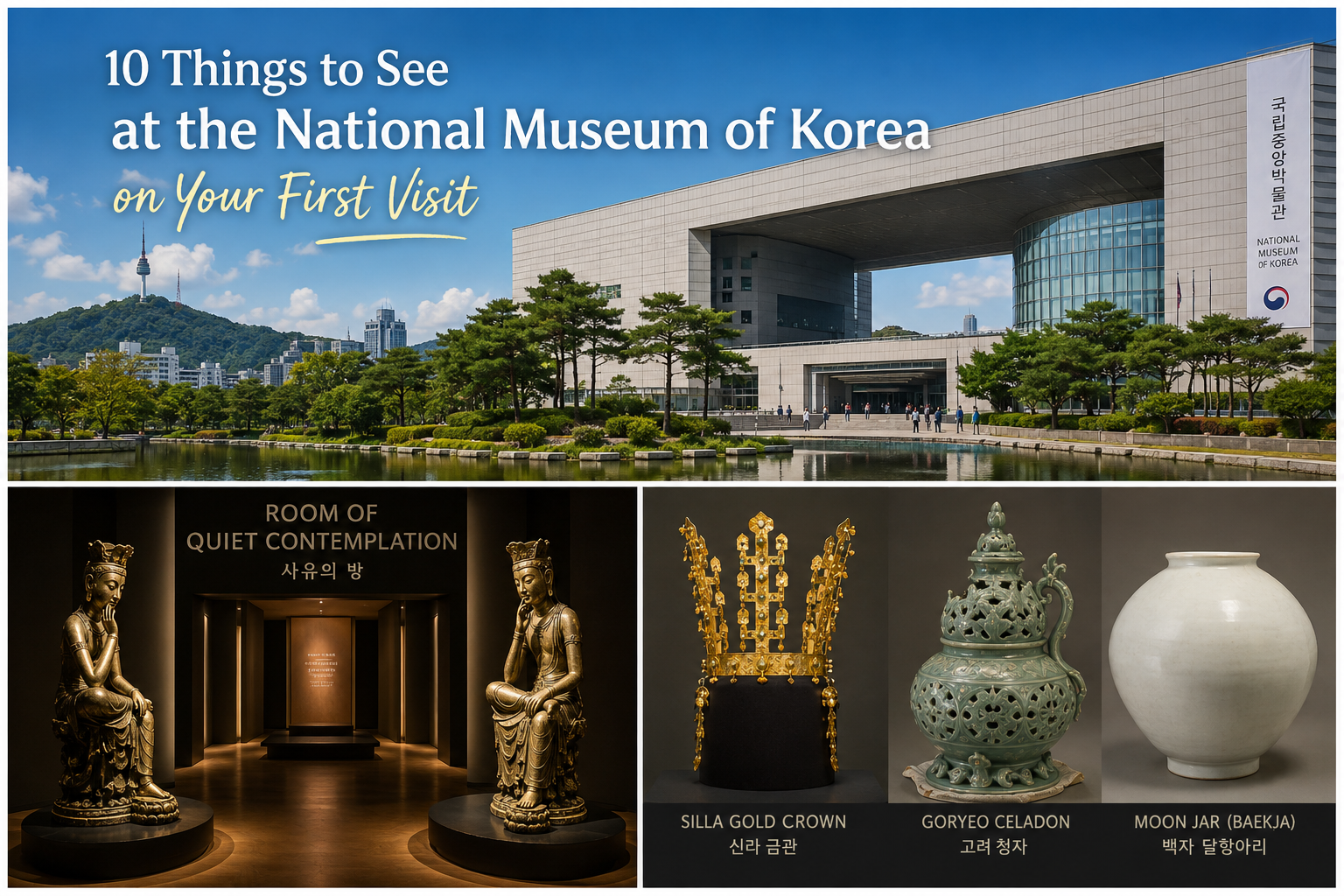

10 Things to See at the National Museum of Korea on Your First Visit
A First-Timer’s Guide to Korea’s Most Important Museum
If you want to understand Korea beyond K-pop, K-dramas, and Korean food, there is one place in Seoul that deserves a spot on your itinerary: the National Museum of Korea.
Located in Yongsan, Seoul, the museum takes you through thousands of years of Korean history—from prehistoric communities and ancient kingdoms to Goryeo celadon, Joseon white porcelain, Buddhist art, and the Korean Empire.
And here is the surprising part:
You do not need to be a history expert to enjoy it.
The permanent galleries contain more than 12,000 objects, including some of Korea’s best-known National Treasures. But for a first-time visitor, trying to see everything can be overwhelming.
So instead of rushing from gallery to gallery, start with these ten highlights.
1. The Pensive Bodhisattvas — Korea’s Most Peaceful Masterpieces
📍 Room of Quiet Contemplation
If you see only one room at the museum, make it this one.
Two gilt-bronze Pensive Bodhisattvas, created around the late sixth and early seventh centuries, sit quietly in contemplation.
One leg rests over the other. A hand gently touches the cheek. The expression is neither clearly happy nor sad.
It is simply… thoughtful.
The museum has created an entire space around these two National Treasures called the Room of Quiet Contemplation.
Rather than filling the room with dozens of objects, the architecture, darkness, lighting, and silence encourage visitors to slow down and spend time with just two sculptures.
The figures represent a bodhisattva contemplating fundamental questions of human existence, including birth, aging, sickness, and death.
Why you should see it:
It is not simply an ancient artifact. It is one of the best examples of how a modern Korean museum can transform cultural heritage into an emotional experience.
Naru’s Tip:
Don’t rush through this room. Put your phone away for a minute and simply look at the statues.
You may understand why this room has become one of the museum’s signature experiences.
2. The Silla Gold Crown — When Ancient Korea Loved Gold
📍 Prehistory and Ancient History
Many visitors arrive in Korea imagining a culture of restrained white porcelain and simple wooden architecture.
Then they see a Silla gold crown.
The ancient kingdom of Silla produced extraordinary gold objects, including elaborate crowns decorated with tree-like and antler-like forms.
They immediately challenge the idea that traditional Korean aesthetics were always minimal.
Ancient Korea could be spectacular.
The National Museum of Korea’s collection includes a famous Silla gold crown designated as a National Treasure.
Hidden Story:
Silla was not an isolated kingdom at the eastern edge of Asia. Archaeological discoveries from ancient Korean tombs include objects and influences that point toward much wider networks across Eurasia.
Looking at the gold crown is therefore also a reminder that Korea was connected to the wider ancient world.
3. Goryeo Celadon — Korea’s Famous Jade-Green Ceramics
📍 Sculpture and Crafts
If Silla gives you gold, Goryeo gives you green.
The Goryeo Dynasty (918–1392) became famous for producing elegant celadon ceramics with a distinctive jade-like color.
Among the museum’s masterpieces is a remarkable celadon incense burner with an openwork design, designated as a National Treasure.
Look closely.
The beauty is not only in the color.
It is in the extraordinary control required to shape, decorate, glaze, and fire something so delicate centuries ago.
Did You Know?
Goryeo artisans became particularly famous for their sophisticated inlay techniques. Designs were carved into the clay and filled with contrasting material before glazing.
It helped Korean celadon develop its own distinctive artistic identity.
4. The Moon Jar — Why Imperfection Can Be Beautiful
📍 White Porcelain
At first, it may seem almost too simple.
A large white jar.
No gold.
No elaborate painting.
No bright colors.
But the Moon Jar (달항아리) has become one of the most recognizable symbols of Korean aesthetics.
Its large rounded form resembles a full moon, but look carefully and you may notice that it is not perfectly symmetrical.
That is part of its beauty.
Large moon jars were traditionally difficult to create as a single piece, so the upper and lower sections could be formed separately and joined together.
The resulting shape could be slightly irregular.
Instead of destroying its beauty, those imperfections give each jar its own character.
Why it matters:
The moon jar provides a beautiful introduction to an idea you will encounter repeatedly in Korean culture:
Beauty does not always require decoration.
Sometimes restraint itself becomes the design.
5. The Ten-Story Pagoda from Gyeongcheonsa Temple Site
This one is difficult to miss.
Standing dramatically inside the museum is the enormous Ten-Story Pagoda from Gyeongcheonsa Temple Site, a National Treasure dating to the Goryeo period.
Unlike the gray granite associated with many Korean stone monuments, this pagoda was made from marble.
Its surfaces are covered with extraordinarily detailed Buddhist imagery.
But there is another reason it is worth seeing.
Its journey reflects Korea’s turbulent modern history.
The pagoda was illegally taken to Japan in the early twentieth century before eventually being returned to Korea.
Today, standing inside Korea’s national museum, it tells two stories at once:
one about Buddhist art—
and another about the protection and return of cultural heritage.
6. Prehistoric Korean Pottery — Before There Was a “Korea”
📍 Prehistory and Ancient History
Before kings, palaces, Hangul, or even a unified Korean identity, people were already living across the Korean Peninsula.
One of the most recognizable objects from prehistoric Korea is comb-pattern pottery, known in Korean as bitsalmunui togi.
Its geometric patterns may look surprisingly modern.
But these vessels take us back thousands of years.
This part of the museum is worth visiting because Korean history did not suddenly begin with famous dynasties like Joseon.
The archaeological galleries reveal a much longer human story.
Think About It:
When you look at an ancient bowl in a museum, you are not just looking at “art.”
Someone once used it.
Someone cooked with it.
Someone carried it.
Someone may have eaten dinner with their family from it thousands of years ago.
That thought makes archaeology much more personal.
7. Joseon Paintings — Look Closely at Everyday Korea
📍 Calligraphy and Painting
Historical paintings are almost like photographs from a world before photography.
Joseon-era works can reveal clothing, architecture, landscapes, social relationships, celebrations, scholars, officials, and ordinary people.
Instead of only looking at the central subject, try studying the smallest figures in the background.
What are they wearing?
What are they carrying?
Where are they sitting?
How are buildings arranged?
These details can sometimes teach you as much about historical Korea as the main subject.
2026 Visitor Note:
Parts of the Calligraphy and Painting galleries are undergoing renovation, so some galleries or works may not be accessible during your visit. Check the museum’s current exhibition information before planning your route.
8. The Digital Galleries — Ancient Korea Meets Technology
Museums don’t have to be only glass cases and labels.
The National Museum of Korea has increasingly used digital technology to help visitors experience cultural heritage differently.
One example is Vivid Moments with Masterpieces, where selected objects can be explored through ultra-high-resolution digital imagery.
You can examine details that may be difficult to see when the original object is protected behind glass.
For international visitors unfamiliar with Korean history, these experiences can make complicated historical objects much easier to understand.
Why it matters:
This is also a fascinating example of contemporary Korea.
A country famous for technology is using digital tools not to replace its past—but to make the past more accessible.
9. The Museum Architecture and View Toward Namsan
Don’t spend the entire visit looking inside display cases.
Take a moment to experience the museum building itself.
The enormous central corridor creates a dramatic visual axis through the museum, while the surrounding outdoor spaces provide a completely different atmosphere from central Seoul’s crowded shopping districts.
On a clear day, the surrounding landscape and views toward Namsan make the museum feel connected to the geography of Seoul rather than separated from it.
This is one reason I recommend giving the museum more time than you think you need.
The experience is not just about seeing artifacts.
It is also about walking, stopping, looking outside, and giving yourself space to absorb what you have seen.
10. The Museum Shop — Take Korean Heritage Home
Yes, the museum shop belongs on this list.
Korean museum merchandise has become surprisingly creative.
Instead of simply printing an artifact on a postcard, designers increasingly reinterpret traditional patterns, ceramics, paintings, and historical objects into products that feel contemporary.
This tells us something interesting about Korea today.
Cultural heritage is no longer treated only as something to preserve behind glass.
It is increasingly being redesigned, reinterpreted, and brought into everyday life.
If you find something inspired by an artifact you saw earlier in the museum, you suddenly understand the design differently.
You know the story behind it.
And that makes a souvenir much more meaningful.
If You Only Have 2 Hours
Don’t try to see everything.
For a first visit, I would prioritize:
Prehistory & Ancient History → Silla Gold Crown → Goryeo Celadon → Moon Jar → Room of Quiet Contemplation → Museum Shop
If you have extra time, explore the historical galleries and digital experiences afterward.
The museum’s permanent exhibitions contain more than 12,000 objects, so trying to complete the entire museum in one visit can actually make the experience less memorable.
Choose fewer things.
Look at them longer.
Practical Information
📍 National Museum of Korea, Yongsan, Seoul
🎟️ Permanent Exhibition: Free admission
Special exhibitions may require separate tickets.
🕐 Regular opening hours:
Monday, Tuesday, Thursday, Friday & Sunday: 9:30 AM–5:30 PM
Wednesday & Saturday: 9:30 AM–9:00 PM
Admission normally closes 30 minutes before the museum closes.
Because galleries, exhibitions, and opening arrangements can change, always check the museum’s official website before visiting.
5 Korean Words to Know Before Your Visit
| English | Korean | Pronunciation | Chinese | Spanish |
|---|---|---|---|---|
| Museum | 박물관 | bak-mul-gwan | 博物馆 | Museo |
| National Treasure | 국보 | guk-bo | 国宝 | Tesoro nacional |
| Cultural heritage | 문화유산 | mun-hwa-yu-san | 文化遗产 | Patrimonio cultural |
| Pottery / ceramics | 도자기 | do-ja-gi | 陶瓷 | Cerámica |
| Exhibition | 전시 | jeon-si | 展览 | Exposición |
Korean Phrase of the Day
가장 유명한 작품이 뭐예요?
Gajang yumyeonghan jakpumi mwoyeyo?
English: What is the most famous artwork here?
Chinese: 这里最有名的作品是什么?
Spanish: ¿Cuál es la obra más famosa de aquí?
A useful phrase whenever you visit a museum or gallery in Korea.
Did You Know?
The National Museum of Korea is not simply an art museum.
Its permanent galleries take visitors across Korean archaeology, history, painting, calligraphy, Buddhist art, ceramics, sculpture, and cultural exchanges with the wider world.
That is why it is one of the best places to visit at the beginning of a trip to Korea.
Once you understand the objects here, things you see later—temples, palaces, ceramics, traditional patterns, Buddhist statues, and even modern Korean design—start making more sense.
Today’s Question
If you could take one object from the National Museum of Korea home with you, which would you choose?
The peaceful Pensive Bodhisattva?
A glittering Silla gold crown?
The jade-green Goryeo celadon?
Or a simple white Moon Jar?
Tell me your choice in the comments.
Naru’s Travel Tips
1. Don’t try to “complete” the museum.
Choose a few galleries and enjoy them slowly.
2. Visit the Room of Quiet Contemplation when you have time to stop.
It deserves more than a quick photograph.
3. Look at the ceramics up close.
Small imperfections and details often reveal how they were made.
4. Leave time for the museum shop.
Understanding the original artifacts makes the modern products much more interesting.
5. Consider Wednesday or Saturday evening.
The museum’s regular schedule currently extends opening until 9 PM on those days.
Naru’s Hidden Story
There is an interesting transformation happening in how Korea presents its history.
For many years, museums were often seen primarily as places where important objects were protected and studied.
Today, Korea’s cultural institutions increasingly ask another question:
How can an ancient object become meaningful to someone living today?
The answer can be seen throughout the National Museum of Korea.
A Buddhist statue is placed inside an almost meditative architectural experience.
Centuries-old masterpieces are explored through digital technology.
A Joseon ceramic becomes inspiration for contemporary design.
And museum merchandise allows visitors to carry fragments of traditional Korean aesthetics into everyday life.
Perhaps that is one reason Korean heritage is attracting a new generation of visitors.
The past has not changed.
The way Korea tells its story has.
Final Thoughts
If Gyeongbokgung shows you where Korean kings lived and Insadong shows you how traditional culture survives in today’s city, the National Museum of Korea helps explain why those things matter.
You don’t need to memorize dynasties.
You don’t need to recognize every National Treasure.
Start with ten objects and experiences.
Look closely.
Ask why they were made.
And think about what they tell us about the people who lived here centuries before us.
Because sometimes the best way to understand modern Korea is to spend an afternoon with its past.