Why This Ancient Korean Gold Crown Looks So Modern
What a 1,500-Year-Old Silla Crown Reveals About Ancient Korea
Imagine walking into a museum and seeing a gold crown glowing inside a dark display case.
It is delicate.
Geometric.
Almost minimalist in structure, yet covered with tiny pieces of gold and jade-like ornaments.
You might guess that it was created by a modern jewelry designer inspired by nature.
But this crown is roughly 1,500 years old.
It comes from Silla, one of the ancient kingdoms that ruled parts of the Korean Peninsula for nearly a thousand years.
And once you look closely at a Silla gold crown, an even more interesting question appears:
Why does something made in ancient Korea look surprisingly modern today?
The answer takes us beyond gold.
It leads into royal power, nature, burial rituals, craftsmanship, and the surprising connections between ancient Korea and the wider Eurasian world.
1. First, What Was Silla?
To understand the crown, we need to understand the kingdom that created it.
Silla (신라) was one of Korea’s Three Kingdoms, alongside Goguryeo and Baekje.
Its capital was Gyeongju, in southeastern Korea.
Today, Gyeongju is famous for enormous grassy burial mounds, ancient temples, archaeological sites, and royal treasures.
But around the fifth and sixth centuries, it was the center of a powerful kingdom.
And Silla’s elite loved gold.
Archaeologists have discovered extraordinary objects from Silla tombs:
gold crowns, earrings, necklaces, belts, shoes, glass vessels, weapons, and horse equipment.
The gold crown became one of the most spectacular symbols of that world.
2. Look at the Crown Before Reading the Label
If you see a Silla crown at a museum, try something first.
Don’t immediately read the description.
Just look.
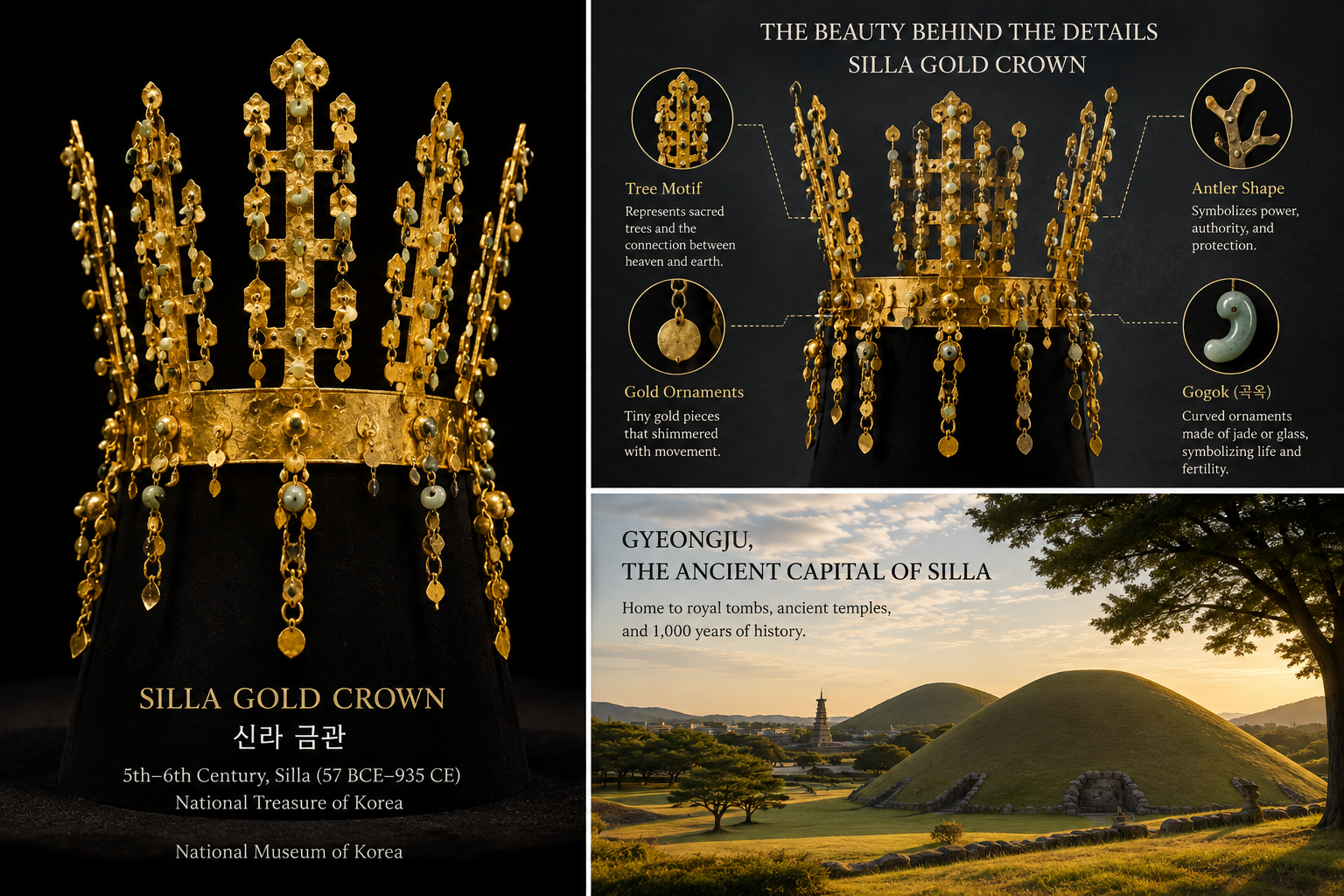
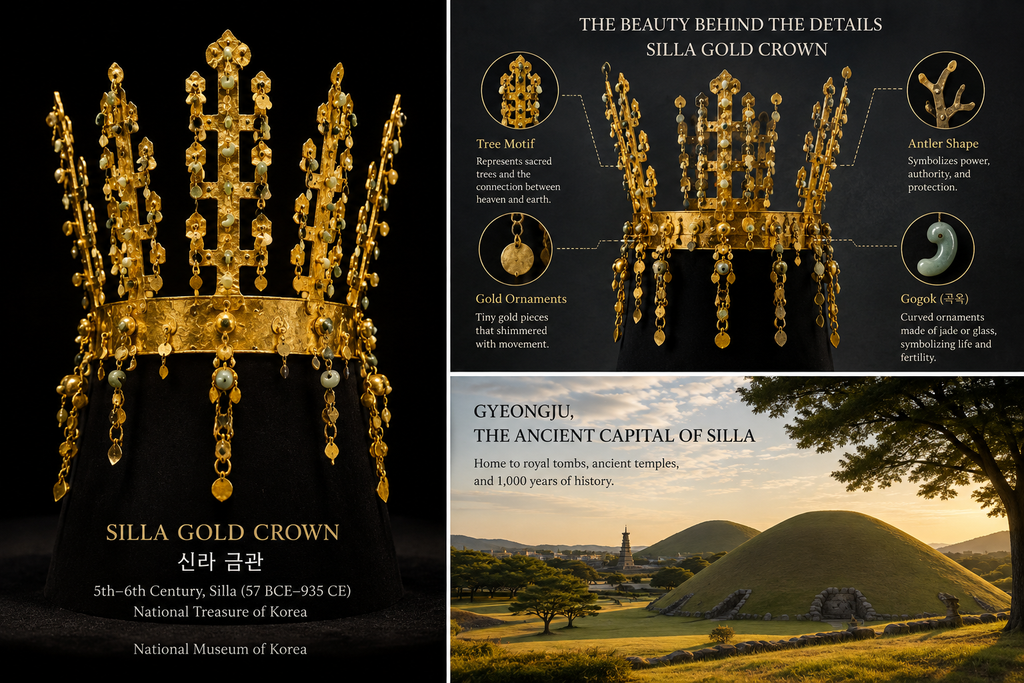
Several tall branches rise vertically from the crown.
Some resemble trees.
Others look like antlers.
Small gold discs hang from the branches.
Then there are curved jade-like ornaments called gogok (곡옥).
When light hits the crown, these tiny pieces would have moved and reflected light.
So the crown we see today as a silent archaeological object may once have produced an entirely different visual effect.
It was not simply gold.
It was movement, light, symbolism, and power combined into one object.
3. Why Does It Look Like a Tree?
One of the first things international visitors notice is the unusual shape.
Why does a royal crown have something resembling tree branches growing out of it?
There is no single interpretation accepted for every element, but scholars have connected the tree-like motifs with ideas about sacred trees, royal authority, nature, and cosmology.
Trees have played symbolic roles in many ancient cultures.
Their roots reach into the earth.
Their trunks exist in the human world.
Their branches stretch toward the sky.
That makes the tree a powerful visual connection between different worlds.
Seen this way, the crown was potentially much more than royal decoration.
It could communicate the ruler’s place within a larger spiritual and political universe.
4. And Why Are There Antlers?
Look again and another shape appears.
Deer antlers.
The antler-like projections are among the most distinctive features of Silla crowns.
Deer and antlers carried symbolic importance in various ancient cultures across northern Eurasia, and scholars have long examined possible connections between Silla imagery and broader traditions across the Eurasian steppe.
But we should be careful.
That does not mean we can simply look at one antler and declare that Silla copied another culture.
Ancient cultural exchange was complicated.
Ideas, objects, technologies, and symbols could travel across enormous distances and then acquire completely new meanings in local societies.
That is precisely what makes the Silla crown fascinating.
It encourages us to see ancient Korea as part of a much larger world.
5. The Tiny Curved Objects Have Their Own Story
Among all that gold, you may notice small comma-shaped ornaments.
These are called gogok (곡옥).
They were made from materials including jade and glass and appear in ancient Korean jewelry and royal objects.
Their exact symbolic meaning remains debated.
Some interpretations have associated the curved form with seeds, fruit, embryos, animal claws, or symbols of life and fertility.
Whatever their precise meaning, their placement on crowns and other elite objects shows that they were valued.
And aesthetically, they create a beautiful contrast.
Rigid gold branches.
Round gold discs.
Softly curved gogok.
The result feels surprisingly balanced—even to modern eyes.
6. Why Does a 1,500-Year-Old Crown Look Modern?
This is perhaps the most interesting question.
Part of the answer may be that many qualities we associate with contemporary design are already visible here.
Strong geometry.
Repeated forms.
Natural motifs transformed into abstraction.
Contrast between materials.
Movement created through hanging elements.
The crown does not attempt to reproduce a realistic tree or deer.
Instead, nature is reduced to recognizable visual symbols.
That is something modern designers do constantly.
Take something complex.
Reduce it.
Repeat it.
Turn it into a visual language.
Of course, Silla artisans were not trying to be “modern.”
We are the modern viewers.
But perhaps that is exactly why the crown is so fascinating.
Great design can sometimes cross enormous distances in time.
7. The Crown Was Hidden Underground
There is another reason these objects survived.
Many famous Silla treasures were discovered inside the enormous royal tombs of Gyeongju.
From outside, some look like simple grassy hills.
Inside were carefully constructed burial spaces containing the deceased and valuable objects.
Unlike many above-ground monuments that could be looted or destroyed repeatedly over centuries, the structure of some Silla tombs helped protect their contents.
When archaeologists excavated them, remarkable collections of gold objects emerged.
Imagine that moment.
A grassy mound has stood quietly in a city for centuries.
Then beneath it appears a world of gold.

Hidden Story — The Tomb Named After a Heavenly Horse
One of Gyeongju’s best-known tombs is Cheonmachong (천마총).
The name means roughly “Tomb of the Heavenly Horse.”
But that was not the name of the person buried there.
In fact, the identity of the tomb’s occupant is uncertain.
The modern name came from an extraordinary artifact discovered during excavation: a painted image of a heavenly horse on a birch-bark mudguard.
This is a wonderful reminder of how archaeology works.
Sometimes we know the objects.
We know the approximate period.
We know the status of the person buried there.
But we still do not know their name.
History often survives in fragments.
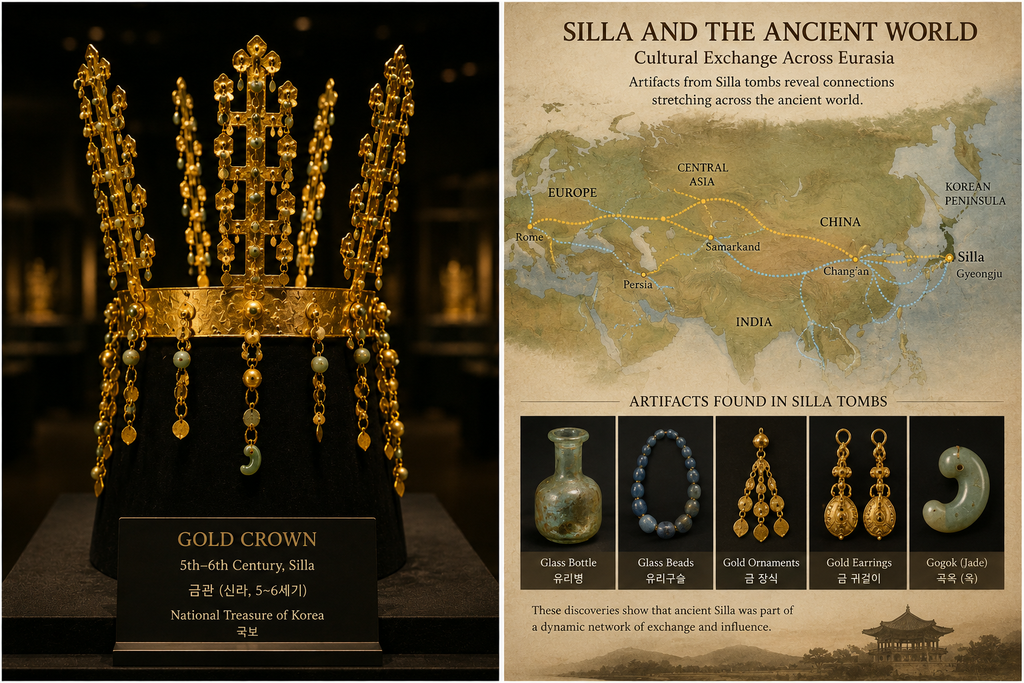
8. Ancient Korea Was More Connected Than You Might Think
This may be the most surprising part of the story.
Objects excavated from Silla tombs include not only locally produced gold treasures but also items that suggest connections to distant regions.
Glass vessels and other artifacts found in Korean tombs have encouraged scholars to investigate trade and cultural networks stretching across Central and Western Asia.
This does not mean a merchant simply traveled directly from Rome to Gyeongju carrying a suitcase of luxury goods.
Ancient exchange usually worked through networks.
An object could move from one trading community to another, crossing regions and cultures before eventually reaching its destination.
That makes Gyeongju’s tombs fascinating evidence of a broader truth:
Ancient Korea was geographically distant from Europe, but it was not necessarily isolated from the wider Eurasian world.
9. Gold Was Also a Language of Power
Why use so much gold?
The obvious answer is wealth.
But gold does more than display wealth.
It does not rust like iron.
It reflects light.
It is rare.
It can be shaped into extraordinarily thin sheets.
And visually, it immediately separates the wearer from everyone around them.
Imagine a Silla ruler or elite figure wearing a crown, gold earrings, a decorated belt, and other ornaments.
In sunlight or firelight, the tiny hanging pieces could have shimmered with every movement.
The person would not simply possess authority.
The clothing and objects would make that authority visible.
Gold was therefore not merely decoration.
It was communication.
10. Where Can You See a Silla Gold Crown Today?
For international visitors, one excellent starting point is the National Museum of Korea in Seoul, where important Silla objects help tell the story of Korea’s ancient kingdoms.
But if this story fascinates you, go to Gyeongju.
There, the story changes completely.
You are no longer simply looking at artifacts removed from their archaeological context.
You can see the enormous burial mounds rising directly from the city landscape.
You can visit archaeological sites.
You can walk through a city that served as the Silla capital for centuries.
And suddenly the crown feels different.
It is no longer simply a beautiful object in a display case.
It belongs to a place.
From Seoul to Gyeongju: A Perfect Korea History Journey
If you are interested in Korean history, I recommend experiencing these places in this order:
1. National Museum of Korea — Seoul
Understand the overall timeline of Korean history.
↓
2. Silla Gold Crown
Choose one artifact and look deeply into its story.
↓
3. Gyeongju
Visit the landscape where Silla’s kings and elites actually lived and were buried.
↓
4. Gyeongju National Museum
See more of the archaeological discoveries from the ancient capital.
This turns museum tourism into something much more interesting.
You first learn the story.
Then you visit the place where the story happened.
Did You Know?
Some Silla gold crowns are so delicate that scholars have debated whether they were actually worn regularly in life.
They may have had ceremonial or funerary functions, and questions remain about exactly how individual crowns were used.
That uncertainty is important.
Museums can sometimes make history look completely solved.
It isn’t.
Archaeology is often a conversation between what we know, what evidence suggests, and what we still cannot explain.
5 Korean Words to Know
| English | Korean | Pronunciation | Chinese | Spanish |
|---|---|---|---|---|
| Silla | 신라 | sil-la | 新罗 | Silla |
| Gold crown | 금관 | geum-gwan | 金冠 | Corona de oro |
| Gold | 금 | geum | 金 | Oro |
| Tomb | 무덤 | mu-deom | 坟墓 | Tumba |
| Cultural heritage | 문화유산 | mun-hwa-yu-san | 文化遗产 | Patrimonio cultural |
Korean Phrase of the Day
이건 언제 만들어졌어요?
Igeon eonje mandeureojyeosseoyo?
English: When was this made?
Chinese: 这个是什么时候制作的?
Spanish: ¿Cuándo se hizo esto?
This is a simple but useful phrase when visiting museums, galleries, temples, or historical sites in Korea.
Today’s Question
If you saw the Silla gold crown without knowing its age, when would you guess it was designed?
Would you believe it was created around 1,500 years ago?
And which part looks most interesting to you:
the tree branches, the antlers, the curved gogok, or the tiny pieces of hanging gold?
Tell me in the comments.
Naru’s Travel Tips
See the crown twice.
First, stand back and look at the entire silhouette.
Then move closer and examine the small hanging decorations and curved ornaments.
Don’t skip Gyeongju.
If Seoul introduces you to Korean history, Gyeongju allows you to walk through one of its most extraordinary chapters.
Look beyond the gold.
Ask why each shape exists. The crown becomes much more interesting when you stop seeing it simply as expensive jewelry.
Connect this article with the National Museum of Korea.
If this is your first trip to Seoul, read “10 Things to See at the National Museum of Korea on Your First Visit” before going.
A Small Business Insight: Why Ancient Korea Still Has Modern Value
There is another reason the Silla crown matters today.
Its silhouette is instantly recognizable.
That gives it something modern brands spend enormous amounts of money trying to create:
distinctive visual identity.
The crown can be reinterpreted through jewelry, museum merchandise, graphics, fashion, exhibitions, digital content, and tourism.
But the strongest cultural products do more than simply print a gold crown onto something.
They translate the story behind the object.
Why those branches?
Why those antlers?
Why the curved ornaments?
Why was it buried?
Why does it still look contemporary?
When consumers understand those questions, an ancient artifact can become something much more powerful than a souvenir.
It becomes a piece of cultural storytelling.
That is one way Korea’s heritage can continue traveling around the world.
Final Thoughts
The Silla gold crown is beautiful because it is made from gold.
But that is probably the least interesting thing about it.
Look closer and you find trees.
Antlers.
Curved ornaments.
Royal authority.
Burial rituals.
Extraordinary craftsmanship.
And traces of a Korean kingdom participating in a much wider ancient world.
Perhaps that is why it still feels surprisingly contemporary.
Not because Silla artisans somehow predicted modern design.
But because they understood something designers still understand today:
A powerful shape can communicate an idea before anyone explains what it means.
The next time you visit the National Museum of Korea and see ancient gold glowing behind glass, don’t just ask:
“How much gold is that?”
Ask:
“What was this design trying to say?”
That question may take you much further into Korean history.
Naru’s Quote
“The Silla crown feels modern not because ancient Korea looked like us, but because great design can survive long after the world that created it disappears.” — Naru