What to Buy at Korea’s Most Famous Museum Shop—and the Stories Behind the Gifts
You visit the National Museum of Korea.
You see a 1,500-year-old Silla gold crown.
You stand quietly in front of the Pensive Bodhisattvas.
You admire Goryeo celadon and the soft curves of Joseon white porcelain.
And then, just when you think your museum visit is over, you enter the museum shop.
That may be a mistake for your wallet.
Because the National Museum of Korea has become surprisingly good at turning Korean cultural heritage into things people actually want to own.
This is not a shop filled only with postcards, magnets, and miniature monuments.
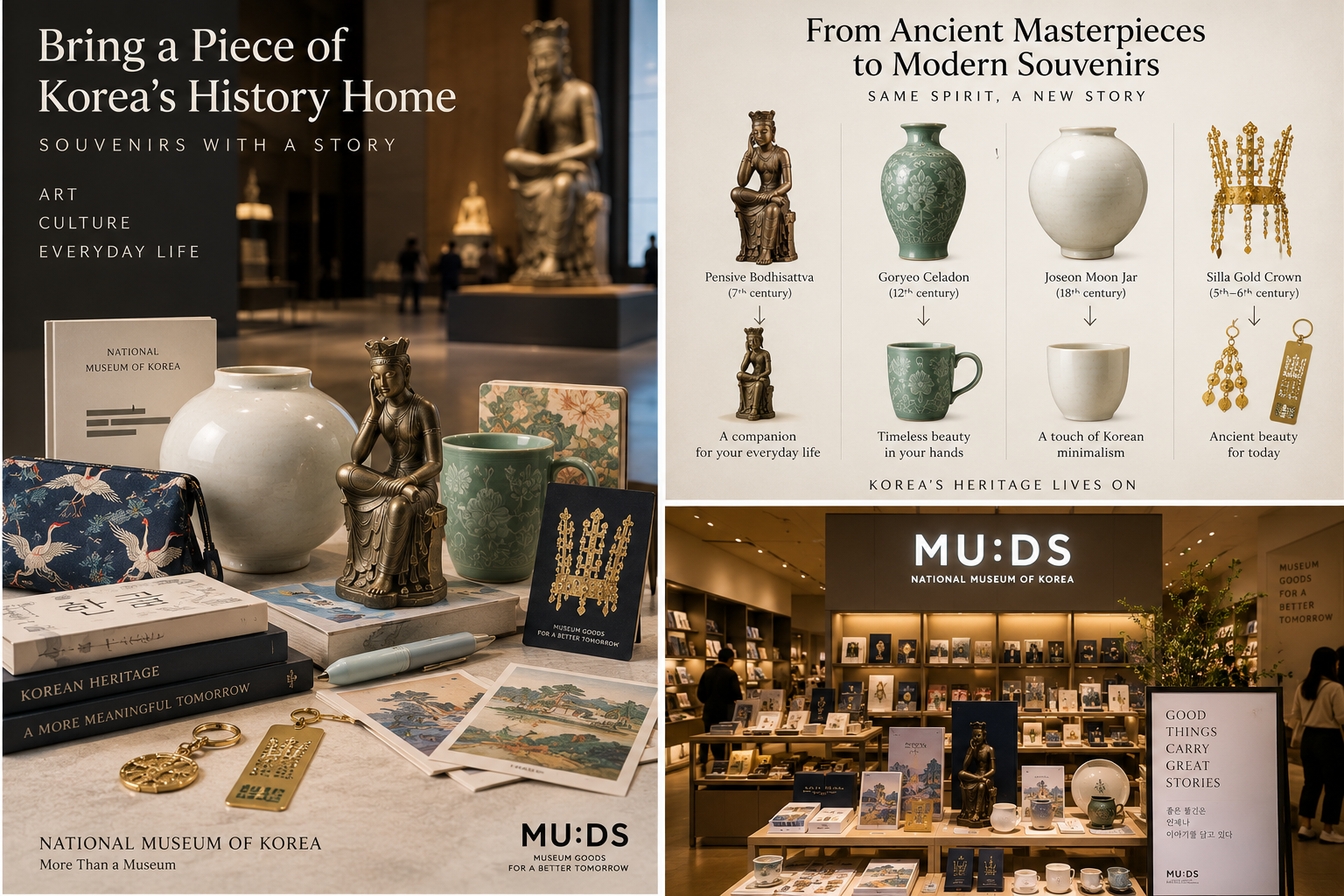
Korea’s museum merchandise brand, MU (뮷즈), reinterprets historical objects through stationery, accessories, homeware, miniatures, fashion items, and contemporary collaborations.
So if you are wondering what to bring home from Korea, here are ten types of souvenirs worth looking for—and the Korean stories behind them.
1. Pensive Bodhisattva Miniatures
Best for: The Most Iconic Museum Souvenir
If you visited the Room of Quiet Contemplation, this is probably the souvenir that will mean the most.
The museum’s famous gilt-bronze Pensive Bodhisattvas sit with one leg crossed over the other and a finger gently touching the cheek.
Their expressions are peaceful, thoughtful, and strangely contemporary.
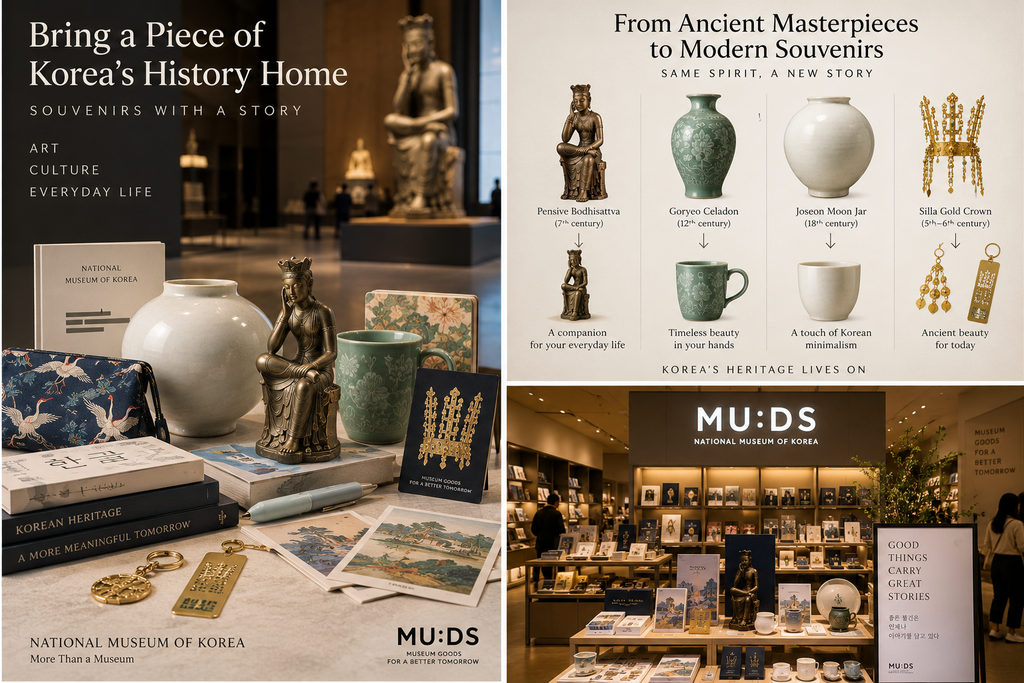
MU has transformed this ancient image into miniatures and other products that can sit on a desk or shelf.
The contrast is wonderful:
An ancient Buddhist masterpiece becomes part of your everyday modern life.
Some recent editions even reinterpret the figure with playful contemporary gestures and collaborations.
Why buy it:
It is immediately recognizable to anyone who knows the National Museum of Korea, but it also works beautifully as a design object even if you do not know its history.
Naru’s Pick: ★★★★★
If I could choose only one meaningful souvenir from the museum, this would be one of my first choices.
2. Goryeo Celadon-Inspired Goods
Best for: Elegant Korean Design
Goryeo celadon is famous for its mysterious blue-green color.
Depending on the light, it can appear green, blue, gray, or almost like jade beneath water.
Instead of buying a large ceramic reproduction—which may be difficult to carry home—look for products that reinterpret celadon colors and patterns in more practical forms.
The museum shop has offered items such as celadon-inspired stationery, including pen sets.
This makes an excellent gift for someone who likes Korean design but does not necessarily want something that looks like a conventional tourist souvenir.
Why buy it:
It represents one of Korea’s greatest historical craft traditions while still feeling sophisticated and modern.
Naru’s Pick: ★★★★★
3. Moon Jar-Inspired Homeware
Best for: Minimalist Design Lovers
A white jar may not sound exciting.
Until you understand the moon jar.
The large white porcelain vessels of the Joseon period are admired for their soft curves, restrained color, and slightly imperfect forms.
Today, the Moon Jar (달항아리) has become one of the most recognizable symbols of Korean minimalist aesthetics.
Look for merchandise that borrows its rounded silhouette or simple white aesthetic.
These products are especially interesting because they do not scream:
“I bought this at a tourist attraction.”
Instead, they can look like contemporary Korean design.
Hidden Story:
Large moon jars could be made by forming the upper and lower halves separately and joining them together. The process contributed to the subtle asymmetry that makes individual jars so distinctive.
Naru’s Pick: ★★★★★
4. Silla Gold Crown-Inspired Accessories
Best for: Something Unmistakably Korean
After seeing a Silla gold crown in the museum, take another look at it as a designer would.
Branches.
Antlers.
Curved gogok ornaments.
Tiny hanging gold discs.
Strong symmetry mixed with organic shapes.
These details can be reinterpreted beautifully as jewelry, bookmarks, accessories, stationery, and decorative objects.
The result often feels surprisingly modern.
That is what makes Silla-inspired merchandise interesting.
You are not simply buying a miniature crown.
You are taking home a visual language created in Korea around 1,500 years ago.
Why buy it:
Few historical objects have a silhouette this distinctive.
Naru’s Pick: ★★★★☆
5. Korean Heritage Bookmarks
Best for: Small, Affordable Gifts
If you need souvenirs for several friends or colleagues, bookmarks are one of the smartest choices.
They are:
light,
easy to pack,
useful,
and inexpensive compared with larger museum products.
But the better museum bookmarks are more than a logo with the word “Korea” printed on them.
Their designs can incorporate famous Korean artifacts and traditional motifs.
That means even a tiny souvenir can introduce someone to a Silla crown, Buddhist sculpture, pagoda, or traditional painting.
Naru’s Pick: ★★★★☆
Travel Tip:
This is one of the easiest categories to buy in multiples without filling your suitcase.
6. Hangeul-Inspired Stationery
Best for: Language Lovers
One of Korea’s most powerful design systems is not an artifact.
It is an alphabet.
Hangeul (한글) was created during the reign of King Sejong in the 15th century and remains visually distinctive even to people who cannot read Korean.
Modern Korean designers frequently turn Hangeul characters into patterns and graphic elements.
That makes Hangeul stationery particularly good for international visitors.
A notebook or writing accessory can become a small introduction to one of the most important developments in Korean cultural history.
Why buy it:
It combines language, history, graphic design, and everyday usefulness.
Naru’s Pick: ★★★★★
7. Traditional Painting-Inspired Pouches and Accessories
Best for: Colorful Gifts
Not everything in Korean heritage is white, green, or gold.
Traditional Korean paintings are filled with flowers, animals, landscapes, plants, and vivid colors.
Museum designers can take one small detail from an old painting and transform it into a pouch, bag, umbrella, notebook, or textile pattern.
The museum shop has also featured products inspired by historical imagery such as The Smile of Silla.
This is where museum merchandise becomes especially interesting.
You may not want a reproduction of an entire historical painting on your wall.
But you might happily carry one tiny piece of it on a pouch.
Naru’s Pick: ★★★★☆
8. Museum Stickers, Cards and Small Goods
Best for: Under-Budget Souvenirs
Do not ignore the small items.
Stickers, postcards, cards, magnets, and other inexpensive goods are often where museum designers can be most playful.
For example, the Pensive Bodhisattva has been reinterpreted in removable and holographic stickers, including limited collaborative designs.
This creates an amusing cultural transformation:
Ancient Buddhist sculpture → smartphone sticker.
It sounds strange.
But that is precisely why it works.
The artifact stops being something distant behind museum glass and becomes something younger visitors can interact with.
Naru’s Pick: ★★★★☆
9. Tableware Inspired by Korean Food Culture
Best for: Food Lovers
This category is particularly interesting because it connects two things international visitors increasingly love about Korea:
Korean heritage + Korean food.
Museum merchandise can reinterpret traditional dining culture, paintings, and historical tableware as modern bowls, plates, cups, table mats, and lunch sets.
Recent MU collections have even connected museum exhibitions about Korean dining culture with contemporary tableware.
This means you are not simply buying a bowl.
You are buying a modern interpretation of how Koreans have eaten, served food, and gathered around tables.
For K-Global Stage readers interested in Korean food, this may be one of the most meaningful categories.
Naru’s Pick: ★★★★★
10. Limited-Edition MU Collaborations
Best for: Collectors
Before leaving, look for the products that you did not expect to find.
MU increasingly collaborates with artists, designers, and brands to reinterpret museum collections.
Some products are produced in limited quantities.
Others are connected to temporary exhibitions or anniversaries.
This means the museum shop changes.
And that is important.
The best souvenir may not be something you found on an online list before visiting.
It may be something that exists only when you are there.
Naru’s Tip:
If you see a limited product you genuinely love, do not automatically assume you can come back months later and find exactly the same thing.
If You Can Buy Only 5 Things
For a first-time international visitor, my shortlist would be:
🥇 Pensive Bodhisattva Miniature
The most meaningful connection between the museum experience and a physical souvenir.
🥈 Moon Jar-Inspired Item
For anyone who loves minimalist Korean design.
🥉 Goryeo Celadon-Inspired Item
Elegant, historic, and unmistakably connected to Korean craftsmanship.
4. Hangeul Stationery
Practical and easy to give as a gift.
5. Heritage Bookmark or Small Accessory
Affordable, light, and easy to pack.
The exact products and availability can change, so treat this as a guide to what to look for rather than a fixed shopping list.
What Is MU?
You will probably see one name repeatedly:
MU — 뮷즈
The name combines the idea of museum + goods.
But the concept is more interesting than the name.
MU takes cultural heritage from Korea’s national museums and adds creativity and practical everyday use.
In other words:
Artifact → Story → Design → Product → Everyday Life
This is why MU feels different from conventional souvenir merchandise.
The goal is not simply to put a museum logo on a mug.
The better products ask:
What makes this artifact recognizable?
Then they take that element—its shape, color, pattern, character, or story—and reinterpret it.
Hidden Story — Museum Souvenirs Have Become a K-Culture Business
Here is something that may surprise international visitors.
Museum goods are no longer a tiny side business in Korea.
MU has grown into a significant cultural brand.
This reflects a larger transformation happening in Korean culture.
For decades, cultural heritage was often presented primarily as something that needed to be preserved, protected, and studied.
Those things remain essential.
But now there is another idea:
Heritage can also be used.
A 1,500-year-old sculpture can inspire a desk object.
Goryeo celadon can inspire a pen.
Joseon porcelain can inspire contemporary homeware.
Traditional paintings can become fashion accessories.
Hangeul can become graphic design.
The artifact remains in the museum.
But its story travels outside.
That may be one of the most interesting things about modern Korean cultural branding.
Souvenir Shopping by Budget
Under ₩10,000
Look for stickers, postcards, cards, small stationery, or other lightweight gifts.
₩10,000–₩30,000
This is often a good range for stationery, pouches, small accessories, and practical design products.
₩30,000–₩100,000
Look for more substantial homeware, tableware, design objects, or premium merchandise.
Special Gift
Consider a miniature, craft-inspired object, or limited-edition collaboration connected to an artifact you actually saw during your visit.
Important: Prices and inventory change, so check the museum shop for current availability.
5 Korean Words to Know at the Museum Shop
| English | Korean | Pronunciation | Chinese | Spanish |
|---|---|---|---|---|
| Souvenir | 기념품 | gi-nyeom-pum | 纪念品 | Recuerdo |
| Museum | 박물관 | bak-mul-gwan | 博物馆 | Museo |
| Cultural heritage | 문화유산 | mun-hwa-yu-san | 文化遗产 | Patrimonio cultural |
| Gift | 선물 | seon-mul | 礼物 | Regalo |
| Traditional | 전통 | jeon-tong | 传统 | Tradición |
Korean Phrase of the Day
이거 선물용으로 포장해 주세요.
Igeo seonmuryongeuro pojanghae juseyo.
English: Please wrap this as a gift.
Chinese: 请把这个包装成礼物。
Spanish: Por favor, envuélvalo para regalo.
A very useful phrase when shopping for souvenirs anywhere in Korea.
Today’s Question
If you could take one Korean masterpiece home in souvenir form, which would you choose?
Would it be:
the Pensive Bodhisattva,
a Silla gold crown,
Goryeo celadon,
a Moon Jar,
or Hangeul-inspired design?
Tell me in the comments.
Naru’s Travel Tips
Visit the galleries before the shop.
A moon jar souvenir means much more after you have stood in front of an actual Joseon moon jar.
Photograph the artifact you loved.
When you reach the shop, compare the original with the modern interpretation. You will start noticing how designers translated historical details.
Buy small gifts in multiples.
Bookmarks, stationery, stickers, and small accessories are much easier to distribute to friends and colleagues than conventional bulky souvenirs.
Check limited collections.
Special exhibitions and collaborations can produce merchandise that may not remain available permanently.
Don’t shop only for “traditional-looking” products.
Some of the best Korean souvenirs are the ones that look completely contemporary until you discover that their design comes from an object made hundreds—or even thousands—of years ago.
Why This Museum Shop Is Worth Visiting Even If You Buy Nothing
There is one final reason to visit the shop.
Treat it like one more gallery.
Walk around and ask:
Which artifact inspired this product?
Why did the designer choose this shape?
Why this color?
Why this pattern?
Suddenly, the shop becomes an experiment in cultural translation.
The galleries tell you what Korea created in the past.
The museum shop shows you what Korea is doing with that heritage today.
And that may be the best reason MU has become so interesting.
It does not ask visitors to choose between tradition and modernity.
It puts both in the same shopping bag.
Final Thoughts
The best souvenir from Korea does not necessarily need to say SEOUL in giant letters.
It can be much quieter.
A tiny Pensive Bodhisattva on your desk.
A pen inspired by Goryeo celadon.
A notebook built around Hangeul.
A small object shaped by the curves of a Joseon moon jar.
These things carry something more interesting than the name of a destination.
They carry a story.
And months after your trip, when someone asks:
“What is that?”
you get to tell that story again.
That is when a souvenir becomes more than something you bought.
It becomes a small piece of Korea that continues traveling.
Naru’s Quote
“The best souvenir doesn’t just remind you where you went. It reminds you what you learned there.” — Naru
국립중앙박물관에서 꼭 사야 할 기념품 10가지
한국을 대표하는 박물관 숍에서 무엇을 사야 할까? 그리고 그 기념품에 담긴 이야기
국립중앙박물관을 방문합니다.
1,500년 전 신라의 금관을 보고, 사유의 방에서 반가사유상을 조용히 바라봅니다. 고려청자의 신비로운 색과 조선 백자의 부드러운 곡선도 감상합니다.
그리고 박물관 관람이 끝났다고 생각하는 순간, 뮤지엄숍에 들어갑니다.
아마 지갑에는 좋지 않은 선택일지도 모릅니다.
국립중앙박물관은 한국의 문화유산을 사람들이 실제로 소장하고 싶어 하는 현대적인 상품으로 재해석하는 데 매우 뛰어나기 때문입니다.
한국의 박물관 상품 브랜드 **MU(뮷즈)**는 단순히 엽서나 자석에 유물 사진을 인쇄하는 데서 그치지 않습니다.
고대 유물과 전통문화의 형태, 색, 문양과 이야기를 문구류, 액세서리, 생활용품, 미니어처 등으로 새롭게 해석합니다.
한국 여행에서 특별한 기념품을 찾고 있다면 다음 10가지를 살펴보세요.
1. 반가사유상 미니어처
추천 대상: 국립중앙박물관을 가장 잘 기억할 수 있는 기념품
사유의 방을 방문했다면 가장 의미 있는 기념품 중 하나입니다.
한쪽 다리를 올리고 손가락을 뺨에 댄 채 깊은 생각에 잠겨 있는 반가사유상은 국립중앙박물관을 대표하는 작품입니다.
이 고대 불교 조각상이 작은 미니어처가 되어 책상이나 선반 위에 놓이는 순간 흥미로운 변화가 일어납니다.
고대의 문화유산이 현대인의 일상으로 들어오는 것입니다.
Naru’s Pick: ★★★★★
하나만 고른다면 가장 먼저 고려할 기념품입니다.
2. 고려청자에서 영감을 받은 상품
추천 대상: 우아한 한국 디자인을 좋아하는 사람
고려청자는 신비로운 청록빛으로 유명합니다.
빛에 따라 녹색, 파란색, 회색 또는 물속의 옥과 같은 색으로 보이기도 합니다.
커다란 도자기 복제품 대신 청자의 색과 문양을 활용한 펜, 문구류 또는 생활용품을 찾아보세요.
관광지 기념품처럼 보이지 않으면서도 한국의 뛰어난 도자기 문화를 담을 수 있다는 것이 장점입니다.
Naru’s Pick: ★★★★★
3. 달항아리에서 영감을 받은 생활용품
추천 대상: 미니멀 디자인을 좋아하는 사람
커다란 흰색 항아리.
처음에는 별로 특별해 보이지 않을 수도 있습니다.
하지만 조선의 **달항아리(달항아리)**를 이해하기 시작하면 생각이 달라집니다.
달항아리는 부드러운 곡선과 절제된 흰색, 완벽하지 않은 형태 때문에 오늘날 한국적인 미니멀리즘을 대표하는 디자인 중 하나가 되었습니다.
달항아리의 둥근 실루엣을 활용한 생활용품이나 장식품을 찾아보세요.
Hidden Story:
큰 달항아리는 위아래 부분을 각각 만든 뒤 이어 붙이는 방식으로 제작되기도 했습니다. 그 과정에서 생기는 미세한 비대칭은 오늘날 오히려 달항아리의 아름다움으로 평가됩니다.
Naru’s Pick: ★★★★★
4. 신라 금관 디자인 액세서리
추천 대상: 확실하게 한국적인 디자인을 원하는 사람
신라 금관을 자세히 보면 놀라울 정도로 많은 디자인 요소가 들어 있습니다.
나뭇가지 같은 형태.
사슴뿔.
곡옥.
흔들리는 작은 금 장식.
이러한 요소들은 액세서리, 책갈피, 문구류와 장식품으로 재해석하기 좋습니다.
1,500년 전 만들어진 시각적 언어가 현대 디자인으로 다시 태어나는 것입니다.
Naru’s Pick: ★★★★☆
5. 한국 문화유산 책갈피
추천 대상: 저렴하고 가벼운 선물
여러 명에게 기념품을 줘야 한다면 책갈피가 좋은 선택입니다.
가볍고, 실용적이며, 여행 가방에서 공간을 거의 차지하지 않습니다.
특히 금관, 불상, 전통문양 등 한국 문화유산을 활용한 디자인을 고르면 작은 물건 하나에도 이야기를 담을 수 있습니다.
Naru’s Pick: ★★★★☆
6. 한글 디자인 문구류
추천 대상: 언어와 그래픽 디자인을 좋아하는 사람
한국이 만든 가장 뛰어난 디자인 시스템 중 하나는 유물이 아니라 문자입니다.
바로 한글입니다.
현대 디자이너들은 한글의 자음과 모음을 그래픽 패턴으로 활용해 노트, 펜, 가방 등 다양한 상품을 만듭니다.
외국인에게는 한국어를 읽지 못하더라도 한글 자체가 독특한 시각적 디자인으로 느껴질 수 있습니다.
Naru’s Pick: ★★★★★
7. 전통 회화에서 영감을 받은 파우치와 액세서리
추천 대상: 화려한 색을 좋아하는 사람
한국의 문화유산이 항상 흰색, 녹색, 금색인 것은 아닙니다.
전통 회화에는 꽃, 동물, 산수, 식물과 강렬한 색채가 가득합니다.
디자이너들은 옛 그림 전체를 복제하는 대신 작은 부분을 골라 파우치, 우산, 가방이나 패턴으로 재해석합니다.
이 방식은 전통미술을 훨씬 자연스럽게 현대인의 일상으로 가져옵니다.
Naru’s Pick: ★★★★☆
8. 박물관 스티커와 소품
추천 대상: 저렴한 기념품을 찾는 사람
작은 상품도 놓치지 마세요.
스티커, 엽서, 카드, 자석 같은 제품에서는 디자이너들이 문화유산을 더욱 재미있게 재해석할 수 있습니다.
예를 들어 반가사유상이 스마트폰이나 노트북에 붙이는 스티커가 됩니다.
고대 불교 조각 → 스마트폰 스티커
조금 이상하게 들리지만 바로 그 점이 재미있습니다.
유물이 박물관 유리장 안에만 머무르지 않고 젊은 세대의 일상으로 들어옵니다.
Naru’s Pick: ★★★★☆
9. 한국 식문화에서 영감을 받은 테이블웨어
추천 대상: 한국 음식을 좋아하는 사람
이 카테고리는 K-Global Stage 독자에게 특히 재미있습니다.
한국 문화유산 + 한국 음식이 만나기 때문입니다.
전통 식기, 회화와 음식문화를 현대적인 그릇, 접시, 컵, 테이블 매트 등으로 재해석할 수 있습니다.
단순히 그릇 하나를 사는 것이 아닙니다.
한국인이 과거부터 어떻게 음식을 담고, 먹고, 함께 식사했는지에 대한 이야기를 가져가는 것입니다.
Naru’s Pick: ★★★★★
10. MU 한정판과 컬래버레이션
추천 대상: 수집가
박물관숍에서는 예상하지 못했던 상품도 찾아보세요.
MU는 문화유산을 현대적으로 재해석하기 위해 다양한 작가와 디자이너와 협업합니다.
특별전이나 특정 시기에만 판매되는 상품도 있기 때문에 박물관숍은 방문할 때마다 조금씩 달라질 수 있습니다.
Naru’s Tip:
정말 마음에 드는 한정 상품을 발견했다면 다음 방문 때도 있을 것이라고 생각하지 않는 편이 좋습니다.
딱 5개만 산다면?
🥇 반가사유상 미니어처 — 박물관 경험을 가장 잘 기억할 수 있는 상품
🥈 달항아리 디자인 상품 — 한국 미니멀리즘을 좋아한다면 추천
🥉 고려청자 디자인 상품 — 우아하면서 한국 공예의 정체성이 강함
4. 한글 문구류 — 실용적이고 선물하기 쉬움
5. 문화유산 책갈피 또는 소형 액세서리 — 가볍고 가격 부담이 적음
MU(뮷즈)란?
MU는 Museum + Goods의 개념에서 출발한 박물관 상품 브랜드입니다.
핵심은 단순히 박물관 로고를 상품에 붙이는 것이 아닙니다.
유물 → 이야기 → 디자인 → 상품 → 일상
이라는 과정을 거칩니다.
좋은 뮷즈 상품을 보면 이런 질문을 하게 됩니다.
“이 디자인은 어떤 유물에서 왔을까?”
그 질문이 다시 사람을 한국 역사와 문화로 이끕니다.
Hidden Story — 박물관 기념품이 K-Culture Business가 되다
한국의 박물관 상품은 이제 단순한 부가사업이 아닙니다.
흥미로운 변화는 문화유산을 바라보는 방식입니다.
과거에는 문화유산을 주로 보존하고, 보호하고, 연구하는 것에 집중했다면 이제 새로운 질문이 더해졌습니다.
문화유산을 현대인의 일상에서 다시 사용할 수 있을까?
1,500년 된 불상이 책상 위 미니어처가 됩니다.
고려청자가 펜의 색과 문양이 됩니다.
조선 백자가 현대적인 생활용품이 됩니다.
옛 그림이 패션 액세서리가 됩니다.
한글이 그래픽 디자인이 됩니다.
유물은 박물관에 그대로 남아 있습니다.
하지만 그 이야기는 박물관 밖으로 여행하기 시작합니다.
Today’s Question
한국 문화유산 하나를 기념품으로 가져갈 수 있다면 무엇을 고르시겠어요?
반가사유상?
신라 금관?
고려청자?
달항아리?
아니면 한글 디자인?
댓글로 여러분의 선택을 알려주세요.
Naru’s Quote
“좋은 기념품은 어디에 갔었는지만 기억하게 하지 않는다. 그곳에서 무엇을 배웠는지도 기억하게 한다.” — Naru
韩国国立中央博物馆最值得买的10件纪念品
在韩国最具代表性的博物馆商店里应该买什么?这些礼物背后又有什么故事?
来到韩国国立中央博物馆,你可以看到拥有约1500年历史的新罗金冠,在“思惟之屋”静静欣赏半跏思惟像,也可以近距离感受高丽青瓷神秘的色彩与朝鲜白瓷柔和的曲线。
当你以为参观已经结束时,还有一个地方很可能让你停留更久:
博物馆商店。
韩国的博物馆纪念品已经不只是明信片、冰箱贴和印有博物馆Logo的马克杯。
博物馆文化商品品牌 MU(뮷즈) 将韩国历史文物的形状、颜色、纹样和故事重新设计成文具、饰品、家居用品、微型摆件以及各种现代生活商品。
如果你正在寻找真正有“韩国故事”的旅行纪念品,下面这10类商品值得特别留意。
1. 半跏思惟像微型摆件
最适合:最具国立中央博物馆代表性的纪念品
如果你参观过著名的 “思惟之屋”,那么半跏思惟像的微型摆件可能是最有意义的纪念品之一。
一条腿搭在另一条腿上,手指轻轻触碰脸颊,表情平静而深思。
这件古代佛教艺术杰作被缩小后,可以出现在现代人的书桌或书架上。
这形成了一个非常有趣的对比:
古代文化遗产进入了现代人的日常生活。
Naru推荐:★★★★★
2. 高丽青瓷灵感商品
最适合:喜欢优雅韩国设计的人
高丽青瓷最迷人的地方之一就是它难以准确描述的青绿色。
有时像绿色。
有时像蓝色。
有时又像水中的玉石。
与其购买难以携带的大型陶瓷复制品,不如寻找以青瓷色彩和纹样为灵感设计的笔、文具或生活用品。
它们既具有韩国传统工艺的故事,又不会显得像普通旅游纪念品。
Naru推荐:★★★★★
3. 月亮罐灵感家居用品
最适合:极简设计爱好者
一个巨大的白色罐子为什么会成为韩国美学的代表?
答案就在朝鲜时代的 月亮罐(달항아리)。
柔和的曲线、纯净的白色,以及略微不对称的形状,使月亮罐成为今天韩国极简美学的重要象征。
寻找那些使用月亮罐圆润轮廓或白瓷美学的现代商品,会是非常不错的选择。
Hidden Story:
大型月亮罐有时需要分别制作上下两部分,再将它们连接起来。制作过程中形成的细微不对称,如今反而成为其最受欣赏的特点之一。
Naru推荐:★★★★★
4. 新罗金冠设计饰品
最适合:寻找具有鲜明韩国特色的设计
仔细观察新罗金冠,你会发现丰富的视觉元素:
树枝般的结构、鹿角、曲玉,以及会随动作晃动的金色装饰。
这些元素非常适合被重新设计成首饰、书签、文具和装饰品。
换句话说:
1500年前创造的视觉语言,在今天重新成为现代设计。
Naru推荐:★★★★☆
5. 韩国文化遗产书签
最适合:轻便又实惠的礼物
如果你需要为很多朋友或同事准备纪念品,书签是非常聪明的选择。
它们重量轻、容易携带、实用,而且价格通常不会太高。
选择带有新罗金冠、佛像、传统纹样或其他韩国文物元素的设计,小小的礼物也可以拥有自己的文化故事。
Naru推荐:★★★★☆
6. 韩文设计文具
最适合:语言与设计爱好者
韩国最伟大的设计系统之一,其实不是一件文物。
而是一套文字。
韩文(한글)。
现代韩国设计师经常将韩文字母的几何结构转化成图案,用于笔记本、文具、包袋和其他生活用品。
即使不会韩语,外国游客也可以欣赏韩文字体本身独特的视觉美感。
Naru推荐:★★★★★
7. 韩国传统绘画灵感配饰
最适合:喜欢丰富色彩的人
韩国传统文化并不只有白瓷的白色、青瓷的绿色和金冠的金色。
传统绘画中还有花朵、动物、山水、植物和大量鲜艳的色彩。
现代设计师可以从古画中提取一个小细节,再把它转化成包袋、雨伞、收纳包或纺织图案。
这让传统艺术更自然地进入现代生活。
Naru推荐:★★★★☆
8. 博物馆贴纸、卡片与小商品
最适合:预算有限的旅行者
不要忽略那些价格较低的小商品。
贴纸、明信片、卡片和冰箱贴往往是设计师发挥创意最多的地方。
想象一下:
古代佛教雕塑 → 手机贴纸。
听起来有一点奇怪。
但这正是它有趣的地方。
文化遗产不再只是玻璃展柜里的东西,而是进入了年轻人的日常生活。
Naru推荐:★★★★☆
9. 韩国饮食文化主题餐具
最适合:韩国美食爱好者
这个类别把两个越来越受国际游客欢迎的元素结合在一起:
韩国文化遗产 + 韩国美食。
传统餐具、古代绘画以及韩国饮食文化都可以被重新设计成现代碗、盘子、杯子和餐桌用品。
因此你购买的不只是一个碗。
你带走的也是关于韩国人如何盛放食物、如何吃饭,以及如何一起围桌用餐的文化故事。
Naru推荐:★★★★★
10. MU限定版与联名商品
最适合:收藏爱好者
参观博物馆商店时,也要寻找那些你事先没有计划购买的商品。
MU会与不同设计师、艺术家和品牌合作,以新的方式重新解释韩国文化遗产。
部分产品可能与特展或特定活动有关,也可能限量销售。
因此,每一次去博物馆商店,看到的商品都可能有所不同。
Naru小贴士:
如果遇到真正喜欢的限定商品,不要理所当然地认为几个月后回来还能买到。
如果只能买5件
🥇 半跏思惟像微型摆件 — 最能代表博物馆体验
🥈 月亮罐设计商品 — 适合喜欢韩国极简美学的人
🥉 高丽青瓷灵感商品 — 优雅又具有韩国传统工艺特色
4. 韩文设计文具 — 实用,也很适合送礼
5. 文化遗产书签或小饰品 — 轻便、容易携带
什么是MU?
MU的概念来自 Museum + Goods。
但它并不是简单地把博物馆Logo印在商品上。
它更像一个过程:
文物 → 故事 → 设计 → 商品 → 日常生活
优秀的MU商品会让你产生一个问题:
“这个设计来自哪一件文物?”
而这个问题又会把人带回韩国的历史与文化。
Hidden Story — 当博物馆纪念品成为K-Culture生意
韩国博物馆商品最值得关注的地方,并不仅仅是销量。
更有意思的是韩国正在改变人们与文化遗产之间的关系。
过去,文化遗产首先意味着:
保存、保护与研究。
这些当然依然非常重要。
但今天又多了一个问题:
文化遗产能不能重新进入现代人的日常生活?
1500年前的佛像变成桌上的微型摆件。
高丽青瓷变成一支笔的颜色。
朝鲜白瓷变成现代家居设计。
传统绘画变成时尚配饰。
韩文变成平面设计。
真正的文物仍然留在博物馆里。
但是它们的故事开始走出博物馆。
这或许正是韩国现代文化品牌最有趣的地方之一。
Today’s Question
如果可以把一种韩国文化遗产变成纪念品带回家,你会选择什么?
半跏思惟像?
新罗金冠?
高丽青瓷?
月亮罐?
还是韩文设计?
欢迎在评论区告诉我。
Naru’s Quote
“最好的纪念品,不只让你记得去过哪里,也让你记得在那里学到了什么。” — Naru
10 mejores recuerdos para comprar en el Museo Nacional de Corea
Qué comprar en la tienda del museo más importante de Corea y las historias que hay detrás de cada recuerdo
Visitas el Museo Nacional de Corea.
Contemplas una corona de oro de Silla de hace unos 1.500 años.
Entras en la Sala de Contemplación Silenciosa y observas los famosos Bodhisattvas Pensativos.
Descubres el misterioso color del celadón de Goryeo y las suaves curvas de la porcelana blanca de Joseon.
Y justo cuando piensas que la visita ha terminado, llegas a la tienda del museo.
Puede que no sea una buena noticia para tu cartera.
Los recuerdos de los museos coreanos ya no son solamente postales, imanes y tazas con un logotipo.
La marca MU (뮷즈) reinterpreta las formas, colores, patrones e historias del patrimonio cultural coreano y los convierte en artículos de papelería, accesorios, objetos decorativos y productos para la vida cotidiana.
Si buscas un recuerdo de Corea que tenga una historia detrás, estas son diez categorías que merece la pena explorar.
1. Miniaturas del Bodhisattva Pensativo
Ideal para: El recuerdo más representativo del museo
Si has visitado la famosa Sala de Contemplación Silenciosa, probablemente este sea uno de los recuerdos más significativos.
El Bodhisattva aparece con una pierna cruzada y un dedo apoyado suavemente sobre la mejilla.
Su expresión parece tranquila y profundamente reflexiva.
Cuando esta antigua obra maestra budista se convierte en una pequeña figura para colocar sobre un escritorio, ocurre algo interesante:
el patrimonio antiguo entra en la vida moderna.
Elección de Naru: ★★★★★
Si tuviera que elegir un solo recuerdo, este estaría entre mis primeras opciones.
2. Productos inspirados en el celadón de Goryeo
Ideal para: Amantes del diseño coreano elegante
Una de las características más fascinantes del celadón de Goryeo es su misterioso tono azul verdoso.
A veces parece verde.
A veces azul.
A veces recuerda al jade visto a través del agua.
En lugar de comprar una reproducción de cerámica grande y difícil de transportar, busca bolígrafos, artículos de papelería u objetos cotidianos inspirados en sus colores y patrones.
Son productos relacionados con una de las grandes tradiciones artesanales de Corea, pero no parecen los típicos souvenirs turísticos.
Elección de Naru: ★★★★★
3. Artículos inspirados en el Moon Jar
Ideal para: Amantes del minimalismo
¿Por qué una gran vasija blanca se ha convertido en uno de los símbolos de la estética coreana?
La respuesta está en el Moon Jar (달항아리) de la era Joseon.
Sus curvas suaves, su color blanco y su forma ligeramente irregular representan una estética basada en la sencillez y la moderación.
Busca productos que utilicen su característica silueta redondeada o la estética de la porcelana blanca.
Hidden Story:
Algunos Moon Jars de gran tamaño se fabricaban creando por separado las partes superior e inferior y uniéndolas después. Las pequeñas irregularidades resultantes forman hoy parte de su atractivo.
Elección de Naru: ★★★★★
4. Accesorios inspirados en la corona de oro de Silla
Ideal para: Un diseño inconfundiblemente coreano
Observa atentamente una corona de Silla.
Encontrarás ramas parecidas a árboles, formas que recuerdan a astas de ciervo, adornos curvos llamados gogok y pequeñas piezas de oro colgantes.
Estos elementos pueden transformarse en joyas, marcapáginas, artículos de papelería y objetos decorativos.
Es fascinante pensar que un lenguaje visual creado hace unos 1.500 años pueda seguir pareciendo contemporáneo.
Elección de Naru: ★★★★☆
5. Marcapáginas del patrimonio coreano
Ideal para: Regalos pequeños y económicos
Si necesitas comprar recuerdos para varios amigos o compañeros, los marcapáginas son una opción excelente.
Son ligeros, prácticos y ocupan muy poco espacio en la maleta.
Busca diseños inspirados en coronas, esculturas budistas, patrones tradicionales u otros objetos históricos.
Incluso un regalo muy pequeño puede contener una gran historia.
Elección de Naru: ★★★★☆
6. Papelería inspirada en el Hangeul
Ideal para: Amantes de los idiomas y el diseño
Uno de los grandes sistemas de diseño creados en Corea no es un objeto.
Es un alfabeto:
Hangeul (한글).
Los diseñadores coreanos modernos utilizan con frecuencia las formas geométricas de sus consonantes y vocales para crear patrones en cuadernos, bolsos y otros objetos.
Incluso si un visitante extranjero no puede leer coreano, el Hangeul posee una identidad visual muy característica.
Elección de Naru: ★★★★★
7. Bolsos y accesorios inspirados en la pintura tradicional
Ideal para: Quienes prefieren diseños coloridos
El patrimonio coreano no es solamente el blanco de la porcelana, el verde del celadón y el oro de Silla.
La pintura tradicional está llena de flores, animales, paisajes, plantas y colores intensos.
Los diseñadores pueden seleccionar un pequeño detalle de una pintura histórica y transformarlo en un bolso, paraguas, estuche o patrón textil.
Así, el arte tradicional entra de manera natural en la vida cotidiana.
Elección de Naru: ★★★★☆
8. Pegatinas, postales y pequeños artículos
Ideal para: Presupuestos pequeños
No ignores los productos más económicos.
Las pegatinas, postales, tarjetas e imanes permiten a los diseñadores reinterpretar el patrimonio de una manera mucho más divertida.
Por ejemplo:
una antigua escultura budista → una pegatina para el móvil.
Puede parecer extraño.
Precisamente por eso funciona.
El patrimonio deja de existir solamente detrás del cristal de un museo y entra en la vida de una nueva generación.
Elección de Naru: ★★★★☆
9. Vajilla inspirada en la cultura gastronómica coreana
Ideal para: Amantes de la comida coreana
Esta categoría une dos elementos que cada vez atraen a más visitantes internacionales:
patrimonio coreano + gastronomía coreana.
La vajilla tradicional, las pinturas históricas y la cultura gastronómica pueden reinterpretarse como cuencos, platos, tazas y otros objetos contemporáneos.
Así, no compras solamente un plato.
También te llevas una pequeña historia sobre cómo los coreanos han servido la comida, comido y compartido la mesa a lo largo del tiempo.
Elección de Naru: ★★★★★
10. Colaboraciones y ediciones limitadas de MU
Ideal para: Coleccionistas
Busca también aquello que no esperabas encontrar.
MU colabora con artistas y diseñadores para reinterpretar el patrimonio cultural coreano.
Algunos artículos están vinculados a exposiciones temporales y otros pueden producirse en cantidades limitadas.
Por eso, la tienda puede ser diferente cada vez que la visitas.
Consejo de Naru:
Si encuentras una edición limitada que realmente te encanta, no des por hecho que seguirá allí dentro de unos meses.
Si solo pudieras comprar cinco cosas
🥇 Miniatura del Bodhisattva Pensativo — La conexión más significativa con la experiencia del museo.
🥈 Producto inspirado en el Moon Jar — Perfecto para amantes del diseño minimalista coreano.
🥉 Producto inspirado en el celadón de Goryeo — Elegante y profundamente conectado con la artesanía coreana.
4. Papelería Hangeul — Práctica y fácil de regalar.
5. Marcapáginas o pequeño accesorio — Ligero, asequible y fácil de transportar.
¿Qué es MU?
El concepto de MU combina las ideas de Museum + Goods.
Pero no consiste simplemente en imprimir el logotipo de un museo sobre un producto.
El proceso es más interesante:
Objeto histórico → Historia → Diseño → Producto → Vida cotidiana
Los mejores productos hacen que te preguntes:
“¿Qué objeto del museo inspiró este diseño?”
Y esa pregunta puede llevarte de nuevo a la historia y la cultura de Corea.
Hidden Story — Cuando los recuerdos del museo se convierten en K-Culture
Lo más interesante del crecimiento de los productos de museo en Corea no es solamente su éxito comercial.
También refleja un cambio en la relación entre el patrimonio y la vida moderna.
Tradicionalmente, el patrimonio cultural debía ante todo:
preservarse, protegerse y estudiarse.
Todo eso sigue siendo esencial.
Pero ahora existe otra pregunta:
¿Puede el patrimonio volver a formar parte de nuestra vida cotidiana?
Una escultura budista de hace 1.500 años se convierte en una figura para el escritorio.
El celadón de Goryeo inspira un bolígrafo.
La porcelana Joseon inspira objetos modernos para el hogar.
Una pintura tradicional se transforma en un accesorio de moda.
El Hangeul se convierte en diseño gráfico.
El objeto original permanece en el museo.
Pero su historia sale al mundo exterior.
Y esa puede ser una de las ideas más interesantes detrás del branding cultural contemporáneo de Corea.
Today’s Question
Si pudieras llevarte a casa una obra del patrimonio coreano convertida en souvenir, ¿cuál elegirías?
¿El Bodhisattva Pensativo?
¿La corona de oro de Silla?
¿El celadón de Goryeo?
¿Un Moon Jar?
¿O un diseño inspirado en el Hangeul?
Cuéntame tu elección en los comentarios.
Naru’s Quote
“El mejor recuerdo no solo te recuerda dónde estuviste. También te recuerda lo que aprendiste allí.” — Naru